Artificial Intelligence Lyrics Generator: A Plain-English Ex

MuseGen Team
5/15/2026
The first time I used an artificial intelligence lyrics generator, I expected magic: type a theme, get a chart-ready verse. What I got was closer to a fast, tireless co-writer - great at momentum, sometimes weak on meaning. If you've ever stared at a blank page thinking "I know what I want to say, but I can't find the lines," this tool is built for that moment. The real question is: how do you use an artificial intelligence lyrics generator to sound more like you, not less?
What an artificial intelligence lyrics generator is (in plain English)
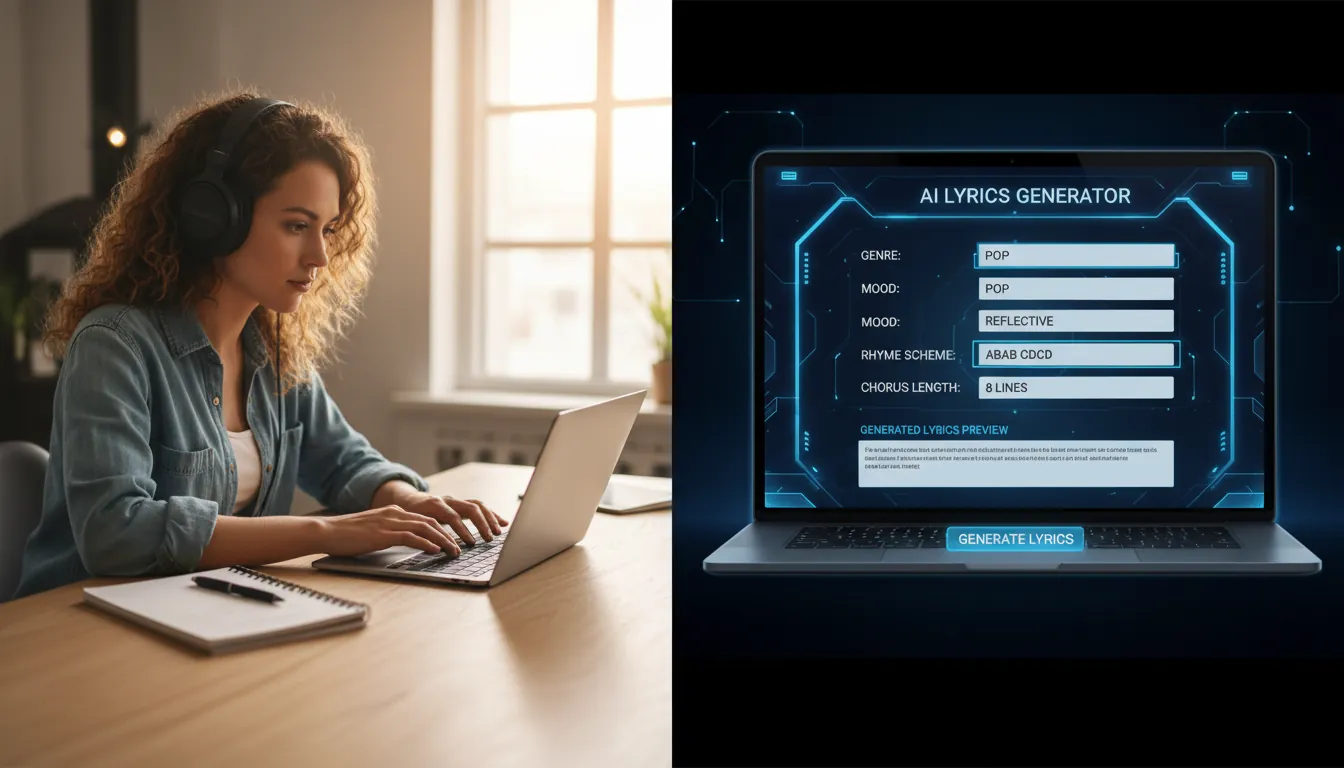
An artificial intelligence lyrics generator is software that drafts song lyrics from your inputs - topic, mood, genre, artist vibe, keywords, or even a rough chorus. Most modern systems use large language models (LLMs) or transformer-based approaches that learned patterns from huge text datasets, including lyrics-like writing, poetry, and general language. Research reviews of AI in music note the shift from older Markov/RNN approaches to transformer-based models that better maintain context and theme control, though singability and prosody are still hard problems (Applications of Artificial Intelligence in Music: A Review).
What it's not: a guaranteed "hit song" button. Think of it as a drafting engine that can quickly generate options you can reshape into something original and performable.
Why these tools are suddenly everywhere
Creator workflows are compressing: people need more content, faster, across more channels. Market research also suggests strong growth across AI music generation broadly - one report estimates the global AI music generation market at $3.2B in 2025, projecting $18.9B by 2034 (CAGR 21.8%) (AI Music Generation Market Research Report 2034). Separate industry coverage points to rapid commercial maturity in generative AI music through the decade (AI music market 2026 analysis).
In practice, adoption is being pulled by three forces:
- Speed: you can test 20 lyric directions in an hour.
- Access: beginners can start writing without years of craft training.
- Iteration: you can "rewrite like..." without burning out.
A musician adoption survey reported 87% of musicians using AI in some part of their creative process, with many using generators for parts of songs rather than full tracks (Digital Music News coverage).
How an artificial intelligence lyrics generator works (the useful mental model)
Most tools follow a loop: prompt -> draft -> critique -> revise. Your inputs act like constraints, and the model predicts the next most likely words given those constraints and the text it already wrote.
The best mental model is "probability + guidance":
- The model is good at common lyrical shapes (verse/chorus, rhyme, hooks).
- It struggles with lived specificity (real details, fresh metaphors, believable voice).
- It improves when you add constraints: syllable count, rhyme scheme, internal rhymes, perspective, and scene details.
If you want "singable," you often need to specify:
- Meter / syllables (e.g., "8 syllables per line")
- Rhyme scheme (AABB, ABAB, near-rhyme)
- Vowel sounds for melody friendliness (open vowels on long notes)
What makes AI-generated lyrics sound generic (and how to fix it)
Generic lyrics usually come from generic prompts. When users write "sad love song about heartbreak," the generator reaches for familiar phrases because that's statistically safe.
To get stronger drafts, feed it concrete story ingredients:
- Who is speaking? ("tired night-shift nurse," "new dad," "retired boxer")
- Where are we? ("parking lot outside the ER," "kitchen at 2 a.m.")
- What object anchors the scene? ("ring on the sink," "gas station receipt")
- What's the emotional turn? ("I'm relieved, then ashamed of the relief")
I've found the fastest upgrade is asking for three distinct choruses that keep the same meaning but change imagery, then you stitch the best lines.
A practical workflow: from prompt to performance-ready lyrics
Use this 6-step process to make an artificial intelligence lyrics generator feel like a collaborator, not a replacement.
- Define the song job
- Platform? (TikTok hook vs. album track)
- Emotion? (wistful, defiant, playful)
- Target structure? (Verse/Chorus/Verse/Chorus/Bridge/Chorus)
- Write a "scene prompt," not a "topic prompt"
- Include place, time, sensory detail, and a twist.
- Generate 5-10 variations
- Don't chase perfection - chase options.
- Score drafts quickly
- Keep lines that are singable, specific, and new to you.
- Human rewrite pass
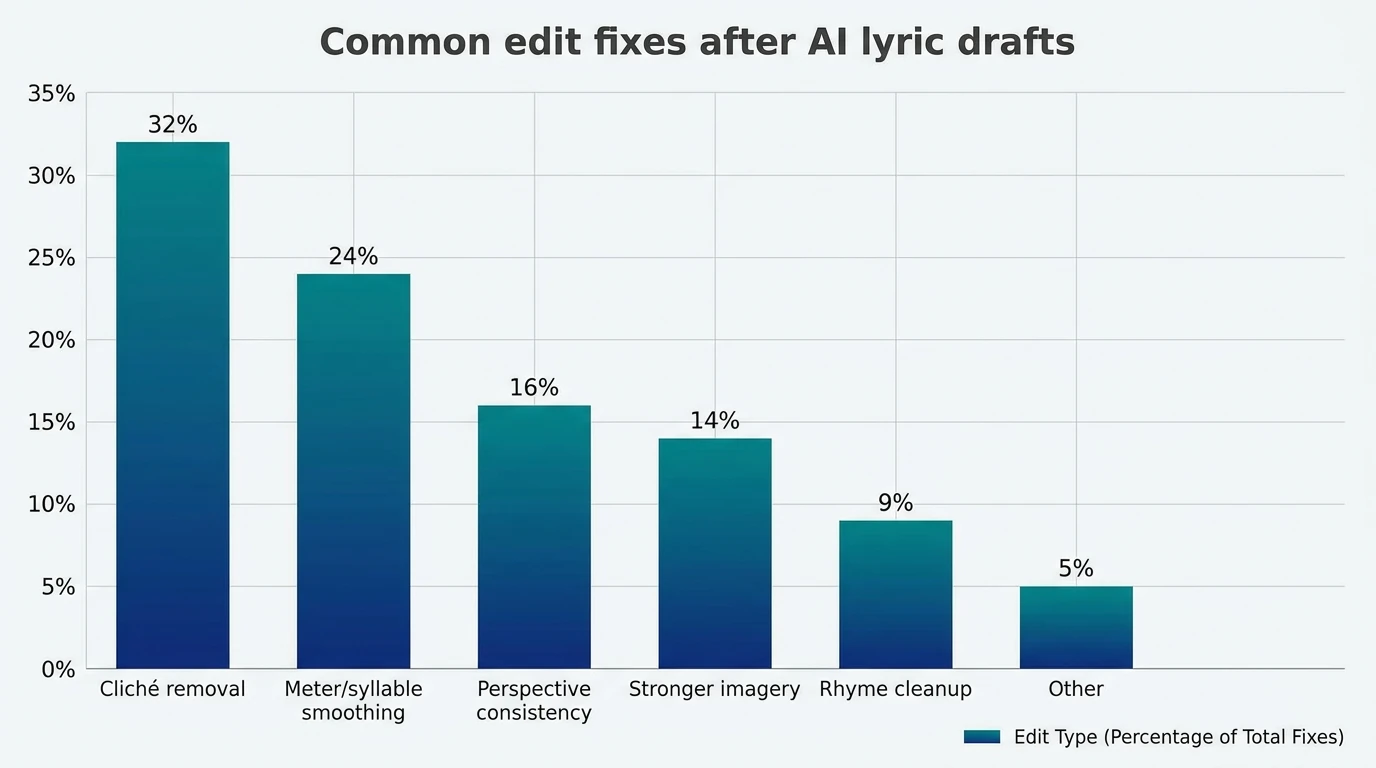
- Replace cliches, add lived detail, tighten syllables.
- Read/sing it out loud
- If you trip on consonant clusters, rewrite for flow.
Top 5 Ways AI Is Revolutionizing Songwriting (Without Replacing You)
MuseGen angle: lyrics + full production in one loop
A common frustration is writing lyrics that don't "sit" on the music. The MuseGen approach (lyrics + vocals + stems) is designed for the full pipeline: draft words, generate a matching song, then refine production details and export stems/MIDI for a DAW.
Where this matters most:
- Fast demos: turn a concept into a listenable draft without booking sessions.
- Genre exploration: test the same lyric idea across styles.
- Editing control: iterate on individual parts (vocals, drums, harmony) rather than redoing everything.
If you want to go deeper, see how MuseGen-style workflows support production tasks like arrangement and exporting assets for professional refinement in your broader process (for context, compare with the wider market direction described in the AI Music Generation Market Research Report 2034).
Comparison: AI lyrics generator vs. traditional writing (and "AI-assisted" writing)
The best results usually come from AI-assisted writing, where you keep authorship decisions.
| Approach | Best for | Weak spots | My recommendation |
|---|---|---|---|
| Human-only lyrics writing | Unique voice, lived detail, long-term craft | Slower, harder to iterate | Best when you already have momentum |
| Artificial intelligence lyrics generator (AI-only) | Speed, quantity, quick hooks | Generic lines, weak narrative, legal ambiguity in some cases | Use for brainstorming, not final |
| AI-assisted (human edits + AI drafts) | Fast iteration and originality | Requires taste + editing time | Best default for creators and teams |
| Hybrid with music generation + stems | Demo-to-release workflows | Needs careful QA for rights and brand voice | Great for content pipelines and rapid prototyping |
Legal + ethical basics you should know (without the panic)
AI lyrics raise two different issues: ownership and infringement risk. Guidance varies by jurisdiction, and platform terms matter.
Here are the practical guardrails I use:
- Document your human contribution: keep drafts, edits, timestamps, and notes.
- Avoid "sound like" requests targeting a living artist: it invites ethical and brand problems.
- Don't paste copyrighted lyrics into prompts unless you have rights.
- Read the tool's terms: some services set rules on inputs and acceptable use.
For accessible background reading on ethical and legal considerations, see AI in Lyric Writing: Ethical and Legal Considerations and broader creator-facing risk discussion in AI music copyright legal risks (2026). For a concrete example of how some generators frame user obligations and prohibited content, review a representative set of terms like AI Lyrics Generator Terms of Service.
Note: I'm not a lawyer. If you're releasing commercially, especially with brand clients, get legal advice tailored to your region and the exact tools you used.
Quality checklist: what to test before you publish lyrics
Before you commit to a final draft from an artificial intelligence lyrics generator, run this checklist. It's fast and catches the usual "AI tells on itself" patterns.
- Singability: Are the vowels open on long notes? Are there tongue-twisters?
- Specificity: Do at least 5 lines contain concrete images (objects, places, actions)?
- Hook strength: Can you quote the chorus after one listen?
- No accidental copying: Does anything feel oddly familiar?
- Perspective consistency: No random "I" to "you" switches unless intentional.
- Emotional arc: Is there a turn - regret to resolve, fear to relief, etc.?
Prompts that actually work (copy/paste templates)
Use these as starting points, then add your details.
- Story-first chorus prompt
- "Write 3 chorus options for a ___ (genre) song. Theme: ___. Setting: ___. Key object: ___. Emotional turn: ___. 8 syllables per line, near-rhymes, modern language, no cliches."
- Verse that supports the hook
- "Write verse 1 that sets up this chorus: '___'. Keep the verse conversational, add sensory detail, and end with a line that naturally leads into the chorus."
- Bridge as contrast
- "Write a bridge that changes perspective (from 'I' to 'we'), raises the stakes, and introduces one new image. Keep it tighter than the verse."
Internal resources (MuseGen)
FAQ: artificial intelligence lyrics generator questions people search
1) Is an artificial intelligence lyrics generator good enough for professional songs?
Yes for drafts and options; rarely for final lyrics without human rewriting. Pros use it to explore hooks, rhyme directions, and alternate phrasing fast.
2) How do I stop AI-generated lyrics from sounding generic?
Use scene details, constraints (syllables/rhyme), and ask for multiple versions. Then do a human pass to add lived specificity and remove cliches.
3) Can I copyright lyrics written with an artificial intelligence lyrics generator?
It depends on your jurisdiction and the level of human authorship. In practice, keep evidence of your creative decisions and edits, and review tool terms.
4) Is it safe to ask the tool to "write like" a famous artist?
It's risky ethically and may violate platform rules or create brand issues. Safer: describe musical qualities (tempo, tone, imagery) without naming an artist.
5) What inputs make the biggest difference?
Perspective (I/you/we), structure, syllable count, rhyme style, key objects, and a clear emotional turn.
6) Should I generate lyrics first or music first?
Either works. If you need a strong hook, lyrics-first can help; if you need natural phrasing on melody, music-first (then rewrite to fit) is often smoother.
7) Can MuseGen help beyond lyrics?
Yes - MuseGen is positioned for end-to-end creation: lyrics/vocals plus music generation, stem editing, and exports (WAV stems/MIDI) to finish professionally.
Conclusion: use the generator, keep the author
An artificial intelligence lyrics generator is at its best when it removes friction - not when it replaces your point of view. I've seen the strongest results when creators treat AI drafts like raw clay: shape it, cut it, and add the personal details only a human can know. If you're building a faster songwriting pipeline, pairing lyric drafts with production tools (like the MuseGen generate-edit-export workflow) can turn "idea" into "release-ready" with fewer dead ends.