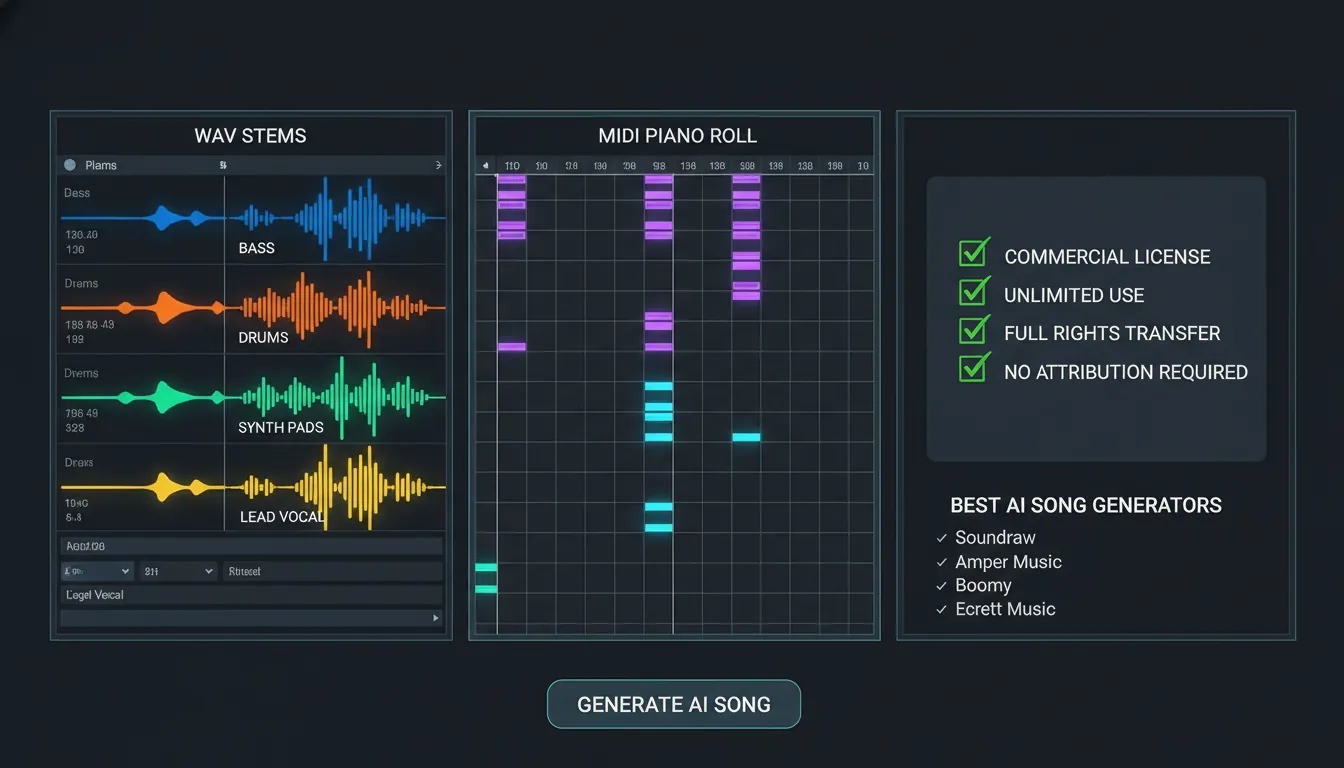
 MuseGen
Best AI Song Generators: 9 Tools Tested in 2026
MuseGen Team
5/5/2026
An AI song generator in 2026 feels like a tireless studio partner: you describe the vibe, and it hands you a listenable draft before your coffee cools. The real question is which AI song generator fits your workflow - full vocal tracks, background cues, cinematic scores, or developer-grade APIs. I tested the tools below the way creators actually use them: fast prompting, a few rewrites, and export into real projects.
How I tested these AI song generators (so the list is useful)
To keep this listicle honest, I focused on what makes a "best AI song generator" practically better, not just impressive demos.
My test criteria
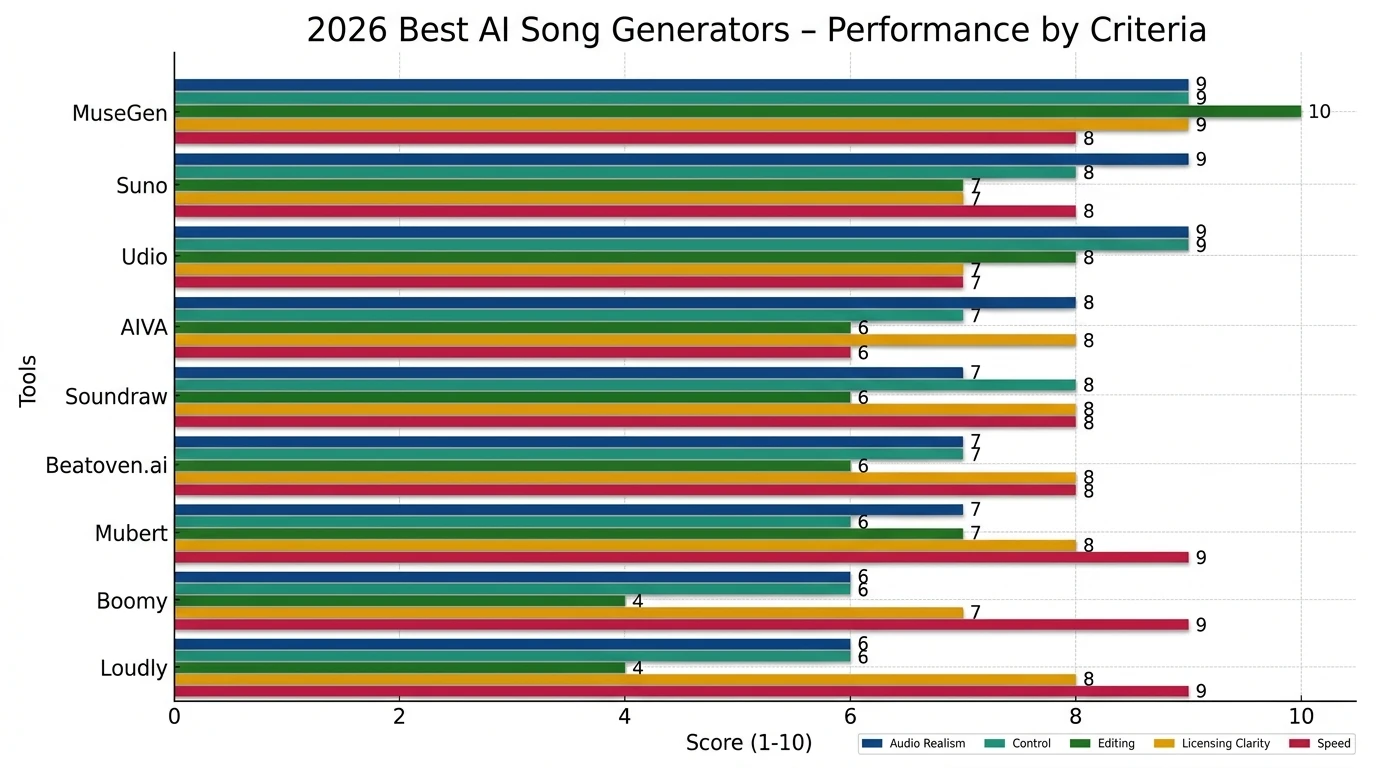
- Audio realism: does it sound like a finished demo or a sketch?
- Prompt & structure control: verses/chorus, transitions, endings, and consistency across regenerations
- Editing: stems, inpainting/remix, section replace, and loop handling
- Licensing clarity: free vs paid commercial rights and documentation
- Speed & reliability: how often I had to re-run generations due to errors or weird artifacts
Industry evaluation often blends listening tests (MOS) with objective metrics, but in real production you mostly care about "Can I ship this?" and "Can I legally use this?" (See evaluation background in ITU-T style MOS discussions summarized in academic work like this thesis on perceptual assessment.)
Quick comparison table (pick the best AI song generator for your use case)
| Tool | Best for | Output type | Editing & exports | Licensing note (high level) | | --------------- | ------------------------------------------- | --------------------------------- | -------------------------------------------------------------- | --------------------------------------------------- | | MuseGen | Studio-ready songs + stem workflows | Full songs, instrumentals, vocals | WAV stems + MIDI, stem-level editing, mixing/mastering, MV | Clear plans for creators/business use | | Suno | Fast full songs with vocals | Full songs with lyrics/vocals | Strong prompting; limited deep stem workflow | Paid tier typically needed for commercial use | | Udio | Realistic "studio-like" generations + remix | Full songs + extension tools | Inpainting/remix + audio extension | License grants use; copyright status can be nuanced | | AIVA | Cinematic/orchestral composition | Instrumental scores | Composition controls; export options vary | Pro tiers improve commercial rights | | Soundraw | Video-friendly background music | Instrumentals | Arrangement tweaking, creator workflow | Designed with content licensing in mind | | Beatoven.ai | Emotion-driven scoring for scenes | Instrumentals | Adaptive transitions for film/podcast | Good fit for media projects | | Mubert | Adaptive/streaming + API use | Instrumentals | API + "render" style workflows | Plans differ; attribution may apply on free tiers | | Boomy | Absolute beginners + quick publishing | Simple songs | Minimal controls; fast outputs | Check distribution and rights per plan | | Loudly | Commercial beds and loops | Instrumentals | Quick generation, looping improvements | Built for advertising/content use |
1) MuseGen - Best AI song generator for creators who need stems, MIDI, and "finish-ready" output
MuseGen is the AI song generator I reach for when the track has to survive real editing: tightening a chorus, swapping a drum kit, or exporting stems to a DAW. I tried a dozen prompts across pop, lo-fi, trap, and cinematic hybrid, then pushed the outputs through stem edits and quick masters. The biggest difference versus "one-click" tools is that MuseGen is built for iteration, not just surprise-and-delight.
Why it wins in 2026
- Multiple inputs: text-to-music plus starting points like lyrics, audio, or images
- Pro exports: high-quality WAV stems and MIDI for serious production refinement
- Creator workflow extras: AI vocals/lyrics, smart mixing/mastering, and a One-Click MV Generator
If you've ever generated a great hook and then lost it while regenerating the "same" idea, MuseGen's precision controls feel like insurance.
Best for
- YouTubers needing unique intros/outros
- Producers who want stems + MIDI for arrangement control
- Agencies shipping lots of branded audio variations
Internal links
- Learn the workflow: AI Music Generator
- Go deeper on singing: AI Vocal & Lyrics Generator
- Turn tracks into visuals: One-Click MV Generator
2) Suno - Best AI song generator for instant full songs (vocals included)
Suno remains one of the most popular answers to "which is the best AI music generator?" because it's unbelievably fast at producing complete songs from a prompt. In my tests, it was the quickest path from concept ("upbeat indie-pop about late-night drives") to a full, catchy structure with hooks and vocals.
Strengths
- Full-song generation with vocals and lyrics from one prompt
- Strong pop sensibility and "radio demo" polish
- Great for rapid A/B testing of concepts
Trade-offs
- Advanced editing can feel constrained compared with stem-based platforms
- Licensing hinges on plan level, so review terms carefully before monetizing
What is the Suno controversy (and is it bad for the music industry)?
The controversy centers on training data, permissions, and compensation - issues that have polarized parts of the music community. Beyond ethics, it also creates practical risk: brands and filmmakers often want squeaky-clean provenance. If you're doing high-stakes commercial work, get clear on licensing and consider legal guidance.
Authoritative context on licensing and evolving rules: AI-generated music copyright in 2026.
3) Udio - Best AI song generator for studio-quality realism and "coproduction" feel
Udio is the tool I use when realism matters most - especially for instrumental beds that need to sit under dialogue or for "this could be a real band" vibes. It also shines for creators who want to extend or refine an idea instead of regenerating from scratch.
Standout features
- Strong realism and coherent arrangement
- Helpful remix/inpainting-style workflows for revisions
- Good for musicians using AI as a collaborator, not a replacement
Licensing reality check
Udio typically grants a license to use outputs, but the broader copyright status of AI-generated music can be unsettled in practice. This is explained clearly in discussions like Can you use Udio AI music commercially? (still: always verify current terms).
4) AIVA - Best for cinematic, orchestral, and score-first composition
AIVA remains a go-to for composers and filmmakers who think in cues, not chart hooks. When I tested cinematic prompts (tension risers, bittersweet strings, heroic brass), AIVA delivered musically "correct" orchestration more often than general-purpose generators.
Pros
- Strong orchestral/cinematic bias
- Better for underscore than pop vocals
- Familiar to media composers
Cons
- Often needs human arranging/mixing for final delivery
- Commercial rights may depend on tier (double-check before release)
5) Soundraw - Best AI song generator for video editors who want arrangement control without prompts
Soundraw is less about poetic prompting and more about fast, practical music assembly. I found it especially good when you already have a cut and need the music to match pacing, sections, and energy shifts.
Best for
- YouTube, ads, product videos, social content
- Editors who prefer "tweak the arrangement" controls
External reference for broader 2026 positioning: Best AI music generators in 2026.
6) Beatoven.ai - Best for emotion-driven soundtrack beds (podcasts, film, explainers)
Beatoven.ai is built around scoring to emotion and timing. In my tests, it handled scene-like transitions better than many "song-first" tools, especially when I needed a clear arc (calm -> tense -> resolved) without vocals.
Why pick it
- Adaptive transitions for storytelling formats
- Great for podcasters and filmmakers needing consistent vibe
- Less time fighting structure
Limitations
- Less "freeform prompt magic" than text-first generators
- More about utility than standout hooks
7) Mubert - Best AI song generator for adaptive music and developer/API workflows
Mubert feels like the practical engineer's choice: generate beds at scale, integrate via API, and keep output consistent. I've used tools like this for background streams and app experiences where you need music that behaves like a service, not a single track.
Good at
- Adaptive/streaming-friendly instrumentals
- Developer integrations and volume generation
- Fast turnaround for content catalogs
If you're comparing pricing models across AI music tools, this overview from a cloud/dev perspective is useful: AI music generators overview.
8) Boomy - Best AI song generator for beginners who want "publishable enough" fast
Boomy is the quickest on-ramp if you're brand new and want a full track without fiddling with settings. In my tests, it was the easiest to get something finished, but it's not where I'd go for deep genre accuracy or pro-level control.
Best for
- First-time creators
- Social content, experiments, lightweight releases
Watch-outs
- Limited fine control and editing depth
- Always verify usage rights for your distribution plans
9) Loudly - Best AI song generator for commercial loops and ad-ready beds
Loudly's strength is speed and utility: quick loopable tracks for ads, promos, and brand content. When I needed "clean, upbeat, non-distracting," it delivered without much prompting drama.
Ideal use cases
- Short-form ads and branded clips
- Loop-focused background music
- Teams that want fast output over deep customization
Udio vs Suno: which is better in 2026?
If you're choosing between these two AI song generators, decide based on workflow.
- Pick Suno if you want instant full songs (often with catchy vocals) with minimal effort.
- Pick Udio if you care most about realism and iterative refinement (remix/extend-style editing).
For commercial projects, treat licensing like a checklist item, not an afterthought. A helpful overview of "own, sell, profit" considerations is this 2026 guide: AI music copyright guide.
Practical licensing tips (so your AI song generator choice won't bite you later)
I've seen teams spend hours perfecting a track, then realize the license doesn't match the use case. Before you commit to any AI song generator, do this:
- Confirm the plan level required for commercial use (free tiers often restrict it).
- Save license documentation or invoices for client work.
- Add human contribution (arrangement edits, stems, mix decisions, lyric rewrites) for clearer authorship signals.
- For high-stakes releases, consider an entertainment attorney - especially if the track becomes a brand asset.
Suno vs Udio: The Best AI Music Maker Showdown of 2025!
Conclusion: the "best AI song generator" is the one you can finish with
After testing across the major categories, the pattern is clear: some tools are built for wow, others are built for work. If you need professional control - stems, MIDI, editing, and reliable exports - MuseGen is the most production-friendly choice on this list. If you want instant viral-style songs, Suno and Udio remain power picks, but your final decision should match your licensing needs and how much you plan to edit.
FAQ: Best AI Song Generators (2026)
1) Which is the best AI music generator in 2026?
The best AI music generator depends on your goal: full songs with vocals (Suno/Udio), cinematic scoring (AIVA), or professional editing with stems and MIDI (MuseGen).
2) Which AI can make the best songs?
For "complete songs" (vocals + structure), Suno and Udio are frequent top picks. For songs you plan to polish in a DAW, an AI song generator with stem and MIDI export (like MuseGen) usually produces the best final results.
3) What is better, Udio or Suno?
Udio often wins on realism and revision workflows; Suno often wins on speed and hooky full-song output. Your preferred editing style is the tiebreaker.
4) What is the Suno controversy?
It's largely about training data, permissions, and compensation, plus broader concerns about how AI music affects working artists. It also impacts brand risk tolerance for commercial projects.
5) Is Suno allowed on Spotify?
It can be, but it depends on distribution rules, your rights under Suno's plan, and platform enforcement. Review the generator's commercial terms and your distributor's policies before uploading.
6) Is Suno bad for the music industry?
It's complicated. AI song generators can lower barriers for creators and speed up production, but disputes about consent, licensing, and compensation are real and ongoing.
7) Can I use AI-generated songs commercially?
Often yes - if your tool's license and subscription tier allow it, and you follow attribution/documentation requirements. For important releases, keep records and consider legal advice.