 MuseGen
Melody Writer Checklist: 10 Steps to Catchy Hooks
MuseGen Team
5/8/2026
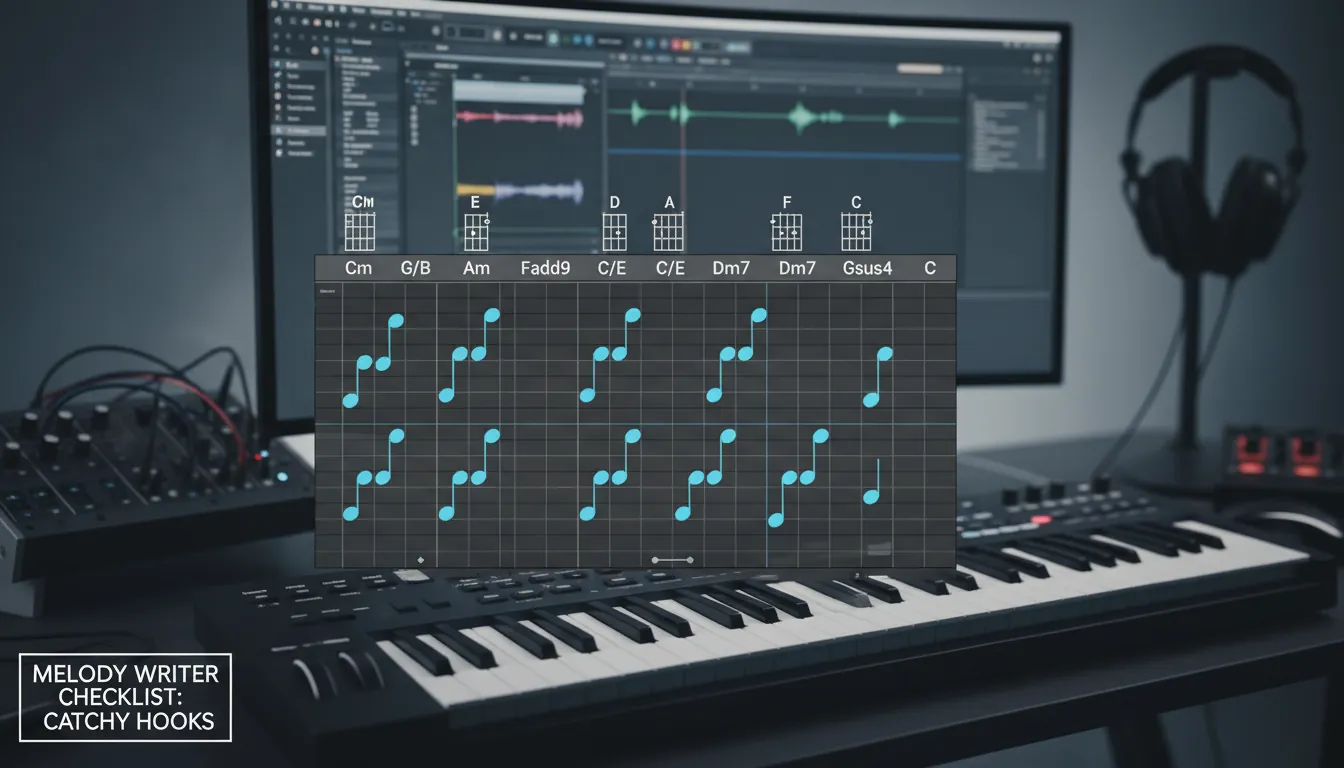
You open your DAW, play four chords, and... nothing. The loop feels fine, but the topline won't land - and you can't stop thinking, "Am I even a melody writer?" The good news: catchy hooks aren't luck. They're usually a repeatable mix of simplicity, rhythm, emotional intent, and a smart balance of predictability and surprise - the same ingredients you'll see across hit-writing analysis and music cognition research.
What a "melody writer" actually does (in one minute)
A melody writer shapes the main singable line people remember - often the chorus hook, sometimes an intro motif, bass hook, or rhythmic chant. In practice, you're making decisions about:
- Contour (how the notes rise/fall)
- Rhythm & phrasing (how it talks with the beat)
- Repetition vs variation (what repeats, what changes)
- Harmony relationship (how it fits the chords)
This checklist is built to get you from blank session -> testable hook fast, without getting lost in theory.
The 10-step melody writer checklist (catchy hook workflow)
1) Pick one clear emotion + listener "use case"
Before notes, choose the job the hook must do: anthem, sad confession, playful flex, cinematic lift. In my own sessions, the fastest way to kill a hook is writing a "generic cool melody" with no emotional target. A single sentence is enough.
- Prompt yourself: "This hook should feel like ______."
- Add one constraint: bright, dark, nostalgic, urgent, floaty.
This aligns with songwriting guidance that strong hooks are emotionally engaging, not just technically correct.
2) Set guardrails: key, scale, and vocal range
Catchy hooks are often simple because they're easy to sing and remember. Pick a comfortable range early (especially if it's for vocals).
- Beginner-friendly: A minor (all white keys) or C major
- Typical hook range target: ~8-12 semitones (one octave-ish)
- Decide: will the hook peak high (excitement) or sit mid (cool/confident)?
If you're using AI to prototype, lock the key/scale so "happy accidents" stay usable.
3) Build a loop that invites melody (chords + groove)
Hooks stick when melody and beat interlock. Start with:
- A short chord loop (2-4 bars)
- A drum pattern with a clear pocket
- A bass rhythm that leaves space for phrases
This is consistent with chorus-writing advice to build around the beat - rhythm can be as memorable as pitch.
4) Write a 2-4 note "cell" (your hook DNA)
Most earworms begin as a tiny motif you can whistle. Keep it short enough to survive repetition.
Try these starting cells (pick one):
- Stepwise: 1-2-3 (smooth, friendly)
- Leap + resolve: 1-5-3 (attention -> satisfy)
- Repeated note rhythm: 3-3-3-2 (chanty, modern pop)
From experience: if you can't hum the cell after 10 seconds, it's not ready to be a hook.
5) Use repetition on purpose (but hide it with micro-variation)
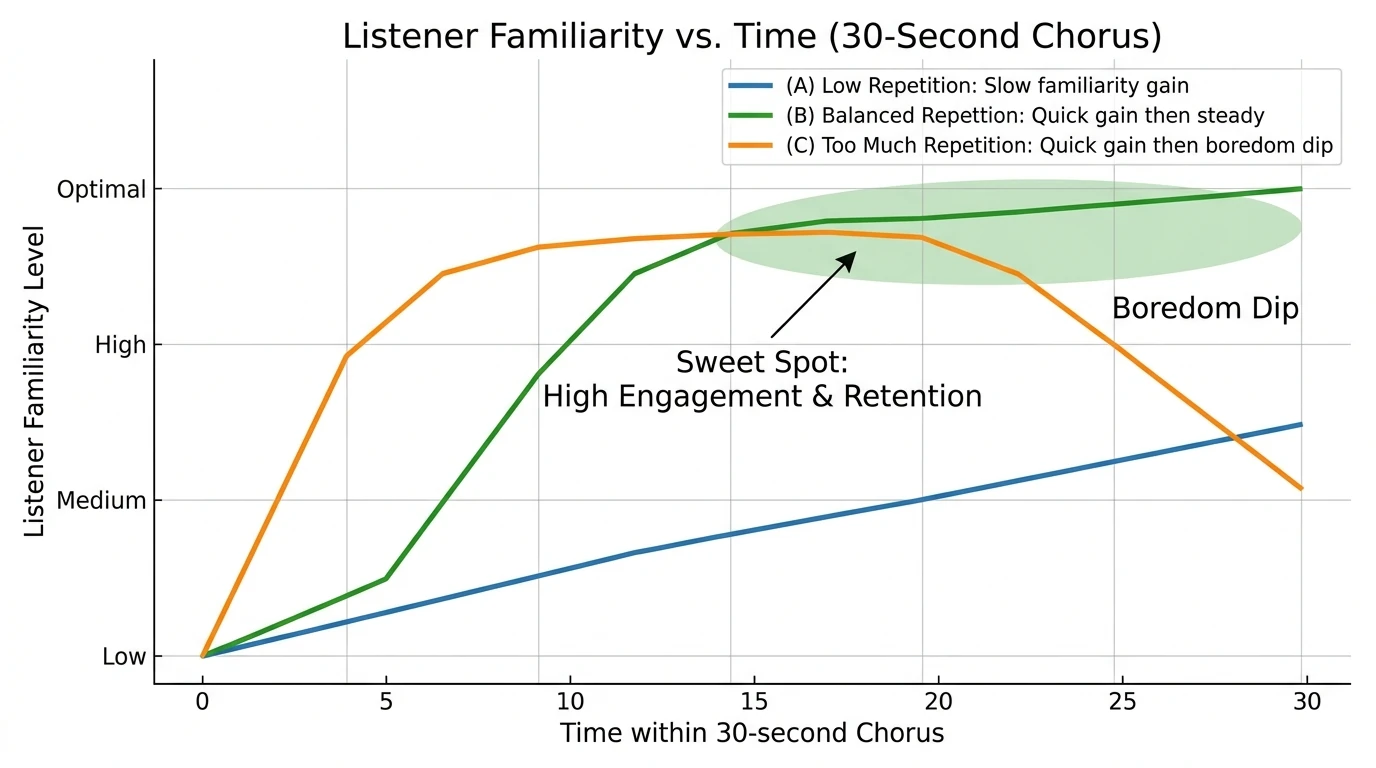
Research and hit-writing craft agree: repetition boosts memorability, but too much can feel boring. Your job is to repeat the identity while changing the surface.
- Repeat the rhythm, change the ending note
- Repeat the notes, change the rhythm (syncopate)
- Repeat the first half, vary the second half (classic)
A practical target: 60-80% familiarity (recognizable) + 20-40% change (interesting).
6) Create melodic movement: mostly steps, occasional leaps
One reliable pattern for catchy writing is small steps with a few well-placed jumps. Steps make it singable; leaps create "headline moments."
Checklist:
- Are most note-to-note moves within 1-2 scale steps?
- Do you have 1-2 leaps that feel exciting?
- Does the leap resolve to a stable chord tone shortly after?
This matches common hook advice: avoid flat predictability; add movement and shape.
7) Phrase like a conversation (call-and-response)
Brains remember structured chunks. Write your hook as two "sentences":
- Call (question / setup)
- Response (answer / payoff)
Keep phrases balanced (often 2 bars + 2 bars). Leave a tiny breath or rest - silence helps hooks feel bigger and more "quoteable."
8) Make the rhythm do some of the hooking (syncopation + placement)
If the pitch is simple, make the rhythm signature - and vice versa. Great hooks often lean on placement against the grid.
Try one:
- Start on the "and" of 2 or 4 (instant bounce)
- Hold a long note across the barline (tension)
- Use a repeated rhythm with a one-hit surprise at the end
When I'm stuck, I'll clap 2-3 rhythm options before touching notes. It prevents "random MIDI noodling."
9) Humanize and produce the hook so it feels alive
Even a perfect melody can feel stiff if it's robotic. Before judging the writing, humanize:
- Slight timing offsets (a few ms early/late)
- Velocity shaping (accent the identity notes)
- Layer doubles (octave, unison, or soft harmony)
- Choose a lead sound that matches emotion (pluck vs pad vs vocal chop)
This mirrors producer-focused guidance: humanization and sound choice strongly affect perceived hook quality.
10) Test like a pro: earworm check + feedback loop
A hook is "catchy" if it survives time and distraction.
Run these tests:
- One-listen hum test: after 30 seconds, can you hum the main idea?
- Phone speaker test: does it read on tiny speakers?
- Title test: does the hook contain (or imply) the song's key phrase?
- Outside ears: play it for one non-musician - what do they sing back?
For a deeper definition of catchiness as long-term musical salience, see Soundfly's discussion of memorability and cognition: What makes a song "catchy?".
Quick comparison: hook tools that help a melody writer decide faster
| Tool/Approach | Best for | Strength | Watch-out | | ------------------------- | -------------- | ------------------------------------ | ---------------------------------- | | Piano/voice sketch | First ideas | Fast, emotional, no distractions | Can miss groove detail | | MIDI in DAW | Precision | Easy to edit rhythm & contour | Can turn robotic without humanize | | Reference track A/B | Direction | Clarifies "modern" phrasing & pacing | Don't copy - translate | | AI generator (text/audio) | Rapid variants | Tons of hook drafts in minutes | Needs taste + editing to be unique | | Co-writing feedback | Reality check | Catches weak moments quickly | Too many opinions can blur vision |
How MuseGen helps you act like a melody writer (even on a deadline)
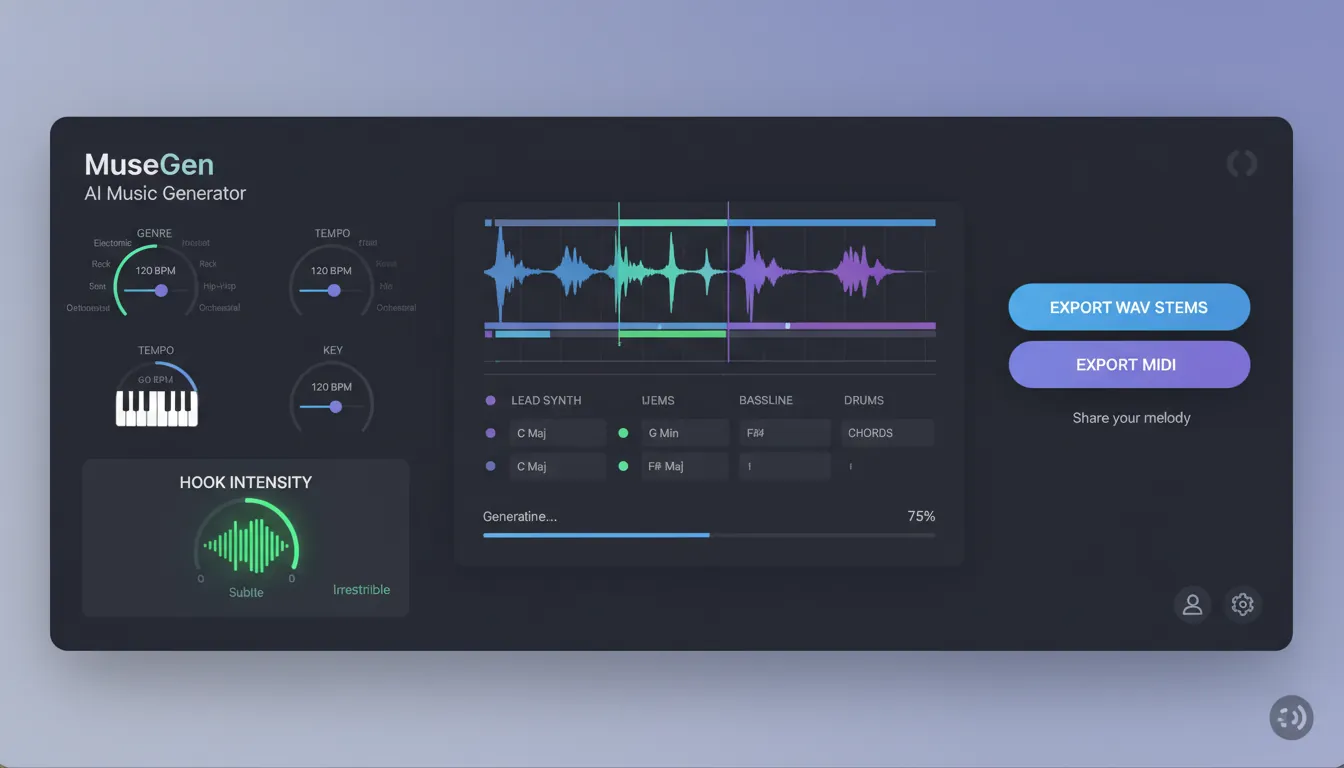
When you're building hooks at speed, iteration matters. MuseGen is useful because it's not just "generate a song" - it's built for quick hook prototyping + stem-level refinement.
A practical MuseGen workflow I've used for clients making short-form content:
- Describe the hook target in one line (emotion + genre + tempo).
- Generate 5-10 variations.
- Keep one motif, then edit timing/notes and export stems + MIDI for a DAW finish.
Helpful starting points on the platform:
- AI Music Generator for fast drafts
- Text to Music to turn a hook brief into options
- AI Vocal & Lyrics Generator when you want a singable topline fast
To compare modern AI composition approaches at a high level, MIT Technology Review's overview of generative AI is a good grounding read: Generative AI. For music-making specifically, see Ableton's learning resources on writing and producing workflows: Ableton Learning Music.
This One Melody Tip Will Make Your Melodies GREAT
Common melody-writer mistakes (and the quick fix)
These show up constantly in real sessions - especially when the loop is strong but the hook won't stick.
- Too many notes
- Fix: delete 30-50%, keep only identity notes.
- No rhythmic identity
- Fix: clap a 1-bar rhythm and rebuild pitches on it.
- No "peak moment"
- Fix: add one leap or one highest note on the emotional word.
- Doesn't loop cleanly
- Fix: make the last note lead back (stepwise into bar 1 or resolve to tonic/third).
- Over-repetition
- Fix: vary the second half, or change the last note every other repeat.
For more on simplicity and repetition as hook fundamentals, see: How to Write Catchy Hooks in 5 Simple Steps and Mixed In Key's hook checklist perspective: How to write a catchy hook.
Conclusion: your next hook is a process, not a miracle
A melody writer isn't someone who "waits for inspiration." It's someone who can generate small motifs, repeat them smartly, shape movement, and test quickly until one idea sticks. Next time you're staring at an empty session, run the 10 steps above and force 5 imperfect drafts - because draft #4 is where the real hook usually shows up.
FAQ: melody writer questions people actually search
1) What does a melody writer do in a song?
They create the main melodic line (often the chorus hook) and shape its rhythm, contour, and repetition so it's memorable and singable.
2) How do I write a catchy hook if I don't know music theory?
Start with a 2-4 note motif, keep it in one scale (like A minor), focus on rhythm, and use repetition with small variations.
3) How long should a hook melody be?
Most hooks are short - often 1-2 bars of a strong motif repeated across a 4-8 bar chorus.
4) Why do my melodies sound boring?
Common causes are too much stepwise motion with no peak, no rhythmic identity, or no contrast between phrases. Add one leap, one syncopation, or a call-and-response structure.
5) How do I make a melody more "human" in MIDI?
Adjust timing slightly off-grid, shape velocity, add breath spaces, and choose a lead sound that matches the emotion.
6) Can AI help me write melodies without copying existing songs?
Yes - use AI to generate original variations, then edit the motif, rhythm, and phrasing, and export MIDI/stems to finalize your own structure and signature choices.
7) What's the fastest way to improve as a melody writer?
Write many short hooks, finish them, test them on others, and keep a library of motifs. Speed + feedback beats overthinking.