 MuseGen
Rap Gen FAQ: Answers to Common Questions & Best Uses
MuseGen Team
4/28/2026
"Rap gen" usually shows up the moment you're stuck: you have a hook idea, a mood, maybe a couple of bars - but the verse won't land, the flow feels off, or you can't find fresh rhymes without sounding like a clone. In today's creator economy, rap gen can mean a few different things, and that confusion slows people down. I've used rap-gen style tools in real sessions to break writer's block and to prototype demos fast, but the results depend heavily on what type of "rap gen" you actually need.
This FAQ-style guide clears up definitions, best uses, limitations, and the practical workflow for creators - especially if you're using an AI music platform like MuseGen to go from prompt to studio-ready stems.
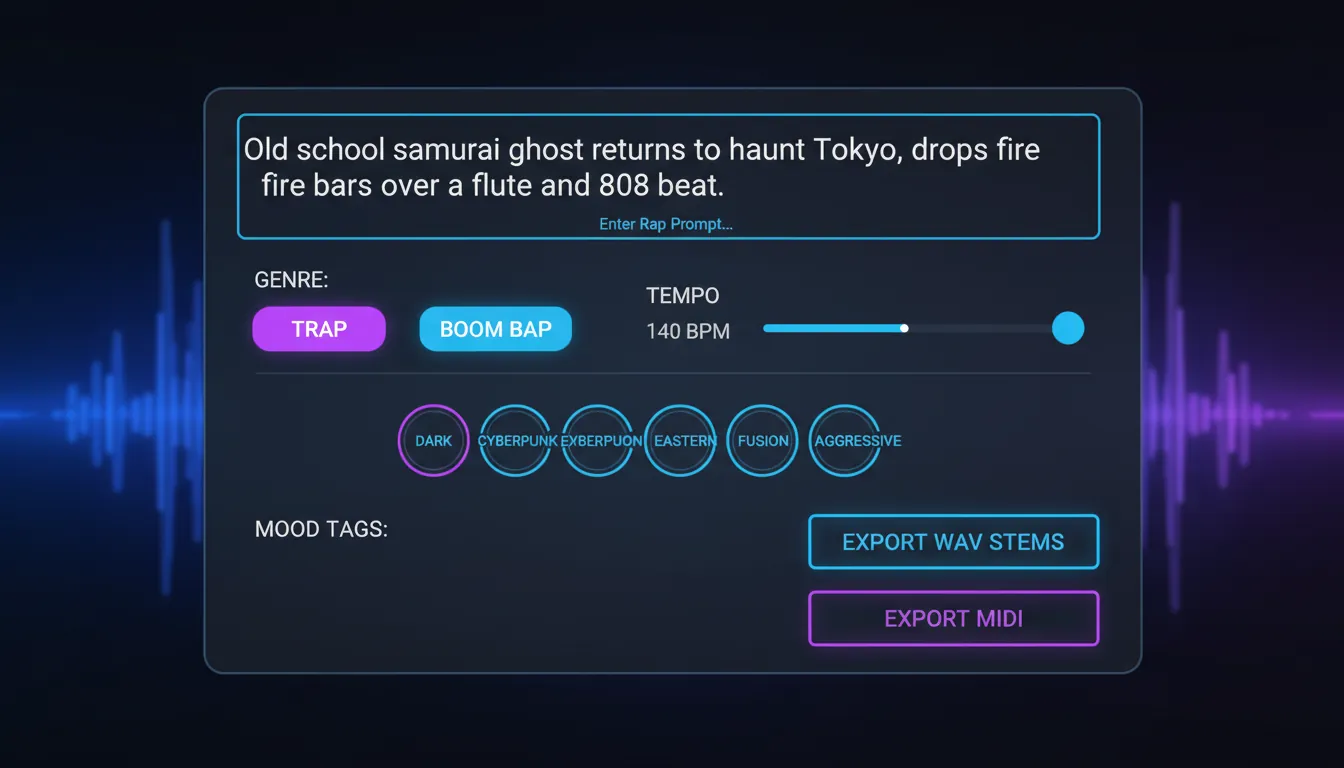
What does "rap gen" mean?
In common usage, rap gen is short for rap generator. Most people mean one of these:
- AI rap lyric generator: produces bars, hooks, rhyme schemes, punchlines.
- AI rap beat generator: creates instrumentals (trap, boom bap, drill, lo-fi, etc.).
- AI full rap song generator: generates beat + arrangement, and sometimes vocals.
- "RAP-Gen" in software engineering: a research system for automatic program repair (not music), often referenced in academic papers.
Rap itself is defined more by rhythm, rhyme, cadence, and lyrical delivery than pitch-heavy melody, which is why rap-gen tools often focus on flow and structure (bars, syllable counts, stress patterns) more than "singable" melodies. For background on rap as a form and its performance focus, see EBSCO's rap music overview and Wikipedia's rapping entry.
Is "rap gen" the same as hip-hop?
Not exactly. Rap is the vocal delivery style (rapping), while hip-hop is a broader culture and musical umbrella that includes DJing, production aesthetics, and more. In practice, most "rap gen" tools target hip-hop subgenres, but you can also generate rap vocals over non-hip-hop styles if the platform supports it.
What are the best uses of a rap gen (lyrics, beats, or full tracks)?
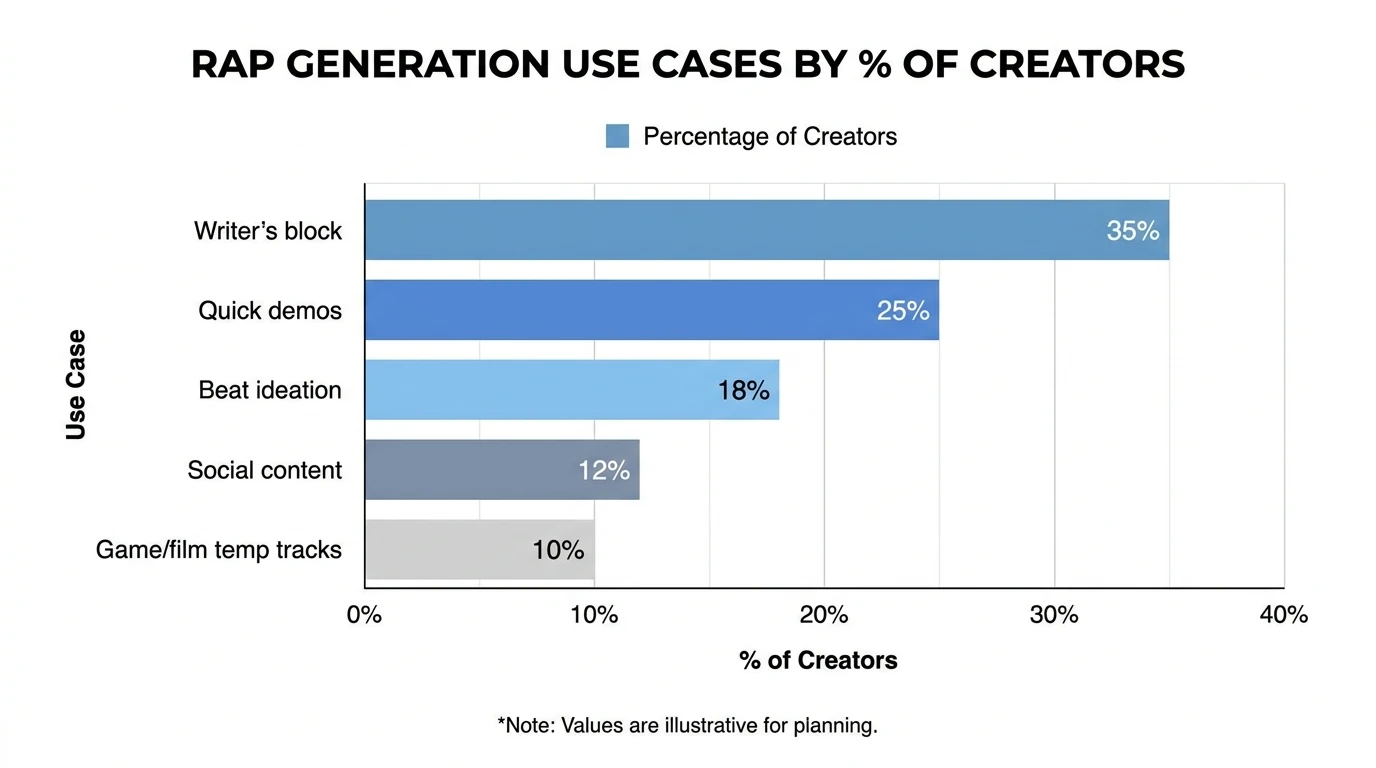
The highest-ROI uses I see (and personally rely on) are about speed + iteration:
- Beating writer's block (fast idea volume)
A rap gen can spit 10 hook directions in minutes, helping you pick one you'd actually write yourself. - Exploring flows and rhyme schemes
You can request internal rhymes, multisyllabic patterns, triplets, or double-time pockets - then rewrite with your own voice. - Rapid demo creation for content
Short-form creators, podcasters, and ad teams can generate 15-45 second cues quickly and keep moving. - Pre-production for real sessions
I've used AI drafts as "scratch lyrics" to map cadence and arrangement before a vocalist ever touches the mic. - Game/film temp tracks
A full rap gen track can act as a temporary placeholder (tempo, energy, structure) until final music is commissioned.
MuseGen fits particularly well when you need studio-ready outputs (WAV stems, MIDI, and editable parts) rather than a single flattened MP3.
Rap gen vs. "RAP-Gen" (the research paper): why this matters
If you search "rap gen," you may see "RAP-Gen: Retrieval-Augmented Patch Generation..." - that's software engineering, not music. It's about fixing code using retrieval-augmented generation, with reported improvements on benchmarks like TFix and Defects4J in academic evaluations (see the paper on arXiv). Great work, wrong tool - so always confirm whether a result is about rap generation or patch generation.
What should a good rap gen tool include?
Look for control, not just "generate."
Must-have controls (practical checklist)
- Genre + tempo + mood controls (trap, boom bap, drill; BPM ranges)
- Structure options (intro/verse/hook/bridge; bar counts)
- Rhyme scheme control (AABB, ABAB, internals, multis)
- Vocal options (if included): tone, cadence, ad-libs, explicitness filter
- Edits + exports: stems (drums, bass, melody), WAV, MIDI
Why stems matter (creator reality)
If you can't separate drums/bass/music or export MIDI, you're stuck "mixing a photo." MuseGen's stem export approach is what you want when the track needs a real mix, not just a quick post.
MuseGen workflow: how to use rap gen for studio-ready results
This is the repeatable workflow I use when I want speed and control:
- Write a tight prompt (constraints beat vibes)
Include BPM range, subgenre, reference characteristics (not artist names), and structure.
Example: "140 BPM trap, dark minor key, sparse 808, 8-bar hook, 16-bar verse, space for doubles." - Generate 3-5 variations
Keep one variable changing at a time (tempo, drum density, hook melody). - Lock the arrangement, then edit stems
Pull down busy hi-hats, carve space for vocal, and fix hook repetition. - Generate lyrics separately (or bring your own)
Use AI for options, then rewrite for authenticity and originality. - Export WAV stems + MIDI
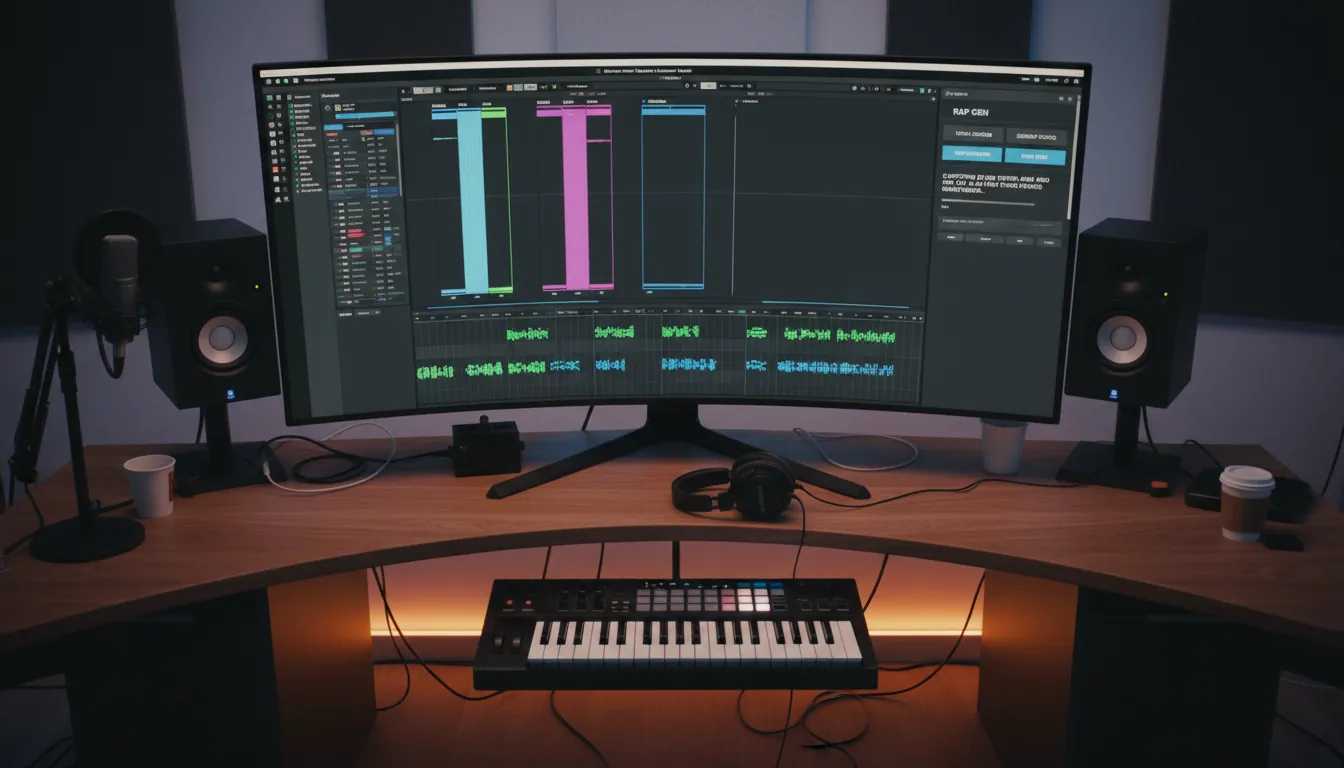
Finish in your DAW with real automation, transitions, and mastering polish.
Comparison table: rap gen options (lyrics vs beats vs full tracks)
| Rap gen type | What it generates | Best for | Main limitation | Ideal MuseGen add-on | | ------------------ | ---------------------------------- | --------------------------------------- | ---------------------------------------------- | ------------------------------------------- | | Lyric-only rap gen | Verses, hooks, rhyme schemes | Writer's block, punchline ideation | Can sound generic without human rewrite | AI Vocal & Lyrics Generator + editing tools | | Beat-only rap gen | Instrumentals, loops, arrangements | Freestyle practice, content beds | Less "song identity" without a hook concept | Stem export + smart mixing/mastering | | Full-track rap gen | Beat + structure, sometimes vocals | Fast demos, temp tracks, social content | Risk of sameness; vocal realism varies by tool | WAV stems + MIDI + precise stem edits | | Research "RAP-Gen" | Code patches (not music) | Software repair | Not related to audio/music | N/A |
How do I prompt a rap gen for better results?
A strong rap gen prompt reads like a mini creative brief. Use:
- Tempo: "90 BPM boom bap" or "150 BPM drill"
- Sound palette: "vinyl crackle, dusty keys, chopped soul sample feel"
- Drums: "swing at 55%, snare on 3, tight hats"
- Structure: "8-bar hook, 16-bar verse, 4-bar turnaround"
- Mix intent: "vocal-forward, wide hook, mono 808"
Avoid naming real artists. Instead, describe attributes: "aggressive triplet flow, minimal melodic content, call-and-response hook."
Is rap gen legal for commercial use? (copyright and licensing)
This depends on the platform license and how you use outputs. Key points:
- Avoid prompts that imitate specific artists ("make it like Drake") - that's widely considered a legal and ethical risk area.
- Document your process: save prompts, versions, and your edits. This advice is echoed by creators and legal commentary discussing AI music disputes and risk reduction (see Silverman Sound's 2026 overview).
- Lyrics are special: lyrics can be copyrighted, and originality matters. Many platforms also restrict reproducing existing lyrics; for context on why full copyrighted lyrics are sensitive, read Soundverse's explanation.
- Read the tool's terms: ownership and commercial rights vary. Some tools explicitly include commercial licenses in paid plans, while free tiers may not.
If you're producing client work, I recommend writing or heavily rewriting lyrics yourself and using AI as a drafting partner - not the final author.
Common limitations: what rap gen still struggles with
Even strong systems can miss "human" details:
- Overly perfect symmetry: verses feel evenly spaced but emotionally flat.
- Repetitive phrasing: hooks repeat without development.
- Weak point-of-view: no lived-in details, few concrete images.
- Mix translation: a cool demo can collapse on phone speakers without real mixing.
The fix is usually hybrid: generate, then edit like a producer - arrangement changes, ear candy, vocal pockets, and a real master.
Ai MAGIC! 🤯 How to Get STEMS and MIDI from ANY Song?!
Best practices for creators using MuseGen as a rap gen engine
- Start with a clear goal: freestyle beat, TikTok hook, or full commercial track.
- Iterate quickly, then commit: don't polish version #1.
- Export stems early: if the chorus doesn't lift, you'll want control.
- Humanize the final: rewrite bars, add transitions, change drum patterns in verse 2.
- Keep compliance simple: avoid artist-name prompts; keep records.
For more hands-on guides, you can also explore:
FAQ: Rap Gen questions people search most
1) What is a rap gen used for?
A rap gen is used to generate rap lyrics, beats, or full tracks quickly - most often for writer's block, demo creation, and beat ideation.
2) Can rap gen create full songs with vocals?
Some tools can generate vocals, but quality and consistency vary. For professional results, use stem exports and mix the vocal pocket intentionally.
3) How do I make rap gen lyrics sound less generic?
Ask for a specific point-of-view, setting, and concrete details, then rewrite with your personal language. Treat AI text as a first draft.
4) Is rap gen free?
Many platforms offer limited free generations, with paid tiers for more credits, better models, and commercial rights.
5) Can I use rap gen music on YouTube or in ads?
Often yes if your plan includes commercial usage rights - but always confirm the platform license and avoid copying existing songs or lyrics.
6) Why does my rap gen prompt fail when I name an artist?
Some generators block or fail on artist names to reduce legal risk and impersonation issues. Use descriptive attributes instead.
7) What export formats should I look for?
For pro workflows: WAV stems and MIDI. MP3-only exports are fine for drafts, not ideal for real releases.
Conclusion: turning "rap gen" into real, release-ready music
Rap gen is best thought of as a creative accelerator - great for sparking ideas, shaping structure, and getting a demo moving fast. The highest-quality outcomes happen when you pair generation with producer habits: tight prompts, multiple iterations, stem-level edits, and a human rewrite that locks in identity. If you want rap-gen speed without sacrificing control, MuseGen's approach - prompt-to-track plus stems, MIDI, and editing - fits the way modern releases are actually built.