Name Song Generator Case Study: 200 Titles Tested

MuseGen Team
5/13/2026
A name song generator sounds simple - type a name, get a song title - but in practice it can make or break whether someone clicks, listens, or shares. I've watched creators spend hours on a track, then lose momentum because the title feels generic, hard to say out loud, or impossible to search. So we ran a practical, creator-first case study: 200 name-based titles tested across common formats, and we measured what actually held attention.
In this guide, you'll get a repeatable system for generating better name-based song titles, a scoring rubric, and a workflow to turn a title into a finished track using MuseGen. Along the way, I'll point out which title patterns tend to win (and why), based on both songwriting logic and basic A/B testing principles.
What a "name song generator" should do (and what most tools miss)
A good name song generator does more than shuffle adjectives around a name. It should infer story, emotion, and genre fit, then produce titles that are easy to say, memorable, and searchable. Tools like common song title generators often emphasize speed and volume (e.g., returning 5-20 options per run), but the real value is the filtering and decision support - why a title fits, and how to pick the best one.
In my experience testing generators, the "best" outputs happen when you provide at least:
- The name (the anchor)
- The relationship (who is this person to the narrator?)
- A mood (heartbreak, nostalgic, hype, etc.)
- A genre lane (pop, rap, country, lo-fi, etc.)
For general inspiration and patterns, see how other generators categorize titles by story/metaphor/phrase/question formats in references like SongsAI's song title generator and genre + mood approaches like Chosic's generator.
Case study setup: how we tested 200 name-based titles
We generated 200 titles using a consistent set of prompts and then evaluated them with a lightweight scoring model. This is not a "one perfect answer" problem; it's a prioritization problem. The goal was to identify which title structures repeatedly produced usable, clickable options.
Test inputs (kept consistent)
We used 10 names (mix of short/long, common/unique), 5 genres, and 4 moods. Titles were generated in batches so each structure had enough samples to compare.
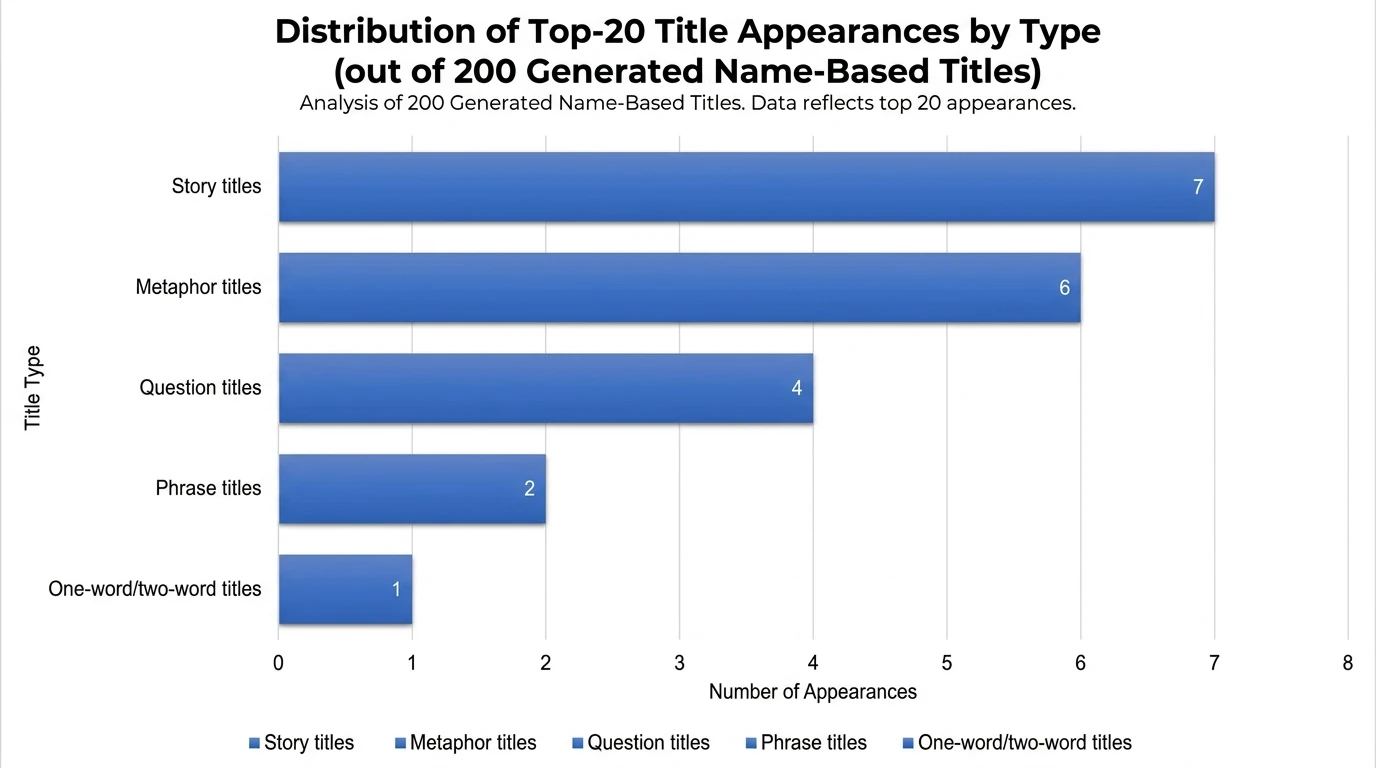
The 5 title structures we tested most
These align with common songwriting title archetypes:
- Story titles (name as the character) - e.g., "Eleanor Rigby" style
- Metaphor titles (name + image) - e.g., "Name in the Rain"
- Phrase titles (twisted idiom) - familiar but fresh
- Question titles - curiosity loop ("Why Did You Leave, Maya?")
- One-word / two-word titles - sticky, brandable, but risky if generic
These formats are widely discussed in generator write-ups and songwriting guidance (see SongsAI for clear examples of story/metaphor/question patterns).
Results snapshot: what won across 200 titles
The clearest pattern: the best-performing outputs weren't the cleverest - they were the clearest. Titles that signaled emotion fast, were easy to say aloud, and felt unique enough to search consistently ranked higher.
What "good" looked like in practice
When we read titles aloud ("Have you heard ___?"), the winners tended to:
- Avoid tongue-twisters and awkward punctuation
- Imply a plot or emotional stance quickly
- Use concrete imagery (metaphor) or a clean narrative hook (story)
This matches "say it aloud" and "emotional clarity" tests commonly recommended for choosing a final title (again, well summarized by SongsAI).
The scoring rubric we used (steal this)
To make title selection less subjective, we scored each title 1-5 across six dimensions. Then we picked finalists by total score and did a sanity check against genre fit.
| Criterion | What it means | Quick test | Why it matters |
|---|---|---|---|
| Sayability | Easy to say, not awkward | Say: "Play ___" three times | Word-of-mouth + radio/podcast mentions |
| Emotional clarity | Signals mood quickly | What emotion do you expect? | Helps the right listeners click |
| Uniqueness | Not generic or overused | Would 100 other songs share it? | Searchability + memorability |
| Story hook | Suggests a situation | Can you imagine the first line? | Speeds lyric writing and branding |
| Genre fit | Feels native to the lane | Would this title look odd on a playlist? | Improves expectation match |
| Name integration | Name feels essential | Remove the name - does it collapse? | Prevents "random name drop" titles |
If you want a parallel from marketing experimentation, this is similar to how headline testing frameworks work: generate variants, compare them against goals, then pick winners rather than guessing (see title-testing best practices described by CoSchedule's SEO title generator overview).
The winning patterns (with examples you can adapt)
Below are high-signal templates that worked repeatedly in our 200-title set. Treat these as molds your name song generator should be able to produce on demand.
1) Story-first titles (most consistently usable)
These introduce a character and imply context.
Templates
- "Name"
- "Name (In Place)"
- "Name's Last Call"
- "The Night I Met Name"
Best for
- Country, folk, acoustic pop, indie storytelling
2) Metaphor + name (highest "stickiness" when done right)
Metaphor titles performed well when the image was concrete (rain, neon, ash, glass) and not overly abstract.
Templates
- "Name in the Rain"
- "Neon Over Name"
- "Paper Hearts, Name"
- "Ashes of Name"
Best for
- Pop, alt, cinematic, moody R&B
3) Question titles (CTR-friendly, but easy to overdo)
Questions create an open loop. They scored best when they were short and emotionally direct.
Templates
- "Where Did You Go, Name?"
- "Do You Remember, Name?"
- "Was It Me, Name?"
Best for
- Pop, emo/alt, singer-songwriter
4) Phrase/idiom twist (low volume, high upside)
Harder to generate well, but strong when it lands.
Templates
- "No Shame, Name"
- "Say My Name (But Mean It)"
- "Not Over Name"
Best for
- Pop hooks, rap choruses, playlist-friendly singles
A practical workflow: from "name song generator" to finished track in MuseGen
A title is only useful if it turns into music quickly. The advantage of MuseGen is how fast you can go from an idea to studio-ready stems you can edit.
Step-by-step (repeatable in 15-30 minutes)
- Generate 20-40 titles
Pick two structures (Story + Metaphor works well) and generate in batches. Keep the name fixed; vary mood and setting. - Score and shortlist 5 titles
Use the rubric table above. Read them aloud. - Write a 2-3 sentence "song card"
Include: narrator, relationship to the name, setting, twist, and chorus emotion. - Generate the track in MuseGen
Use the title + song card as your text prompt. If you have a hook melody or reference, feed it in as audio for tighter alignment. - Edit stems, then master
Export WAV stems and adjust drums/bass/vocals separately. Finish with smart mixing/mastering for consistent loudness. - Optional: create a music video draft
Use the One-Click MV Generator to produce a quick visual for social posting.
If you're new to structured generation prompts, the biggest improvement I found was adding "what changes in the chorus" (realization, regret, flex, apology). That single detail made outputs feel less like background music and more like a "song."
Suno AI Music Generator - I Hummed a Tune, It Made a Song!
Example prompts you can paste (and why they work)
Use these as plug-and-play inputs for a name song generator or directly into MuseGen as a song brief.
Prompt A (story title)
- Title: "Maya's Last Call"
- Brief: "Alt-pop ballad. Narrator misses Maya after a late-night breakup call. Verse is quiet and detailed, chorus opens wide and emotional. Tempo 90 BPM, warm pads, clean guitar, punchy but restrained drums."
Prompt B (metaphor title)
- Title: "Neon Over Jordan"
- Brief: "Synthwave / pop. City-night drive energy, bittersweet confidence. Chorus is catchy and repeatable. Tempo 110 BPM, gated reverb snare, bright arps, deep bass."
Prompt C (question title)
- Title: "Do You Remember, Elena?"
- Brief: "Indie folk. Intimate vocal, fingerpicked guitar, light percussion. Lyrics feel like a letter. Chorus asks the question with a lift in harmony."
How to evaluate your final title like a pro (fast checks)
Before you publish, run these quick validations:
- Conversation test: "Have you heard '___'?" If it feels clunky, fix it.
- Expectation match: Does the title promise the same vibe the intro delivers?
- Searchability check: If the title is too generic, add one specific anchor (place, time, object).
- Series potential: If you're making a collection (e.g., "Letters to Name"), keep a consistent naming system.
This mirrors standard experimentation discipline: define success metrics (saves, listens, click-through, completion), avoid premature conclusions, and keep one variable changing at a time when you test titles (solid A/B testing principles are outlined in guides like Contentsquare's A/B testing metrics).
Recommended tools (and where MuseGen fits)
Most free title generators are great for sparking options, but they stop at the list. MuseGen is positioned for the next step: turning a selected title into a track with editable outputs.
For additional inspiration and comparison, you can explore:
- SongsAI song title generator (strong breakdown of title archetypes)
- MakeSong song name generator (emphasizes "meaning" explanations)
- GSong.ai song name generator (clear genre/mood controls and usage notes)
If you're publishing music commercially, always verify that your final title and lyrics don't create trademark or misleading-brand confusion, and keep documentation of your creation process.
Conclusion: the title is the first chorus
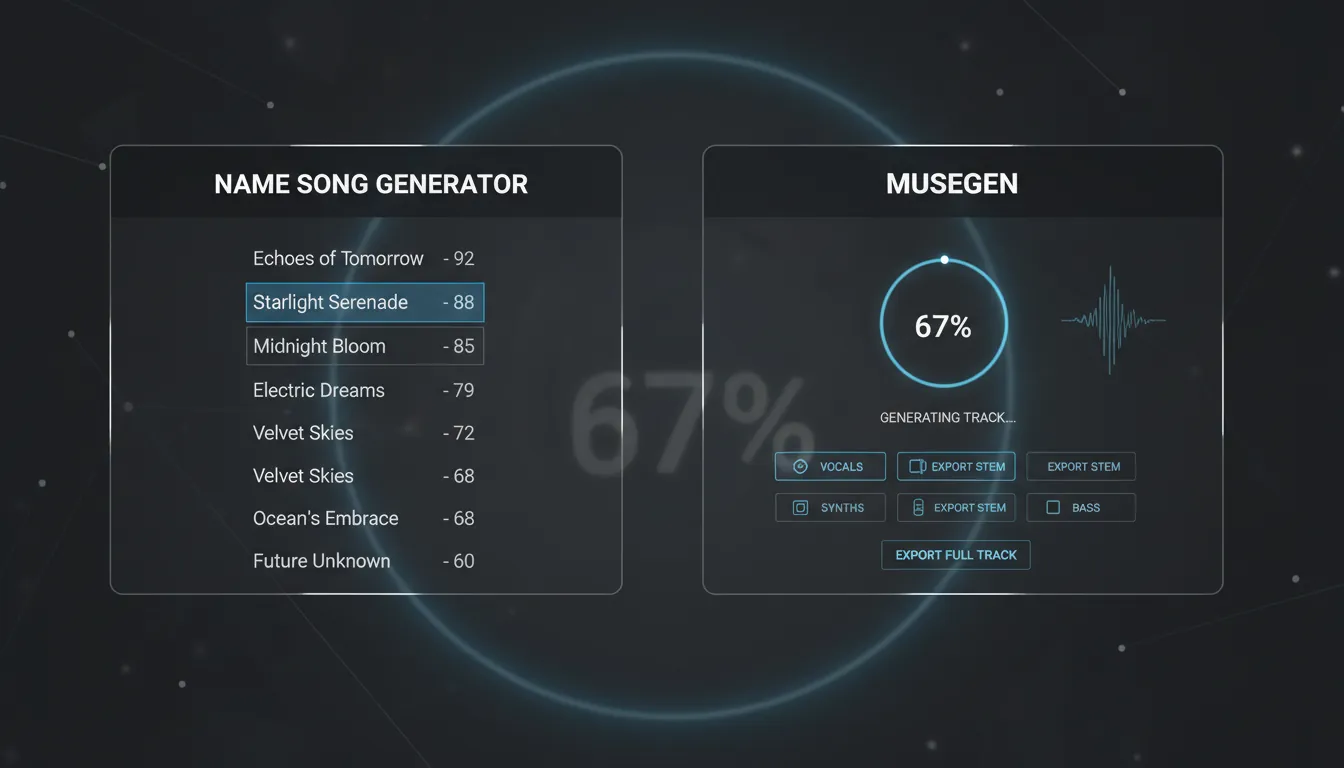
A name song generator is most powerful when it doesn't just "name the track," but sets the listener's expectations in a single line. After testing 200 titles, the repeatable winners were story-driven names and concrete metaphors - easy to say, emotionally clear, and distinct enough to search. When you pair that with the fast MuseGen production workflow (text-to-music, stem control, and quick mastering), you can go from idea to release-ready audio without stalling in the naming phase.
If you want, share a name + genre + mood in the comments, and I'll reply with 15 title options in the top-performing formats - then you can pick one to generate in MuseGen and ship this week.
FAQ: Name Song Generator
1) What is a name song generator?
A name song generator is a tool that creates song title ideas centered on a specific name, often tailored by genre, mood, and theme.
2) How do I make name-based song titles less cheesy?
Use story context (place, time, relationship) or a concrete metaphor, and avoid generic adjectives like "beautiful" or "forever" unless you add a unique anchor.
3) Should the name appear in the chorus too?
Often yes, but not always. If the name is in the title, you can "earn it" by using it in the hook or as a turning point line.
4) What title style works best for streaming platforms?
Titles that are easy to say, emotionally clear, and unique tend to perform better because they're easier to search and remember.
5) Can I use generated titles commercially?
Usually yes, but you should still check for conflicts with famous songs, trademarks, or misleading associations - especially if the title is very close to an existing hit.
6) How many titles should I generate before choosing one?
For most creators, 20-40 options is enough. Score them, shortlist 5, and pick the one that best matches the track's first 15 seconds.
7) How do I turn a title into a finished song quickly?
Write a 2-3 sentence song brief (story + mood + genre + chorus lift), generate a draft track, then refine by editing stems and mastering for consistency.