Which Countries Use AI Music the Most? The Top 6 in 2026

MuseGen Team
7/27/2026
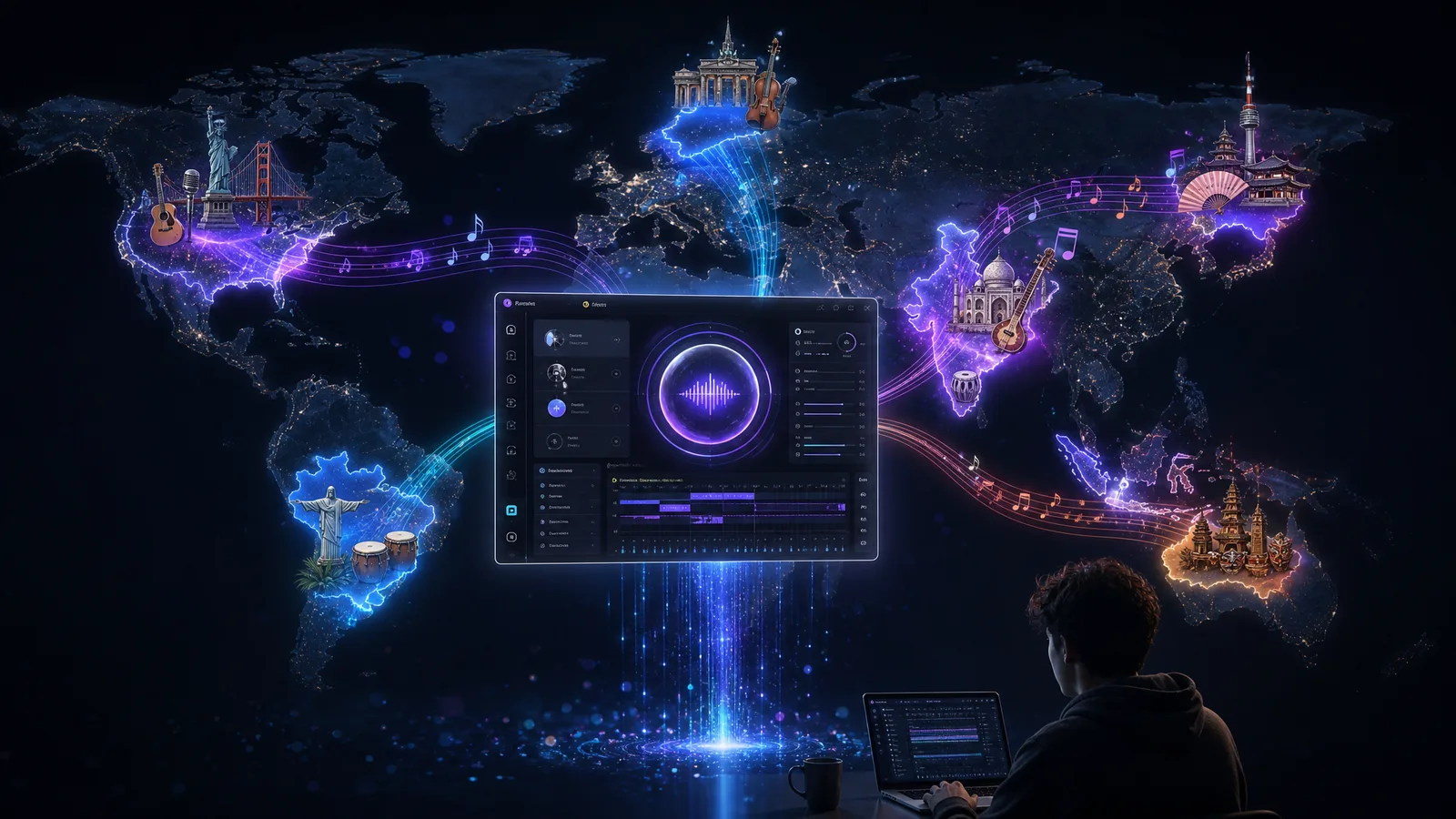
In just a few years, making music with AI went from a niche experiment to a global habit. Leading platforms now generate millions of songs a day, and the creators behind them are spread across every continent. But usage isn't even — some countries have embraced AI music far more than others. Using download shares, web-traffic data, and market research, here's a data-backed ranking of the top 6 countries using AI music in 2026, and what's driving them.
The Big Picture: A Global Explosion
Before the rankings, three numbers set the scene for just how fast this space is moving:
- $6.65B — global AI music market size in 2025, projected to reach $60B+ by 2034 (~27.8% annual growth).
- ~7M — songs generated per day across leading platforms like Suno, Udio, and MuseGen — a signal of mass, everyday creation.
- ~30M — downloads racked up by leading apps such as Suno, Udio, and MuseGen, spread across a fast-globalizing user base.
Roughly a third of users are now outside North America, and the fastest-growing regions — South Korea, India, and Brazil — point to where the next wave is coming from. Let's break it down country by country.
How we ranked this: there is no single official "AI music adoption index." This ranking blends the best public signals available — app-download share, website-traffic share, and market/industry research — into a directional picture. Different sources measure different things (installs vs. site visits vs. surveys), so treat the order as an informed synthesis, not a precise leaderboard.
The Top 6 Countries Using AI Music in 2026
#1 — United States
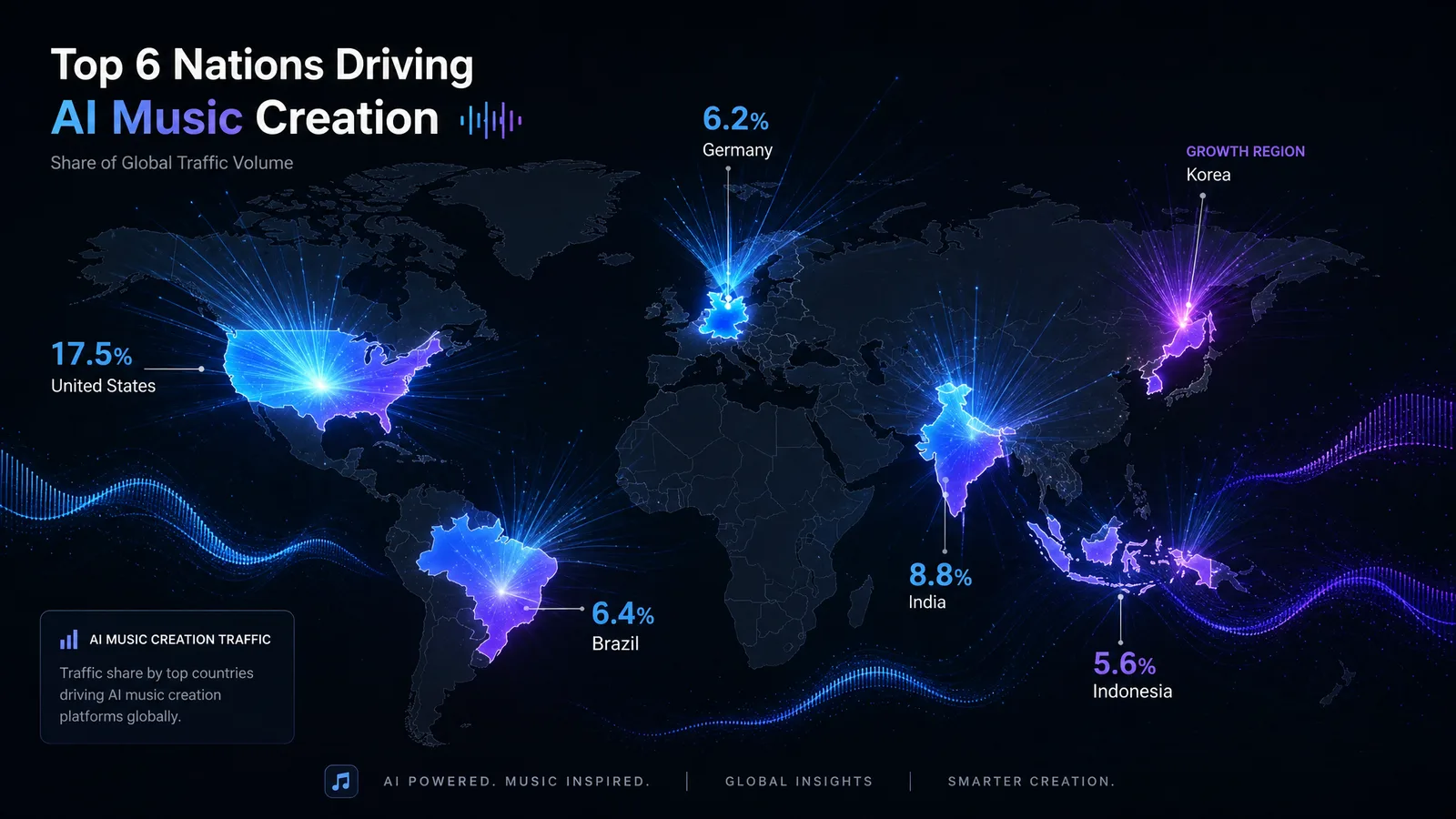
The US is the clear front-runner. It accounts for roughly 15% of Suno's app downloads and the largest single slice of web traffic (about 17.5%) to leading AI-music platforms such as Suno, Udio, and MuseGen. A deep creator economy, an enormous short-form-video culture, and early access to new tools make the US the biggest single market — and the loudest testing ground for what goes viral.
#2 — India
India is the standout growth story. It's consistently the second-largest market — around 13% of app downloads and, on some third-party platforms, even the number-one source of traffic. A massive, mobile-first, young population and a vibrant film-and-music culture make AI music creation a natural fit. India isn't just adopting; on some measures it's leading.
#3 — Brazil
Brazil rounds out the global top three by web traffic (roughly 6.4%) and is repeatedly named among the fastest-growing regions. Brazil's deep musical heritage — from funk to sertanejo — meets an intensely social, meme-driven internet culture, and the result is a booming community of AI-music creators.
#4 — Germany
Germany is Europe's frontrunner, contributing around 6% of web traffic to top platforms. It also anchors much of the industry's serious debate: German bodies like GEMA have driven landmark research and legal discussion on AI, copyright, and fair compensation — a sign of a market that's adopting AI music and thinking hard about its rules.
#5 — Indonesia
Indonesia is a rising powerhouse, drawing roughly 5.6% of web traffic and frequently appearing high on third-party usage charts. As one of the world's largest social-media and mobile-internet populations, it's a textbook example of how AI music creation spreads fastest where phones are the primary computer.
#6 — South Korea
South Korea may not top the raw traffic charts, but it leads on ambition and integration. It's repeatedly cited among the top growth regions, and it's pioneering the most radical mainstream uses of AI in music — including AI-assisted and virtual K-pop acts. Where other countries experiment, Korea is building AI music into its entertainment industry.
At a Glance: Adoption Signals by Country
A side-by-side view of the strongest public indicators. Because sources measure different things, the numbers aren't directly comparable — but the pattern is clear.
| Country | App download share | Web-traffic share* | Why it's growing |
|---|---|---|---|
| United States | ~15% | ~17.5% | Creator economy + viral short-form culture |
| India | ~13% | ~8.8% | Mobile-first, young, huge music culture |
| Brazil | — | ~6.4% | Musical heritage + social-first internet |
| Germany | — | ~6.2% | Europe's leader; strong industry engagement |
| Indonesia | — | ~5.6% | Massive mobile + social-media base |
| South Korea | — | growth region | Virtual idols; deep industry integration |
*Web-traffic share figures reflect visits to a leading AI-music platform and are directional, not a definitive per-country adoption rank.
What's Driving Adoption Where It's Highest
Look across the leaders and the same four forces keep showing up:
- Mobile-first populations. In India, Indonesia, and Brazil, the phone is the primary creative device — and browser-based AI music tools thrive there.
- Short-form video culture. Wherever TikTok, Reels, and Shorts dominate, demand for original, royalty-free background music explodes.
- Young, online, creative demographics. The heaviest users skew young and social, treating song-making as a form of self-expression and memeing.
- Deep local music traditions. From K-pop to sertanejo to Bollywood, strong musical cultures give AI tools a rich starting point — and an eager audience.
Beyond Geography: Who's Actually Creating
Adoption isn't only about where — it's about who and what. A few patterns cut across borders:
- Producers lead. AI adoption is highest among electronic and hip-hop/rap producers, with pop and hip-hop together making up nearly 45% of AI-generated music.
- Musicians are already in. Surveys suggest around 60% of musicians are already using AI in some part of their workflow.
- Listeners often can't tell. In a blind test across eight countries, 97% of respondents couldn't reliably distinguish AI-generated songs from human-made ones — even as most say they want AI music clearly labeled.
What's Next for Global AI Music Adoption
Today's leaderboard is a snapshot, not a finish line. With a third of users already outside North America and the fastest growth coming from mobile-first markets, the map is tilting toward Asia, Latin America, and beyond. Expect the next surge from populous, young, phone-centric countries where a browser and an idea are all it takes to make a song. The barrier to entry has effectively vanished — and that's exactly why AI music creation is going global.
Join the global wave of AI music creators. Turn an idea into an original, royalty-free song right in your browser — from anywhere on the map. → Try MuseGen
Frequently Asked Questions
Which country uses AI music creation the most?
The United States is the single largest market by both app-download share (~15%) and web traffic (~17.5%) to leading AI-music platforms. India is a very close second and, on some third-party measures, even ranks first — making the US and India the two dominant hubs for AI music creation.
Which countries are adopting AI music the fastest?
Industry reporting repeatedly highlights South Korea, India, and Brazil as the fastest-growing regions. These mobile-first, young, socially-connected markets are where AI music creation is spreading most rapidly right now.
How big is the global AI music market?
The AI music market was valued at about $6.65 billion in 2025 and is projected to reach more than $60 billion by 2034, growing roughly 27.8% per year. On the creation side, one platform alone reportedly generates around 7 million songs per day.
Why is adoption so high in mobile-first countries?
In markets like India, Indonesia, and Brazil, smartphones are the primary computing and creative device. Because modern AI music tools run in a browser with no installs or hardware requirements, they're accessible to huge, young, social populations — which accelerates adoption.
Can listeners tell the difference between AI and human music?
Often not. A blind test across eight countries found 97% of respondents couldn't reliably distinguish AI-generated songs from human-made ones. That said, surveys also show most listeners want AI-generated music to be clearly labeled.
Why isn't China on the list?
Not because China isn't creating AI music — it's a measurement blind spot. This ranking is built from public data on the leading Western platforms (app-download share and website traffic). China has a large, fast-growing AI-music scene, but it runs largely on a separate ecosystem of domestic apps that these global-platform datasets simply don't capture. In other words, China is likely a major player; it's just mostly invisible to the Western-platform metrics this list relies on. Treat the ranking as "top countries on the leading global platforms," not a complete picture of every market on Earth.
Are these country rankings exact?
No — they're a directional synthesis. There's no single official "AI music adoption index," so this ranking blends app-download share, website-traffic share, and market research. Because those sources measure different things, the order reflects the overall pattern rather than a precise leaderboard.