BPM by Genre and Subgenre: The Full Tempo Chart

MuseGen Team
9/16/2026
Search for a BPM chart and you will find forty of them, all confident, none agreeing. One puts techno at 120 to 150 and the next puts it at 120 to 125. One says trap is 140 and another says trap is 70, and both are describing the same records. Meanwhile the genre you actually wanted — pop, rock, whatever you are writing this afternoon — turns out to have a number that nobody can source at all. This chart is built the other way round: every figure below comes from somewhere you can go and check, and the genres that have no defensible figure are named as such rather than filled in.
In short
Genres that were built to be mixed together have real, narrow, checkable tempo ranges. Genres that were not have no such thing, and any chart that gives them one is guessing.
That single division explains almost everything odd about published BPM charts. Dance music has to synchronise a room full of bodies and survive being beat-matched into the record either side of it, so its tempos converge hard — hard enough that a decade of chart data puts nearly half of all entries inside a five-BPM window. A pop song has to do neither, so its tempo is free, and freedom does not produce a range.
- Dance genres cluster, other genres do not. Styles written to be mixed sit in narrow tempo bands. Pop, rock and country have no comparable range, which is why sourced charts leave them out.
- 128 BPM is the centre of gravity. A ten-year study of weekly dance charts found the main peak sitting at 128 BPM, with the narrow 125 to 130 band holding 44 percent of all entries.
- One number can describe two speeds. A track written at 140 can feel like 70. This is why published charts disagree about trap and dubstep by a factor of exactly two.
- The chart is a starting point, not a rule. Check the real tempo of a reference track before committing. A range tells you where people usually sit, not where you have to sit.
Quick facts
- Slowest entry here: Lo-fi hip hop, roughly 70–90 BPM, clustering near 80.
- Fastest entry here: Salsa, roughly 160–220 BPM — and it is not electronic.
- The most crowded value: 128 BPM — 11.3% of a decade of dance chart entries, on its own.
- Where the crowd thins: Above 145 BPM, only 0.5% of those entries.
- Written versus felt: Trap and dubstep are written near 140 and felt near 70.
- What this chart is not: A rule. Ranges are conventions, and they overlap.
The tempo chart
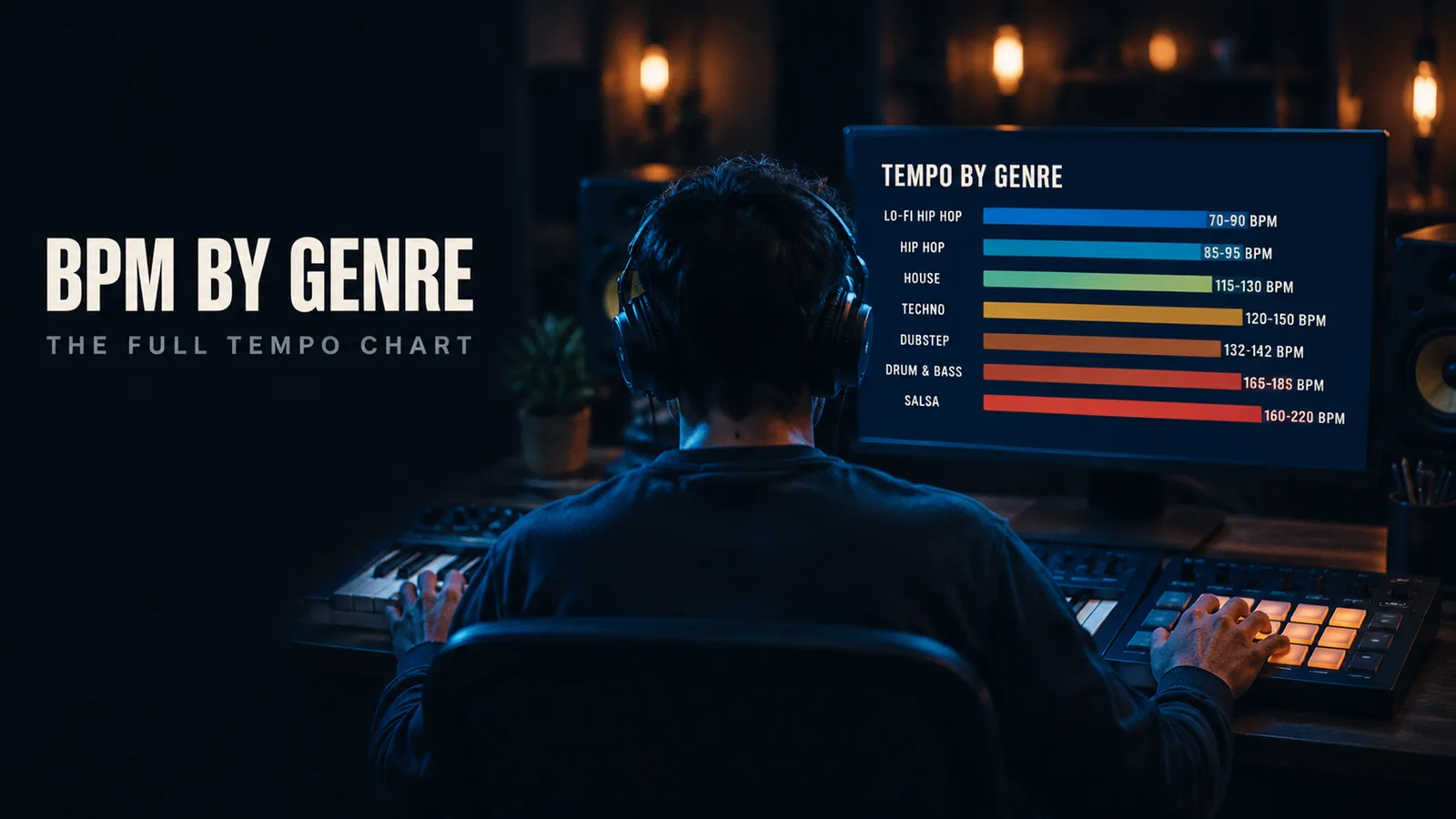
Ordered slowest to fastest by the midpoint of each range, since several entries are wide enough that sorting on the lower bound would scatter them. Every range below is one that a named source actually publishes; where two respectable sources disagree, the disagreement is printed rather than averaged away. If you want the underlying idea of what the number measures, our guide to BPM covers it.
| Genre | Typical BPM | What the sources say |
|---|---|---|
| Lo-fi hip hop | ≈ 70–90 | Clusters near 80; the slow end of anything you will meet |
| Hip hop | ≈ 85–95 | A production-guide figure, not a definitional one — see below |
| Downtempo | ≈ 90 | Defined partly by tempo: deliberately below club speed |
| Glitch hop | ≈ 105–115 | Sits between hip hop's feel and house's pulse |
| House | ≈ 115–130 | One of the few genres where independent sources agree; club tracks land 120–130 |
| Electro | ≈ 128 | Quoted as a single value rather than a range |
| Post-dubstep | ≈ 130 | Defined against dubstep partly by dropping the tempo |
| Speed garage | ≈ 130 | Named for being faster than US garage, which sat at 120 |
| UK garage | ≈ 130–138 | The parent range the garage subgenres all sit inside |
| Techno | ≈ 120–150 | Contested: definitional sources say 120–150, production guides say 120–125 |
| Future garage | ≈ 130–140 | Borrows jungle bass figures written around 170 |
| Nu skool breaks | ≈ 130–140 | Roughly half the drum and bass tempo it split from |
| Dubstep | ≈ 132–142 | Most tracks at 140, with a half-time feel implying about 70 |
| Trance | ≈ 125–150 | Given as 120–150 broadly; recent output has drifted down to 120–135 |
| Trap | ≈ 140 written, 70 felt | Written as low as 50 (100) and as high as 88 (176); typical 70 (140) |
| Hardstyle | ≈ 150–160 | Early records ran 135–150; the modern figure is around 150 |
| Footwork / juke | ≈ 150–165 | Footwork near 160; juke usually given as 150–160 |
| Gabber | ≈ 140–190 | The widest pulse range here; the fast end of four-to-the-floor |
| Jungle | ≈ 170 | Cited only via its bass figures, which are described at 170 |
| Drum and bass | ≈ 165–185 | Mostly 170–180 since about 1996; producers default to 174 |
| Salsa | ≈ 160–220 | The fastest entry here, and the only non-electronic one |
Three things are worth noticing before you use any of it. The rows crowd together between 128 and 142 — ten of the twenty-one entries have their midpoint in that fourteen-BPM window, which is a real fact about dance music and not an artefact of how the table was built. Drum and bass is the entry whose tempo moved furthest within living memory: around 130 BPM in 1990 and 1991, up to 155–165 by 1993, and settled at 170–180 from about 1996 onwards. And the ranges overlap enough that tempo alone will not tell you what you are listening to. A 130 BPM record could be house, techno, trance, post-dubstep, speed garage or nu skool breaks.
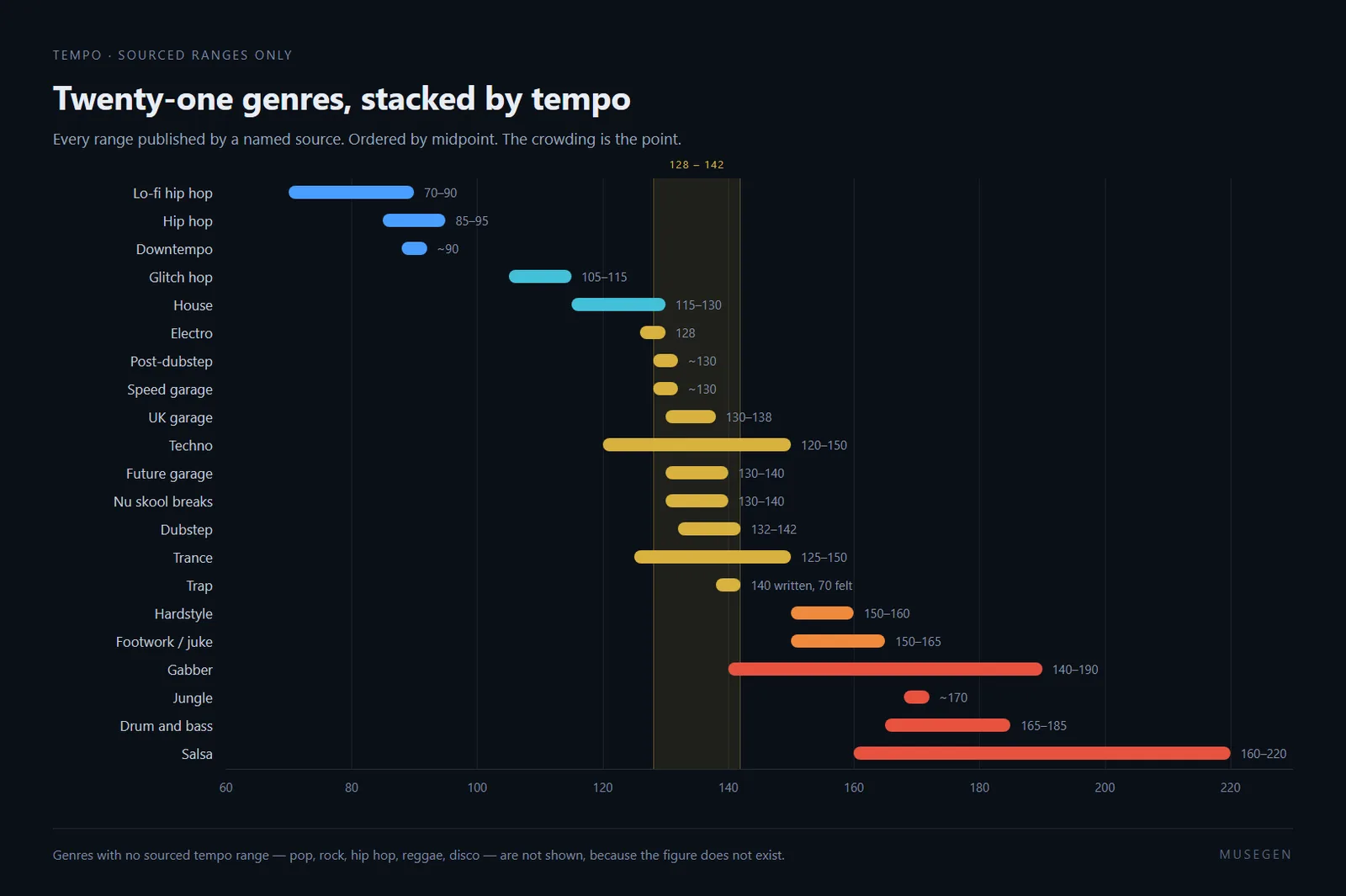
Twenty-one sourced ranges, stacked. The crowding between 128 and 142 is the point.
▶ Watch on YouTube: "Different types of Music Genre and their Typical Tempo BPM" — an outside rundown of the same question this article measures, typical tempo figures genre by genre.
Why genres cluster where they do
The clustering is not fashion, or at least not only fashion. Dirk Moelants at Ghent University took the Scandinavian Dance Charts — a Top 40 updated weekly since 1998 — and analysed ten years of it specifically to separate passing trends from whatever the stable underlying preference was. The distribution is startling: a median of 128 BPM, that single value accounting for 11.3 percent of all entries, 127 to 129 accounting for 27.1 percent, and the band from 125 to 130 holding 44.2 percent of everything charted in a decade. (See Moelants, Hype vs. Natural Tempo, ICMPC 2008.)
Above that peak the numbers collapse. There is a secondary bump around 137 BPM, and then almost nothing: entries at 145 BPM or faster make up 0.5 percent of the data. Ten years of a weekly chart, and one entry in two hundred was quick.
Why 128 specifically? The most durable explanation is that it is close to a resonant frequency of the human body. Work on preferred tempo puts the comfortable rate of spontaneous movement near 2 Hz — two events a second, which is 120 BPM — and human walking research independently lands on the same figure. Music intended to move a room is therefore not free to choose. It has to sit near the rate at which people can move without deciding to, and 125 to 130 is the top edge of that window, fast enough to feel like effort and slow enough to sustain for six hours.
Two other forces push in the same direction. Beat-matching is the practical one: a DJ has to run one record into the next, and a genre whose tracks scattered across forty BPM would be unmixable, so the convention tightens itself with every set played. Equipment history is the accidental one: drum machine defaults, sampler limits and the tempo of whatever the founding records happened to be recorded at all became conventions long after the technical reason expired. Drum and bass runs at 174 partly because that is where the breakbeats being sampled landed once pitched up.
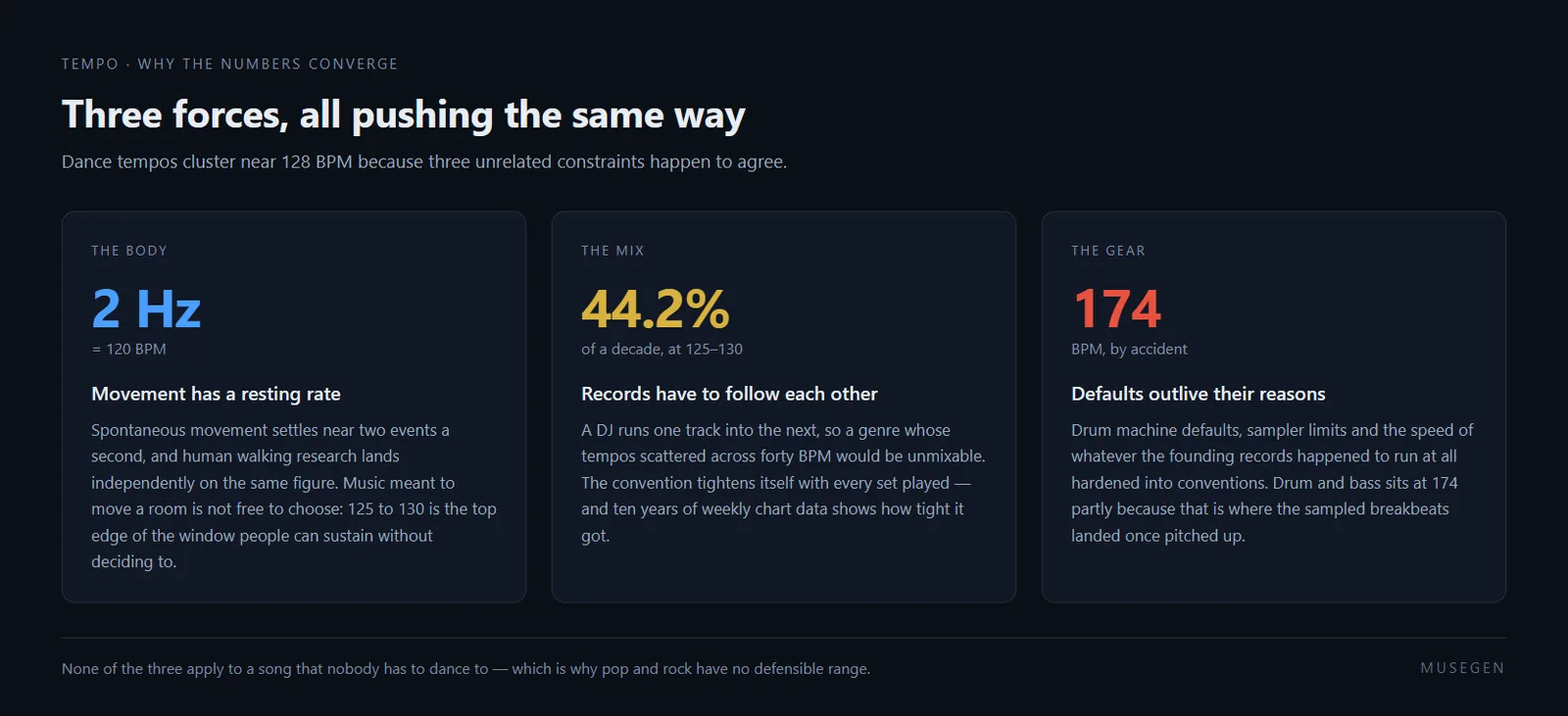
Three forces, all pushing the same way. None of them apply to a song nobody has to dance to.
The genres no chart can honestly list
You will have noticed what is not in the table. Pop, rock, indie, funk, disco, reggae, R&B, country, ambient, bossa nova, drill: all of them appear on other people's BPM charts, and none of them appear here. That is deliberate, and it is the most useful thing on this page.
Those genres have no sourced tempo range because they have no reason to have one. Every force in the previous section — the body's resonance, beat-matching, inherited equipment defaults — applies to music made to be danced to and mixed. A rock band does not need its next song to beat-match the last one. A ballad and an uptempo single can sit on the same album by the same artist, forty BPM apart, and nobody experiences that as a contradiction. Where there is no constraint, there is no convergence, and where there is no convergence there is no honest range to publish.
Check this yourself. The reference works that carry precise tempo figures for house, techno, dubstep, drum and bass and trap carry none at all for hip hop, pop, rock, disco or reggae. It is not an oversight. The figure does not exist to be recorded.
Worse, for pop the target moves. Jason Léveillé Gauvin examined 303 Billboard year-end top-ten singles across three decades and found average tempo rose by roughly eight percent over the period, alongside intros collapsing from over twenty seconds to about five. A number that drifts that far in thirty years is a snapshot, not a property of the genre. (See Léveillé Gauvin, Musicae Scientiae 22(3), 2018.)
The one exception in the table proves the rule from the other side. Salsa is not electronic and not beat-matched, but it does have a sourced range — 160 to 220 BPM — because it is dance music in the older and more literal sense, with specific steps that only work at specific speeds. The constraint is the same constraint. It just arrived a century earlier.
So when a chart hands you "hip hop: 85–95 BPM", read it as what it is: a competent producer's rule of thumb, useful as a starting point, carrying none of the authority of the dance figures next to it on the same page. The 85–95 row is in this table for exactly that reason, labelled as a production-guide figure rather than a definitional one.
The genres named after their tempo
The previous section covered styles with no defensible range. Four rows in the table are the opposite case entirely: styles where the tempo is not a convention that grew up around the music, but part of what the name actually means.
Downtempo, at about 90, says so outright. The word is a comparison to club speed, and a downtempo record at 128 would not be a fast downtempo record; it would be something else. Speed garage, at about 130, was named for being faster than the US garage it came out of, which sat around 120. Nu skool breaks, at 130 to 140, sits at roughly half the drum and bass tempo it split away from — a genre defined by a ratio to another genre's clock. Post-dubstep, at about 130, is defined against dubstep partly by dropping below the 140 that dubstep is built on.
For those four rows the BPM column is doing different work than it does anywhere else in the table. A hip hop record at 105 is a hip hop record at an unusual tempo. A downtempo record at 128 is not a downtempo record. Leaving the range does not make you unconventional; it moves you into a different category, whether or not that was the intention.
There is a catch worth carrying with you, though. A name of this kind records a comparison somebody made at a particular moment, and the moment passes. Speed garage was fast against 120. Today 130 is unremarkable — dubstep sits above it, drum and bass sits more than forty BPM above it, and nothing about the number itself reads as quick any more. The name is still accurate about what it was reacting to and no longer accurate about how the tempo feels. That gap is worth remembering any time a genre name appears to be telling you a speed.
When one number means two speeds
The second reason charts disagree has nothing to do with sourcing. Some genres are written at one tempo and felt at half of it. A dubstep track is programmed at 140 with a snare on beat three rather than beats two and four, which is heard as a groove at about 70. Both numbers are true. Which one a chart prints depends on whether whoever wrote it was thinking like a programmer or like a listener.
Trap is the clearest case, because the reference works actually write both numbers at once — tempos given as "50 (100)" at the slow end, "88 (176)" at the fast end, and "70 (140)" as typical. That parenthetical is a source telling you, in the notation itself, that the question has two correct answers.
This is also why automatic tempo detection sometimes returns exactly half or exactly double what you expected. The mechanism, and what to do about it, is covered in the pillar's section on half-time and double-time. For chart-reading purposes only one consequence matters: when you see 140 in a table, find out whether the genre is felt at 140 or at 70 before you copy the number into anything. A trap beat and a techno record can share a tempo and have nothing else in common.
How to read a published range
The third reason charts disagree is the least obvious, and it is a reading skill rather than a fact about music. A range has two ends, and the two ends are almost never the same kind of statement.
The lower bound is usually definitional. It marks where a style stops being itself, and whoever drew it had every incentive to reach low enough that no genuine record gets excluded — the early ones, the slow ones, the outliers everybody agrees belong. House is given as 115 to 130 for exactly that reason. 115 is not where house happens; it is where house stops.
The upper bound is usually descriptive. It marks roughly where records stop appearing, which is a claim about output rather than about identity, and it moves as the music moves. Techno's 150 and gabber's 190 are both of that kind: the outer edge of what has been released under the name, not a second centre of gravity.
Two consequences follow, and between them they are most of what this chart is for.
The midpoint of a range is not the middle of the genre. Split 115 to 130 and you get 122.5, while ten years of weekly dance chart data put the peak at 128. Split gabber's 140 to 190 and you get 165, which describes very few gabber records. A midpoint is an arithmetic accident of where two different kinds of bound happened to land, and it is the single most common way a good chart gets misused.
Width tells you about the source as much as about the genre. A fifty-BPM range is rarely a genre that genuinely spans fifty BPM; far more often it is a definitional source stretching to cover everything that has ever carried the name. So when a production guide gives something much narrower for the same genre — techno at 120 to 125 against a definitional 120 to 150 — the two are not really in conflict. One is protecting the edges of a definition, the other is describing where the records are. That single difference in purpose is behind most of the disagreements you will find between published BPM charts, including the two-source rows on this page.
How to actually use the chart
Treat it as a starting point, then measure. A range describes a population; you are writing one track. The genuinely reliable move is to take two or three reference records you want to sit alongside and find their actual tempo, which takes a minute with a BPM detector and settles the question for your specific corner of a genre rather than for the genre as a whole.
Expect the subgenre to beat the genre. The spread inside a parent genre is frequently wider than the gap between two neighbouring genres. UK garage covers 130 to 138 while its speed garage branch sits at 130 and its future garage branch reaches 140 — and the whole family overlaps house and techno on one side and dubstep on the other. If your reference is a subgenre, use the subgenre's number.
Do not average a contested range. Techno is given as 120 to 150 by definitional sources and 120 to 125 by production guides. Splitting the difference at 135 produces a tempo neither source is describing. Pick the source whose purpose matches yours: if you are trying to sound like current club techno, the production guide is closer to what is actually being released.
Leave the range on purpose or not at all. Sitting outside a convention is a legitimate decision and occasionally the entire idea — but only when you know the convention you are leaving. Being at 118 because you never checked is different from being at 118 because 128 felt frantic for the song you are writing.
What a range is for. It tells you where the crowd is standing, not where you have to stand. It exists so records can be played next to each other — so it binds you exactly as much as that matters to your track, and no more.
Turning a chart number into a track
Everything above is a number you look up. Tempo happens to also be the one you can hand over before a note exists — which makes it unusually cheap to get right and unusually expensive to leave to chance. MuseGen splits that into two steps: measure the number, then write it into the prompt.
The measuring half is MuseGen's Detect BPM: feed it a reference track that sits where you want to sit and you get a figure from an actual record rather than an estimate from a chart. The writing half is the MuseGen AI Song Maker, where that figure goes straight into the description — "Deep house, 124 BPM, warm analogue pads, restrained vocal" constrains the tempo in a way that "deep house, chilled" does not. Tempo is the one variable where being specific costs you nothing in character.
It matters more than it looks, because tempo is the hardest thing to change afterwards. Nearly everything else about a generated track can be addressed by regenerating with a different description. Speed is structural: it is the grid the arrangement was written against, and stretching a finished piece to a different tempo audibly damages it. Deciding the number before you generate — which is the whole reason MuseGen puts the detector and the generator in one place — is not perfectionism, it is the cheapest decision available.
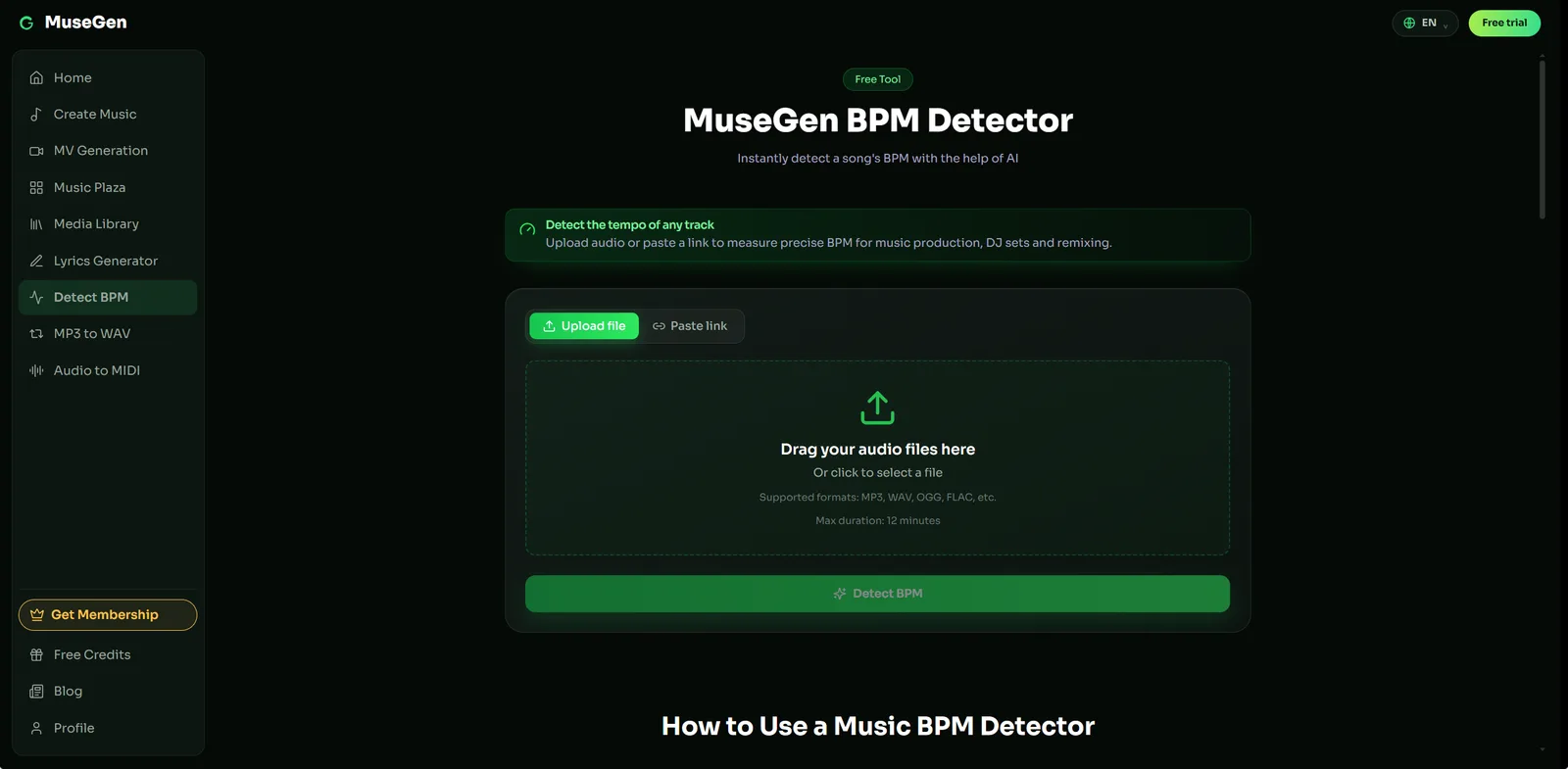
Detect BPM: a measured figure from an actual reference, not a range from a chart.
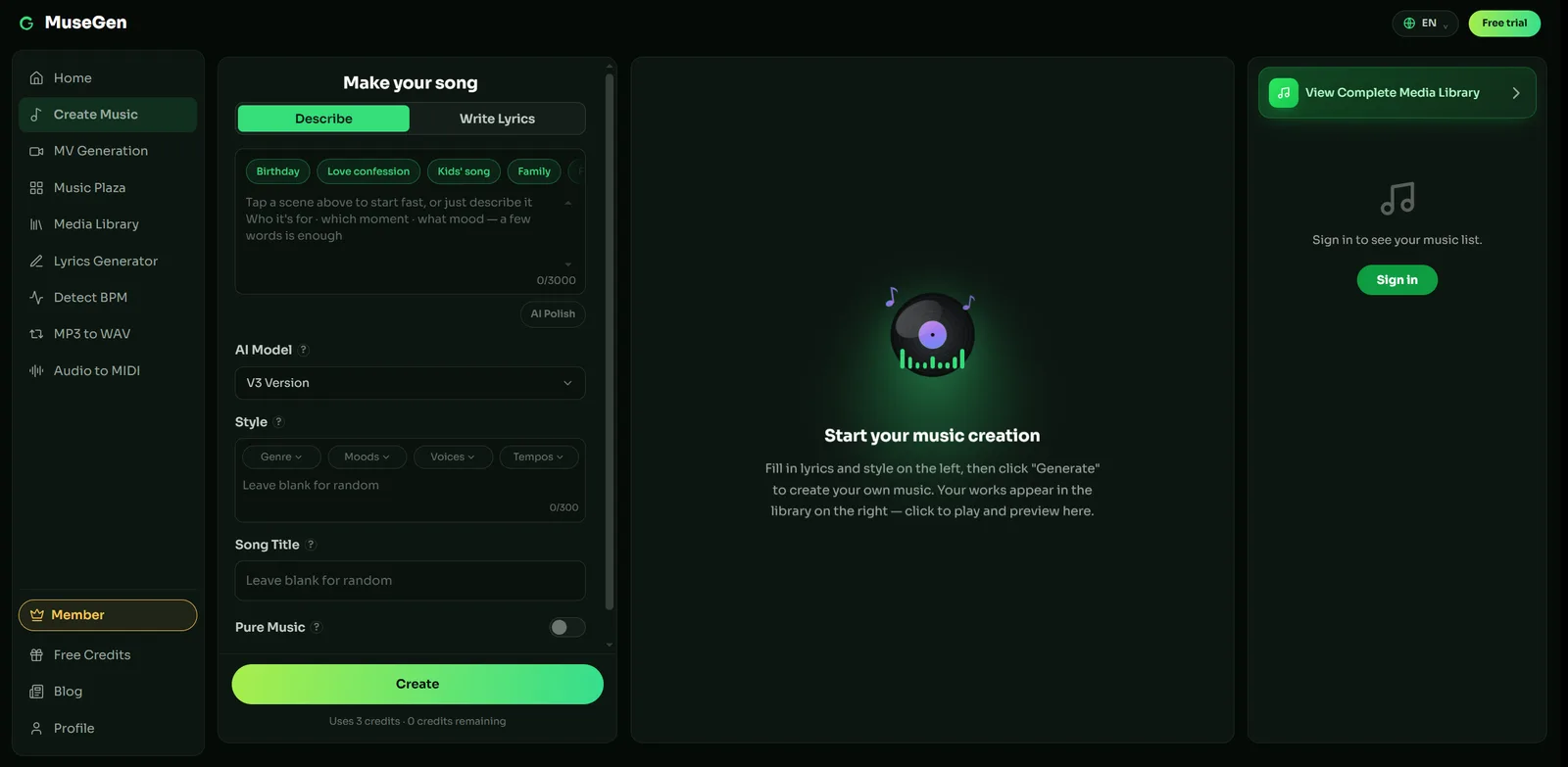
AI Song Maker: the tempo goes into the description, before anything is generated.
Set the tempo before you set anything else. Measure a reference track, then write that number into the prompt — try MuseGen.
FAQ
What BPM is most music?
Most music people listen to falls between roughly 60 and 180 BPM. Within dance music the spread is far tighter. A study of ten years of weekly dance charts found a median of 128 BPM, with 44 percent of all entries sitting in the narrow band between 125 and 130.
What is the most common BPM in dance music?
128 BPM. Dirk Moelants analysed ten years of weekly dance chart data and found the peak stayed at 128 throughout, with that single value accounting for 11.3 percent of all entries and the 125 to 130 band for 44.2 percent. The distribution falls away sharply above it: only 0.5 percent of entries were at 145 BPM or faster.
What BPM is EDM?
EDM is not a tempo, it is an umbrella. The styles under it in this chart run from house at 115 to 130 BPM up to drum and bass at 165 to 185, with techno given as 120 to 150 and dubstep at 132 to 142. If you need one number to start from, 128 is the safest: ten years of weekly dance chart data put the peak there.
What BPM is house music?
House is usually given as 115 to 130 BPM, and this is one of the few genres where independent sources agree. Wikipedia's definition and iZotope's production guide give the same 115 to 130 figure, with most club-oriented tracks landing between 120 and 130.
What BPM is drum and bass?
Drum and bass is typically 165 to 185 BPM, and since around 1996 the bulk of releases have stayed in the 170 to 180 range. Producers often quote 174 as the default. The earliest material was far slower, around 130 BPM in 1990 and 1991.
What BPM is pop music?
There is no reliable figure, which is why this chart leaves pop out. Pop has no tempo convention because nothing imposes one: it does not have to mix with other records and it is not written to be danced to at a fixed speed. It also moves. A study of 303 Billboard year-end top-10 singles found tempo rose about 8 percent over thirty years, so any single number would be a snapshot of one decade.
Why do two BPM charts give different numbers for the same genre?
Two reasons. Some genres are written at one tempo and felt at half that, so a chart may print 140 where another prints 70. And most published ranges are editorial rather than measured, so they reflect whoever wrote them. Techno is given as 120 to 150 in one source and 120 to 125 in another.
Should I stick to my genre's BPM range?
Only if you need the track to work alongside others in that genre, which is what the ranges exist for. If nothing has to mix with it, the range is a convention rather than a requirement. Start inside it, then move deliberately once you know what the convention is buying you.
Related reading
- What Is BPM? — what the number measures, and why detectors report half or double.
- What Is Lofi Music? — the slowest row in the table, in detail.
- How to Make AI Song Mashups — what to do when two tracks are not at the same tempo.
- What Is Arrangement in Music? — the decisions that come after the tempo.
Sources
- Dirk Moelants — Hype vs. Natural Tempo: a Long-term Study of Dance Music Tempi (ICMPC 2008, Ghent University) for the 128 BPM peak and the decade-long distribution.
- Jason Léveillé Gauvin — Drawing listener attention in popular music, Musicae Scientiae 22(3) for the drift in pop tempo over thirty years.
- iZotope — Using Different Tempos To Make Beats For Different Genres for the production-guide ranges.
- Wikipedia — House music for the 115–130 house range.
- Wikipedia — Techno for the contested 120–150 techno range.
- Wikipedia — Dubstep for the 132–142 figure and the half-time feel.
- Wikipedia — Trap music for the written-versus-felt trap tempos.
- Wikipedia — Drum and bass for the 165–185 range and its history.
- Wikipedia — UK garage for the parent garage range.
- Wikipedia — Hardstyle for the hardstyle figure.
- Wikipedia — Footwork (genre) for footwork and juke tempos.
- Wikipedia — Salsa music for the 160–220 salsa range.