The Ultimate Guide to AI Music Prompts: Templates, Formula & Examples (2026)

MuseGen Team
9/10/2026
The trouble with a page of prompts is that it looks like a page of answers. It is not. Every line below is somebody else's first draft, with the boring decisions already made so your attention goes to the two or three that are yours. Copy the closest one, then read section three.
In short
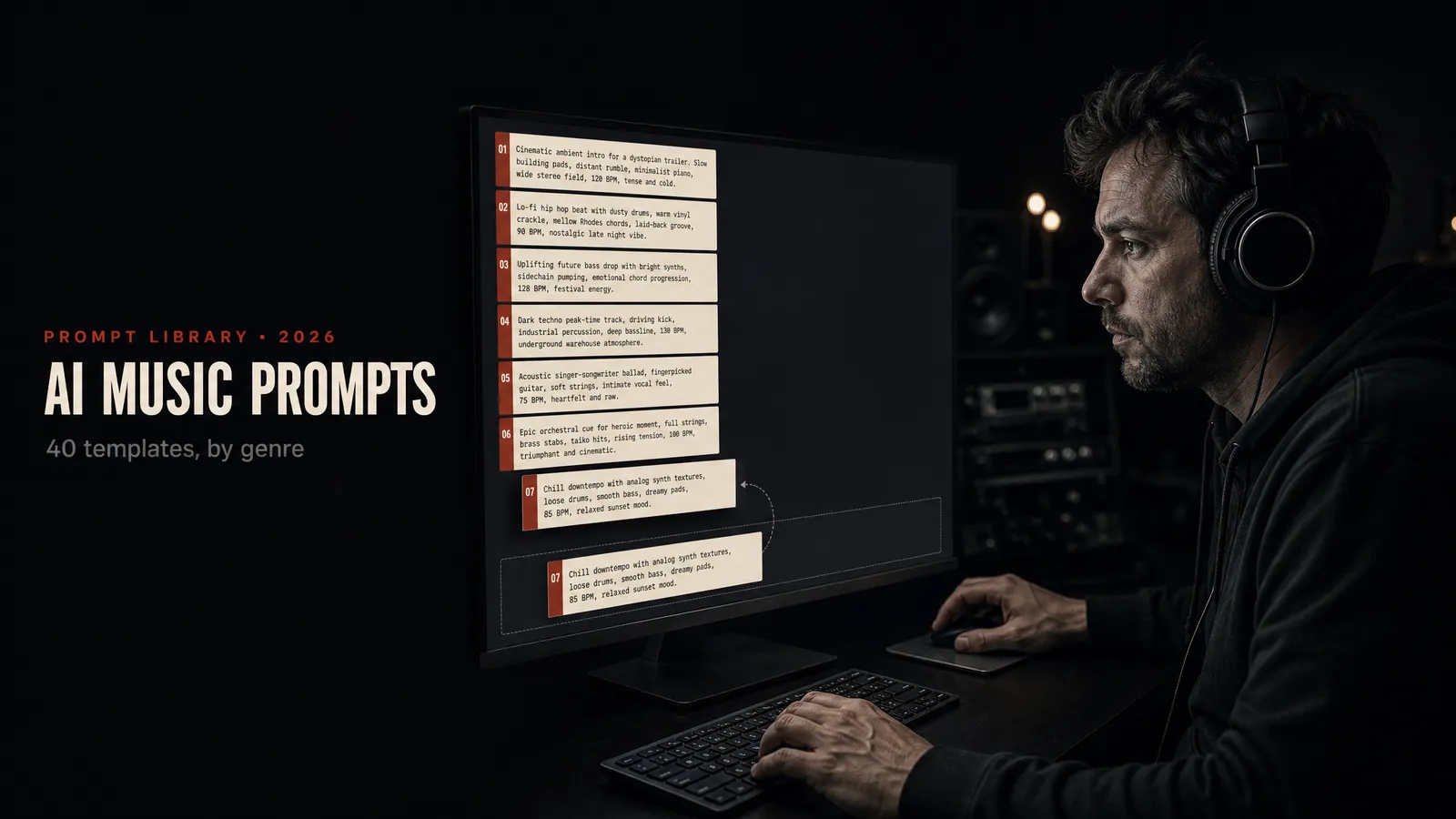
Forty prompts, grouped by what the genre asks a prompt to do rather than by alphabet. Find your family, take the nearest line, and treat it as a draft rather than a setting.
- Hip-hop and R&B. Built around the drum feel: swing, spacing, and how hard the low end sits.
- Electronic and dance. Tempo and production carry the track; the arrangement is a series of entrances.
- Guitar and rock. Amp character, and how many guitars are playing at the same time.
- Jazz, funk and soul. Who solos, who comps, and how loose the time is allowed to be.
- Folk and acoustic. Named instruments and the room they were recorded in, rather than a mood.
- Latin and global. The rhythm pattern, not the genre name, is the load-bearing clause.
- Pop and synth. Cast the vocal first, then build the production around the voice.
- Classical and ambient. No drums, so register and pace have to do the work instead.
Quick facts
- What is here — Forty prompts, eight families, five in each, none reused from our other pages.
- Length of each — Around forty words across six slots. Specific enough to bite, short enough to survive.
- The formula — One line in section two. The long version links out rather than repeating itself.
- How to use them — Paste as written, then change three things. Section three says which three.
- Not on this page — Artist-name translations, which most tools filter anyway, and the metal, country and C-pop families, which are in the MuseGen prompt library.
- Accurate as of — September 2026. How a prompt is parsed shifts with every model release.
The template all forty are built on
Every line here answers the same six questions in the same order. That matters when you want to edit one, because editing means finding the clause that holds what you want to change.
The shape of every prompt below
[genre, plus one qualifier], [BPM] and [feel]. [What leads], then [what each other part does]. [Who sings, or instrumental]. [How it was recorded, and when]. [Duration], [final gesture].
Six slots, front-loaded. Genre and tempo lead because early clauses carry more weight than late ones. The ending comes last because almost nobody writes it, which is why almost everything fades out.
That is the entire formula section, on purpose. Why each slot exists, and what to write in it when you are stuck, is the subject of two other pages: the six-slot prompt formula has a lookup table for every slot, and our eight rules for writing AI music prompts covers the reasoning underneath. For scoring to picture rather than writing a song, the cinematic prompt guide narrows the same template to scene work.
What none of them gives you is a stack of finished lines to steal. That is the rest of this page.
Watch: "How to Prompt LITERALLY EVERY Genre in Suno AI" — a genre-by-genre walkthrough in one AI music tool, organised the same way this library is.
Before you copy: the three things to change
A library has an obvious failure mode. Paste a line unedited and you get a competent, anonymous version of that genre — which is what it was written to produce, because it had to work for everyone. Three edits usually pull it somewhere specific, and they are always the same three.
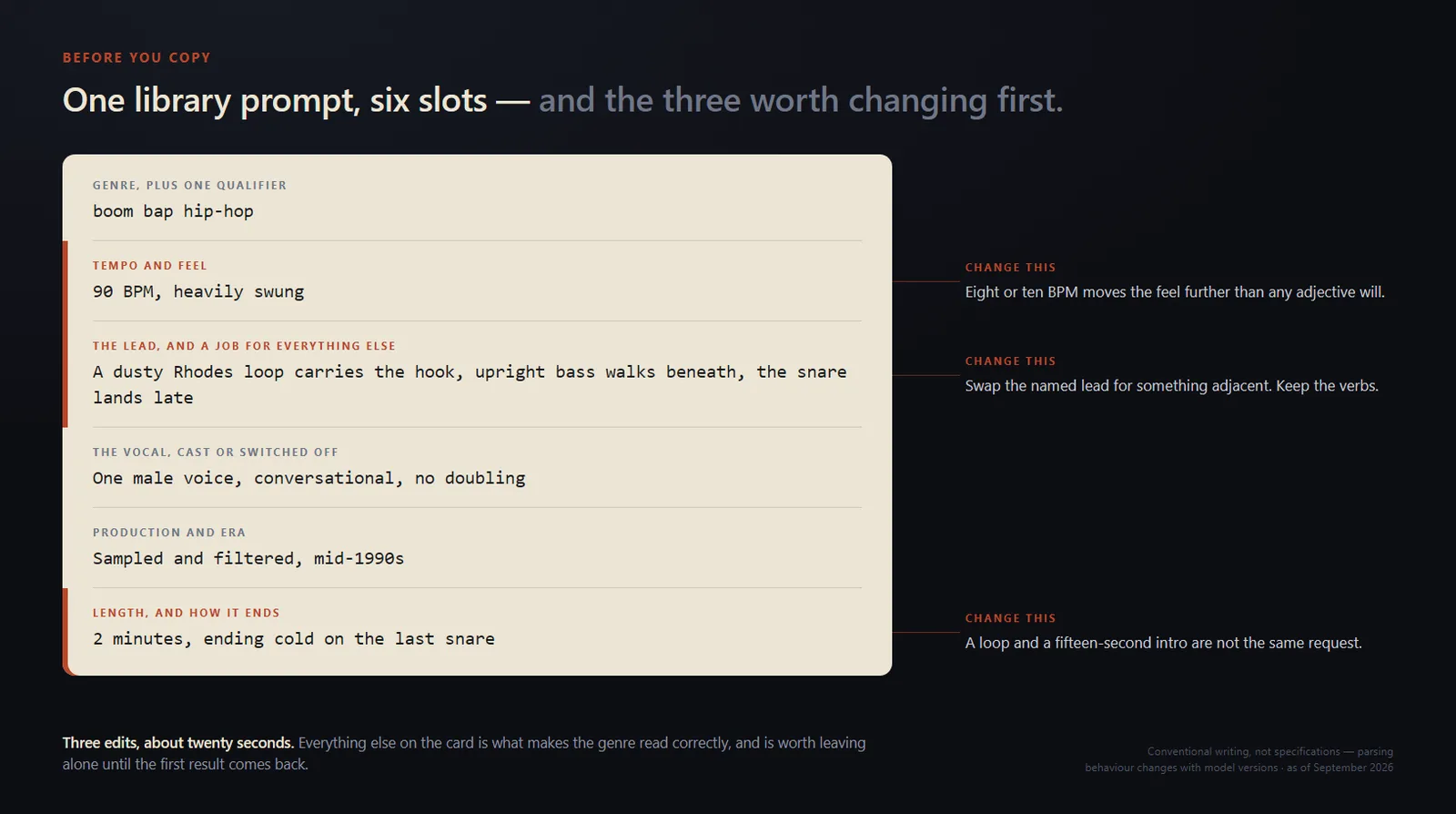
The three tagged slots are the ones that move the result furthest for the least typing.
The tempo. Every number below sits in the middle of its genre's range, which is the safest choice and therefore the most generic. Moving it eight or ten BPM changes the feel more than any adjective will: the same instrumentation at 96 sounds unhurried and at 108 sounds busy. To sit alongside an existing track, run it through BPM detection rather than estimating, because guesses cluster low.
The lead instrument. This clause decides what the track sounds like from the first bar, and it is the one every copy of the prompt shares. Swapping the named lead for something adjacent — a clarinet where the line says flute, a baritone guitar where it says electric — keeps the genre intact while making the surface unlike everyone else's.
The length and the ending. Both are written here as a duration plus a final gesture, and both are worth setting deliberately, because a track that runs under a two-minute video and a track that has to loop are not the same request. The ending is the slot people skip, and skipping it hands you a fade.
One thing not to change: the roles. If a line says the bass walks and the piano comps, keep the verbs when you swap instruments. An instrument list with no jobs attached reads as everything playing at once, which is why detailed prompts come back as walls of sound.
Hip-hop and R&B prompts
These five are about the drums. The genre word matters less than the swing, the spacing and how much room the low end gets. Delivery is the second lever: half-sung, conversational and clipped are three records over one beat. Of the three edits in section three, tempo is the one to make first here: eight BPM either way, or swung to straight, moves these further than a new instrument will. Swap the lead once the drums feel right, because nothing sitting on top of them sounds right until they do.
Boom bap · 90 BPM
boom bap hip-hop, 90 BPM, heavily swung. A dusty Rhodes loop carries the hook, upright bass walks beneath, the snare lands late. One male voice, conversational, no doubling. Sampled and filtered, mid-1990s. 2 minutes, ending cold on the last snare.
Tuned for the late snare. Swap the Rhodes for a muted horn.
Drill · 140 BPM
UK drill, 140 BPM, sliding 808 and skittering hi-hats. The 808 carries the melody, a thin bell figure answers, sparse pads underneath. One male lead, half-sung and clipped. Dark and dry. 2 minutes 30, ending on a filter sweep.
Tuned for the 808 slide. Swap the bell for plucked strings.
Phonk · 130 BPM
phonk, 130 BPM, half-time drum feel. A detuned cowbell melody leads, a distorted 808 slides underneath, a filtered vocal chop returns every four bars. Instrumental apart from the chop. Saturated and tape-warped. 90 seconds, ending on a hard stop.
Tuned for the saturation. Swap the cowbell for a detuned organ.
Alternative R&B · 68 BPM
alternative R and B, 68 BPM, behind the beat. Muted guitar carries the chords, sub bass holds long notes, brushed drums stay quiet. One female lead, breathy, harmony only in the chorus. Wide and reverberant. 3 minutes, ending on a held chord.
Tuned for the space around the voice. Swap the guitar for electric piano.
G-funk · 96 BPM
G-funk, 96 BPM, laid-back shuffle. A high portamento synth lead sits on top, funk bass carries the groove, a talkbox answers each phrase. One male lead, relaxed and low in the mix. Bright and analogue. 3 minutes, fading on the lead.
Tuned for the portamento lead. Rewrite the ending first, since it fades.
Electronic and dance prompts
Dance prompts are structural: what separates them is when things arrive and when they leave. Duration is load-bearing, so the same instructions at ninety seconds and at six minutes produce different arrangements. Which makes the length and ending clause the first edit in this family rather than the last. Move an entrance by fifteen seconds, or halve the duration, and the same words come back arranged differently. The lead synth is worth changing only once the shape is right.
UK garage · 134 BPM
UK garage, 134 BPM, two-step with a shuffled hi-hat. A chopped vocal sample carries the hook, sub bass answers on the offbeat, the kick skips the second beat. Female chops only. Crisp and tightly compressed. 4 minutes, ending on the drums alone.
Tuned for the skipped kick. Change the length first for a loop.
Amapiano · 112 BPM
amapiano, 112 BPM, patient and rolling. A log drum carries the bassline, soft piano chords sit above it, shakers keep the pulse steady. One male voice, spoken and sparse, entering after the first minute. Warm and open. 5 minutes, fading out.
Tuned for the late vocal entrance. Move that entry point in minutes.
Psytrance · 145 BPM
psytrance, 145 BPM, driving and relentless. A rolling triplet bassline carries the track, an acid lead builds across sixteen bars, pads open out in the breakdown. Instrumental. Dry, tight, heavily sidechained. 4 minutes, ending abruptly after the final drop.
Tuned for the sixteen-bar build. Change the bar count to repace it.
Jersey club · 136 BPM
jersey club, 136 BPM, triplet kick pattern throughout. A pitched vocal chop is the main melody, a squeak sample punctuates every bar, bass hits stay short. Chopped vocals only, no sustained singing. Loud and unsubtle. 2 minutes, ending on a single chop.
Tuned for the triplet kick. Swap the chop source for a horn stab.
Ambient techno · 126 BPM
ambient techno, 126 BPM, steady and unhurried. A four-on-the-floor kick holds the pulse, a detuned pad drifts above it, one delayed blip answers every other bar. Instrumental. Dubby, no sharp transients. 6 minutes, ending as the kick drops and the pad decays.
Tuned for the decay at the end. Swap the pad for a bowed drone.
Guitar and rock prompts
Ask for guitars and you get an undifferentiated wall of them. So these five say how many there are, what each is doing, and what the amp sounds like — which is what separates subgenres that share every other word. This is also the one family where a fourth slot outranks all three of the usual edits: change the amp before anything else. Clean to cranked, or two guitars down to one, does more than a tempo move, and tempo is the last thing to touch here rather than the first.
Post-punk · 152 BPM
post-punk, 152 BPM, urgent, driving eighths. A chorused bass carries the main riff, one clean guitar plays sparse high figures, drums stay tight. One male lead, flat and deadpan, doubled in the chorus. Thin and dry. 3 minutes, ending on a hard stop.
Tuned for the bass-led riff. Change deadpan to shouted.
Stoner rock · 76 BPM
stoner rock, 76 BPM, heavy and dragging. Two fuzzed guitars play the same riff an octave apart, bass doubles them, drums hit hard and leave gaps. One male lead, buried and reverb-soaked. Thick and murky. 5 minutes, ending on a long feedback tail.
Tuned for the octave doubling. Drop ten BPM for more weight.
Math rock · 168 BPM
math rock, 168 BPM in shifting odd meters. Two clean tapped guitars interlock, bass follows one of them and not the other, drums accent the changes rather than the beat. Instrumental. Bright, close, almost no distortion. 4 minutes, ending mid-phrase.
Tuned for the interlock. Change the meter if it returns too even.
Surf rock · 160 BPM
surf rock, 160 BPM, fast with a driving tom pattern. A heavily reverbed tremolo-picked guitar carries the melody, a second guitar chugs behind it, upright bass keeps time. Instrumental. Wet spring reverb, mono, early 1960s. 2 minutes 15, ending on a crash.
Tuned for the spring reverb. Swap the lead for a baritone guitar.
Grunge · 94 BPM
grunge, 94 BPM, sludgy and mid-paced. One guitar alternates between clean verse chords and a cranked chorus riff, bass follows the root, drums are loose and heavy. One male lead, strained and unpolished. Roomy and compressed. 3 minutes 30, ending on a ringing open chord.
Tuned for the clean-to-cranked switch. Tighten or loosen the drums.
Jazz, funk and soul prompts
These are the prompts where roles matter most. Each names a soloist and says what everyone else does meanwhile, because the instruments barely change across five very different results. So the lead is the first edit here, and it is a larger one than it looks: handing the solo from a horn to a piano rewrites what every other part is doing underneath it. Change who is soloing before you change how fast.
Hard bop · 210 BPM
hard bop, 210 BPM, swung and fast. Trumpet and tenor sax state the head in unison, then trade solos while piano comps sparsely and upright bass walks four to the bar. Instrumental. Close and dry, 1958. 4 minutes, ending on a restated head.
Tuned for the unison head. Swap the horns for sax and vibraphone.
Jazz fusion · 108 BPM
jazz fusion, 108 BPM, syncopated and busy. An electric piano carries the theme, fretless bass moves constantly underneath, drums play ghost notes between the backbeats, a guitar solos in the middle. Instrumental. Clean and wide, mid-1970s. 5 minutes, ending unresolved.
Tuned for the ghost notes. Move the solo from guitar to synth.
P-funk · 102 BPM
P-funk, 102 BPM, deep in the pocket. A slap bass carries the groove, clavinet answers on the offbeats, a horn section punctuates each phrase, drums stay loose. Group vocals, call and response. Warm and overdriven. 5 minutes, fading on the groove.
Tuned for call and response. Swap the horns for synth brass.
Disco · 118 BPM
disco, 118 BPM, four-on-the-floor with an open hi-hat offbeat. A string section carries the hook, octave bass drives underneath, rhythm guitar plays sixteenth-note chops. One female lead with a backing chorus. Lush and layered, 1978. 4 minutes 30, ending on a strings-only tag.
Tuned for the octave bass. Swap the strings for a synth hook.
Cool jazz · 82 BPM
cool jazz, 82 BPM, relaxed and behind the beat. A muted trumpet carries the melody, piano comps very sparsely, brushed drums and upright bass keep time barely present. Instrumental. Warm and distant. 4 minutes, ending on a single held note.
Tuned for restraint. Swap the trumpet for flugelhorn or clarinet.
Folk and acoustic prompts
Acoustic prompts live or die on named instruments and a named room. A genre word alone pulls in defaults a century and a continent from what you meant. The same trio close-miked and in a stone hall are two records. So change the room before the tempo. It costs four words and it is the largest single move available in this family. The instrument swap is second, and the number at the front barely matters until both of those are settled.
Celtic reel · 106 BPM
celtic reel, 106 BPM, lively with a steady driving pulse. A fiddle carries the tune, tin whistle doubles it on the repeat, bodhran and guitar keep the rhythm underneath. Instrumental. Close-miked and warm, a live-in-the-room sound. 3 minutes, ending on a unison note.
Tuned for the doubled repeat. Swap the whistle for concertina.
Old-time · 116 BPM
old-time string band, 116 BPM, steady and unswung. Clawhammer banjo drives throughout, fiddle carries the melody high, guitar plays bass runs between chords. Instrumental, or one plain unaccompanied voice. Mono and roomy, a single microphone. 2 minutes 30, ending abruptly.
Tuned for the single-mic sound. Swap the banjo for mandolin.
Nordic folk · 64 BPM
nordic folk, 64 BPM, slow and modal. A nyckelharpa carries the melody, a low drone holds underneath, a frame drum enters halfway and stays quiet. One female voice, unadorned and low. Cold and spacious, natural hall reverb. 4 minutes, ending as the drone fades.
Tuned for the drone. Move the drum entry earlier, or cut it.
Fingerstyle guitar · 78 BPM
fingerstyle acoustic guitar, 78 BPM, gentle and rubato. A single steel-string guitar carries melody and bass at once, an upright bass shadows it quietly from the second minute, no drums. Instrumental. Close and intimate, string noise audible. 3 minutes, ending on a harmonic.
Tuned for the audible string noise. Move the bass entry, or remove it.
Americana · 84 BPM
americana, 84 BPM, loping with a brushed backbeat. Acoustic guitar and dobro trade the lead, upright bass keeps time, pedal steel holds long notes behind. One weathered male voice, female harmony on the last chorus. Dry and wooden. 3 minutes 30, ending on a strum.
Tuned for the traded lead. Swap the dobro for fiddle or mandolin.
Latin and global prompts
A genre name here returns an average of everything filed under it. What narrows the result is the rhythm pattern, so each of these five describes the pattern rather than trusting the label. Edit that description rather than the tempo. Most of these sit inside a narrow band where eight BPM does very little, while a rewritten pattern clause changes everything downstream of it. The lead is the second edit, and the number is the third.
Cumbia · 92 BPM
cumbia, 92 BPM with the offbeat scraper pattern. An accordion carries the melody, bass plays a simple two-note figure, guiro and congas hold the rhythm. One male lead, warm and unhurried, a group answering. Bright and live. 3 minutes 30, ending on a percussion break.
Tuned for the scraper pattern. Swap the accordion for clean guitar.
Reggaeton · 95 BPM
reggaeton, 95 BPM with the dembow pattern. A minor-key synth carries the hook, sub bass follows the kick, percussion fills every fourth bar. One male lead, half-sung, a female voice on the pre-chorus. Loud and tight. 3 minutes, ending on a stripped loop.
Tuned for the dembow. Swap the synth for a plucked guitar figure.
Highlife · 119 BPM
highlife, 119 BPM, bright and rolling. Two clean guitars interlock in high registers, a horn section answers between vocal lines, bass and congas hold a relaxed groove. One male lead with a group chorus. Warm and live, 1970s. 5 minutes, fading on the guitars.
Tuned for the guitar interlock. Swap the horns for an organ.
Qawwali · 80 BPM
qawwali, 80 BPM, building steadily in intensity. A harmonium carries the melody, tabla drives underneath, a group claps on the offbeat throughout. One lead male voice with a chorus answering every line. Live and roomy. 6 minutes, ending at full intensity.
Tuned for the build. The length sets how gradual it is.
Fado · 66 BPM
fado, 66 BPM, slow and rubato with no fixed pulse. A Portuguese guitarra carries the countermelody, a classical guitar holds the chords, no percussion. One female voice, dramatic and unhurried, alone in front. Close and dark. 4 minutes, ending on a guitarra flourish.
Tuned for the absence of a pulse. Recast the voice as male.
Pop and synth prompts
Here the vocal is the instrument, so every line casts it first: register, delivery, whether it is stacked and where. Production then follows the voice rather than competing with it. Which is why the first edit here is a recast rather than a tempo move: register and stacking pull a pop result further than any synth swap does. Leave the production clause alone until the voice is the one you wanted, because it was written to sit around that voice.
Synthpop · 122 BPM
synthpop, 122 BPM, propulsive with a gated snare. An arpeggiated synth carries the hook, analogue bass follows the kick, a pad fills the chorus. One female lead, clear and stacked in thirds on the chorus. Big reverb, mid-1980s. 3 minutes 30, ending on an arpeggio.
Tuned for the stacked chorus. Drop the gated snare if it dates it.
Dream pop · 100 BPM
dream pop, 100 BPM, floating and mid-paced. Layered chorused guitars wash across everything, bass carries what melody there is, drums stay soft and distant. One female voice inside the mix rather than on top. Hazy, no sharp edges. 4 minutes, ending as the guitars decay.
Tuned for the buried vocal. Change how far forward the voice sits.
Hyperpop · 158 BPM
hyperpop, 158 BPM, frantic and maximal. A saw-lead hook sits above everything, distorted bass hits in short bursts, drums switch pattern every eight bars. One heavily pitched-up voice, doubled and processed beyond naturalism. Clipped and harsh. 2 minutes, ending on an abrupt cut.
Tuned for the pitch processing. Twenty BPM down buys legibility.
Indie pop · 128 BPM
indie pop, 128 BPM, bouncing with a backbeat. A clean guitar plays the hook high, bass drives the verse, a tambourine enters at the chorus. One male lead, unpolished and slightly flat, group harmonies on the hook. Dry and close. 3 minutes, ending on a group vocal.
Tuned for the imperfect vocal. Swap the tambourine for handclaps.
Bedroom pop · 86 BPM
bedroom pop, 86 BPM, loose and slightly behind. A detuned guitar carries the chords, a simple drum machine keeps time, one synth line answers in the chorus. One soft voice close to the microphone. Lo-fi and narrow, tape hiss audible. 2 minutes 45, ending mid-phrase.
Tuned for the closeness of the voice. Swap the machine for brushed kit.
Classical and ambient prompts
Take the drums away and two things carry the prompt: register and pace. These five are the library's most specific about who plays high, who plays low, and how slowly things change. Pace is the first edit, and it is not the same thing as tempo: ask for a change every eight bars instead of every two and the same instruments become a different piece. The ending is second, because a fade is the default everywhere and is almost never what a piece like this wants.
String quartet · 72 BPM
string quartet, 72 BPM, restrained and contrapuntal. First violin carries the melody, second violin and viola move in inner voices, cello holds a slow walking line beneath. Instrumental. Close but natural, a small hall. 4 minutes, ending on a quiet unison.
Tuned for the inner voices. Make the cello sustained instead of walking.
Solo piano · 58 BPM
solo piano, 58 BPM, slow and rubato. A single felt piano plays a repeating figure in the middle register with sparse low notes beneath. Instrumental. Very close, hammer noise and pedal audible. 3 minutes 30, ending on a single low note.
Tuned for the mechanical noise. An octave up buys brightness.
Choral · 56 BPM
choral, 56 BPM, slow and sustained. A chamber choir sings in four parts with no instruments, sopranos carrying the line, basses holding long pedal notes. Wordless vowels rather than a lyric. Distant, a stone building, long reverb. 5 minutes, ending as the chord decays.
Tuned for the room. Swap wordless vowels for a plain one-word text.
Drone ambient · 46 BPM
drone ambient, 46 BPM, barely moving. A low bowed string drone holds throughout, a second layer enters a fifth above after two minutes, faint high harmonics drift in and out. Instrumental, no percussion. Dark, wide, heavily processed. 8 minutes, fading to near silence.
Tuned for the entrance at two minutes. Change that timing, or the interval.
Baroque harpsichord · 132 BPM
baroque, 132 BPM, brisk and evenly articulated. A harpsichord carries a two-part invention in the right hand and a running bass in the left, a cello doubles the bass quietly. Instrumental. Dry, close, period instruments. 2 minutes 30, ending on a decisive cadence.
Tuned for the two-part writing. Swap the harpsichord for organ.
One prompt, twelve jobs
Genre is half of what a prompt specifies. The other half is the job the music has to do, and that changes the request more than the family does. Below is the fingerstyle line from section eight, rewritten twelve times. In the first ten the instrumentation barely moves and length, density and ending do all the work. In the last two the job overrules the genre outright, which is the more useful lesson of the two.
A fifteen-second channel intro
fingerstyle acoustic guitar, 78 BPM. A single steel-string guitar plays one short rising figure, no bass, no drums. Instrumental. Close and intimate. 15 seconds, arriving on a bright final chord with no fade.
Everything cut but one gesture, and the ending made an arrival.
A bed to speak over
fingerstyle acoustic guitar, 78 BPM, very sparse. A single steel-string guitar repeats a simple pattern in the low-middle register with long gaps, no melody line, no bass, no drums. Instrumental. Soft and distant. 4 minutes, ending on a fade.
The melody removed on purpose: a tune competes with a voice, a pattern does not.
A thirty-second advert
fingerstyle acoustic guitar, 78 BPM, warm and building. A steel-string guitar states a simple theme, an upright bass joins at ten seconds, light shakers at twenty. Instrumental. Close and bright. 30 seconds, ending on a full strummed chord.
Two timed entrances, because thirty seconds needs a shape to feel finished.
A loopable layer
fingerstyle acoustic guitar, 78 BPM, steady and unchanging. A single steel-string guitar repeats one eight-bar pattern with no variation and no dynamic build, no bass, no drums. Instrumental. Even throughout. 60 seconds, ending exactly as it began.
Variation is what breaks a loop, so this one asks for its absence twice.
A cafe playing it all day
fingerstyle acoustic guitar, 78 BPM, even and unhurried. A single steel-string guitar plays a mid-register pattern with a small melody that never resolves upward, no bass, no drums, no dynamic peaks. Instrumental. Warm and slightly distant. 5 minutes, ending on a fade.
Written to survive the fortieth pass, which means nothing is allowed to peak.
Something to concentrate under
fingerstyle acoustic guitar, 78 BPM but felt in half time. A steel-string guitar sustains long single notes and open chords with silence between them, no melody line, no bass, no drums. Instrumental. Soft, wide, distant. 10 minutes, ending on a fade.
A melody is something to follow, and following is the opposite of concentrating.
A wedding processional
fingerstyle acoustic guitar, 78 BPM, tender and deliberate. A single steel-string guitar states one theme twice, an upright bass joins on the second pass, a cello holds long notes underneath. Instrumental. Close and warm. 2 minutes 30, ending on a held final chord.
It has to arrive rather than stop, because somebody is walking to it.
A bed for a narrated explainer
fingerstyle acoustic guitar, 78 BPM, light and forward-moving. A steel-string guitar repeats a simple figure, light shakers from thirty seconds, a soft synth pad from ninety, nothing louder than the guitar. Instrumental. Clean and dry. 2 minutes, ending on a fade.
Two timed entrances give an editor places to cut, and no build to fight.
A game background that runs for an hour
fingerstyle acoustic guitar, 78 BPM, steady. A single steel-string guitar moves between three related patterns every thirty seconds in no fixed order, no build, no climax, no bass, no drums. Instrumental. Even and close. 4 minutes, ending exactly as it began.
The opposite of the loop above: variation without an arc, so the ear never learns it.
A full song
fingerstyle acoustic guitar, 78 BPM, gentle. A steel-string guitar carries melody and bass, upright bass shadows it from the second minute, brushed drums enter for the last third. One soft male voice from the chorus. Close and intimate. 3 minutes 30, ending on a harmonic.
The only version that casts a voice, and the only one needing an arrangement.
A running track, where the job wins
driving indie electronic, 176 BPM, straight and relentless. A distorted synth bass carries the pulse, a bright arpeggio answers it every four bars, a kick on every beat throughout. Instrumental. Loud, compressed, wide. 4 minutes, ending on a hard stop.
Nothing survives from the guitar line but the order of the clauses. Some jobs name their own tempo.
A highlights cut, where the job wins again
hybrid orchestral, 96 BPM, sparse then enormous. Low strings pulse alone for fifteen seconds, a taiko pattern enters, brass stabs land across the final eight bars over a rising tone. Instrumental. Huge and reverberant. 60 seconds, ending on a single hit.
Cut to a picture, so the prompt describes a timeline rather than a texture.
The same exercise works on any line here. Decide what the track is for before what it sounds like, because the job dictates the two slots people most often leave to the tool — and now and then, as the last two show, it dictates the genre as well.
The value is in the second version. Every line here is a first draft written to work for anybody, which is precisely why it will sound like it. The model has heard this shape from everyone who ever pasted something similar. Three edits — tempo, lead, ending — is roughly the distance between what this page hands you and something you actually decided.
Where a library stops being useful
A page like this has a problem built into it: forty people paste line eleven and get forty similar songs. That is not a flaw in the writing, it is what a shared starting point is. Which means the interesting part of any tool is not how well it reads a pasted prompt, but how easily it lets you leave one behind.
Our own AI song maker renders a full track from a written description, so any line above can go straight into the style box. What matters for the editing in section three is what sits beside it: Genre, Moods, Voices and Tempos pickers for the coarse decisions, with free text for what the pickers cannot hold — the qualifier, the roles, the ending. The hint under the box says plainly that anything left blank is filled at random. Words for the voice go in the prompt; the words it sings belong in the lyrics generator.
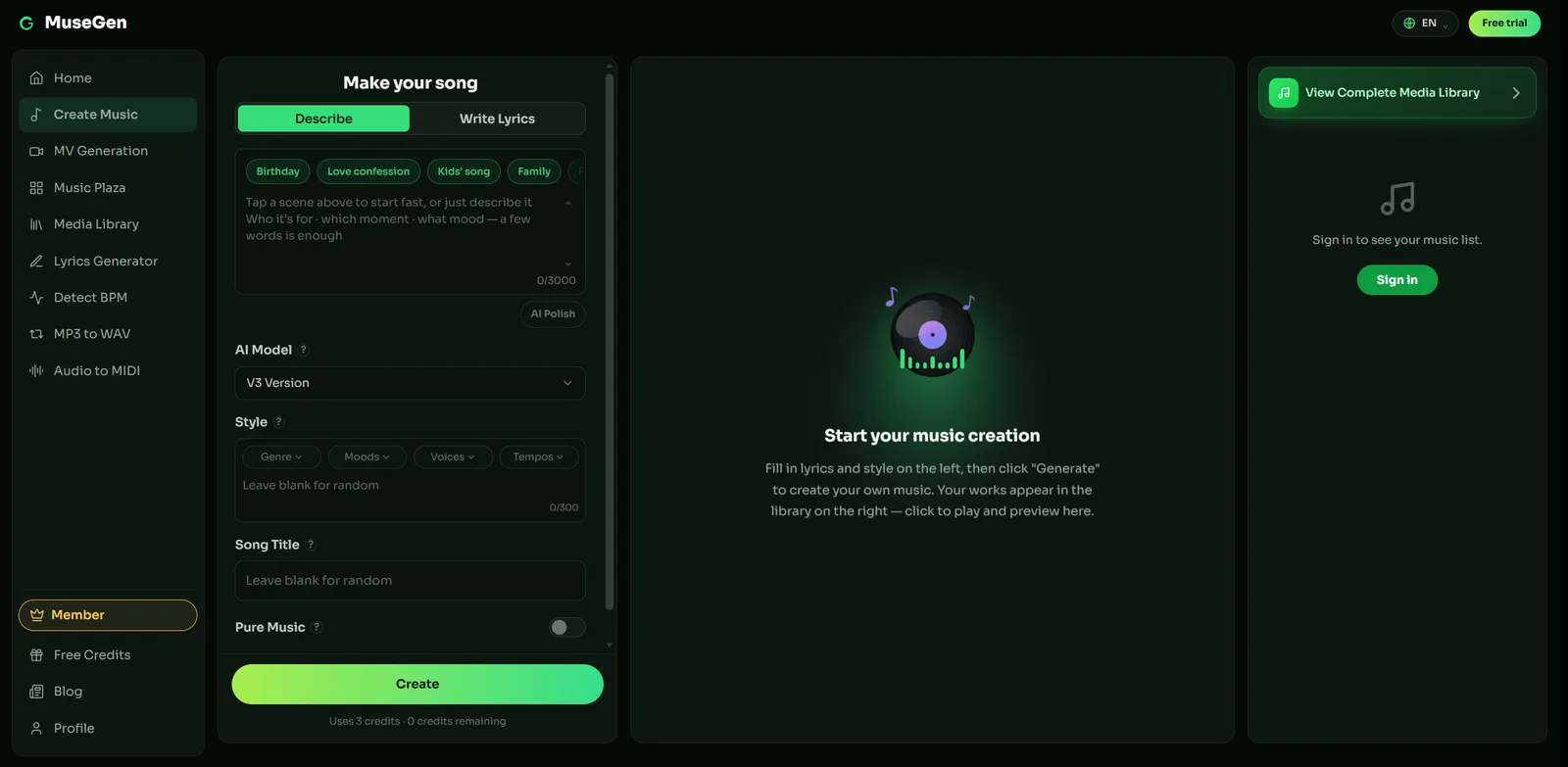
Paste a line from this page into the style box, then edit around the pickers.
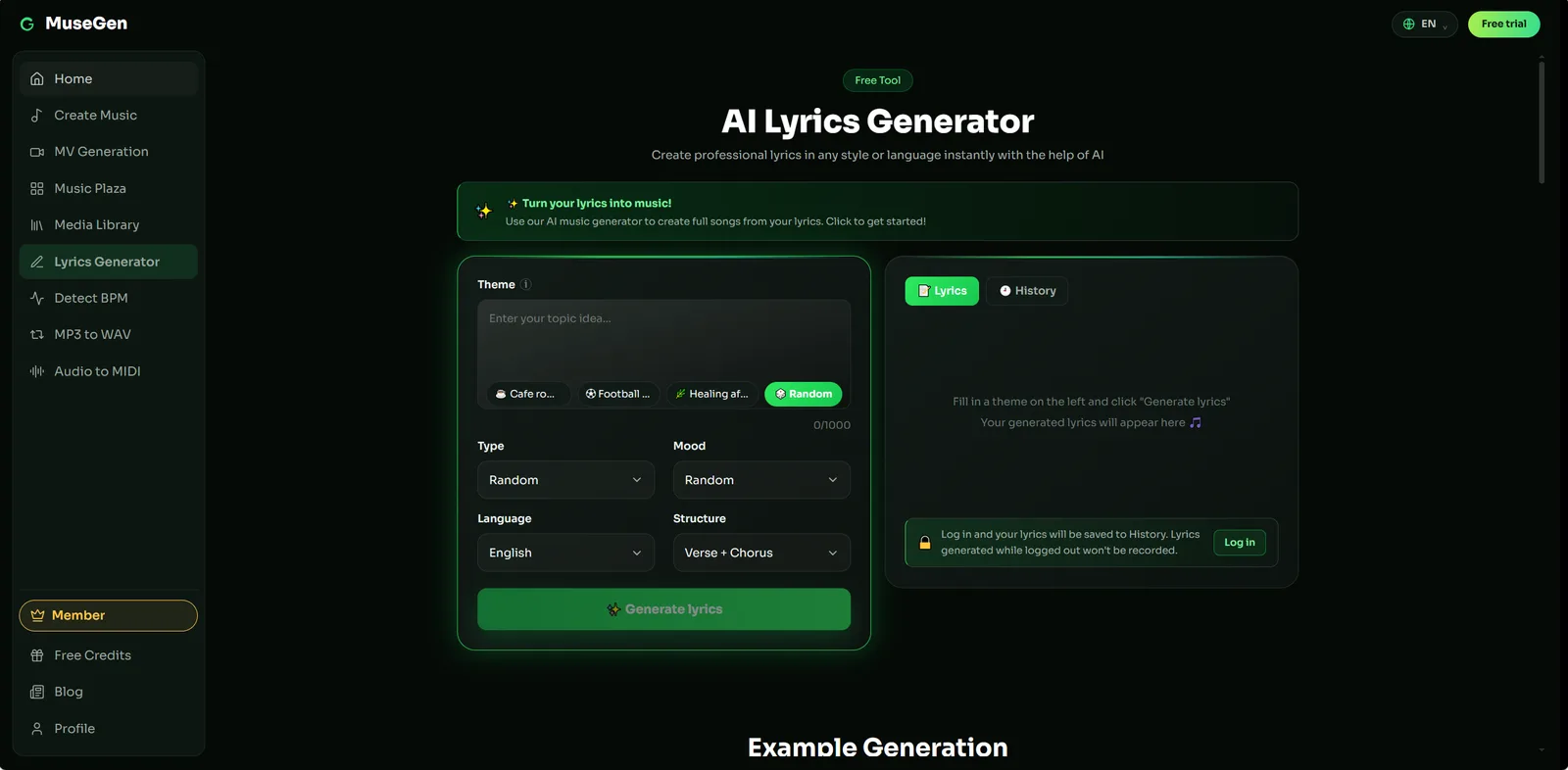
Casting the voice happens in the prompt; writing its words happens here.
None of which turns any line above into a setting. Paste the same forty words twice and two different songs come back. A library is a way of skipping the blank page, not a way of ordering a result.
FAQ
Can I copy these prompts exactly as written?
Yes, and they are written to work that way. What comes back will be a competent version of that genre, which is what a line written for everybody produces. The three edits in section three take about twenty seconds and are the difference between a demonstration of a genre and a track with a decision in it.
Why do two people using the same prompt get different songs?
Because generation is probabilistic rather than deterministic. The same words are a set of constraints, not a specification, and the tool picks one path through everything those constraints allow. The same is true of one person running one prompt twice. Filling more slots narrows the range of what can come back; it never collapses it to a point.
What should I change first when a result is close but not right?
Change one thing, not four. If the feel is wrong, move the tempo eight to ten BPM. If the sound is wrong, swap the named lead instrument. If the shape is wrong, rewrite the length and ending clause. Changing several at once means the next result cannot tell you which edit did what.
Can I combine two prompts from different sections?
Combine slots rather than whole lines. Taking the drum feel from one and the instrumentation from another usually works. Pasting two full prompts together does not, because you end up with two genres, two tempos and two endings competing, and the later clauses tend to lose. Pick one line as the base and import single clauses into it.
What do I write for a genre that is not on this page?
Find the family it belongs to and borrow that family's priorities. Anything drum-led follows the hip-hop pattern of describing the feel before the instruments. Anything acoustic follows the folk pattern of naming real instruments and a room. If you cannot place it, give the instrumentation and the tempo and leave the genre word out, because a wrong one does more damage than a missing one.
Why does a prompt that worked last month behave differently now?
Because the model underneath changed. Generators are retrained and replaced on their own schedules, and each release shifts how much weight a clause carries, how long a prompt runs before later parts get diluted, and how strictly exclusions are honoured. Nothing here is a specification for that reason. Treat it as a draft to re-tune rather than a bug.
How do I stop a prompt from producing vocals I did not ask for?
Say instrumental explicitly, early, and mention no voice anywhere else in the text. Most defaults lean toward singing, so silence on the subject is read as permission. If a tool has a separate instrumental toggle, use it as well rather than instead, and note that choir, vocal chop and wordless all still count as voices.
Should I paste the whole prompt into the style box or split it across fields?
Split whatever the fields actually cover and put the rest in free text. If there is a tempo field, the BPM belongs there rather than in the sentence. If there is a genre picker, use it and keep only your qualifier in the text. Duplicating an instruction is merely wasteful; leaving a field empty when you had an opinion is not, because empty fields get filled for you.
Keep reading
- The AI Music Prompt Formula: A Simple Template That Works — the six slots in full, with a word list for each.
- How to Write AI Music Prompts: 8 Rules for Better Results — why the prompts above are shaped this way.
- What Is BPM? — the number at the front of every line here.
- How to Write Perfect AI Music Prompts for Cinematic Tracks — the same idea, narrowed to picture.
Sources
- Video: "How to Prompt LITERALLY EVERY Genre in Suno Ai" — youtube.com
- Field layouts, prompt length limits and how strictly a tool honours an exclusion vary between generators and change again with each model release. Check the documentation for whatever tool you have open — suno.com, udio.com or otherwise — because nothing else is current on its parsing.
- Vocabulary behind the clauses used above: What Is Arrangement in Music?, What Is BPM? and What Is a Chord Progression?.