What Is a Chord Progression? Definition, Examples & How They Work (2026 Guide)
MuseGen Team
8/6/2026
Play C, then G, then A minor, then F on a loop. Within seconds it sounds like a song you almost recognize - because you do. That four-chord loop sits under "Let It Be," "Don't Stop Believin'," and dozens of other hits. The reason it works has a name: it is a chord progression.
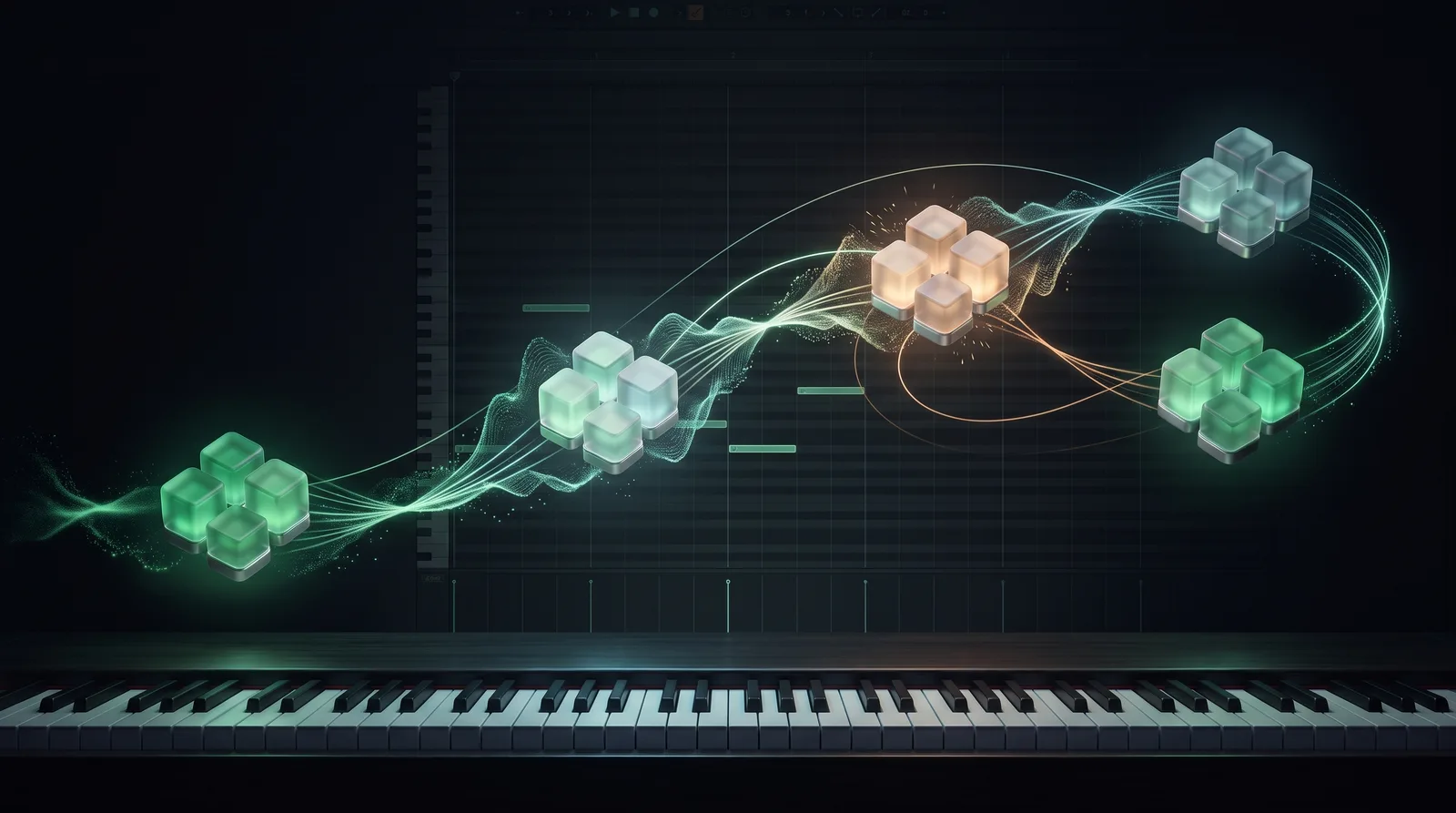
Four chords, endless songs: the same handful of chords power a huge share of modern hits. The order and feel are what change.
In short
- Definition: A chord progression is an ordered series of chords arranged to create harmonic motion, usually moving toward a resting point called a cadence.
- How it works: Each chord has a function - tonic (rest), predominant (setup), or dominant (tension) - and the progression walks through those roles in a satisfying direction.
- Universal notation: Roman numerals (I, ii, iii, IV, V, vi, vii°) describe progressions by pattern, so I-V-vi-IV means the same shape in any key.
- Most famous examples: I-V-vi-IV, the four-chord pop loop, and I-vi-IV-V, the '50s or doo-wop progression, use the same four chords in different rotations.
- Build your own: Pick a key, start on I, add a predominant (IV or ii) and a dominant (V), then resolve. You can hear the result by generating a track from a text prompt in MuseGen.
| Quick fact | Answer |
|---|---|
| What it is | A goal-directed sequence of chords: the harmonic backbone of a song |
| Notation | Roman numerals; uppercase = major, lowercase = minor, ° = diminished |
| Core functions | Tonic (I), predominant (IV or ii), and dominant (V) |
| Classic examples | I-IV-V, I-V-vi-IV, I-vi-IV-V, and 12-bar blues |
| Where it is used | Pop, rock, blues, jazz, classical, film, and effectively all Western music |
What is a chord progression?
A chord progression is a goal-directed succession of chords: an ordered series arranged in a purposeful sequence to create harmonic motion. This is the standard definition used by music theory references such as Wikipedia's overview of chord progressions. If a single chord is a word, the progression is the grammar. It lets a string of chords mean something and feel like it is going somewhere.
The key idea is motion toward a goal. Standard harmony references describe a progression as aiming for the definite goal of establishing, or deliberately contradicting, a key. It typically arrives at a cadence, a point of resolution that feels like a comma or a full stop. That sense of departure and return is exactly why some chord sequences feel finished and others leave you hanging.
Chord vs. progression: A chord is a stack of notes played together, usually three or more. A progression is what happens when chords move from one to the next over time. One chord is a snapshot; a progression is the story.
How chord progressions actually work
Progressions work because every chord plays a role, known as its harmonic function. In any key there are three main jobs, and a satisfying progression walks through them in a logical order:
- Tonic (I) - home base. As explained in this breakdown of tonic and dominant function, landing on the tonic feels resolved and finished. It is the point of rest that the whole progression orbits around.
- Predominant (IV or ii) - the setup. It moves you away from home and prepares the tension chord, keeping the ear interested instead of bouncing straight between I and V.
- Dominant (V) - tension. The dominant pulls strongly back toward the tonic. Most of the time it resolves to I, though it can move elsewhere to keep a phrase moving forward.
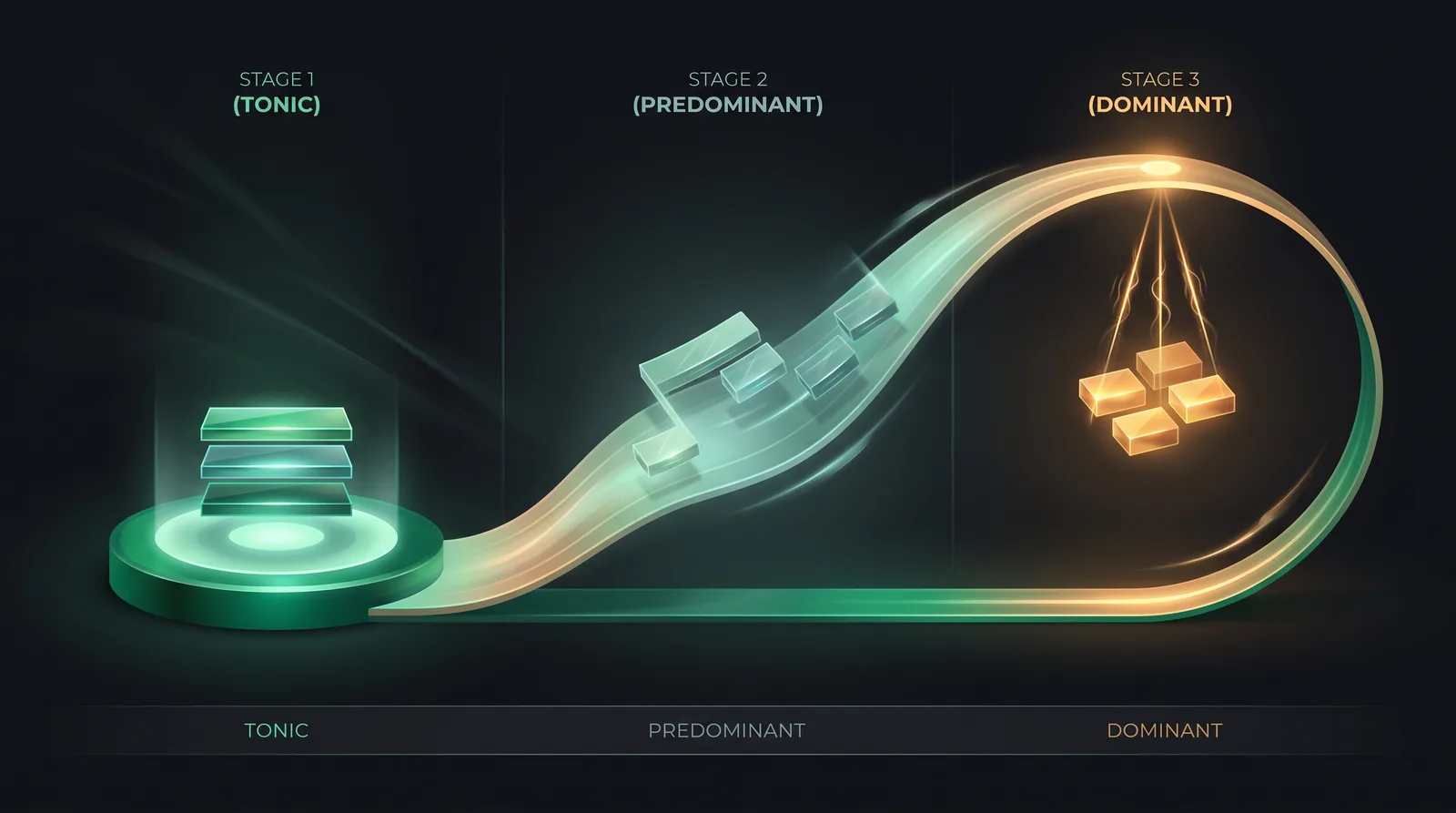
Harmonic function in motion: tonic provides rest, predominant creates movement, and dominant builds tension that pulls back toward home.
Music theorists describe progressions by how the chord roots move, and not all moves feel equal. The strongest-sounding motion is roots falling by a fifth, for example V to I. As documented in the harmony literature, root movement down by a fifth makes up the majority of chord changes in Western music. This is why the tonic and dominant are called the workhorses of harmony: many songs use little more than those two chords.
Why some progressions sound finished and others do not
It comes down to where you stop. End on the tonic (I) and the phrase feels resolved and complete. End on the dominant (V) and you leave tension hanging in the air, which pulls the listener forward into the next phrase. Songwriters exploit this constantly: a verse that ends unresolved makes the chorus feel like an arrival.
Roman numerals: the universal shorthand
Musicians describe progressions with Roman numeral analysis, a system in which chords are labeled by their scale degree so a pattern can be discussed independently of key. The numeral is the scale degree of the chord's root, and the case tells you the quality:
- Uppercase (I, IV, V) = major chords.
- Lowercase (ii, iii, vi) = minor chords.
- Lowercase + ° (vii°) = diminished.
The payoff is transposability. The chords C, G, Am, and F spell I-V-vi-IV in C major. Play the same shape in G major and you get G, D, Em, and C: different absolute pitches, identical pattern. One Roman numeral formula unlocks a song in all twelve keys at once, which is why session musicians can walk on stage and play a chart they have never seen.
| Roman numeral | Scale degree | Chord in C major | Typical function |
|---|---|---|---|
| I | 1st | C major | Tonic (rest) |
| ii | 2nd | D minor | Predominant |
| iii | 3rd | E minor | Tonic-like / color |
| IV | 4th | F major | Predominant |
| V | 5th | G major | Dominant (tension) |
| vi | 6th | A minor | Tonic substitute |
| vii° | 7th | B diminished | Dominant-like |
7 chord progression examples you already know
A surprisingly small toolkit powers most popular music. Here are seven progressions worth memorizing, shown in C major where applicable, with the songs and styles that made each one famous.
1. I-IV-V: the foundation
C-F-G. Tonic, predominant, dominant, resolve. As LANDR's roundup of common progressions notes, this is arguably the most iconic progression in Western music and the backbone of the twelve-bar blues, early rock 'n' roll, and countless folk and country songs. Its power is in the simplicity: three chords, endless songs.
2. I-V-vi-IV: the four-chord pop loop
C-G-Am-F. This is the modern juggernaut, often cited as the most-recorded progression of the last several decades. "Let It Be," "Don't Stop Believin'," and "With or Without You" are all variations on it.
In 2011, the Australian comedy trio The Axis of Awesome made the point unforgettable: their sketch "4 Chords" combines dozens of hit songs over this single loop.
▶ Watch on YouTube: "4 Chords" by The Axis of Awesome — dozens of hit songs performed over the same I-V-vi-IV loop.
3. I-vi-IV-V: the '50s or doo-wop progression
C-Am-F-G. Also known as the "Heart and Soul" chords, the "Stand by Me" changes, or the "ice cream changes", this sequence dominated late-1950s and early-1960s pop. Canonical examples include "Earth Angel" by The Penguins (1954) and "Stand by Me" by Ben E. King (1961).
Here is the twist: it uses the exact same four chords as the pop loop above, just rotated to start on I and drop to the minor vi. Same ingredients, different recipe.
4. vi-IV-I-V: the emotional rotation
Am-F-C-G. Start that same four-chord set on the minor vi and the mood flips: wistful and yearning rather than triumphant. It is a go-to for ballads and stadium anthems, and a clean demonstration that order, not just chord choice, carries emotion.
5. ii-V-I: the jazz cadence
Dm-G-C. Predominant to dominant to tonic, textbook. This turnaround is the gravitational center of jazz harmony and the single most important progression to internalize if you want to understand how jazz standards move from phrase to phrase.
6. 12-bar blues: I-IV-V
This is a repeating 12-measure form built entirely on I, IV, and V. It is the framework beneath the blues, early rock 'n' roll, and much of R&B. It proves that a strict, predictable structure can still leave enormous room for individual expression in the melody and phrasing on top.
7. i-VII-VI-V: the Andalusian cadence
Am-G-F-E. A descending minor-key line with a dramatic, Spanish pull. It is a reminder that progressions live in minor keys too, and that a simple stepwise bass descent can sound cinematic all by itself.
The big picture: Examples 2, 3, and 4 all draw from the same four chords: I, V, vi, and IV. They recur because that set is a proven, satisfying balance of bright major and emotional minor. The melody, rhythm, and production are what make each song sound distinct.

The same harmonic ingredients can lead to very different creative results once the order, rhythm, melody, and production change.
How to build your own progression in 5 steps
You do not need to memorize theory to write a progression that works. Follow the functional path: tonic out, tension up, then home.
- Pick a key. C major is the friendliest place to start because it has no sharps or flats. Its seven chords are C, Dm, Em, F, G, Am, and B°.
- Start on the tonic (I). Establish home so the listener has somewhere to return to.
- Add a predominant (IV or ii). This moves you off home and sets up the tension.
- Reach the dominant (V). Now you have built tension that wants to resolve.
- Resolve back to I, or swap in vi for a softer landing, then loop it. Try I-IV-V-I or I-vi-IV-V.
Hear your chord progression with MuseGen
Reading Roman numerals is one thing; hearing your idea is another. The gap between "I think this works" and "yes, that is it" is where songwriting actually happens.
With the MuseGen AI Song Maker, you can generate a full track from a plain-text prompt. Describe the progression, mood, and style, then refine the result and export a finished MP3 or WAV to build on. Download availability depends on your model and plan, and you should always check MuseGen's current terms for commercial use.

A chord progression becomes a song through collaboration: harmony, rhythm, melody, arrangement, and production all shape the final result.
Try a prompt like this:
Warm indie-pop, 92 BPM, in C major. Use a I-V-vi-IV progression (C-G-Am-F) on a soft electric piano with light drums. Nostalgic but hopeful.
Prefer the doo-wop feel? Swap the progression for I-vi-IV-V (C-Am-F-G) and ask for a "1950s ballad, brushed drums, close vocal harmonies."
Coming soon: Separated stems and MIDI export are on the MuseGen roadmap, but are not available yet. For now, generate, refine, and export full audio.
AI-assisted music is a useful way to prototype and learn, but treat generated audio as a starting point you shape rather than a finished original. Understanding chord function is what turns a lucky generation into a repeatable songwriting skill.
Turn a Roman numeral idea into sound with MuseGen.
Frequently asked questions
What is a chord progression in simple terms?
It is an ordered series of chords played in sequence to create a sense of movement and, usually, resolution. Think of it as the harmonic sentence that a melody sits on top of.
What is the most common chord progression?
In modern pop, I-V-vi-IV (C-G-Am-F in C major) is widely considered the most-recorded progression of recent decades. The classic 1950s alternative is I-vi-IV-V, which reuses the same four chords in a different order.
What do the Roman numerals in a chord progression mean?
Each numeral is the scale degree of a chord's root within the key. Uppercase means a major chord (I, IV, V), lowercase means minor (ii, vi), and a ° marks a diminished chord (vii°). The system lets you transpose the same pattern to any key.
Why do some chord progressions sound finished and others do not?
It comes down to function and cadence. Ending on the tonic (I) feels resolved, while ending on the dominant (V) leaves tension unresolved. That unfinished feeling pushes the music forward.
How many chords do you need for a progression?
As few as two. Many songs use only tonic (I) and dominant (V). Three chords (I-IV-V) already cover a huge share of folk, blues, and rock, and four chords (I-V-vi-IV) power much of modern pop.
Can I make a song from a chord progression with MuseGen?
Yes. Describe a progression and style in a text prompt and MuseGen will generate a track that you can refine and export as MP3 or WAV, subject to your model and plan. Check the current terms for commercial use. Separated stems and MIDI export are coming soon and are not available yet.
Sources
- "'50s progression" - Wikipedia for the definition, aliases, and song examples for I-vi-IV-V.
- "Chord progression" - Wikipedia for harmonic motion, root movement, cadence, 12-bar blues, and the Andalusian cadence.
- "Tonic, Dominant, and Subdominant Tones and Chords" - Dynamic Music Room for the harmonic functions of tonic and dominant.
- "Roman numeral analysis" - Wikipedia for numeral case, scale degree, and transposability.
- "7 Common Chord Progressions You'll Instantly Recognize" - LANDR for I-IV-V, I-V-vi-IV, and why four chords work.
- "4 Chords" - The Axis of Awesome for a demonstration of the four-chord pop loop.