What Is BPM in Music? A Beginner's Guide to Tempo & Beats Per Minute
MuseGen Team
8/25/2026
You've probably seen it everywhere — on a beat you bought, in your DAW's top bar, on a workout playlist labelled "150 BPM." Three letters that quietly control how a song feels: whether it drifts, grooves, or drives. BPM is one of the first things you set when you make music and one of the last things you notice when you listen — and once it clicks, a lot of music theory suddenly makes sense.
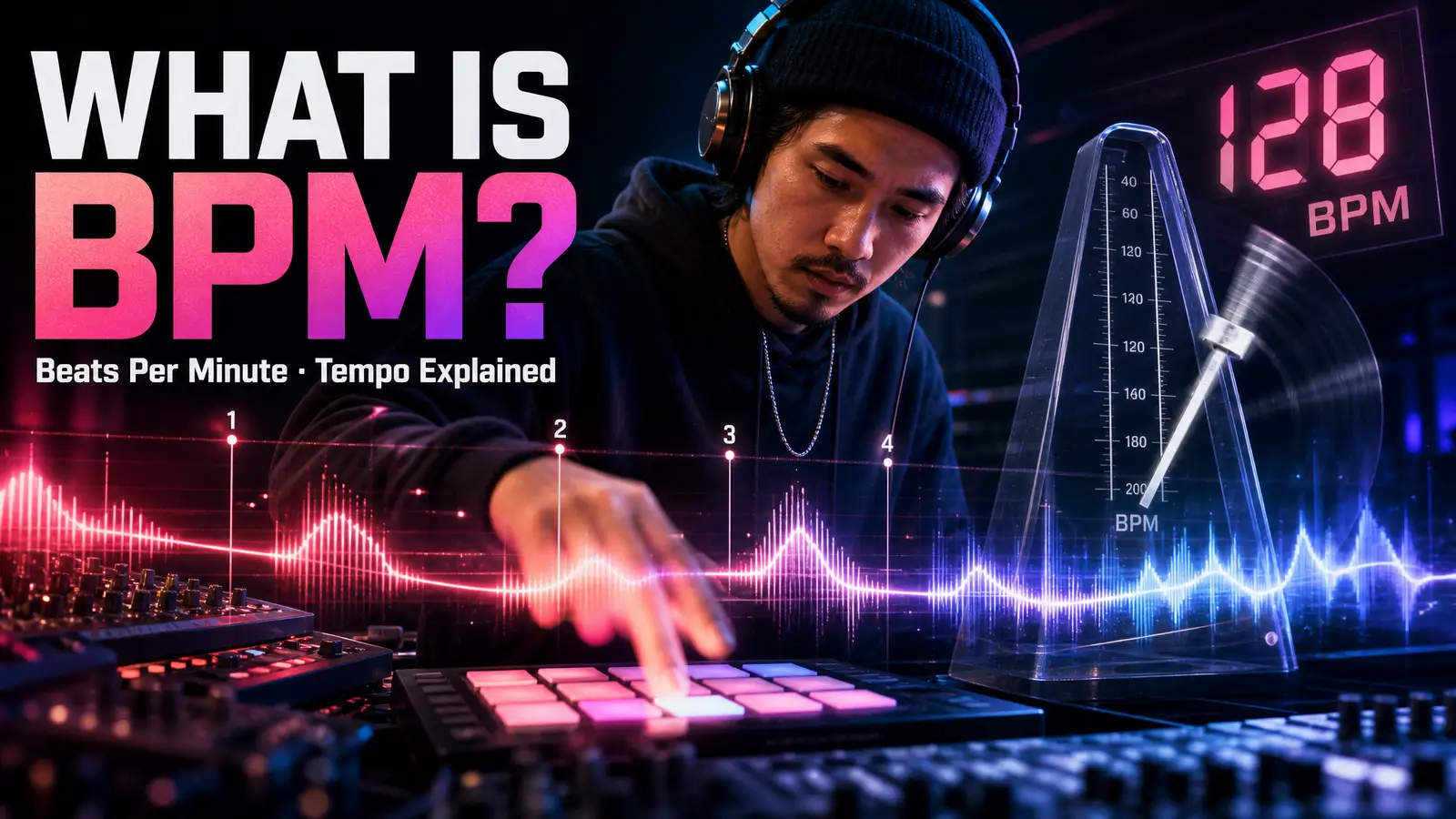
In short
BPM stands for beats per minute — the standard unit of tempo. It counts how many beats happen in one minute, which is just a precise way of saying how fast a song moves. 60 BPM means one beat every second; 120 BPM is twice as fast. Higher BPM = faster music.
Quick facts
- Stands for: Beats per minute — the unit of musical tempo.
- What it measures: How fast a song moves (its speed).
- The math: 60 BPM = 1 beat per second; 120 BPM = 2 beats per second.
- Typical range: Most songs sit around 60–180 BPM.
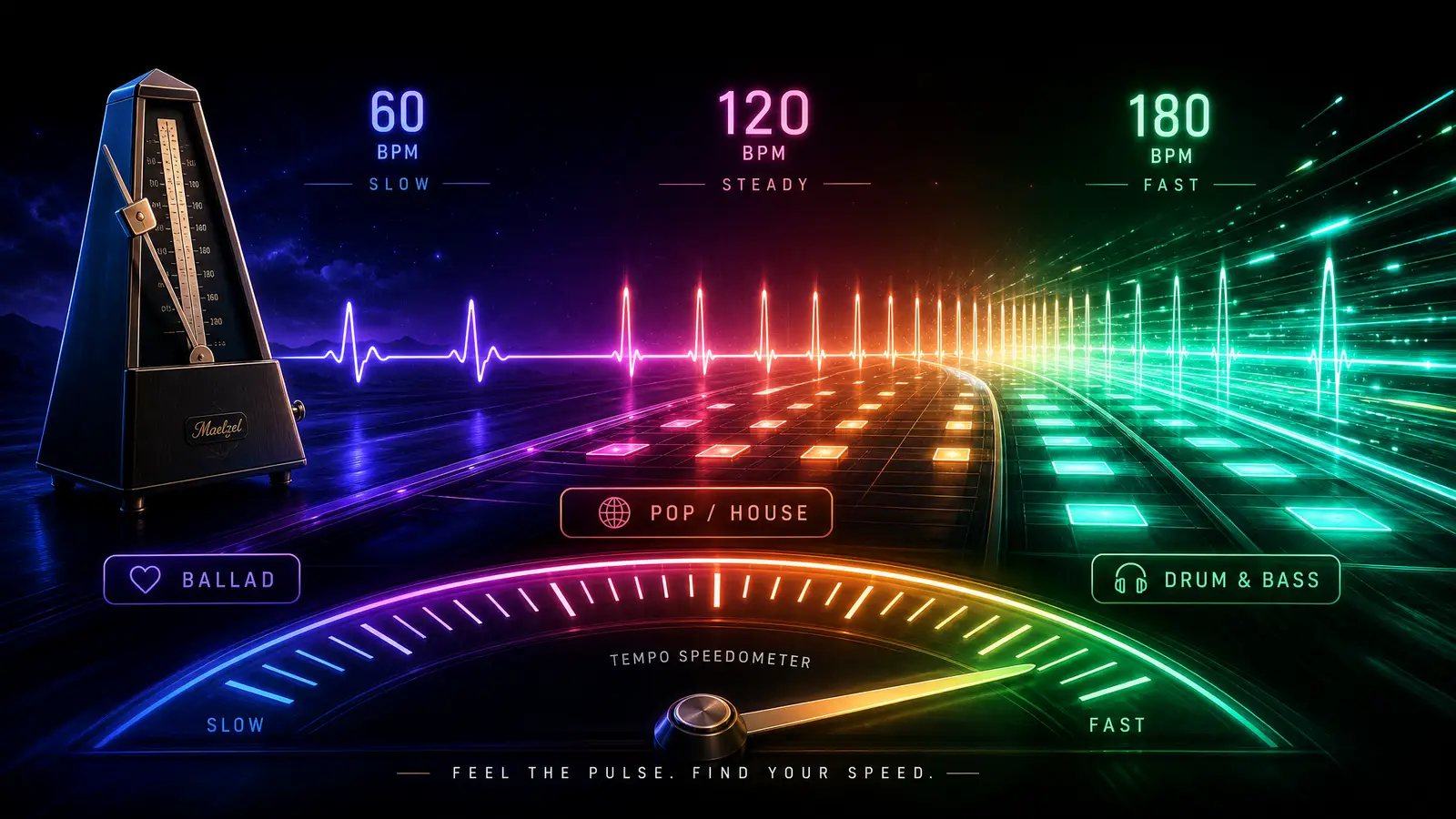
- Slow vs fast: Ballads ≈ 60–90; dance & drum and bass ≈ 120–180.
- Not the same as: Time signature (how beats are grouped per bar).
- How to find it: Tap along, or use a BPM detector.
What BPM actually means
BPM, or beats per minute, is the standard unit for measuring the tempo of a piece of music — the number of steady beats that occur in one minute. The "beat" is the regular pulse you'd clap or tap your foot to, and BPM simply counts how many of those pulses fit into sixty seconds. A track at 90 BPM has 90 beats per minute; a track at 174 BPM has 174. That's the whole idea.
Tempo is just the musical word for speed, and as the definition of tempo puts it, it is usually measured in beats per minute, where 60 BPM equals one beat per second and 120 BPM is twice as rapid. BPM is what turns a vague feeling — "this song is fast" — into an exact, shareable number that any musician, metronome, or piece of software can reproduce.
In one line: BPM is the speedometer of music. It answers a single question — how fast? — and answers it with a number, not an adjective. A higher number is faster; a lower number is slower.
That precision is the reason BPM became universal. Before it, musicians relied on descriptive Italian words like Allegro or Adagio, which capture the feel of a tempo but leave the exact speed open to interpretation. Writing ♩ = 120 removes the guesswork: every player and machine knows precisely how fast the music should go. That's also why BPM sits at the heart of modern production — drum machines, DAWs, samples, and DJ software all lock to it so different elements can line up in time.
How BPM is measured
BPM is measured by counting beats against the clock: one beat per second is 60 BPM, and the count scales directly from there. Because it's tied to real time, the math is refreshingly simple. Double the BPM and you double the number of beats in the same minute; halve it and you halve them.
The easiest mental model is a clock. The second hand ticks 60 times a minute, so it is effectively moving at 60 BPM — one beat every second. Speed that up to two ticks per second and you're at 120 BPM; a fast 180 BPM is three beats every second. In most modern music those beats are counted in groups of four ("1, 2, 3, 4"), so at 120 BPM you'd count a full group of four every two seconds.
The 15-second BPM trick
- Tap your foot to the steady beat of the song.
- Count how many beats happen in 15 seconds.
- Multiply that count by 4 — e.g. 30 beats in 15s × 4 = 120 BPM.
Counting for 15 seconds and multiplying by four is faster than counting a whole minute and accurate enough for most purposes. Count for longer if the tempo is very slow.
One clarification worth making early: a beat is not the same as a note. A single beat can contain many fast notes (think of a rapid hi-hat pattern) or be held by one long chord. BPM measures the underlying pulse — the steady grid everything else is played against — not how many notes happen on top of it.
BPM and how a song feels
BPM shapes the emotional character of a song because tempo maps closely onto the human body — especially the heartbeat. A resting heart rate sits around 60–100 BPM, so music in that zone tends to feel calm, natural, and relaxed. Push the tempo up toward a workout heart rate and the same music starts to feel urgent, energetic, and physical.
That's not a coincidence that producers stumble into — it's a lever they pull on purpose. Slow tempos leave space between the beats, which reads as weight, intimacy, or sadness; fast tempos pack the beats closer together, which reads as excitement and drive. It's why a breakup ballad rarely runs at 160 BPM and a peak-time club track rarely crawls at 70.
A simple way to feel it: a low tempo around 60 BPM is a resting heartbeat — calm and unhurried, the home of ballads and lo-fi. A high tempo around 140 BPM is a heartbeat mid-workout — driving and intense, the home of dance and trap. Most music lives on the spectrum between those two pulses.
Tempo isn't the only thing that creates energy — arrangement, rhythm, and production matter just as much, and plenty of slow songs hit harder than fast ones. But BPM is the foundation the rest is built on, which is why it's usually the first thing you decide when you start a track.
Tempo markings: Largo to Presto
Before BPM numbers existed, composers used Italian tempo markings — words like Largo, Andante, and Presto — that describe roughly how fast (and how expressively) to play. They're still used across classical music and sheet music today, and each one maps onto an approximate BPM range, from very slow to very fast.
| Marking | Feel | Approx. BPM |
|---|---|---|
| Largo | Very slow, broad | ≈ 40–66 |
| Adagio | Slow, stately | ≈ 66–76 |
| Andante | A walking pace | ≈ 76–108 |
| Moderato | Moderate | ≈ 108–120 |
| Allegro | Fast, bright | ≈ 120–156 |
| Vivace | Lively, brisk | ≈ 156–176 |
| Presto | Very fast | ≈ 168–200 |
Treat those numbers as guidance, not law. The ranges overlap and differ from one source to another, and the markings carry a sense of character as much as raw speed — which is exactly why they can't be converted into a single BPM. As the tempo reference notes, a metronome marking cannot be deduced from a descriptive term alone; two conductors can read "Allegro" and land on different tempos and both be right. BPM is the exact figure; the Italian word is the vibe.
Want to see tempo and these markings explained out loud? This short beginner walkthrough covers what BPM is and how the Italian tempo terms fit together:
BPM by genre
Most genres cluster around characteristic BPM ranges, which is why tempo is such a strong clue to a song's style. These are conventions, not rules — a pop song can be slow and a ballad can be quick — but knowing the typical zone helps you set a starting tempo, match a sample, or beatmatch two tracks. Here are common ranges you'll run into.
| Style | Typical BPM | Feel |
|---|---|---|
| Ballads & lo-fi | ≈ 60–90 | Slow, relaxed, spacious |
| Hip-hop & R&B | ≈ 80–100 | Laid-back groove, strong backbeat |
| Pop & rock | ≈ 100–130 | Steady, danceable, radio-friendly |
| House | ≈ 120–130 | Four-on-the-floor, club-ready |
| Techno | ≈ 125–150 | Driving, hypnotic |
| Dubstep | ≈ 140 (feels like 70) | Heavy, half-time groove |
| Drum and bass | ≈ 160–180 | Fast breakbeats, high energy |
Notice how the dance genres bunch up around 120–130 BPM. That's not an accident: it sits close to a moderately raised heart rate and lines up neatly for DJs mixing one track into the next. If you're producing for a specific genre, starting in its usual range is the safe default — then break the convention on purpose once you know why it exists.
BPM vs time signature: a common mix-up
BPM tells you how fast the beats go; the time signature tells you how those beats are grouped into bars — they're related but answer different questions. Beginners often blur the two because both deal with rhythm, but you can change one without touching the other.
| Aspect | BPM (tempo) | Time signature |
|---|---|---|
| Answers | How fast the beats move | How beats are grouped per bar |
| Example | 120 BPM | 4/4 (four beats per bar) |
| Controls | Speed / energy | Feel, meter, and grouping |
| Written as | ♩ = 120 | 4/4 at the start of the staff |
An easy way to keep them straight: two songs can both run at 120 BPM while one is in 4/4 and the other in 3/4 (a waltz feel) — same speed, different grouping. And a single song can hold 4/4 throughout while gradually speeding up or slowing down its BPM. Tempo is the pace; the time signature is the pattern.
Half-time and double-time
Half-time and double-time describe how a groove feels against the underlying BPM — the tempo number stays the same, but the drums make it feel twice as slow or twice as fast. This is the single most common source of BPM confusion, so it's worth understanding.
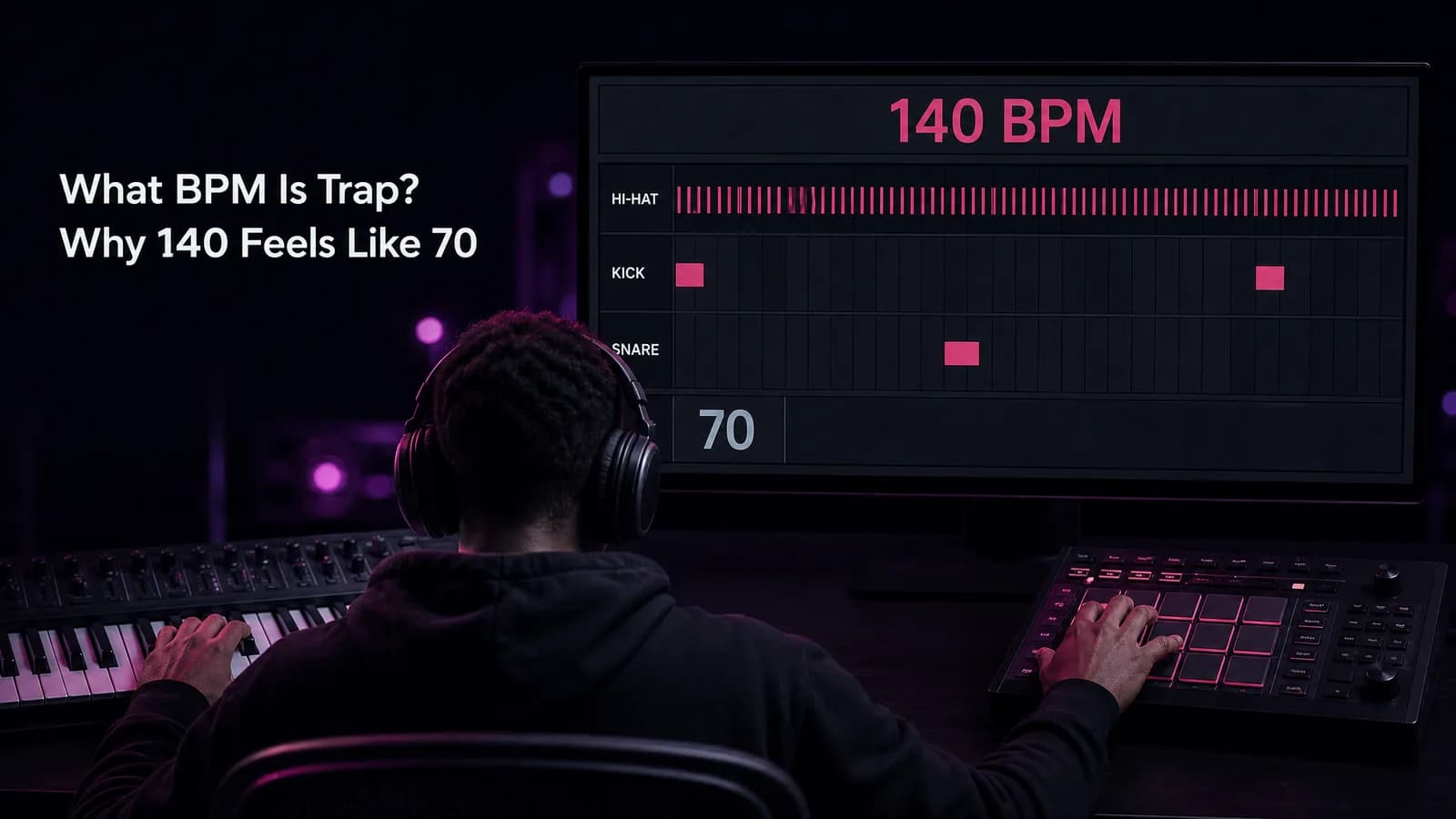
Take dubstep. It's typically written at 140 BPM, yet the snare lands on beat 3 rather than beats 2 and 4, so the groove feels like a slow, heavy 70 BPM. The tempo grid never changed — the drums just imply a slower pulse. Producers use this constantly: a half-time drop makes a section feel huge and weighty without actually slowing the project down, and a double-time feel adds urgency without speeding it up.
This is also why an automatic BPM detector sometimes reports exactly double or half the tempo you expected. It locked onto a different layer of the pulse. The fix is simple: if 140 shows up as 70 (or vice versa) and it doesn't match how the track feels to tap along, just halve or double the number.
How to find a song's BPM
You can find a song's BPM by counting beats manually, tapping along in a tap-tempo tool, or letting software detect it from the audio — no musical training required. Here are four reliable methods, from lowest-tech to fully automatic — broadly the same approaches covered in MasterClass's guide to finding a song's BPM.
- Count the beats for 15 seconds. Tap your foot to the steady pulse, count the beats in 15 seconds, and multiply by four. It's quick, needs nothing but a clock, and gets you within a beat or two of the real tempo.
- Use a tap-tempo tool. Tap a key or button in time with the beat and the tool averages the gaps between taps into a live BPM reading. The more taps you give it, the more accurate it gets — great when you don't have the audio file, only the sound.
- Run an automatic BPM detector. Load the audio into a BPM detector or DAW and it analyses the waveform to estimate the tempo for you. This is the fastest route when you have the file and want a precise number to build on.
- Sanity-check for half or double time. If the detected number feels off by exactly half or double, the tool caught the wrong pulse (see half-time above) — adjust it so it matches how the song actually feels when you tap along.
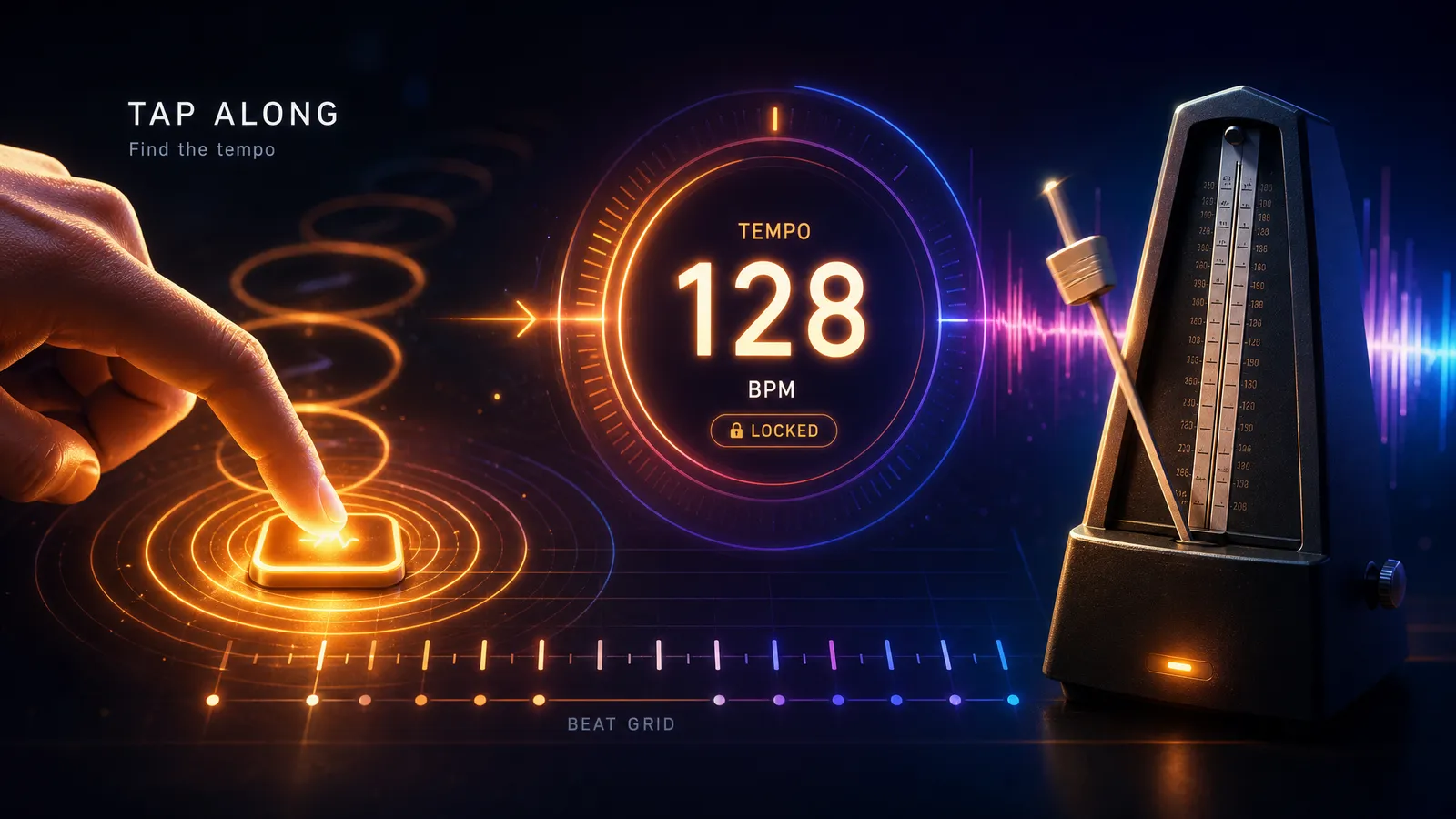
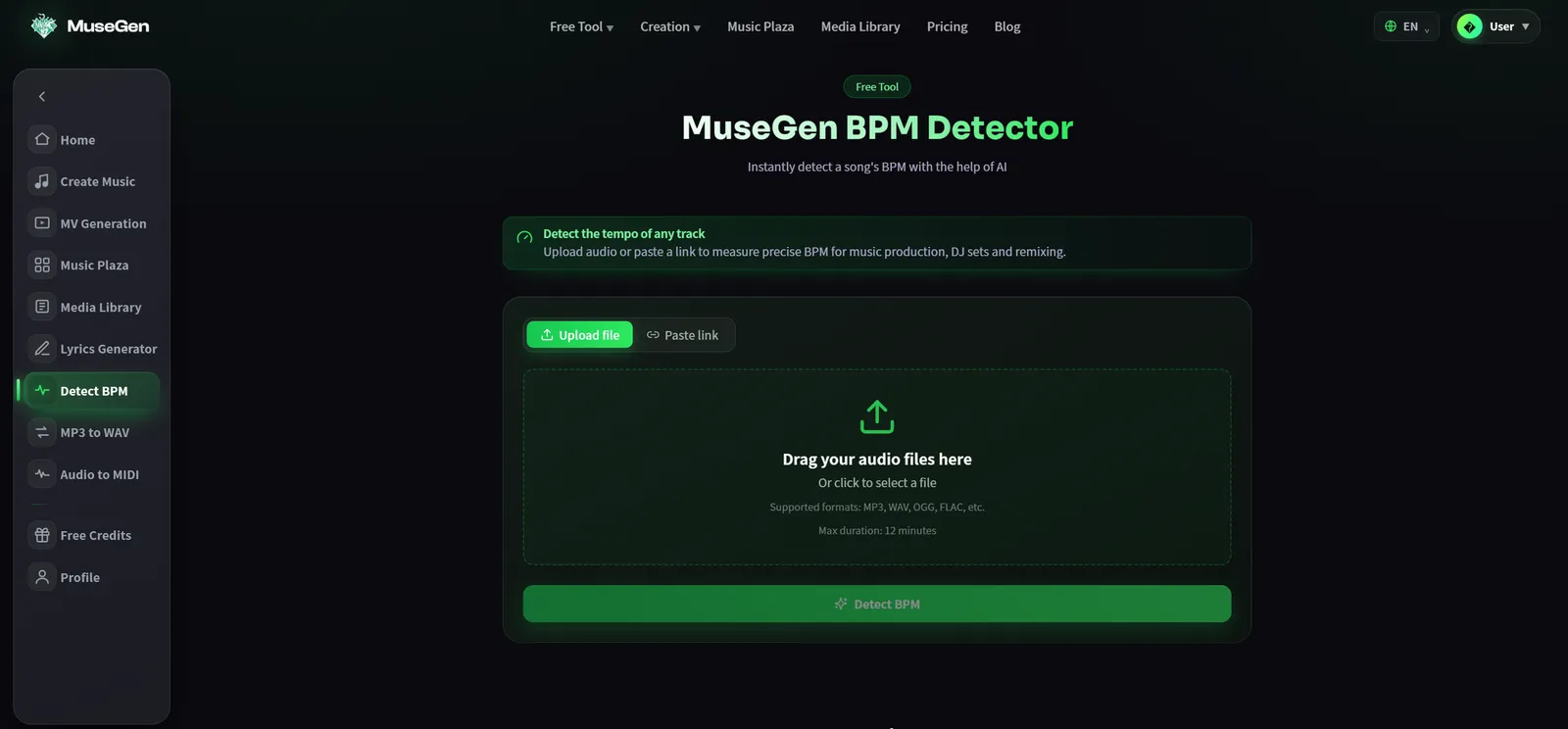
For a quick, no-install option, MuseGen has a tool that lets you detect a song's BPM from the audio, so you can grab the tempo of a reference track before you start writing to it.
Producer tip: once you know a reference track's BPM, set your project to the same tempo before you add anything. Getting the BPM right first means your drums, samples, and melodies all lock together from the very first bar — instead of fighting a tempo you chose by accident.
Where MuseGen fits
Understanding BPM is the easy part; using it to actually make a song is where it pays off. MuseGen is an all-in-one AI music tool that takes you from a written idea to a finished track — and tempo is woven through that process. If you're building a song around a certain feel, knowing your target BPM helps you pick the right reference and the right energy before you generate a thing.
In practice, you can detect the BPM of a track you love to pin down the tempo you're chasing, write a structured lyric to give the song its shape, then turn the whole idea into a complete song. Finished tracks export as royalty-free WAV or MP3 (always check MuseGen's current terms before commercial use), and you can create a music video once the song feels right.
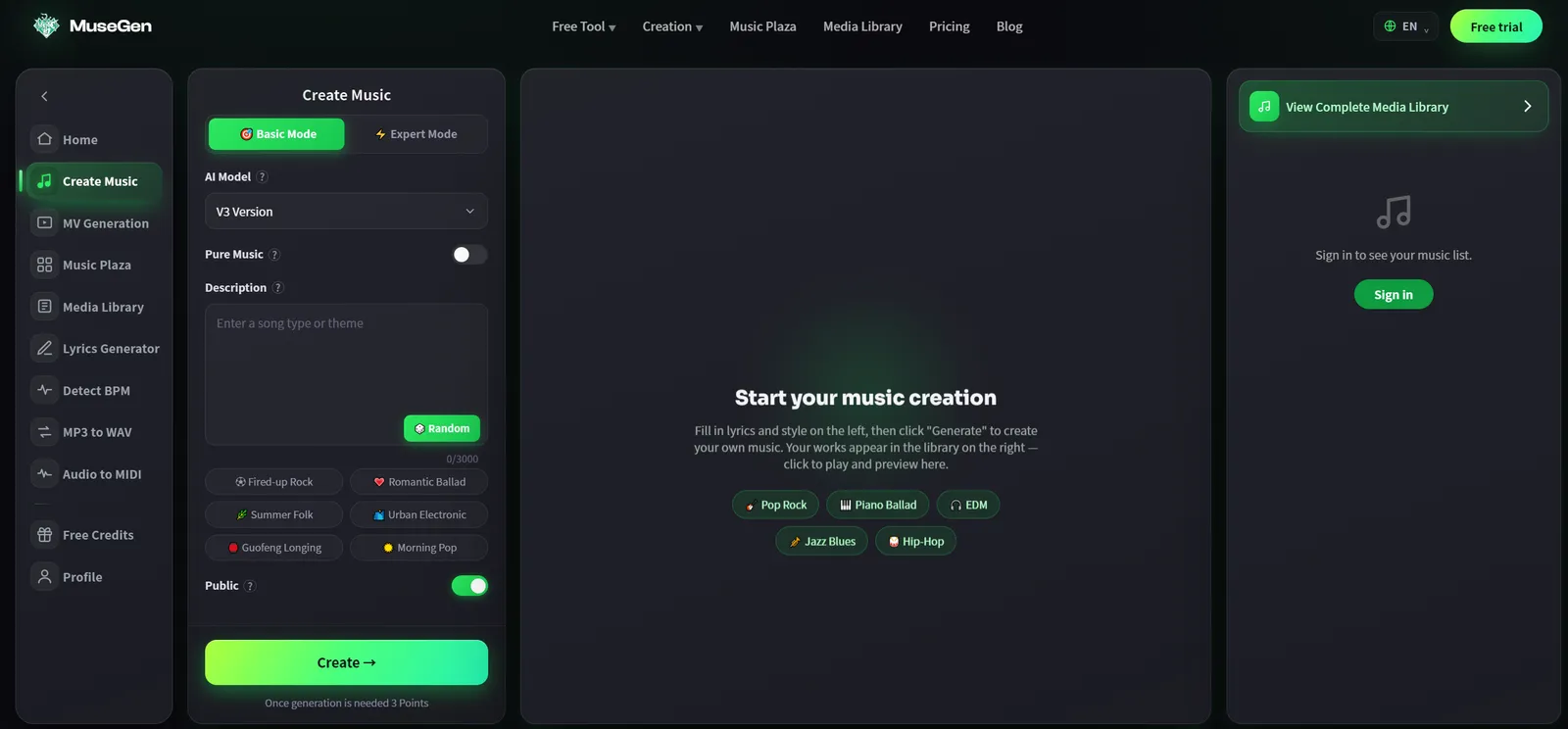
It won't replace learning why a 128 BPM house groove hits differently than a 90 BPM hip-hop beat — that ear is yours to build. But it removes the friction between having an idea at a certain tempo and hearing it as a real, finished song.
Got a tempo and an idea? Turn it into a finished song. Find the BPM, draft the lyrics, and generate a complete track — all in one place. → Make a song with MuseGen
FAQ
What does BPM mean in music?
BPM stands for beats per minute. It's the standard unit of tempo, meaning it counts how many beats occur in one minute of music and so tells you how fast or slow a song moves. A higher BPM is a faster tempo and a lower BPM is a slower one.
What is a normal BPM for a song?
Most popular music sits somewhere between about 60 and 180 BPM, with a large share of pop, rock, and hip-hop clustered around 90 to 130 BPM. Ballads and slow songs tend to sit near 60 to 90 BPM, while dance styles and drum and bass run faster, often 120 to 180 BPM. These are typical ranges, not strict rules.
How do I find the BPM of a song?
The quickest manual method is to tap your foot to the beat, count the beats in 15 seconds, and multiply by four. For an exact figure you can use a tap-tempo tool, or load the audio into a BPM detector or DAW that analyses the waveform and estimates the tempo automatically. If the result is exactly half or double what you expect, adjust it to match how the song feels.
Is BPM the same as time signature?
No. BPM tells you how fast the beats go, while the time signature tells you how those beats are grouped into bars — for example four beats per bar in 4/4. Two songs can share the same 120 BPM tempo but use different time signatures, and a song can keep the same time signature while speeding up or slowing down.
What is half-time and double-time in BPM?
Half-time and double-time describe how a groove feels relative to the underlying BPM. A track at 140 BPM with a slow, spacious backbeat can feel like 70 BPM, which is why genres such as dubstep are often written at 140 but feel half as fast. BPM detectors sometimes report exactly double or half the intended tempo for the same reason.
Does a higher BPM mean a better or more energetic song?
Not automatically. A higher BPM usually feels more energetic because it's closer to a raised heart rate, which is why dance and workout music runs fast. But energy also comes from arrangement, rhythm, and production. Plenty of slow songs hit hard, and a fast tempo alone doesn't make a track better.
What are Italian tempo markings like Allegro and Adagio?
They're traditional words that describe the feel and approximate speed of a piece, used long before BPM became universal. Largo is very slow, Adagio is slow, Andante is a walking pace, Moderato is moderate, Allegro is fast and bright, and Presto is very fast. They map onto rough BPM ranges, but the ranges overlap and vary between sources, so a marking can't be turned into an exact BPM on its own.
Sources
- Wikipedia — "Tempo" for the definition, beats per minute, and Italian tempo markings.
- Wikipedia — "Beat (music)" for the beat and the underlying pulse.
- Wikipedia — "Metronome" for a device that clicks a set number of beats per minute.
- Wikipedia — "Time signature" for how beats are grouped into bars.
- MasterClass — "Beats Per Minute Explained: How to Find a Song's BPM" for the methods to find a song's tempo.
- Ableton — Learning Music: "Tempo and genre" for how tempo maps onto genres.
- Amin Faramarzi — "What Is Tempo in Music? | BPM Explained & Italian Tempo Markings Made Easy" (video) for a beginner explainer of tempo and markings.