What BPM Is Trap? Why 140 Feels Like 70

MuseGen Team
9/22/2026
Wikipedia will tell you that trap is typically around 70 BPM. A different Wikipedia article, about music that also calls itself trap, will tell you it plays at 140. Neither one is wrong and neither one is rounding. They are the same tempo written down twice, once counting every beat and once counting every other beat, and the choice between those two ways of counting is not cosmetic. It changes what you call a hi-hat roll, what a sample pack says on the label, and what a machine does with the number when you hand it over. This page is about why trap ended up written at the faster of the two figures, and what that decision buys.
The short answer
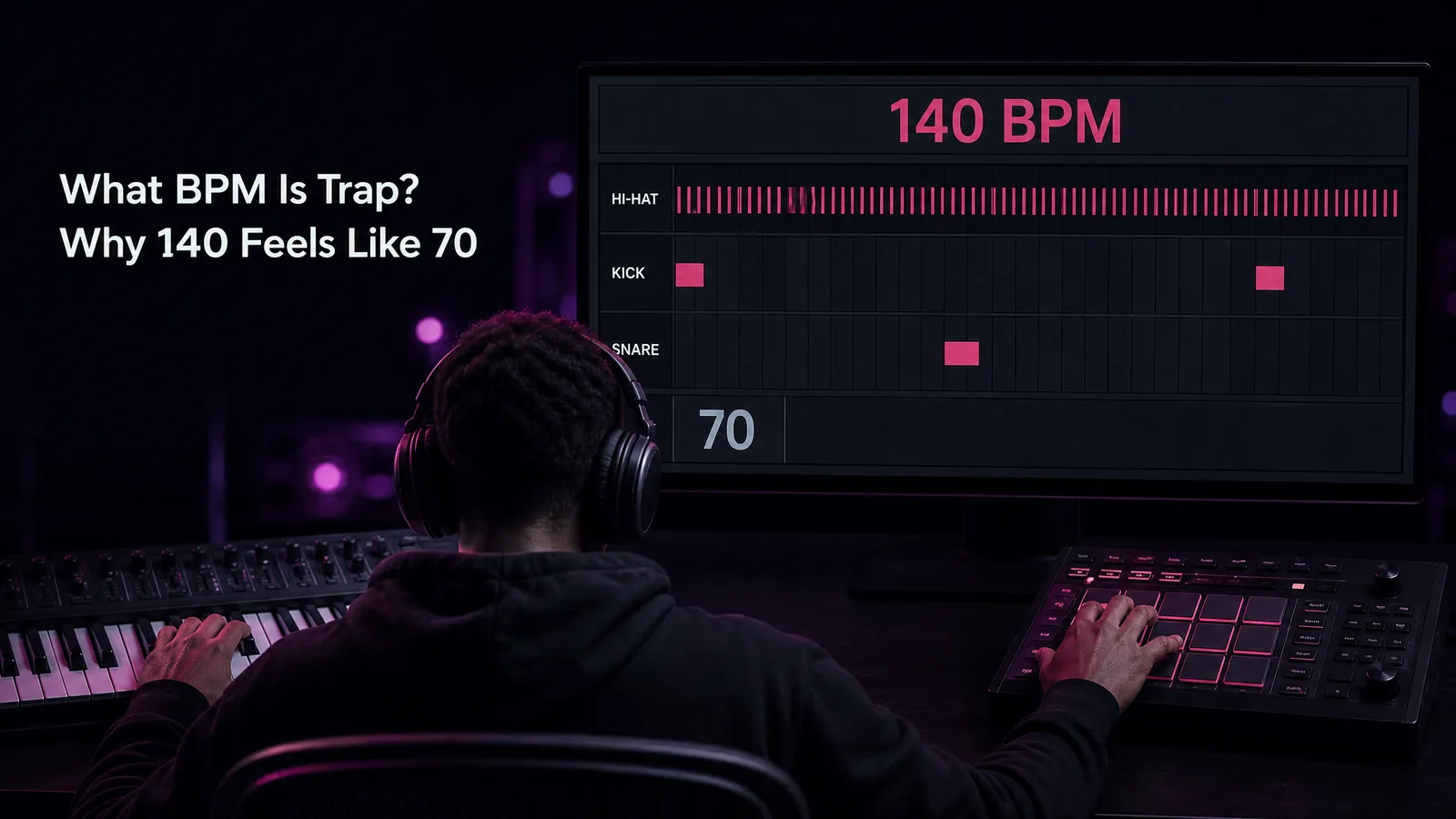
Trap is written at 140 BPM and heard at about 70. The published range runs from 50 to 88 BPM in half-time notation, which is 100 to 176 at full tempo, and the typical value is 70, or 140. The doubling is not a claim about speed. It is a notation choice, made so that fast hi-hat figures land on ordinary note values.
That is the part most tempo charts leave out. They print one of the two numbers, or occasionally both, and stop at the observation that trap is counted strangely. The interesting question is which of the two the genre actually writes with, and why. The answer is 140, and the reason is stated in the reference material in one clause that is easy to read straight past.
- Trap is written at 140 and heard at 70. Both numbers describe the same records. 140 is the figure in the project file and on the sample pack, and 70 is the pulse most listeners count along with.
- The doubling is a notation choice, not a speed. Wikipedia says trap is often programmed in half-time to achieve finer hi-hat subdivisions. Writing 140 buys resolution on the grid rather than tempo.
- The milliseconds never change, only the names do. A run of 107 millisecond notes is sixteenths at 140 and thirty-seconds at 70. The sound is identical. The vocabulary you use to describe it is not.
- Write the number with a word attached. 140 on its own reads as techno and 70 on its own reads as lo-fi. Trap needs both halves: 140, half-time. That is what tells a reader which grid you mean.
Quick facts
- Written tempo: 140 BPM — the figure in project files, sample packs and tutorials.
- Felt tempo: ≈ 70 BPM — the backbeat most listeners count along with.
- Published range: 50 (100) to 88 (176) BPM, from Wikipedia's trap article.
- Typical published value: 70 (140) BPM, from the same article.
- The EDM strand: 140 BPM, quoted at full tempo with no half-time notation at all.
- Measured corpus: median 140 BPM across 135 catalogued tracks, measured September 2026.
Two numbers, one genre
Nearly every genre in a tempo chart is quoted as a band with a middle. House sits between 115 and 130 with the records piled up around 125. Drum and bass is quoted as 165 to 185 and worked at 174. In each case there is one scale, and the argument is only about where on it the music lives.
Trap breaks that pattern in a way no amount of extra measurement would fix, because the disagreement is not about where the music sits. It is about what you are counting. A chart printing 70 and a chart printing 140 are looking at the same records and reaching the same conclusion. We have already made that case in why one number can describe two speeds, where the parentheses in the reference sources turn out to be the sources telling you, in the notation itself, that both answers are available.
So take that as settled and ask the next question, which is the one nobody seems to answer: if both figures are correct, why did trap settle on the higher one? Producers do not open a project at 70 and think of it as trap written slowly. They open it at 140. Sample packs are labelled 140. Tutorials count in 140. Every piece of infrastructure around the genre has agreed on the faster figure, and that agreement is not an arbitrary coin-flip that could have gone the other way.
It has a reason, and the reason sits in a single clause of a single sentence, in the first place anybody looks.
What the published sources say
The definitional source for the rap-derived style is Wikipedia's article on trap music, and the whole of its tempo coverage is one sentence in the characteristics section. It says trap uses a range of tempos, often programmed in half-time to achieve finer hi-hat subdivisions, and then gives figures: from 50 (100) BPM to 88 (176) BPM, with a typical value of about 70 (140) BPM.
Notice the order. The encyclopedia puts the half-time figure first and the full-tempo figure in brackets behind it, which is the convention a listener would use rather than the one a producer would. That single formatting decision is responsible for a large share of the confusion around this genre, because a chart compiled by somebody skimming that line comes away with 70 and a chart compiled by somebody reading the brackets comes away with 140.
Then there is the other article. Wikipedia treats the electronic strand as a separate subject, and its history section says the phase that emerged around 2013 typically plays at 140 BPM with strong bass drops. No brackets, no half-time figure, no acknowledgement that the same music could be counted the other way. Two encyclopedia articles about styles sharing a name use opposite notations for the same tempo, and neither one flags the difference.
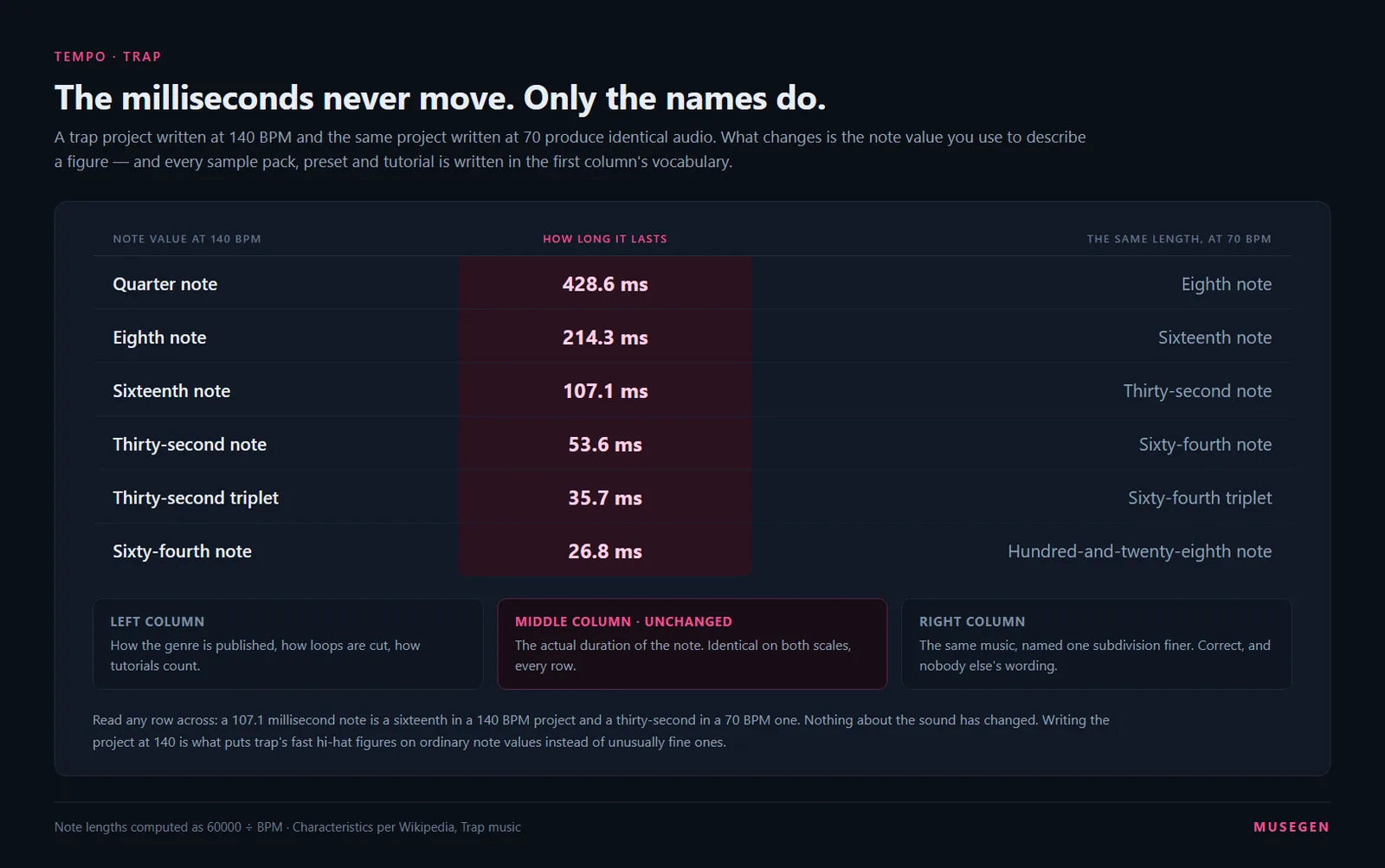
The middle column is the sound. The two outside columns are what you call it, and only one of them is the vocabulary everybody else uses.
Measurement came late. The catalogue study we have leaned on elsewhere splits 49,500 tracks into fourteen genre buckets and does not include one for trap; the closest it comes is a hip-hop bucket, which is a different question and a much wider one. The same company has since measured trap on its own — 135 tracks, September 2026, median 140 — and notes that thirty of them were detected at half tempo and corrected back to their written figure, which is this page restated as a data-cleaning step. The production guide that gives drum and bass a single tempo and house a band has no trap row at all — it covers dubstep at 140 BPM with a half-time, 70 BPM feel, a neighbouring genre answering a neighbouring question.
The electronic subgenres are no better. The trap article on the EDM side names seven offshoots and gives a tempo for none of them. So a table quoting festival trap at 150 and hard trap at 160 is reporting somebody's working habit, not a figure that can be checked. Why published references so rarely count anything is a subject in itself, set out in what the sources do not publish. Here it is enough to say that trap's number began as a convention with a stated reason behind it, and that the reason is unusually informative.
Why 140 and not 70
Read the clause again on its own: often programmed in half-time to achieve finer hi-hat subdivisions. That is a purpose clause. It does not say trap sounds like half its tempo, and it does not say a detector will get it wrong. It says producers write the project at double the felt pulse in order to get something, and the something is subdivision.
The same characteristics section tells you why that would be worth having. It describes the style in terms of crisp, grimy, rhythmic snares, deep 808 kick drums, and double-time, triple-time, and similarly divided hi-hats. Hi-hat division is not decoration in this genre. It is one of the handful of things that makes a beat recognisable as trap at all, and it is the element that carries most of the movement while everything else stays deliberately still. A style built on how finely one instrument can be divided has a practical interest in how that division gets named.
Here is the arithmetic, which is the whole argument in one table. A beat at 140 BPM lasts 60,000 divided by 140, or a little over 428 milliseconds. Halve it, halve it again, and keep going.
| Note value at 140 BPM | How long it lasts | The same length, at 70 BPM |
|---|---|---|
| Quarter note | 428.6 ms | Eighth note |
| Eighth note | 214.3 ms | Sixteenth note |
| Sixteenth note | 107.1 ms | Thirty-second note |
| Thirty-second note | 53.6 ms | Sixty-fourth note |
| Thirty-second triplet | 35.7 ms | Sixty-fourth triplet |
| Sixty-fourth note | 26.8 ms | Hundred-and-twenty-eighth note |
The middle column is the only one that corresponds to anything audible, and it does not move. A hi-hat placed every 53.6 milliseconds is the same hi-hat whichever tempo the project is set to, down to the sample. What differs is entirely in the left and right columns, which are names.
And the names matter more than they look like they should. At 140 the workhorse hi-hat figures are sixteenths and thirty-seconds, with triplets on top of both. At 70 the identical figures are thirty-seconds and sixty-fourths, with sixty-fourth triplets for the fast rolls. Both descriptions are accurate. Only one of them is the language that sample packs, preset names, tutorials, drum-machine documentation and other producers actually use. Say you rolled a hat in thirty-seconds and everyone knows what you did. Say you rolled it in sixty-fourth triplets and half the room will assume you are exaggerating.
That is what writing at 140 buys. Not speed, and not energy — it buys the ordinary vocabulary. Trap is a genre whose defining gesture lives two or three divisions below the beat, and counting the beat twice as often moves that gesture back into the range of note values people already have words for. 140 is not a claim about how fast the music is. It is a claim about how finely it is divided. Everything else about the doubling follows from that, including the part everybody notices, which is that it also happens to feel like 70.
Three reasons a number gets doubled
Tempo doubling turns up across several genres, and it is worth separating because the same visible symptom has three quite different causes. Once you can tell them apart, a chart that looks contradictory usually stops being contradictory.
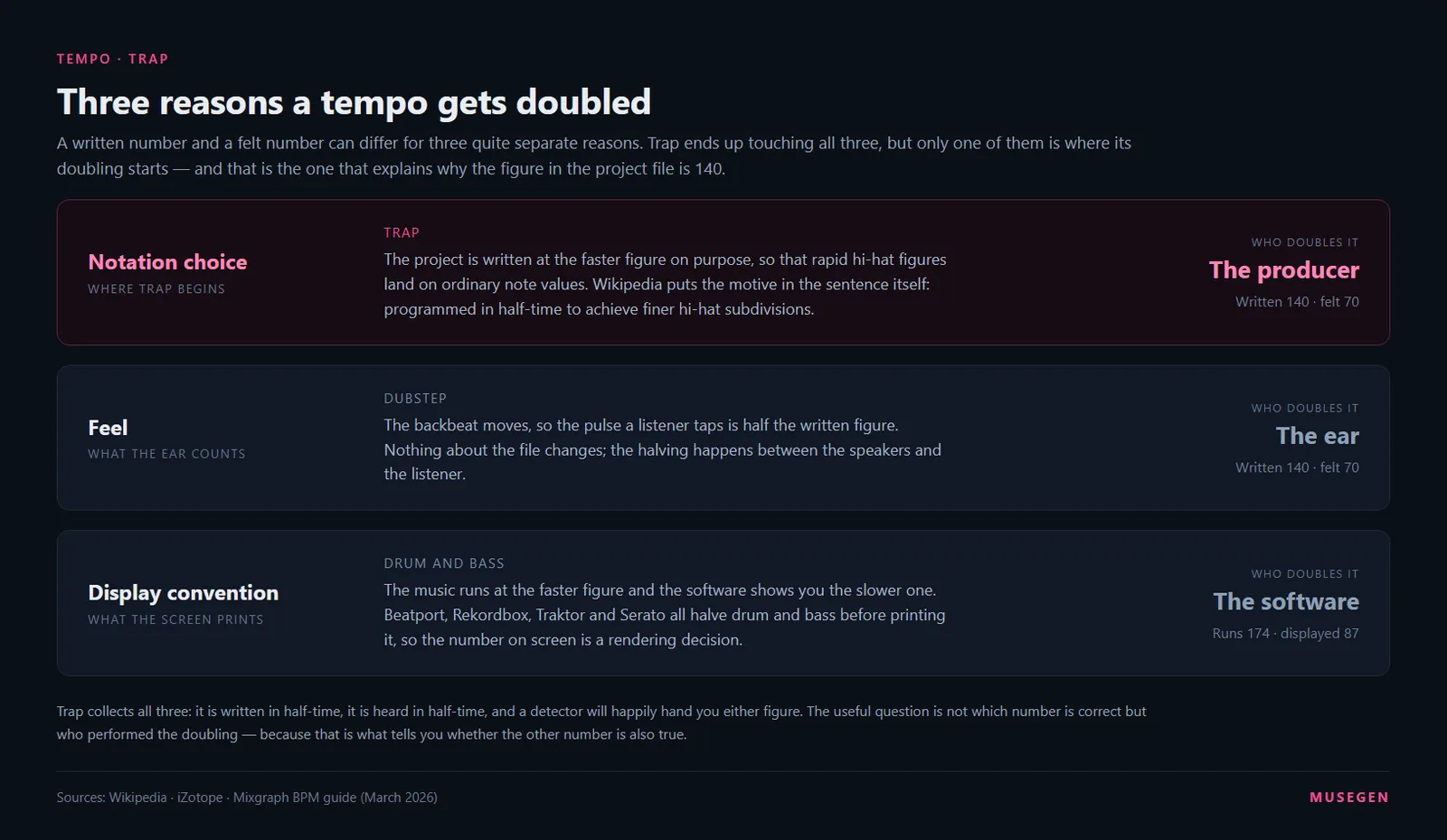
The same symptom, three different causes. The useful question is not which number is right but who chose it.
A notation choice. Somebody sat down and decided to write the project at double the felt pulse, for a reason they could state. This is trap, and the reason is the one above. The doubling exists in the project file before it exists anywhere else, and the audio is built on top of it. Nobody is confused, nothing has gone wrong, and the alternative notation would have produced identical music with more awkward labels.
A feel. The backbeat lands somewhere unusual and the ear reorganises the bar around it, so a track genuinely counts as half its written tempo whether or not anybody planned it. Dubstep is the standard example: written at 140, snare on the third beat instead of on two and four, and heard at 70 by nearly everyone. This is the mechanism, and we work through it properly in half-time and double-time rather than repeating it here.
A display convention. The music is not ambiguous at all, but the software has decided to show you a different figure than the one the drums are moving at. Drum and bass is the case: the breakbeats run at 174, and Beatport, Rekordbox, Traktor and Serato all display around 87 because a beatgrid at that scale is easier to mix against. Nobody who makes the music thinks in 87. We take that apart in why your software says 87.
Trap touches all three. It has the notation choice, it has a genuine half-time feel that follows from the way the drums are then written, and detectors will happily hand you either figure. But the order matters, and in trap the notation came first. That is the difference between this genre and the other two, and it is why the useful diagnostic question is not which number is correct but who did the doubling. In trap the producer did it, deliberately, in the tempo field. In dubstep the listener's ear does it. In drum and bass the software does it, and the producer never asked.
▶ Watch on YouTube: "Which BPM is best for your beat? 140BPM or 70BPM? (Halftime & Double Time Explained)" — an outside explainer on the 140-versus-70 question, framed as halftime and double time.
Three kinds of music behind one number
There is a second reason the figure 140 is slippery in this corner of the chart, and it has nothing to do with notation. Several distinct kinds of record sit behind it.
The oldest is the rap style, out of Atlanta in the 1990s and built around the 808 drum machine, written in half-time and quoted by the encyclopedia at 70 with 140 in brackets. Its numbers travel with it into hip-hop charts, where they land next to figures counted on the ordinary scale and immediately look like an outlier.
The second is the electronic strand, which took the drum programming into dance music around 2013 and is described as playing at 140 with strong bass drops. That is a festival tempo written the way festival tempos are written, on one scale, with no brackets. A DJ reading 140 there and a producer reading 140 in a rap project mean the same grid but very different records — one built for a drop and a large room, the other for a vocal and a car, and only one of the two is routinely written down as 70.
The third is drill, which shares the drum arrangement and gets no number at all. Wikipedia's article on the style contains no tempo figure anywhere. What it does contain is a description, quoted from the BBC, of a rhythm that is often rhythmically rigid, with a snare falling on the third beat of each bar. That is a description of half-time notation without the word for it, and without a figure attached. The reference material knows exactly what the rhythm is and never says how fast.
Put the three side by side and the practical lesson is not about tempo at all. It is that 140 BPM trap is an underspecified request. The number does not tell a collaborator, a search index or a generation model which of these rooms you are standing in, because all three answer to it. The genre word does not narrow it either, since two of the three are called trap. What narrows it is the rest of the description — whether the 808 slides, whether there is a drop, whether the snare is the loudest thing in the bar — and the tempo figure is only useful once it is sitting next to that.
Which number to write down
All of which turns into a short set of practical rules.
In a project file, write 140. This is the one that is not really a judgement call. Loops are cut at 140, one-shot packs are labelled 140, and every tutorial counts that way. Set the project to 70 and the audio is identical, but you have taken yourself out of the shared vocabulary: your sixteenths are now everyone else's thirty-seconds, imported loops read as half-length, and every quantise value you reach for is one step away from the one being described to you. There is no benefit on the other side of that trade.
To a person, write both. The number alone is genuinely ambiguous in this genre in a way it is not in most others. 140 on its own reads as techno-adjacent, up-tempo, driving. 70 on its own reads as a ballad or a lo-fi loop. Neither impression survives contact with an actual trap record. 140, half-time costs you nine characters and removes the whole problem.
From a detector, expect either. A tempo reading of exactly half or exactly double the figure you were expecting is the normal behaviour of every detection method, not a malfunction, and it is especially likely on music built the way trap is built — a sparse backbeat with a dense pattern above it gives an algorithm two defensible answers. If a tool hands you 70 for a record you know is trap, doubling is safe. If it hands you 140, you are already on the producer's scale.
In a written description, put the subdivision next to the tempo. If the hi-hats are the point of the genre, then the tempo figure and the hi-hat figure belong in the same breath, because one is meaningless without the other: thirty-second rolls at 140 and thirty-second rolls at 70 are two different pieces of music, and only the pair of values distinguishes them.
Drum and bass needs one number. Trap needs a number and a word. Write 140, half-time — because 140 alone reads as techno, 70 alone reads as lo-fi, and only the pair survives being handed to somebody, or something, that was not in the room when you made it.
Say 140, then say half-time
Two numbers, one grid, and a description box that will accept either without comment. That is also what happens when you sit down to tell a model what to make. The field does not know that 70 and 140 are the same request for this genre and a completely different request for any other, so the burden of saying which one you mean lands entirely on the sentence you write.
MuseGen keeps the measuring step and the writing step in the same place for exactly this reason. Detect BPM reads a reference record and reports a figure; on trap, reading it correctly means knowing which of the two scales it landed on. Carry the full-tempo number across into the MuseGen AI Song Maker and state the counting alongside it, so that "trap, 140 BPM, half-time, triplet hi-hat rolls, deep 808, sparse minor keys" settles the grid and the subdivision in the same line instead of leaving both to be guessed from the genre word.
Deciding what else goes into that sentence is its own skill, and MuseGen keeps a set of worked AI music prompts to work from. But the tempo is the cheapest thing on the list to state and the most expensive to leave open, and in trap it is the one figure an honest reader can take two ways. Spending one word to close that off is the best trade on the page.
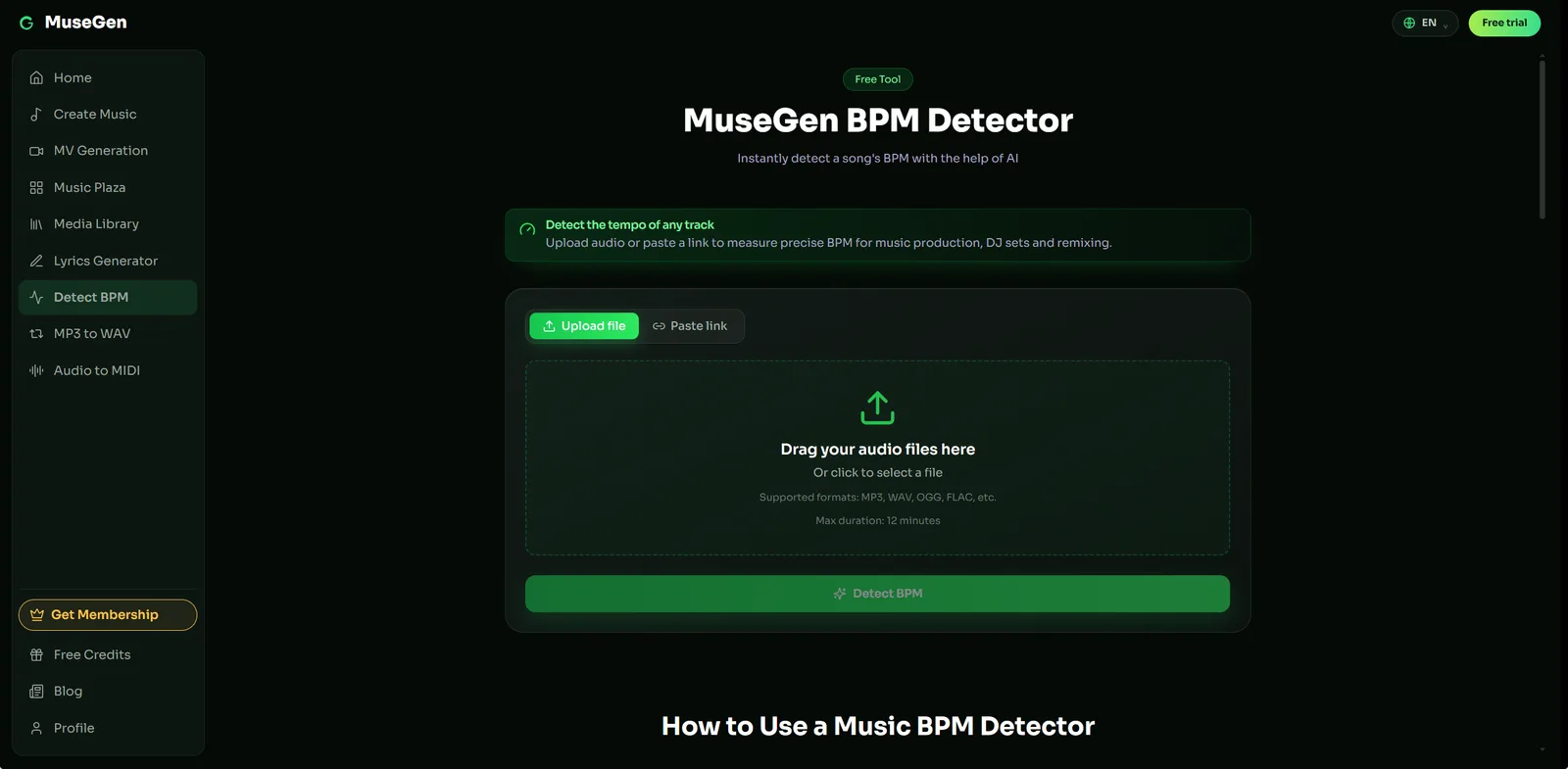
Detect BPM: read the reference first, then work out which of the two scales the number came back on.
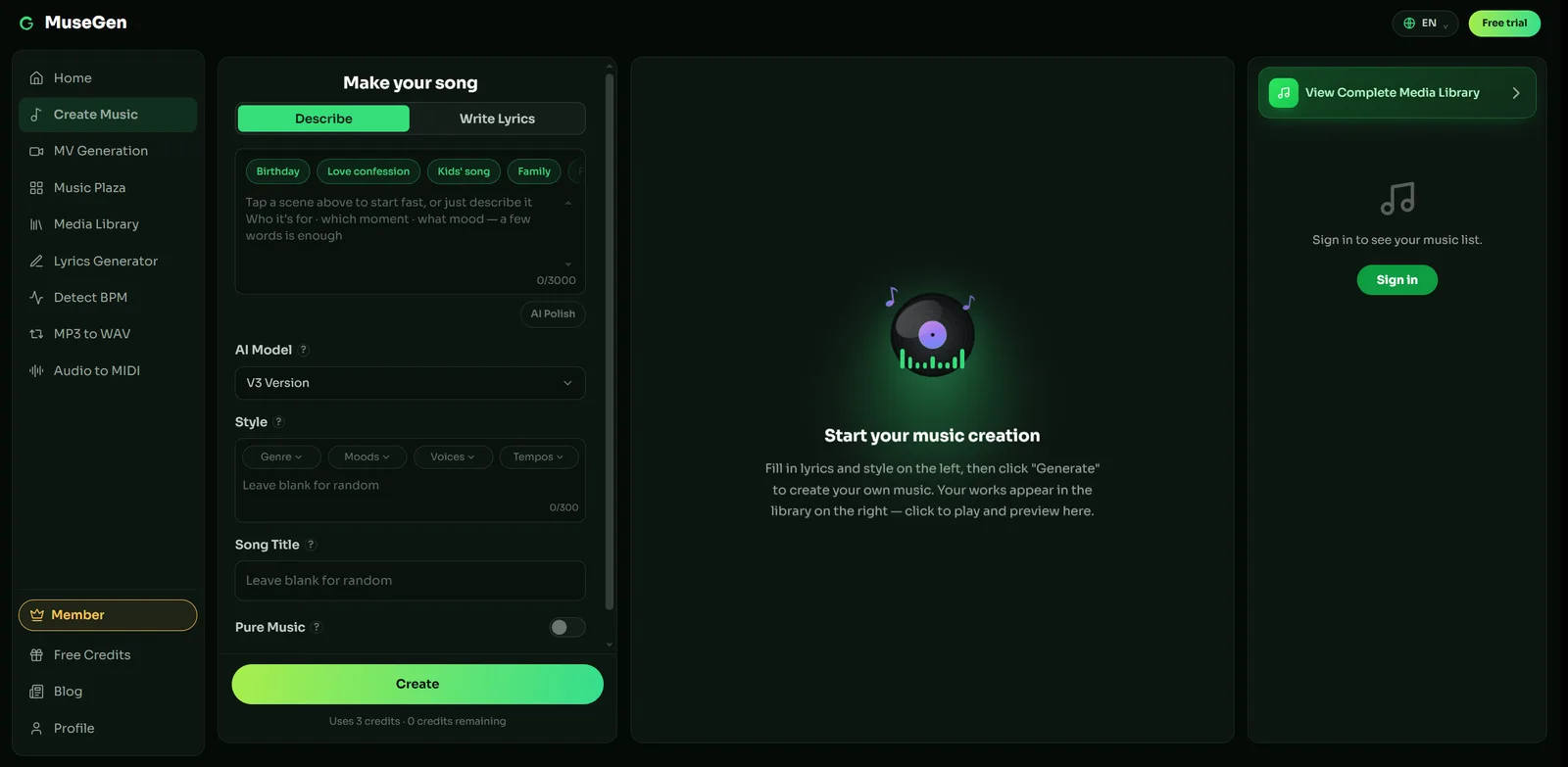
AI Song Maker: the tempo and the way it is counted go in as a pair, because 140 on its own is two requests.
One number is not enough for trap. Write the tempo and the way it is counted, then let the hi-hats be the fast part — try MuseGen.
FAQ
What BPM is trap music?
Trap is normally written at 140 BPM and normally felt at 70. Wikipedia gives a range running from 50 BPM to 88 BPM in half-time notation, which is 100 to 176 at full tempo, with a typical value of 70, or 140. Both figures describe the same records, so a chart quoting 140 and a chart quoting 70 are not actually in conflict.
Is trap 140 BPM or 70 BPM?
Both, and they are one tempo written on two scales. 140 counts every beat of the grid the hi-hats are programmed against. 70 counts the backbeat, which is the pulse most people tap along with. Nothing in the audio changes between them. If you have to pick one to type into a project file, pick 140, because that is the figure sample packs and tutorials are written in.
Why is trap written in half-time?
For resolution rather than for speed. Wikipedia's description of the genre says trap is often programmed in half-time to achieve finer hi-hat subdivisions, and hi-hat subdivision is one of the defining features of the style. Writing the project at 140 rather than 70 means the fast hi-hat figures are counted in ordinary note values instead of unusually fine ones.
Why do trap hi-hats sound faster at the same BPM?
They are not faster, they are more divided. A hi-hat figure is described by how many notes fit inside one beat, so at a fixed tempo a run of thirty-seconds has twice the events of a run of sixteenths. Trap leans on triplets and rapid subdivisions rather than on tempo, which is why a track that feels frantic can sit at a written 140 and a felt 70.
What BPM should I set my project to for a trap beat?
- It matches how the genre is published, how loops and one-shots are cut, and how most tutorials count. Setting the project to 70 gives you exactly the same audio, but every note value you name is then one step finer than the one everybody else is using, which makes swapping presets and working with other people harder than it needs to be.
Is drill the same tempo as trap?
There is no published figure to compare it against. Wikipedia's article on drill music gives no tempo anywhere on the page. What it does describe, quoting the BBC, is a rhythm that is often rigid with the snare falling on the third beat of each bar, which is the same half-time arrangement trap uses. The two share a way of counting rather than a documented number.
What BPM is EDM trap?
140, and the encyclopedia writes it with no parenthetical at all. Wikipedia's article on the EDM strand says the phase that emerged around 2013 typically plays at 140 BPM with strong bass drops. That is the same grid the rap-derived style is written on, where the identical tempo is usually quoted as 70 with 140 in brackets, which is one reason the figure turns up in charts meaning two fairly different kinds of record.
Is trap just slow dubstep?
No, although they are written at the same number and both feel like half of it. The reasons differ. Dubstep is described as half-time because of where the backbeat lands, so the halving is something you hear. In trap the halving starts as a way of writing the project, chosen to get finer hi-hat subdivisions, and the feel follows from it. Same figure, different cause, different music.
Related reading
- BPM by Genre and Subgenre — the full tempo chart trap sits inside, and why two charts can print 70 and 140 for the same records.
- What Is BPM? — half-time and double-time, and why a detector reports exactly half of what you expected.
- What BPM Is Drum and Bass? — the other genre written on two scales, and why there the software picks the slower one.
- The AI Music Prompt Formula — where half-time sits among the other feel words a description can carry.
Sources
- Wikipedia — Trap music for the half-time range, the typical 70 (140) value and the hi-hat subdivision clause.
- Wikipedia — Trap music (EDM) for the electronic strand played at 140 BPM with no half-time notation.
- Wikipedia — Drill music for the snare-on-the-third-beat arrangement given with no tempo figure.
- iZotope — Using Different Tempos To Make Beats For Different Genres for the neighbouring dubstep figure and the absence of a trap row.
- Mixgraph — BPM Guide: Tempo Ranges by Genre (March 2026) for the fourteen-bucket catalogue that omits trap.
- Mixgraph — BPM for Trap (Hip-Hop) (September 2026) for the 135-track median of 140 and the half-tempo corrections.