What BPM Is Drum and Bass? Why 174 Is the Default and Your Software Says 87

MuseGen Team
9/21/2026
Ask a drum and bass producer what tempo the genre runs at and you get one number, immediately, with no hedging: 174. Ask Beatport, or Rekordbox, or the tempo readout in almost any DJ application, and you are told 87. Ask Wikipedia and you get 165 to 185 in the opening sentence and 160 to 180 further down the same page. Four answers, one genre — and this time the folklore is the part that holds up. When somebody measures several thousand drum and bass records and takes the middle, the answer comes back at 174 exactly. What makes this genre unusual is not that the sources disagree. It is that the source most likely to mislead you is the software on your own desk.
The short answer
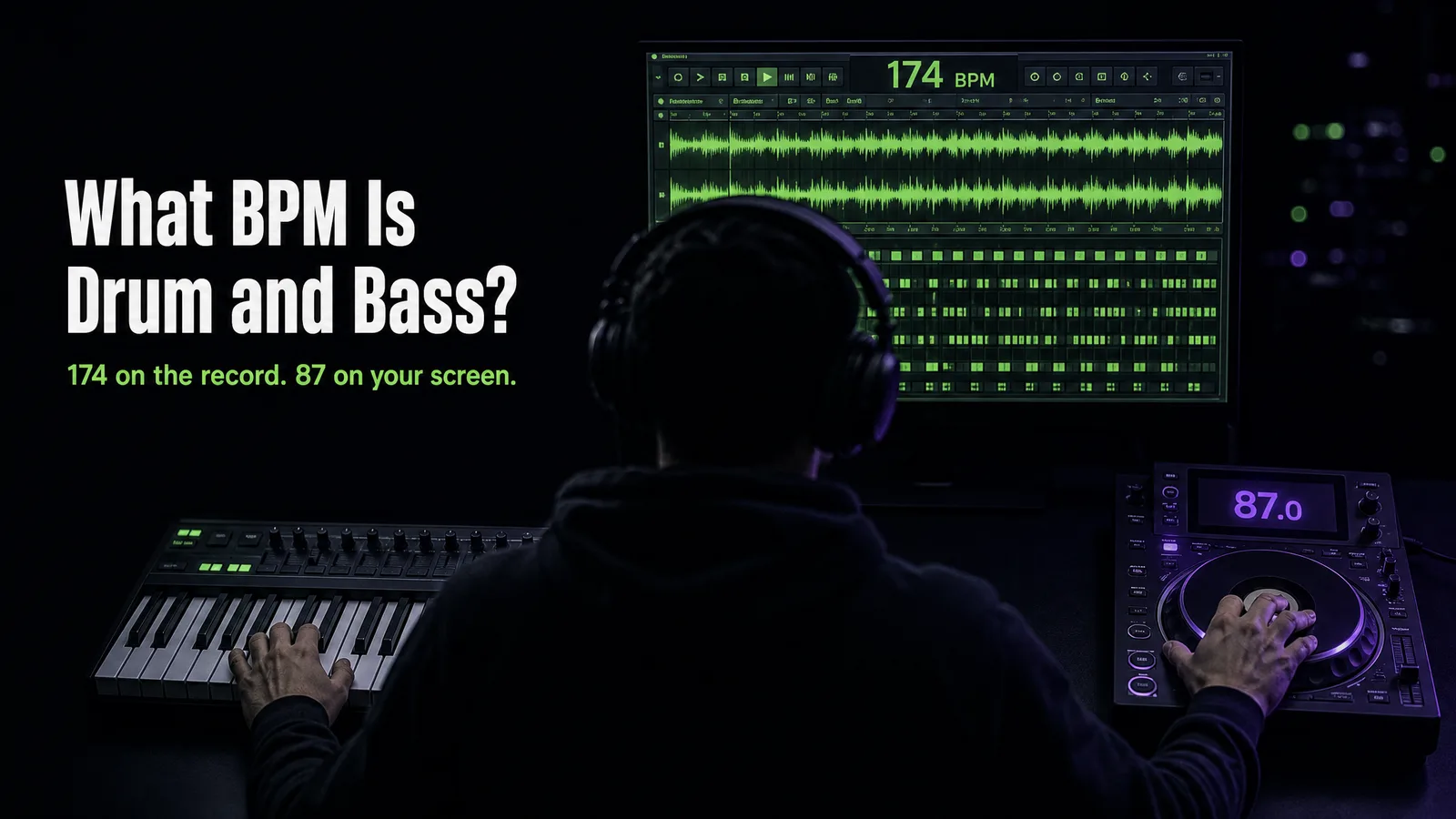
Drum and bass is 165 to 185 BPM in the published sources and 174 in practice: measured across 5,563 catalogued tracks, the full-tempo median is 174 and nine in ten sit between 170 and 184. Your DJ software will display the same records at about 87, which is that same tempo written on a different scale.
Both numbers describe the same breakbeats. 174 is the rate the drums are actually moving at, and the one that belongs in a project file or a description. 87 is a display convention, adopted so a beatgrid lines up in a way that is convenient to mix against. Doubling is always safe. The only real mistake is treating 87 as the speed of the music.
- The range is 165 to 185, and 174 is the default. Published sources give 165 to 185, with releases concentrated in 170 to 180 since about 1996. Production guides skip the range and quote a single number: 174.
- Measurement confirmed that number instead of correcting it. Across 5,563 catalogued tracks the full-tempo median is 174, with 90 percent between 170 and 184. It lands on the figure producers were already using.
- Your software displays the same music at about 87. Beatport, Rekordbox, Traktor and Serato all show drum and bass at half-time. A detector reading 87 is not broken, it is using the other scale: double it and you are back at 174.
- Here the tempo is part of the definition. The same elements at a slower tempo, say 140 BPM, would not be counted as drum and bass. House does not work that way, and that difference matters.
Quick facts
- Published range: 165–185 BPM, from Wikipedia's opening definition.
- Descriptive range: 160–180 BPM, from the musical features section of the same article.
- Production default: 174 BPM, quoted by iZotope as a single value with no range.
- Measured median: 174 BPM at full tempo, across 5,563 catalogued tracks.
- Where nine in ten sit: 170–184 BPM — the bottom of the published band is nearly empty.
- What your software shows: ≈ 87 BPM, half-time, by convention in Beatport, Rekordbox, Traktor and Serato.
The number everyone already knows
Most genres are quoted as a band. House gets 115 to 130, techno 120 to 150, dubstep somewhere around 132 to 142. Drum and bass is the exception, and you can watch a production guide run into it. iZotope's tempo guide walks through seven styles. Four of them get a band — hip hop 85 to 95, glitch hop 105 to 115, techno 120 to 125, house 115 to 130. Three get a single figure instead: electro 128, dubstep 140 with a half-time feel noted, and drum and bass 174, with no range and no note of any kind.
That is a strange thing for a reference to do, and it is not an editing slip. It reflects how the number is used. A producer opening a new project for a drum and bass track types 174 into the tempo field before writing anything, in the way a house producer might type 125 and then move. The difference is that the house producer is choosing a starting point inside a band, while the drum and bass producer is matching a value most of the material they are about to reach for is already sitting at. Sample packs are cut at 174. Breaks are sold stretched to 174. Two records made a decade apart can be expected to line up without anyone touching a pitch fader.
Why the genre converged on one integer rather than a band is a story about the sampled breakbeats it was built from, and about how far those breaks had to be sped up to get there. That belongs to the wider chart rather than to this page, and it is covered in why dance genres cluster at all. What matters here is the consequence: the folk number and the reference number are the same number, which is not something you can say about many genres at all.
What the published sources say
The definitional source is Wikipedia's drum and bass article, and like its house article it gives two different figures in two different places. Both are worth having, because they are doing different jobs.
The opening sentence describes the genre as characterised by fast breakbeats, typically 165 to 185 beats per minute. Further down, the section on musical features opens with a plainer statement: drum and bass is usually between 160 and 180 BPM. Then it narrows once more, and this is the sentence that actually describes the modern genre — since around 1996, tempos have predominantly stayed in the 170 to 180 range.
Those are not three competing claims. The first is a definitional boundary, drawn wide enough that no genuine record falls outside it. The second is a looser account of the same thing. The third is a statement about where releases have actually been for thirty years, and it is both the narrowest and the most useful of the three. The general mechanism behind that pattern — a lower bound marking where a style stops being itself, an upper bound marking where records stop appearing — is what makes published BPM charts disagree with each other, and it is set out in how to read a published range.
One practical consequence: the bottom of the published band is nearly empty. If drum and bass runs from 160, you would expect to find records at 161 and 163 and 165. In the measured data below, ninety percent of tracks sit at 170 or above. House behaves the same way, with a published floor of 115 sitting well under a measured floor of 121, and the reason is worked through in what the published sources say about house. It is worth knowing here mainly so you do not treat 162 as an ordinary drum and bass tempo. It is legal, and it is rare.
The same article also records where the genre started, and it is nowhere near 174: the earliest material ran at about 130 BPM in 1990 and 1991. That arc, and what it says about how far a genre's tempo can travel inside living memory, is traced in our chart of BPM by genre and subgenre.
What measurement says
Everything above is editorial: people who know the music writing down what they know. The useful complement is a count.
In March 2026 a DJ tools company called Mixgraph released tempo figures drawn from the 49,500 tracks in its own library, split into fourteen genre buckets and reported as a median with a fifth-to-ninety-fifth percentile band around it. It is a commercial site publishing figures from its own library rather than an independent study, and it is worth reading in that light. What it offers, and what almost nothing else on this topic offers, is a sample size printed next to every number.
The drum and bass bucket holds 5,563 tracks. Its median is 87, and its typical range is 85 to 92.
Those figures need one step of arithmetic before they mean anything, and Mixgraph supplies it in a footnote on the same page: drum and bass is shown at half-time, at about 87, to match how Beatport, Rekordbox, Traktor and Serato display it, and the full-tempo feel is double those numbers. Doubling gives a median of 174 and a ninety-percent band of 170 to 184.
Read that median against the production guide again. iZotope, writing for producers and quoting no range at all, says 174. A catalogue of 5,563 records, counted on the half-time scale and doubled back, also says 174. Two sources with nothing in common, one editorial and one arithmetic, landing on the same integer is unusual enough to state plainly: the number everybody repeats about drum and bass is correct.
That is not how this usually goes. The companion measurement for house tells the opposite story — the figure everybody repeats there is 128, and the same catalogue puts the median at 125, so the count quietly corrected the folklore. The comparison is in what measurement says about house. Drum and bass is the case where counting confirmed it instead, and the reason is not mysterious: a genre whose sample material is all cut to one tempo has something holding it there.
Set every figure on this page beside the others and the shape of the problem becomes obvious.
| Figure | Where it comes from | What kind of statement it is |
|---|---|---|
| 165–185 BPM | Wikipedia, opening definition | Definitional — the outer boundary of the label |
| 160–180 BPM | Wikipedia, musical features section | Descriptive — a looser account of the same genre |
| 170–180 BPM | Wikipedia, releases since about 1996 | Historical — where the records have been for thirty years |
| 174 BPM | iZotope production guide | The production default, given with no range at all |
| ≈ 87 BPM | Beatport, Rekordbox, Traktor, Serato | Display convention — half-time, for beatgridding |
| 87 BPM (85–92) | Mixgraph, 5,563 tracks, as displayed | Measured, reported on the half-time scale |
| 174 BPM (170–184) | The same 5,563 tracks, doubled | Measured, at the tempo the drums are moving |
| ≈ 130 BPM | Earliest releases, 1990–91 | Historical — where the genre began, not where it is |
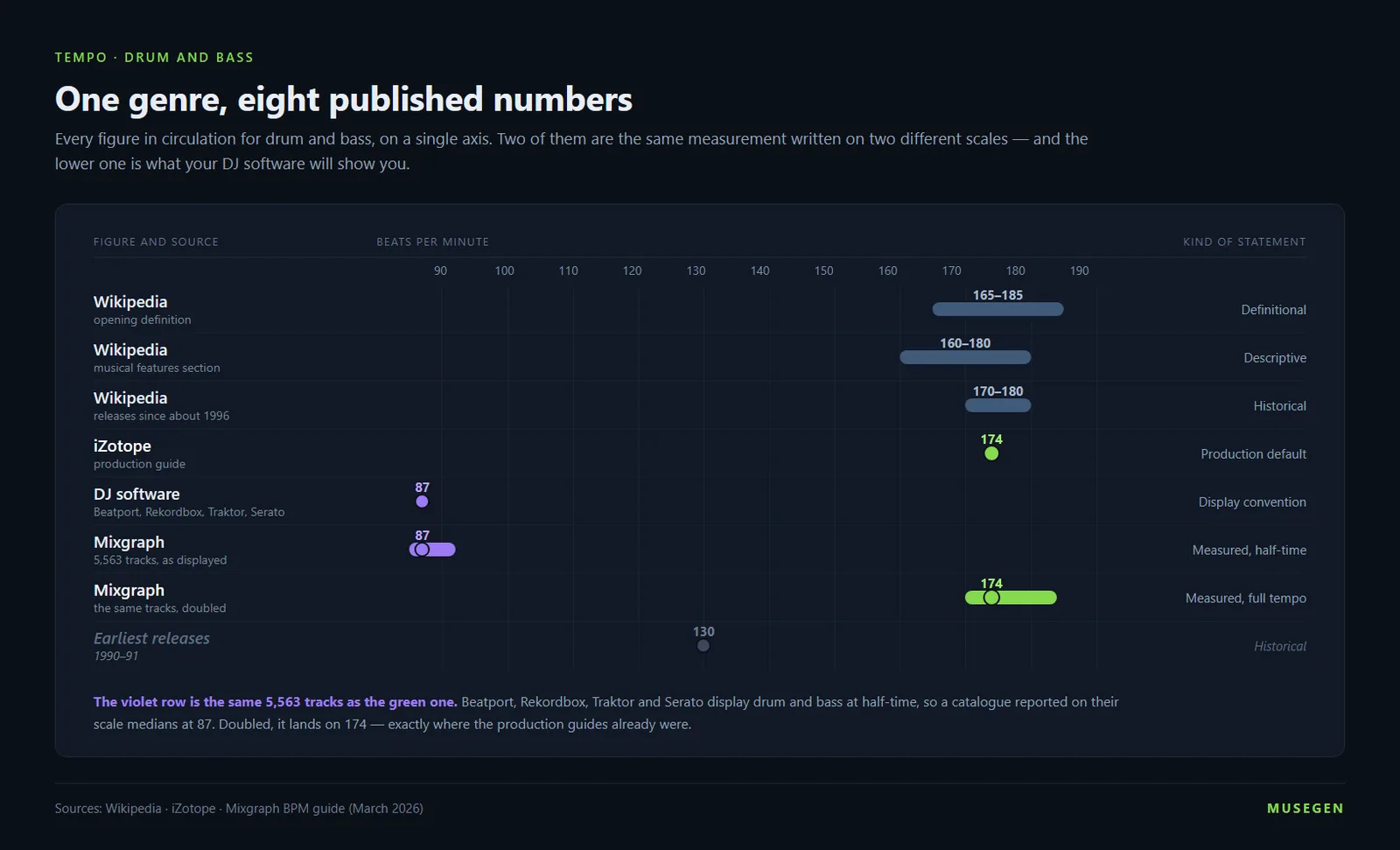
Eight published figures, one genre. Two of them are the same measurement written on two scales.
Eight rows, one genre, and not one of them contradicts another. Two are the same measurement on two scales. Three are the same encyclopedia at three levels of precision. One is thirty-five years old. The only row that will actively mislead you if you take it at face value is the display convention — which is, unhelpfully, the one your own tools hand you first.
Why your software says 87
Load a drum and bass record into Rekordbox and the tempo field reads something in the eighties. Look the same record up on Beatport and the listing agrees. This is not a detection failure, and it is not four tools disagreeing with each other. They have all made the same deliberate choice, and Mixgraph names them in its footnote precisely because its own published figures follow the same convention.
The reason is beatgridding. A DJ application does not just want a number, it wants a grid of bars to warp and align against. At 174 that grid is dense, and small errors in where the first downbeat sits compound quickly across a long track. At 87 the same music is described with half as many gridlines, each twice as long, and the software has an easier time keeping a break locked over eight minutes. There is a library argument too: a drum and bass record filed at 87 sits in the same numeric neighbourhood as hip hop and downtempo, which makes tempo-based sorting behave sensibly across a collection that is not all one genre.
What none of that changes is the music. The breaks in a drum and bass track really are hitting at 174 — the snare pattern, the ride, the rate at which the drums move past your ear. Nothing about the record is slow. 87 describes the ruler, not the thing being measured.
This is worth separating from a different phenomenon that also involves halves. Some music genuinely feels like half its written tempo, because the drums have been programmed sparsely enough that the ear counts the backbeat instead of the beat. That is a fact about how a track was written and how it is heard, with real consequences of its own, and the mechanics are in half-time and double-time on our page about BPM itself. Drum and bass at 87 is not that. The drums are dense, the music is fast, and the halving happens in the display layer rather than anywhere in the record.
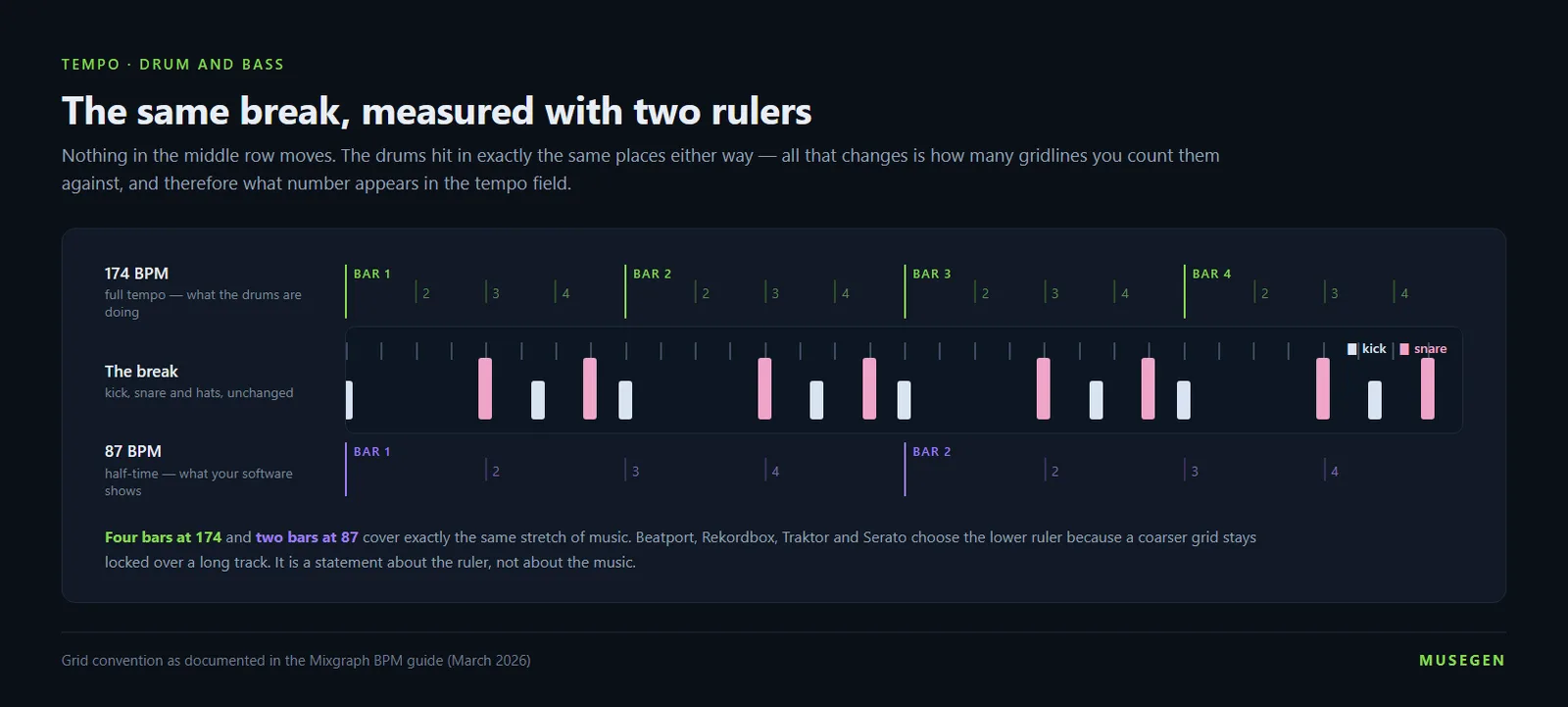
One break, two rulers. The hits land in the same places; only the gridlines counting them change.
The practical rules are short. If a tool reports a tempo in the eighties for something that is unmistakably drum and bass, double it and carry on. If you are setting a project tempo, use 174, because that is what your sample material is cut to, and stretching a break onto the wrong grid is audible. And if you are typing a number into a description of the music rather than into a DAW, use 174 there as well — 87 is a convention shared by four pieces of software, not a fact the rest of the world has agreed to.
▶ Watch on YouTube: "BPM Breakdown: Drum & Bass vs. Hip Hop Tempo Guide" — an outside tempo guide setting drum and bass against hip-hop, which is the same comparison this section runs.
When the tempo is part of the definition
There is one more sentence in that Wikipedia tempo section, and it does something the rest of the article does not. After giving the ranges, it says that a track combining the same elements as drum and bass but at a slower tempo — say 140 BPM — might not be drum and bass at all, and would more likely count as a drum and bass influenced breakbeat track instead.
Read that carefully, because it is a stronger claim than a tempo range. It says speed is not merely conventional here; it is a condition of membership. Take a drum and bass record, keep the breaks, keep the bass writing, keep the arrangement, slow it to 140, and the label stops applying. Not because the record got worse, but because it became something else.
Almost nothing else in the tempo chart behaves this way. The companion page on house reaches the opposite conclusion from the same kind of evidence. Four separately named house styles turn out to have medians of 123, 123, 124 and 125 — two beats per minute covering the lot, which leaves tempo unable to separate any of them. What distinguishes those is harmony and arrangement, and the argument is laid out in what the tempo does not tell you about house. It is worth reading next to this page precisely because the two genres put tempo in opposite roles.
For house, BPM is a shelf the record sits on. For drum and bass, it is closer to a door you have to walk through. That has a direct consequence for anyone filling in a project file, writing a brief or describing music to a machine: with house, getting the number slightly wrong gives you a house record at an unusual speed. With drum and bass, getting it substantially wrong gives you a different genre.
The same logic explains why jungle does not get a separate tempo. Jungle sits at around 170, inside the drum and bass band rather than beside it, and no reference source gives it a figure of its own that could be checked. The two are told apart by how the breaks are chopped and how the bass is written, not by speed. Anyone who tells you jungle is slower is describing a feel rather than a measurement.
The subgenre numbers that do not exist
A page like this usually finishes with a table of subgenres. Drum and bass cannot have one, and that is worth stating rather than papering over.
The genre has more named branches than almost anything else in electronic music: liquid funk, neurofunk, jump up, techstep, drumfunk, darkstep, hardstep, drill and bass, ragga jungle, jazzstep and a dozen more. Checked one at a time, their reference articles contain no tempo figures at all. The jungle article states none. The liquid funk article states none. The neurofunk article states none. On the measured side, the catalogue used above treats drum and bass as a single bucket of 5,563 tracks and does not split it, so there is nothing to count either.
Any chart offering you liquid at 172 and neurofunk at 176 is therefore reporting somebody's working habits. Those habits may well be real — a neurofunk producer probably does sit a beat or two above a liquid producer — but nothing behind the figure tells you how many records were checked, or whether anyone checked any. The house family had the same gap at subgenre level, and the reasons a reference work carries tempo figures for some styles and none for others are set out in the figures nobody publishes.
The difference is that house rewarded the digging. There the branches turned out to have distinct medians nobody had written down: 122 for Afro house, 127 for minimal and deep tech. Here the digging returns nothing, and after a while it becomes clear that the emptiness is the finding rather than an obstacle to it. Drum and bass really does run on one clock. Its branches are separated by drum programming, bass design and mood, and they share a tempo. That is why 174 works as an answer to a question about a genre with twenty subgenres, when 125 would be a poor answer to the same question about house.
174 is the right number. 87 is the same number written on the scale your software prefers. 140 is a different genre wearing the same clothes. Double anything in the eighties, start at 174, and treat the published range as a boundary rather than a menu.
Write 174, not 87
Every figure on this page describes the same music, and two of them are one keystroke apart in consequence. A tempo field will accept 87 without complaint. So will a written description. Neither will warn you that you have just specified music at half the speed you meant, and that is the single point where a harmless display convention stops being harmless.
It is also why MuseGen keeps the measuring step and the writing step on one site. Detect BPM takes a reference record and reports the tempo it was made at; when that record is drum and bass, knowing which of the two scales you are looking at is the whole job, and this page is how you tell. Whatever number you settle on is then worth typing out in full in the MuseGen AI Song Maker, where "drum and bass, 174 BPM, dense breakbeat, heavy sub bass, minimal melody" states the tempo outright instead of leaving it to be inferred from a genre word.
Getting the rest of that sentence to pull its weight is a separate craft, and MuseGen collects worked AI music prompts to start from. But tempo stays the cheapest variable to get right and the most expensive to leave open, because everything else is written against it. In a genre where the encyclopedia, the production guide and 5,563 counted records all point at 174, the description has no business being the one place that number is missing.
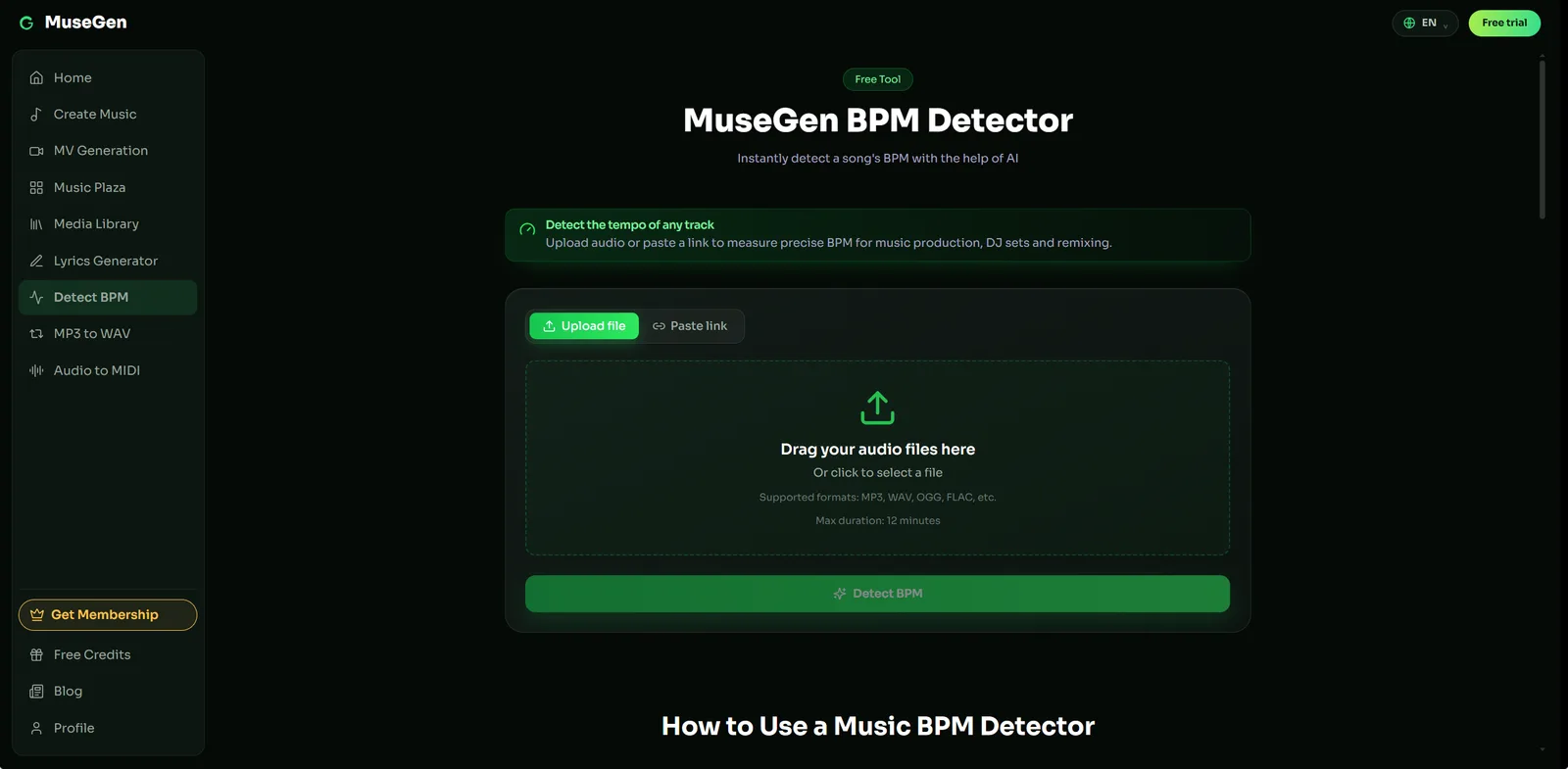
Detect BPM: read the reference, then decide which of the two scales the figure is on.
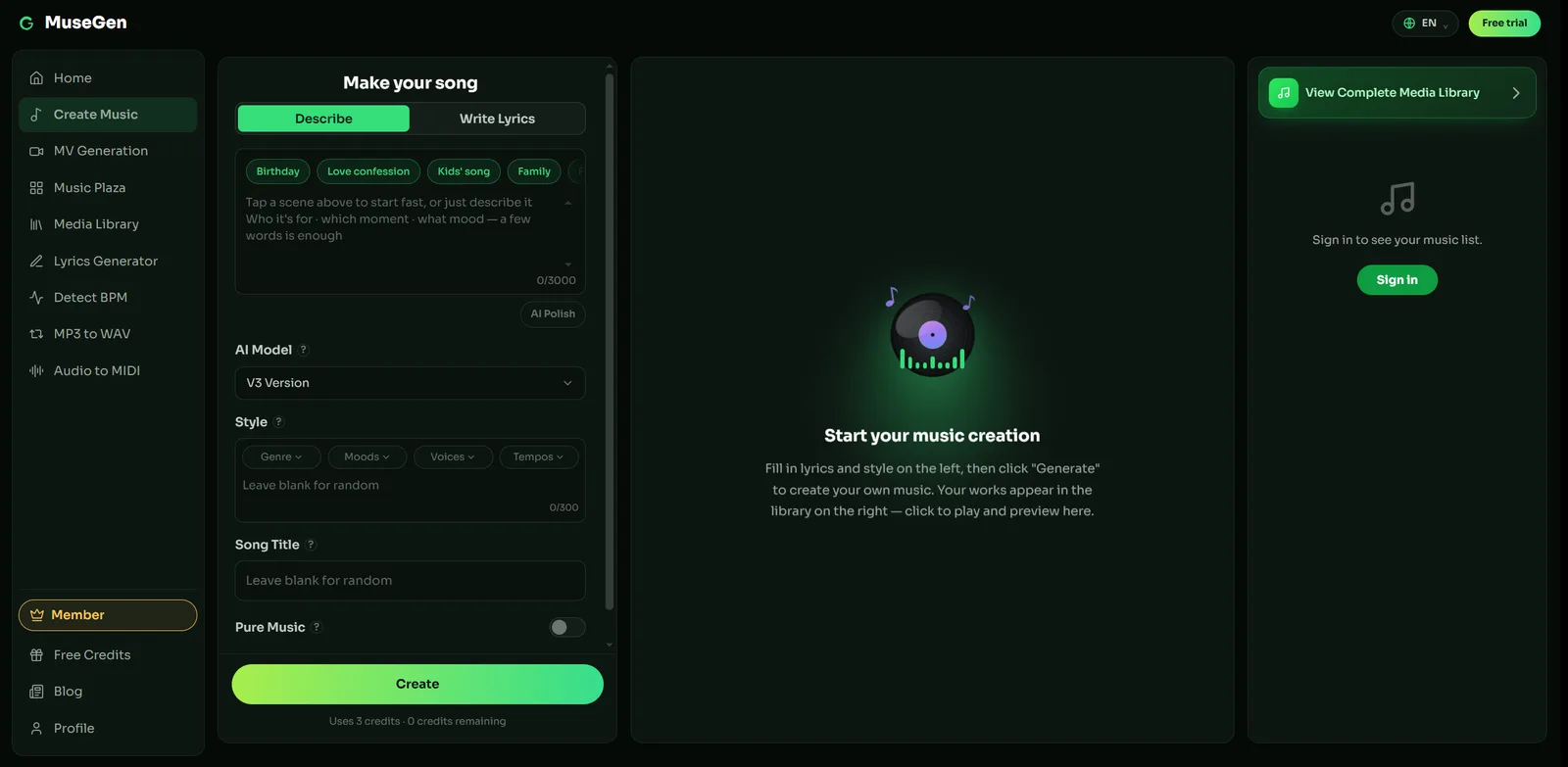
AI Song Maker: the genre word and the number go in together, because 174 is not implied by the word.
87 is a scale. 174 is the tempo. Measure the record you are aiming at, double it if it lands in the eighties, then put the number in writing — try MuseGen.
FAQ
Is drum and bass 174 BPM?
174 is the working default and it holds up under measurement. Published sources give a range of 165 to 185, and across 5,563 catalogued tracks the full-tempo median is 174, with 90 percent between 170 and 184. So 174 is not a rule, but it is genuinely the middle of the genre rather than a rough guess.
Why does my DJ software show drum and bass at 87 BPM?
Because Beatport, Rekordbox, Traktor and Serato all display drum and bass at half-time by convention, and 87 is half of 174. The breakbeats really are running at the faster figure. The software is choosing the scale that makes beatgridding and mixing across genres easier. If a tool hands you 87, double it.
What BPM is jungle?
Around 170, which puts it inside the drum and bass range rather than beside it. The two are not separated by tempo, and no reference source gives jungle a distinct figure of its own. What separates them is how the breaks are chopped and how the bass is written, not the speed.
What BPM is liquid drum and bass?
There is no figure that can be checked. The reference article on liquid funk states no tempo at all, and the catalogue data used on this page does not split drum and bass into subgenres. Any table quoting a specific number for liquid is reporting somebody's habit. Treat it as sitting in the same 170 to 184 band as the rest of the genre.
Is 160 BPM drum and bass?
It sits on the very bottom edge. Wikipedia's musical features section opens the range at 160, but releases are concentrated far above that: 90 percent of measured tracks are at 170 or higher. A track at 160 is inside the definition and outside where the music actually is.
What BPM should I start a drum and bass track at?
- It is the production default, it is the measured median, and it is where most reference material already sits, so anything you sample or layer lines up without stretching. Move off it once you know what the move is buying you.
Can drum and bass be slower than 165 BPM?
Some producers work in the 150 to 170 region, and Wikipedia notes this while still treating the mid 170s as the signature tempo. Below roughly 160 you have left every published range. At 140 the same elements would usually be described as a drum and bass influenced breakbeat track instead.
Is drum and bass just fast house?
No, and tempo behaves in opposite ways across the two. House subgenres sit within two beats per minute of each other, so speed cannot tell them apart at all. Drum and bass is built on breakbeats rather than a four-on-the-floor kick, and its tempo is close to definitional: move it far enough and the label moves with it.
Related reading
- BPM by Genre and Subgenre — the full tempo chart drum and bass sits inside, and how far its tempo has travelled.
- What BPM Is House Music? — the same measurement applied to a genre where tempo classifies nothing.
- What Is BPM? — the number itself, and why a detector sometimes reports half of it.
- How to Write AI Music Prompts — what belongs in the description once the tempo in it is settled.
Sources
- Wikipedia — Drum and bass for the 165–185 range and the definitional-versus-descriptive split.
- Wikipedia — Jungle music for jungle sitting inside the drum and bass band rather than beside it.
- Wikipedia — Liquid funk for the absence of any stated tempo at subgenre level.
- Wikipedia — Neurofunk for the same absence in a second named branch.
- iZotope — Using Different Tempos To Make Beats For Different Genres for the 174 production default given with no range.
- Mixgraph — BPM Guide: Tempo Ranges by Genre (March 2026) for the 5,563-track median and the half-time footnote.