What BPM Is House Music? The Real Range, Subgenre by Subgenre

MuseGen Team
9/17/2026
The number you find depends entirely on who you ask. Wikipedia's opening sentence on house says 115 to 130. Four paragraphs further down, the same article says 120 to 130. Producers in forums will tell you 128 without hesitating. And when someone actually measures a few thousand house records and takes the middle, the answer comes back 125. None of those is wrong, and that is the interesting part — they are four different kinds of statement about the same music, and knowing which kind you are reading is the difference between a number you can build on and a number you are just repeating.
The short answer
House runs 115 to 130 BPM in the published sources and clusters much more tightly than that in practice: measured across 3,587 catalogued house tracks, the median is 125 and nine in ten sit between 121 and 131.
The published range is the width of the doorway. The measured range is where people actually stand once they are through it. Both are useful, but for different jobs: the wide figure tells you what still counts as house, and the narrow one tells you where a house record will sound at home next to the ones around it.
- The published range is wider than the real one. Guides give house a 115 to 130 BPM range. A catalogue of 3,587 house tracks puts the median at 125, with 90 percent between 121 and 131.
- 128 is the chart figure, not the catalogue figure. A decade of dance chart data peaks at 128. Two separate measurements of modern catalogues land near 125. Both numbers are real, and they describe different populations.
- The whole house family fits inside five BPM. Afro house medians at 122 and minimal deep tech at 127. Every named subgenre in between is separated from its neighbours by one or two beats per minute.
- Tempo will not tell you which house you are hearing. Deep, progressive and melodic house all median within two BPM of each other. What separates them is chord density and arrangement, not speed.
Quick facts
- Published range: 115–130 BPM, from Wikipedia's definition and iZotope's production guide.
- Measured median: 125 BPM across 3,587 catalogued house tracks.
- Where nine in ten sit: 121–131 BPM — a ten-BPM window, not fifteen.
- Slowest branch: Afro house, median 122, and the tightest band of the family.
- Fastest branch: Minimal / deep tech, median 127, three under techno's 130.
- What none of it settles: Which subgenre you are writing. Tempo cannot separate them.
What the published sources say
Start with the two figures you are most likely to meet. They come from the same page and disagree.
Wikipedia's article on house music opens by describing it as having "a typical tempo of 115–130 beats per minute." That is the definitional sentence, the one designed to draw a boundary around what the genre is. Further down, in the section on the music's characteristics, the same article describes house as playing "at a tempo of between 120 and 130 bpm." That is a descriptive sentence, written about how the records tend to behave rather than about where the edge of the category lies.
iZotope's tempo guide for producers, which is a working reference rather than a definition, gives house as 115 to 130 — matching the first figure. So if you go looking, you will find 115 to 130 in some places and 120 to 130 in others, and both trails lead back to the same encyclopaedia entry.
This is not sloppiness. It is what happens when one number has to do two jobs. The lower bound of 115 exists to keep slow, dubby, downtempo-adjacent house inside the tent; almost nothing is actually made at 115. The lower bound of 120 exists because that is where a house record starts behaving like one on a floor. A definition has to be generous at the edges or it excludes real music. A description does not.
The same split is behind most disagreements between published BPM charts, which our chart of BPM by genre and subgenre covers in detail. House is a mild case: the gap is five BPM at the bottom of the range and nothing at the top.
What none of these figures are is measured. They are editorial: someone knowledgeable wrote down what they understood the convention to be. That is worth something, and for most genres it is all that exists. House is one of the few where it is not.
What measurement says
Mixgraph, a DJ tool, published a tempo guide in March 2026 built from its own catalogue: 49,500-plus tracks sorted into fourteen genre buckets, with a median for each and a typical range defined as the fifth to ninety-fifth percentile. It is a commercial catalogue rather than a research corpus, worth knowing before you lean on it. But it does the thing the editorial sources cannot: it reports how many tracks each figure came from.
For house itself, the sample is 3,587 tracks. The median is 125 BPM. Ninety percent of those tracks fall between 121 and 131.
That is a noticeably different shape from 115 to 130. The published range is fifteen BPM wide and centred on 122.5. The measured range is ten BPM wide and centred slightly above 125. The bottom five BPM of the published range — 115 to 120 — turn out to be nearly empty in practice, which is exactly what you would expect from a boundary drawn to be inclusive.
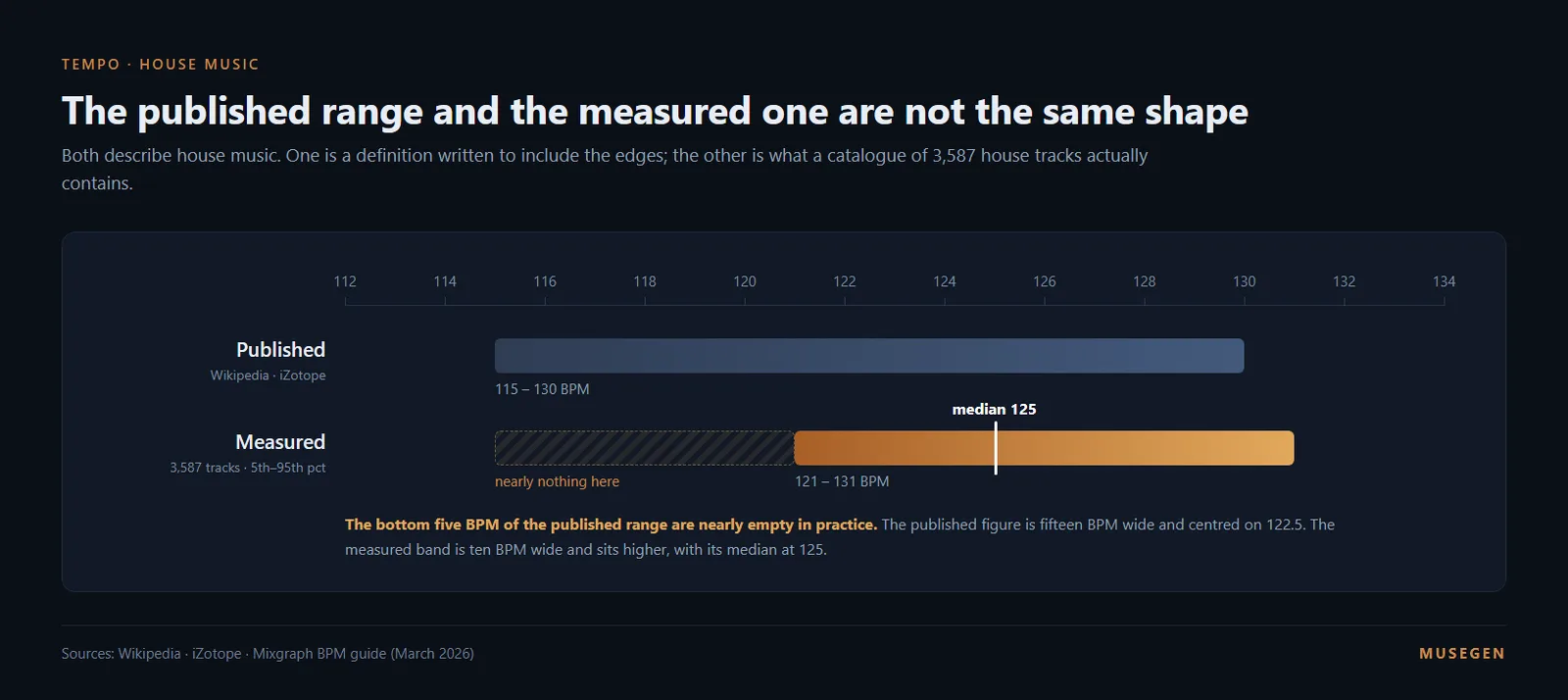
The published range and the measured one describe the same genre and do not have the same shape.
A second measurement points the same way from a completely different direction. EDMProd analysed the Beatport Top 100 track by track in a DAW and reported an average of 124.56 BPM across all one hundred. That is a small sample, it spans several genres rather than house alone, and it is a snapshot of one chart on one day. But two independent people counting actual records both landed within a beat of 125, having started from different libraries and different methods.
So where does 128 come from?
128 is the number everybody says, and it is not folklore. Dirk Moelants studied a decade of weekly dance chart data and found the distribution peaked at 128 for the entire period. That one value took 11.3 percent of every entry on its own; the band from 125 to 130 took 44.2 percent between them. It is a measured, published finding, and it is why 128 has that standing.
The thing to be careful about is what it was measuring. Moelants was counting chart entries across dance music as a whole between 1998 and 2008 — house, trance, hard dance and everything else that charted, weighted by what was popular. Mixgraph is counting a present-day catalogue filtered to the house tag. Those are different populations from different eras, and comparing them directly would be a mistake. This page is not claiming that house has changed speed; there is no dataset here that could support such a claim, because nothing measures the same population twice.
What you can say is narrower and more useful: 128 is the chart figure and 125 is the catalogue figure. If your track needs to sit next to what is charting in dance music generally, 128 is a defensible target. If it needs to sit inside the house catalogue, 125 is closer to the middle. Neither number is a correction of the other.
House, subgenre by subgenre
This is where measured data earns its keep, because the editorial sources go almost completely quiet at subgenre level — a gap worth looking at directly, once you have seen the size of what it is hiding.
The catalogue figures cover house itself, six branches of the family, and techno for contrast. Sample sizes are included deliberately: they are the reason to take these numbers more seriously than a chart someone assembled from memory, and they let you weigh the thin rows against the thick ones.
| Subgenre | Median | Typical range | Tracks measured | Character |
|---|---|---|---|---|
| Afro house | 122 | 118–125 | 1,806 | The slowest branch and the tightest — a seven-BPM spread |
| Deep house | 123 | 118–130 | 4,010 | Slow centre, wide tail; the loosest band of the family |
| Progressive house | 123 | 120–128 | 4,361 | Slower than most people guess; defined by build, not speed |
| Melodic house & techno | 124 | 120–128 | 2,537 | Sits between house and techno in name and in tempo |
| House | 125 | 121–131 | 3,587 | The centre of the family, and the answer to the title question |
| Tech house | 126 | 122–130 | 5,088 | The fastest main branch; the largest sample of the group |
| Minimal / deep tech | 127 | 120–132 | 4,628 | Fastest median in the family, reaching furthest at both ends |
| Techno (for contrast) | 130 | 124–140 | 6,582 | Overlaps house at the bottom, then keeps going |
Deep house is the one branch with an editorial figure to compare against, and both are worth printing rather than splitting the difference. Wikipedia gives deep house 110 to 125; the catalogue gives 118 to 130 with a median of 123. They disagree at both ends by roughly the same amount, and agree that deep house is the slow end of house. Averaging them would produce a number neither source supports.
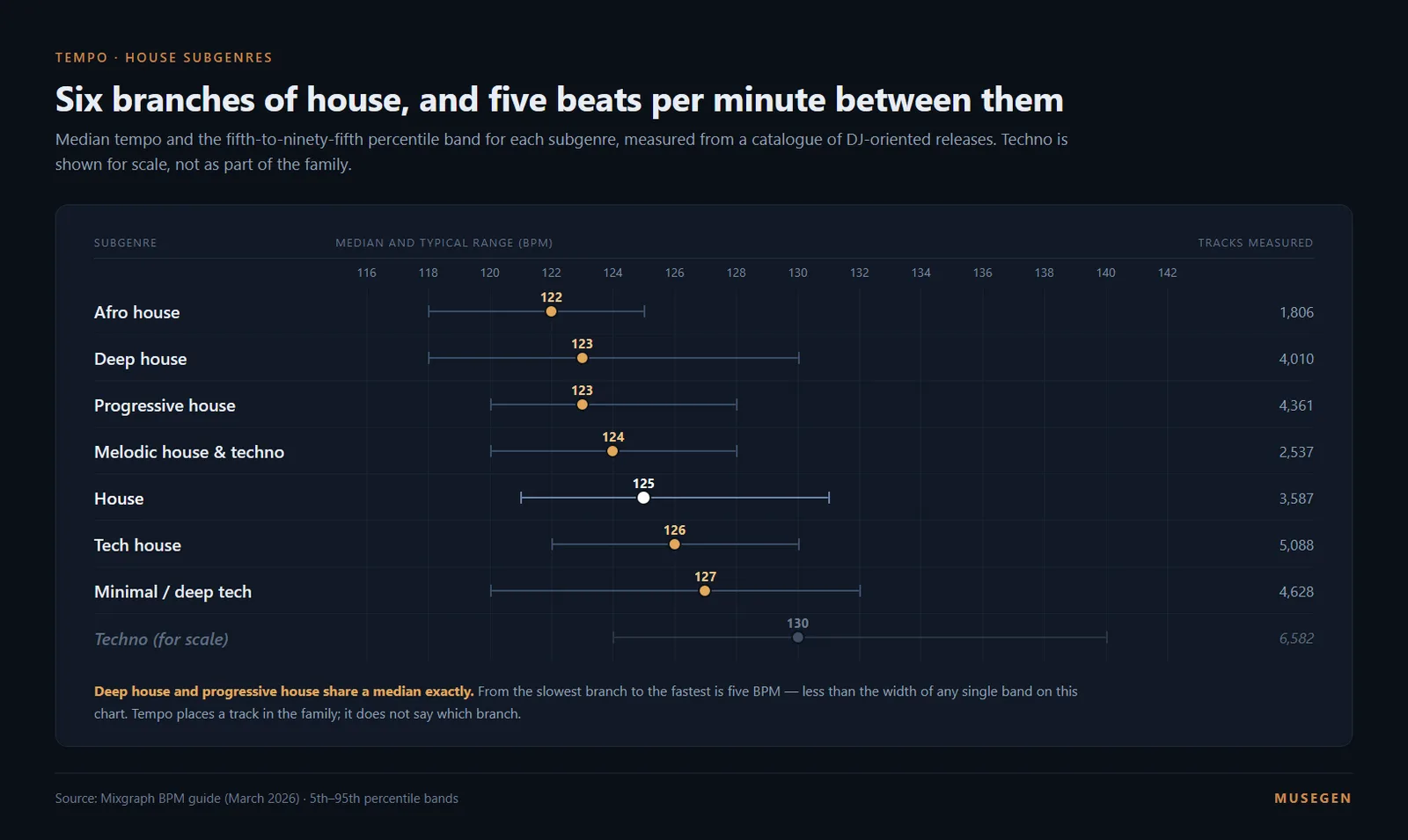
The house family branch by branch: medians, typical ranges and the sample each figure came from.
Look at the medians as a column and the headline finding is how little room the whole family occupies. From the slowest branch to the fastest is five beats per minute. Deep house and progressive house share a median exactly. Melodic house is one BPM above them. House itself is one above that. If you were handed an unlabelled house record and told only its tempo, you would have almost no information about which shelf it belongs on.
▶ Watch on YouTube: "What Is The Typical BPM Of Deep House? — Electronic Mix Masters" — an outside answer to the deep house tempo question, for comparison with the measured figures above.
The figures nobody publishes
It is worth stopping on how unusual that table is, because the reason it is hard to find elsewhere has nothing to do with the numbers being hard to get.
Of the six branches in it, exactly one carries a tempo figure in a general reference work: deep house, at 110 to 125. Tech house, acid house, progressive house and Chicago house have articles running to thousands of words about origins, records and clubs, and not one of them states a tempo — not a vague one, none. Tech house is the branch with the largest sample measured here, at 5,088 tracks. The music exists in quantity, it converges inside eight beats per minute, and the reference literature has no number for it at all.
The reason looks like a division of labour rather than an oversight. Reference articles are written by people documenting where a style came from and which records defined it. A tempo figure requires somebody to have counted, and counting is not what that kind of writing does. Deep house has a figure because its origin story attaches to a small, specific set of records a writer could describe precisely. The branches named later, mostly by DJs and record shops — tech house, minimal, deep tech — never received that treatment, and by the time they existed the people who cared about their tempo were reading Beatport rather than an encyclopedia.
So when a search returns "tech house is 125 to 130 BPM", the figure is real in the sense that somebody who makes tech house wrote it down, and unsupported in the sense that nothing behind it tells you how many records were checked. That is the mirror image of the problem described in our note on the genres no chart can honestly list, where no honest figure exists for pop or rock because nothing forces the music to converge in the first place. Here the convergence is real and it is tight. It has simply never been written down anywhere you would think to look.
Where house sits among its neighbours
The family is five BPM wide. The neighbourhood around it is not much wider, which is the part most people get wrong when they picture genres spaced out along a tempo axis.
The same catalogue measures three styles that border house on the family tree rather than sitting inside it. Disco and nu disco median at 122 across 1,386 tracks, with ninety percent between 115 and 127. Breaks and breakbeat median at 130 across 1,384 tracks, ninety percent between 120 and 136. UK garage medians at 134 across 1,647 tracks and reaches down to 125 at its slow end. Techno, already in the table above, sits at 130.
Line those up against house at 125 and the picture is uncomfortable for anyone who wants tempo to do classification work. Disco sits three beats below house; breakbeat five above; techno five above. The entire span from the slowest neighbour to the fastest is twelve BPM, and every one of those styles overlaps at least one other. A record at 127 falls inside the ninety-percent band of house, deep house, tech house, minimal, techno and disco simultaneously — six labels, one tempo, and nothing in the number to separate them.
One caution about the disco figure, because it is exactly the sort of number that invites a story. That bucket mixes older records with contemporary nu disco, so it measures what sits under the label in a working DJ catalogue today, not what was pressed in the 1970s. It cannot support any claim about how house compares to the music it grew out of, and this page is not making one. What it does support is narrower and more useful: if you are writing house for a disco-leaning set, 122 rather than 125 puts you where those records already are.
What moving inside the band does
With the whole family inside five BPM, it is fair to ask whether the choice matters. It does, but not the way a chart implies: moving within the band does not change the genre, it changes which company your track keeps.
At 122 you are in the densest part of Afro house and near the centre of deep and progressive house. The space between kicks is long enough that a swung hi-hat reads as groove rather than clutter, and it is the tempo at which house is most comfortable carrying a full vocal.
At 125 you are at the median of house proper and inside the typical range of every single branch in the table above. If you have no other information, this is the number with the fewest ways to be wrong.
At 128 you are above the median of every house subgenre listed and inside the top half of tech house and minimal. You are also at the centre of gravity of dance music charts generally, which is why it feels like the default even though the catalogue does not put it there. Records at 128 tend to be the ones written for a peak-time slot rather than an opening one.
At 131 and above you have left the ninety-percent band of house and entered techno's, which starts at 124 and runs to 140. Nothing stops you, and between 124 and 131 both genres are ordinary, but above 131 the tempo alone stops reading as house to anyone sorting by ear. What follows is a decision about arrangement rather than speed: the same 132 BPM will read as fast house or as slow techno depending on whether the chords keep moving.
None of this is a rule about where you must sit. The reason these bands are narrow at all is that dance records have to survive being played next to each other, and that constraint only binds you to the extent that it applies to your track.
What the tempo does not tell you
Four labels — deep house at 123, progressive house at 123, melodic house at 124, house at 125 — sit inside two beats per minute of each other, on samples running from 2,500 to 4,400 tracks each. These are not noisy buckets, and the convergence means something specific: tempo is not a classifier for house music.
If speed does not separate them, something else does. Chord density is the most reliable divider. Deep house typically keeps a seventh or ninth chord sustained across a bar or more, so the harmony moves slowly beneath a busy percussion layer. Progressive house moves its harmony more often and treats the arrangement as the main event, which is where the name came from. Tech house strips the harmony back further than either and puts the burden on the drums and a bassline, which is why it can sit three BPM faster without feeling rushed — there is simply less happening in each bar.
Percussion negative space is the second divider, and it works against tempo rather than with it. A tech house track at 126 often feels calmer than a deep house track at 123, because the faster one leaves more of each bar empty. That is why chasing energy by raising BPM usually does not work.
Then there is where the track is going. Two records at identical tempos can be built completely differently: one holding a single idea for eight minutes, the other stacking a build and a drop every ninety seconds. That is a question of structure rather than speed, and our guide to arrangement in music covers the decisions involved. The point here is only that the tempo does not make them for you.
So the honest version of the answer to the title question is two-part. House is 125 BPM at the centre and 121 to 131 across the bulk of it. And that number, on its own, will not tell you or anyone else which kind of house you are listening to.
115 to 130 is the width of the doorway. 125 is where the people inside are standing. Pick the first number when you need to know what still counts as house, and the second when you need a record that sounds at home among the ones it will be played beside.
The genre word will not carry the number
Nothing on this page tells you what to call your track. What it tells you is that "deep house" and "tech house" are three beats per minute apart, and that the words themselves will not carry those three beats into anything you write. A genre name is a bundle of assumptions, and the assumption about tempo is the one it carries least reliably.
That is a specific problem when you are describing music to a generator rather than playing it, and it is why MuseGen keeps the measuring tool and the writing tool on the same site. Detect BPM takes a reference record that already sits where you want to sit and returns the figure it was actually made at, rather than the figure its genre is supposed to imply. That number then goes into the description in the MuseGen AI Song Maker, where "tech house, 126 BPM, dry percussion, minimal harmony" constrains the tempo in a way that "tech house, driving" simply does not.
Getting the rest of the description to work as hard as the number is a separate skill, and MuseGen keeps a library of worked AI music prompts for exactly that. But tempo is the cheapest of the variables to get right, because it is the only one you can look up before a note exists — and the most expensive to leave to chance, because it is the grid everything else gets written against. A generated track at the wrong speed cannot be stretched to the right one without audible damage. Deciding the number first is not perfectionism; it is the one decision here that costs nothing.
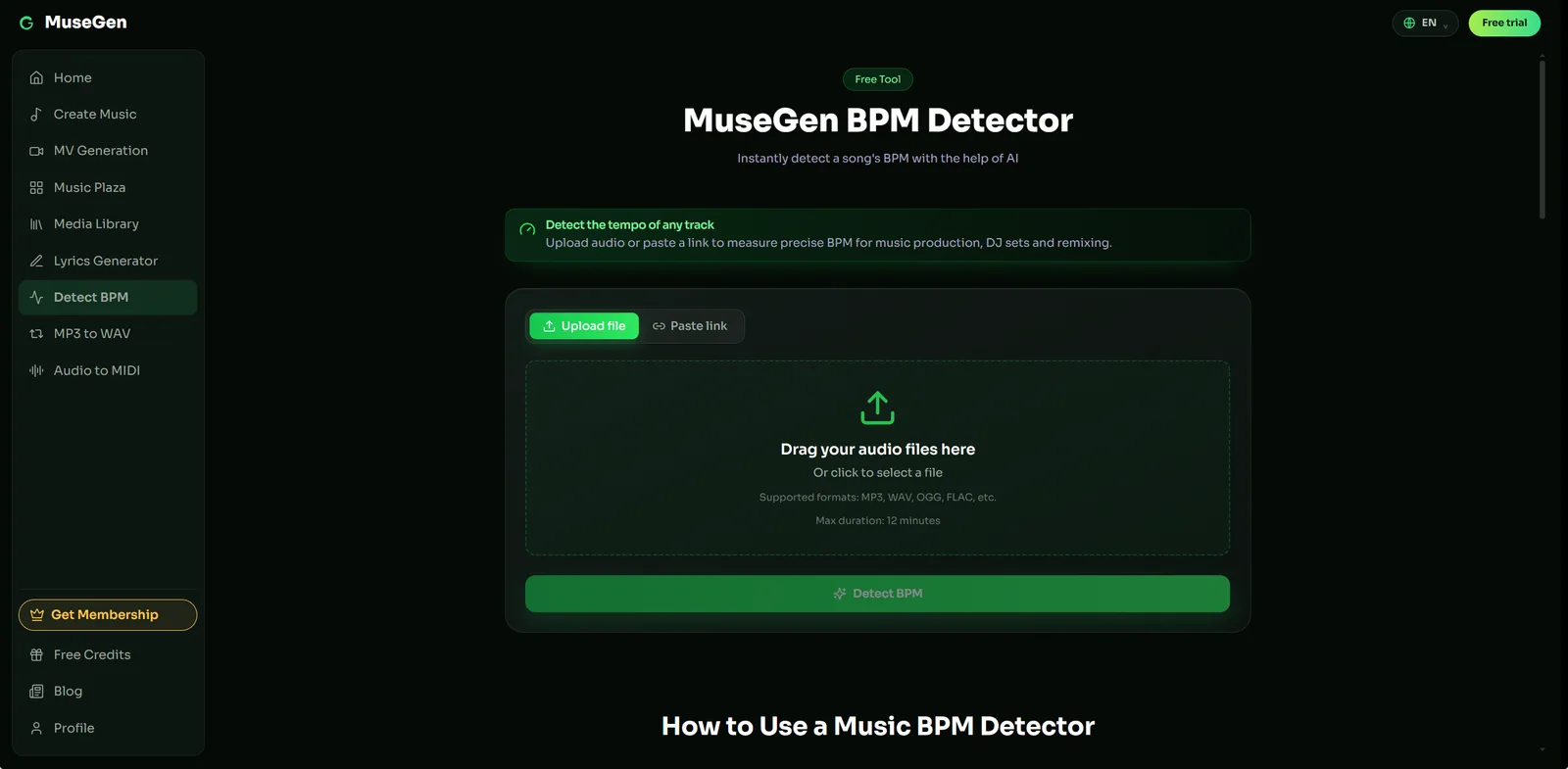
Detect BPM: the figure a reference record was actually made at, not the one its genre implies.
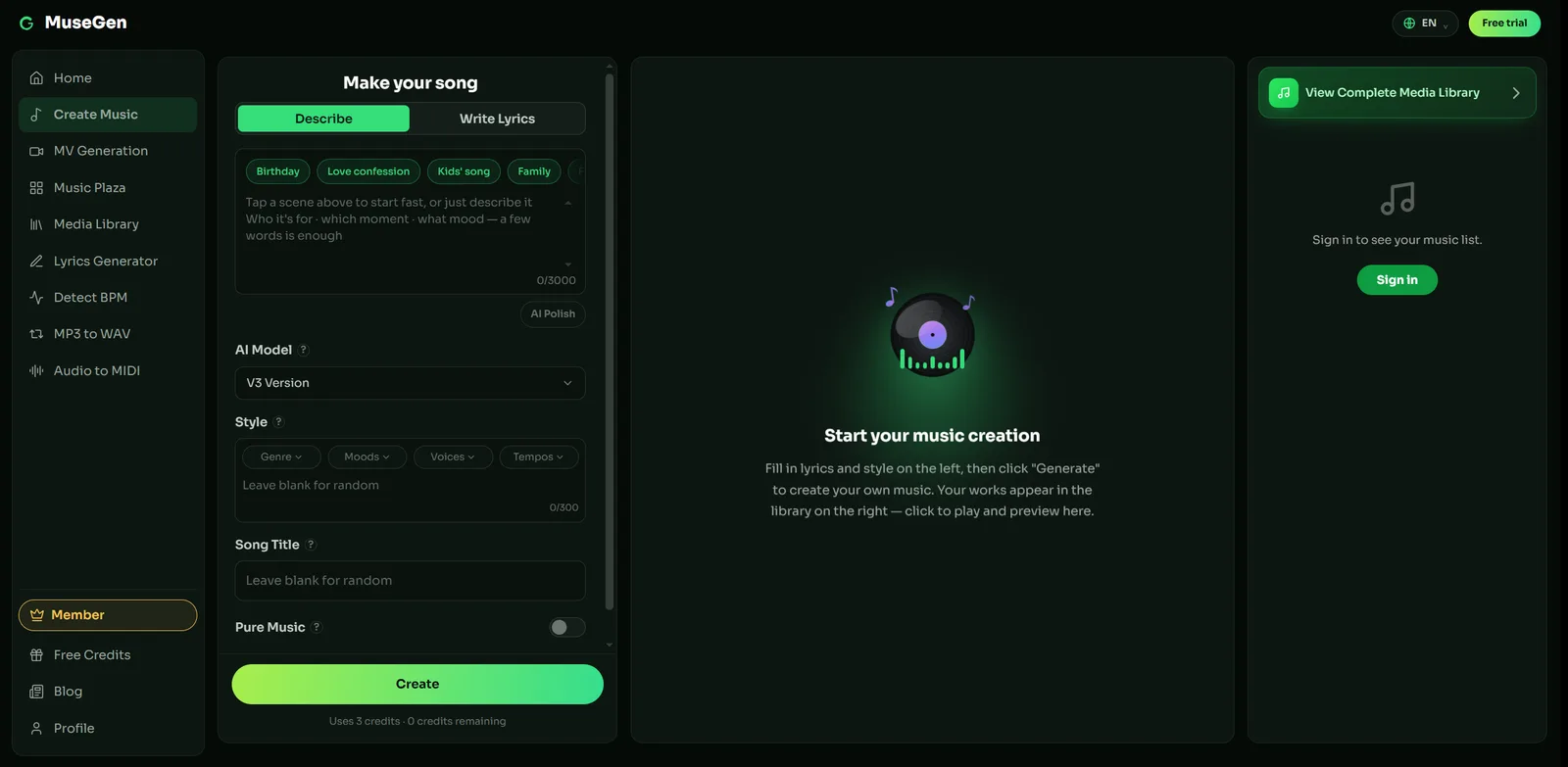
AI Song Maker: the subgenre and the number go in together, because the word alone will not carry it.
Three BPM is the difference between two subgenres. Measure the record you are aiming at, then say the number out loud in the prompt — try MuseGen.
FAQ
What BPM is deep house?
Measured across 4,010 catalogued deep house tracks the median is 123 BPM, with 90 percent between 118 and 130. Wikipedia gives a narrower editorial figure of 110 to 125. Both point at the same conclusion: deep house sits at the slow end of the house family, roughly two beats per minute under house itself.
What BPM is tech house?
126 BPM is the median across 5,088 catalogued tech house tracks, with 90 percent falling between 122 and 130. That makes it the fastest of the main house subgenres and the closest to techno, which medians at 130. Wikipedia's tech house article gives no tempo figure at all.
What BPM is progressive house?
The median is 123 BPM across 4,361 catalogued tracks, with 90 percent between 120 and 128. That surprises people who expect progressive house to be fast, and it is worth knowing that Wikipedia's progressive house article states no tempo at all. The genre is defined by how it builds, not by how quickly it moves.
What BPM is Afro house?
Afro house has the slowest median of the house family at 122 BPM, with 90 percent of 1,806 catalogued tracks between 118 and 125. It is also the tightest band of any house subgenre measured, spanning seven beats per minute where house itself spans ten.
Is house music always 128 BPM?
No. 128 is the most quoted number for house and it comes from real data, but that data is a decade of dance chart entries rather than a house catalogue. Two independent measurements of modern release catalogues put the centre closer to 125. Plenty of house is at 128; it is not where the middle of the genre sits.
What BPM should I start a house track at?
125 is the safest single starting point, because it is the measured median and it sits inside the typical range of every house subgenre. If you already know the substyle, start at its median instead: 122 for Afro house, 123 for deep or progressive house, 126 for tech house.
Can a house track be under 120 BPM?
Yes, and a measurable share of releases are. The bottom of the measured band for house itself is 121, but deep house and Afro house both reach down to 118, so anything from about 118 upward is ordinary. Below roughly 115 you are leaving what published sources still call house.
Does BPM alone make a track house?
No. Deep house, progressive house and melodic house all have medians within two beats per minute of each other, and house overlaps techno across most of its range. A tempo tells you which shelf a track could sit on. What makes it house is the four-on-the-floor pattern, the off-beat hi-hats and the chord writing, none of which are tempo.
Related reading
- BPM by Genre and Subgenre — the full tempo chart house sits inside, and why charts disagree.
- What Is BPM? — the number itself, and why a detector sometimes reports twice it.
- How to Make AI Song Mashups — matching two records that were never written at one speed.
- How to Write AI Music Prompts — getting the rest of the description to work as hard as the tempo.
Sources
- Wikipedia — House music for the 115–130 house range and the definitional-versus-descriptive split.
- Wikipedia — Deep house for the 110–125 deep house figure.
- iZotope — Using Different Tempos To Make Beats For Different Genres for the 115–130 production-guide range.
- Mixgraph — BPM Guide: Tempo Ranges by Genre (March 2026) for the catalogue medians and sample sizes.
- EDMProd — What We Learned From Analysing the Beatport Top 100 for the 124.56 BPM Beatport average.
- Dirk Moelants — Hype vs. Natural Tempo: a Long-term Study of Dance Music Tempi (ICMPC 2008, Ghent University) for the 128 BPM chart peak and the decade-long distribution.