ElevenLabs Music Review 2026: Pricing, Limits and Fine Print

MuseGen Team
10/14/2026
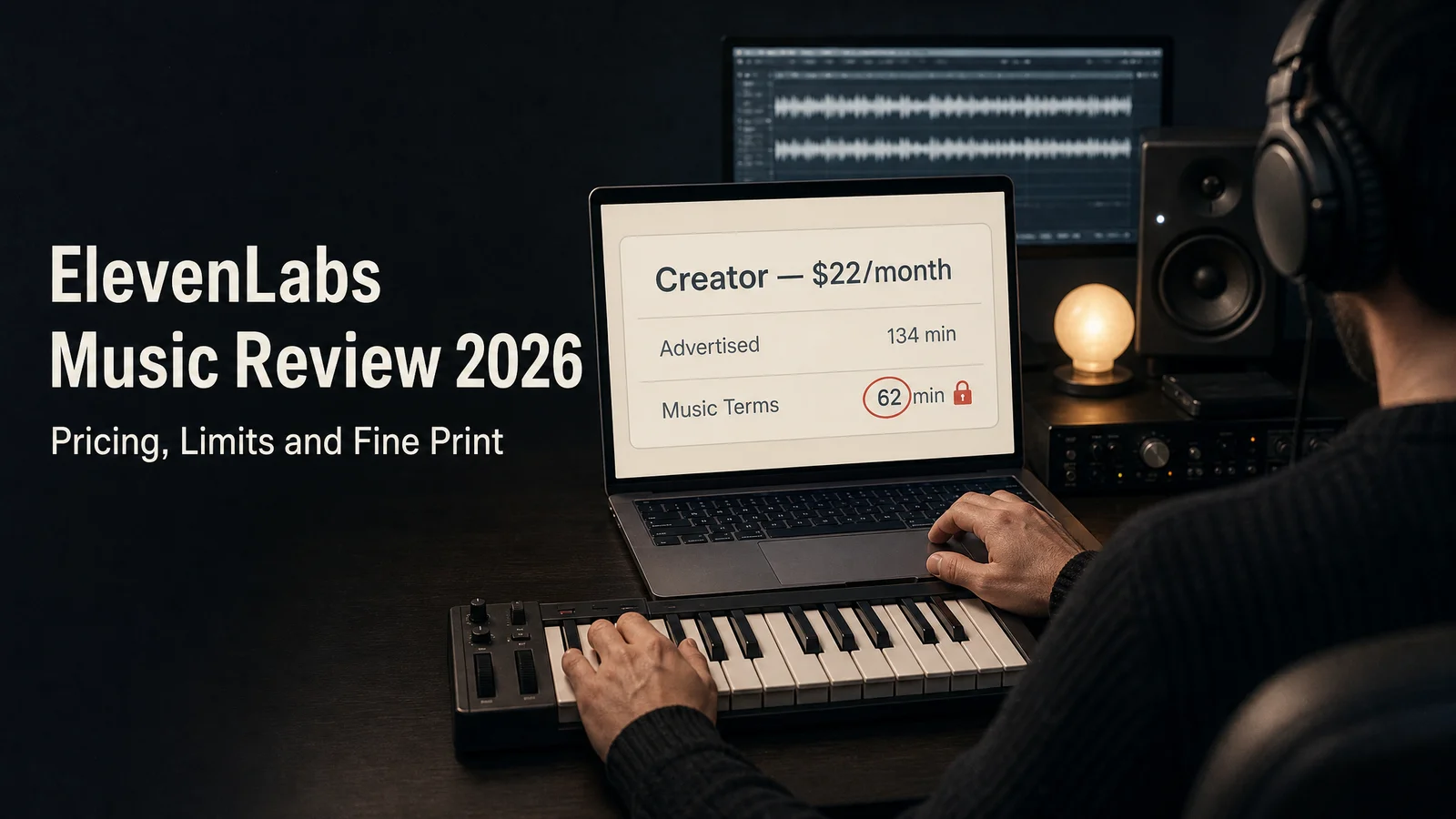
Reviewing ElevenLabs Music turned into a different exercise than we planned. How it sounds is something the free tier lets you judge for yourself, and we explain below why we have not run a listening test of our own. The hard part was answering a question that should have taken one minute: how much music does a paid plan let you make? The product page, the pricing page and the credit arithmetic all give one answer. The Music Terms, the document you actually accept, give another, and on the most popular plan it is less than half the first.
In short
Eleven Music is the only service in this category that sets out what you may do with the output in a versioned contractual table rather than a paragraph of marketing, and it gives you inpainting on every plan including the free one. Both of those are real advantages, and we are a company selling against ElevenLabs while we say so.
The catch is not quality. It is that the allowance ElevenLabs advertises is not the allowance its contract grants. Creator at $22 a month appears as 134 minutes on the product page and in the pricing comparison, which is also what its credits buy at the published music rate. The Music Commercial Rights table in the Music Terms sets a Monthly Generation Limit of 62 minutes, and the Terms make compliance with that table a material obligation. Layered on that are restrictions no rival imposes: film, TV, radio and commercial games from anyone above indie revenue thresholds are excluded from every self-serve plan, and prompts may not name any artist or song.
- Read the Music Commercial Rights table first, not the pricing page. It is the document you agree to, and on every paid plan its generation limit is below the advertised one.
- Check the exclusion against your actual work. Film, TV, radio and commercial games are carved out of every self-serve plan and of Enterprise Music Lite, unless the game qualifies as an Indie Game by revenue.
- Check your headcount, not just your budget. Plans below Scale are individual-use only; Business stops at 50 employees.
- Check the download limit separately from the generation limit. They are different numbers, measured in minutes, and on some plans one is larger than the other.
Quick facts
- What it is: A text-to-music generator inside the wider ElevenLabs audio platform, launched August 5, 2025
- Current model: Music v2, announced May 26, 2026; v2.5 falls inside the same v2 terms family
- Song length: 3 seconds to 10 minutes per generation
- Plans: Free, Starter $6, Creator $22, Pro $99, Scale $299, Business $990 per month; annual billing bills ten months
- Credits: One shared pool across every ElevenLabs product; music costs 900 credits per minute
- Binding generation limit: Free 11, Starter 17, Creator 62, Pro 304, Scale 1,100, Business 4,800 minutes a month
- Download limit: Free not permitted; then 30, 250, 500, 1,500 and 4,000 minutes a month
- Commercial use: Paid plans, excluding film, TV, radio and Studio Games (commercial games above indie revenue thresholds) on every self-serve tier
- Licensing: A multi-year agreement with Universal Music Group published September 10, 2026, plus a collaboration with Believe
- As of: October 2026 — confirm current figures on ElevenLabs' own pricing and terms pages
What Eleven Music is in 2026
ElevenLabs built its name on synthetic speech, and music arrived late: Eleven Music launched on August 5, 2025, roughly thirteen months before this review. It is not a standalone product. It sits inside the same subscription as text to speech, speech to text, sound effects, voice changing and dubbing, and it draws on the same monthly credit pool as all of them. That last detail matters more than it sounds, and we come back to it.
The current model is Music v2, announced on May 26, 2026, with a v2.5 iteration since. You write a prompt, optionally supply lyrics, and get back a complete track with vocals and arrangement. Three capabilities distinguish it from the field. Inpainting lets you select a section of a finished track and regenerate only that section, which is the same idea Udio pioneered and which only a handful of tools offer, MuseGen's Edit song section among them. An Audio Reference feature accepts an uploaded clip of around thirty seconds as creative guidance, screened for copyright compliance before use, and the documentation is explicit that it does not copy or remix what you upload. Finetunes let you train a reusable style or vocal from your own material in roughly five to ten minutes. What each of the three looks like on screen, and what each one draws from the credit pool, is the subject of our Eleven Music walkthrough.
Generations run from three seconds to ten minutes. There is a Music API for paid subscribers, and a Marketplace, added March 19, 2026, where paid users can publish and earn from what they make. On September 10, 2026, ElevenLabs published a multi-year licensing and product agreement with Universal Music Group — the first major-label deal in its music business. Worth noting precisely: the new fan-facing platform that deal describes is, in ElevenLabs' own words, distinct and offered separately from Eleven Music, so it is not a change to the product reviewed here.
Advertised 134 minutes, binding 62: the allowance gap
Here is the question that should have been trivial. You are considering Creator at $22 a month. How many minutes of music may you generate?
ElevenLabs answers on four surfaces. We first read them on September 22, 2026, and read them all again on October 13, after the company replaced its music terms on October 9.
- Product page comparison: 134 minutes, annotated “~34-67 tracks”
- Pricing page, Compare plans, Music tab: 134 minutes
- Credit arithmetic: 121,000 credits at 900 credits per minute, both figures published on the pricing page, giving 134.4
- Music Terms, Exhibit A: Monthly Generation Limit: 62 minutes
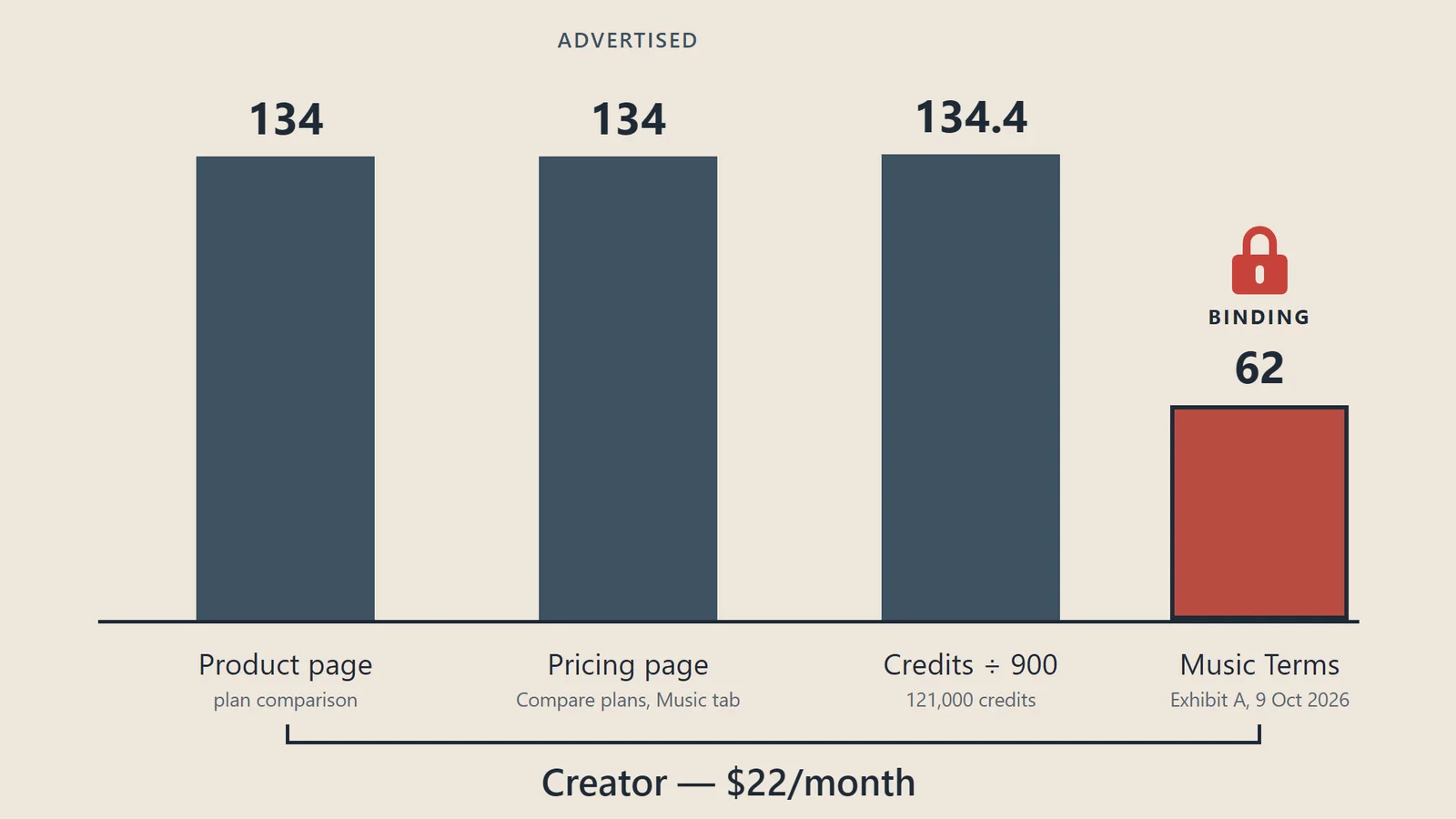
Three surfaces advertise 134 minutes for Creator; the one you accept sets 62
The three marketing surfaces now agree with each other, which is progress. In September the Creator card on the pricing page carried a third figure, “31 minutes of Music”; by October 13 that line had gone and the pricing comparison matched the product page. What has not moved is the contract, and the gap repeats across the range. Starter is advertised at 33 minutes and bound at 17. Pro: 667 against 304. Scale: 2,000 against 1,100. Business: 6,667 against 4,800. Only Free lines up, at 11 minutes everywhere.
One pattern in that is arithmetic rather than inference: the advertised figure is the plan's credits divided by 900, so it is consistent with the credit rate ElevenLabs publishes. The Terms figure follows no rule visible from outside, and we are not going to invent one. What we can do is tell you which number binds you.
The Music Terms, last updated on October 9, 2026, answer that. They make the Music Commercial Rights table, Exhibit A, part of the Terms, and state that “your compliance with the terms and limitations that apply to your plan is a material obligation under the Underlying ElevenLabs Agreement.” A product page and a pricing comparison are not part of that agreement; the table is. The same document reserves the right to “apply concurrency, generation, download, or duration limits”, which is the generation limit's footing.
So on Creator the operative figure is 62 minutes, not 134. The practical consequence is peculiar but real: you can be holding unspent credits and still be at your contractual generation ceiling, because the credits you bought and the minutes you are permitted are set in two different places. In fairness to ElevenLabs, no competitor publishes a table this precise at all, which is exactly why the conflict is visible here and invisible elsewhere. The fix is also trivial for them, which is why it is worth writing down.
The second limit nobody mentions
The Music Commercial Rights table carries a row that appears on no marketing surface at all: Monthly Download Limit, also counted in minutes, and separate from the generation limit.
On the free plan it reads “Not permitted” — the free tier generates music you cannot export. From there it runs 30 minutes on Starter, 250 on Creator, 500 on Pro, 1,500 on Scale and 4,000 on Business. Set those beside the generation limits and the relationship is not what you would expect. Starter may generate 17 minutes but download 30. Creator generates 62 and downloads 250. Pro generates 304 and downloads 500. Then Business inverts: 4,800 minutes of generation against 4,000 of download. The download allowance is the looser constraint on four plans and the tighter one on the largest, which is the opposite of how these things usually scale.
There is a sensible reading of the generous middle: the pricing FAQ states that credits are charged per generation request rather than per download, so downloading the same track more than once does not cost credits, and a download allowance several times the generation allowance leaves room for that. That is our reading of two published facts, not something ElevenLabs says.
Format is its own muddle. The product page comparison ticks a Lossless WAV row from Creator upward. The documentation says flatly that “generated audio is provided in MP3 format with professional-grade quality (44.1kHz, 128-192kbps)” and that “other audio formats will be supported soon.” The Music Terms list High-Quality Downloads (lossless WAV or 192 kbps mp3) as No on Free, Starter and Creator, and Yes only from Pro up; the documentation draws the same line, grouping Free, Starter and Creator together as standard export quality. So the product page offers Creator a lossless WAV that the contract reserves for Pro, while the documentation says WAV is not offered yet at all. If the delivery format is load-bearing for your work, that is a thing to verify inside the account rather than from any page outside it.
One row does behave well: stems. The product page lists two and four stems from Starter and up to six on Pro, and the Terms grant API access on every paid plan. Unlike the minutes and the WAV row, nothing else ElevenLabs publishes contradicts it.
What you are not allowed to type
Most AI music services restrict what you may do with the output. Eleven Music also restricts what you may put in, and the list is stricter than anything comparable in the category. Section 2.1 of the Music Terms, headed Prohibited Prompts, says you may not submit as input, or otherwise prompt the service with:
- Any artist's real name or stage name, whether living or deceased.
- Any songwriter's real name or stage name, on the same terms.
- Any song title.
- Any album title.
- Any music publisher's name.
- Any record label's name.
- A substantial or distinctive portion of any song's lyrics, where a reasonable person would conclude the prompt was meant to reference a particular song.
Read that list against how people actually prompt these tools. The single most widely taught technique in AI music is to name a reference — in the style of some artist, something like a particular record. On Eleven Music that is not a discouraged habit or a filtered request. It is an express breach of the agreement you accepted, and prompting advice written for other generators does not transfer here. A separate clause adds that you may not prompt output replicating or mimicking the voice or identifiable characteristics of a recording artist in a way likely to mislead or imply endorsement.
The workaround is the thing good prompting advice recommends anyway, and ElevenLabs' own documentation recommends it too: describe the music rather than pointing at it. Genre, tempo in BPM, instrumentation, arrangement, mood, vocal character, production era. Something on the order of brooding downtempo r&b, 74 BPM, muted electric piano, close double-tracked female vocal, tape saturation on the low end carries more usable information than any artist name, and it does not put your account at risk. If you want the general method, we wrote it up in our guide to writing AI music prompts.
We should be fair about why this list exists. A company that has signed with Universal and is licensing from Believe has undertakings to honour, and banning reference-by-name is a coherent way to honour them. It is a stricter product because it is a more licensed product. That trade is defensible — it just needs to be known before you subscribe, and it sits in a terms page rather than anywhere near the prompt box.
Who is eligible to buy it
Further restrictions sit in the same table, and they catch people out because nothing on the pricing page hints at them.
The main one is headcount. Free, Starter, Creator and Pro are marked For Individual Use Only. Scale is open to individuals or organisations with fewer than 10 employees, and Business to those with fewer than 50. Above that, the only route is Enterprise. A sixty-person agency cannot lawfully buy any self-serve plan, however much it is willing to pay, and the Terms warn that enrolling in a plan you are not eligible for “may result in suspension or termination of your account or loss of Output, Fees, or credits.” Two more rows: Model Resale and Music Library Creation and Distribution are Prohibited on every self-serve plan, so building a catalogue of generated output to license onward is off the table without an Enterprise agreement.
Sector is the other variable, and it changed in October. The September terms barred whole industries from the product, from firearms and tobacco to religious organisations and political campaigns. The October 9 rewrite drops that list. What remains is a general right to “condition availability on your location, your processing region, your industry or sector, your plan” where a legal, regulatory or third-party requirement calls for it, and a line in the usage policy against political campaigning without ElevenLabs' prior written consent. That is looser than before, but it is still a condition ElevenLabs can apply to you, not a content filter you might get around.
One clause in this area is unambiguously in the customer's favour and deserves saying. Upgrade, and all output already in your account becomes subject to the higher plan — rights improve retroactively. Downgrade or cancel, and existing output keeps the rights of the plan it was made under; only new output follows the new plan. That is a cleaner arrangement than most of this industry offers, and it means a short spell on a higher plan permanently lifts the work made during it.
What it actually sounds like
Here we have to be straight with you about the limits of this review. We have run no blind comparison, and we could not find third-party coverage of Eleven Music from 2026 that we were willing to cite. The most prominent English-language article that search surfaces on the subject carries a publication date of May 2024, more than a year before the product existed, so whatever it describes is not this. We would rather say that than dress up a search summary as a listening test.
What we can report is what ElevenLabs claims, marked as such. The Music v2 announcement promises better vocals, instrumentation and arrangement across genres, long-form composition, fast rap, mid-track genre transitions, improved inpainting and multilingual support, with lyrics and arrangements meant to sound native to the language they are written in. The product page demonstrates opera-to-metal transitions inside a single continuous track. Those are the vendor's descriptions of the vendor's product.
The free tier is where you resolve this for yourself, and the honest advice is to use it before reading anyone's opinion, ours included. Eleven minutes is enough to hear whether the vocals convince you on the kind of material you actually make. One thing to have in mind while listening, because ElevenLabs states it in its Terms of Service and it applies to every tool in this category: output “may not be unique across users, as the Services may produce the same or similar Output for you and a third party.” That is unusually candid for a disclaimer and worth reading before you build a brand on a generated theme.
What it does genuinely well
This review spends a lot of words on fine print, so the strengths deserve the same precision.
- The commercial terms are a contract, not a claim. Eleven Music publishes a versioned Music Commercial Rights table, plan by plan, row by row, and the Terms make compliance with it a material obligation. No other service in this category does that. The conflicts documented above are visible only because the document exists.
- Inpainting is available on every plan, including the free one. The product page ticks Inpainting and section editing on every plan, Free included. Being able to repair a section instead of rerolling a whole track is the most useful editing idea in AI music, and this is the cheapest place to get it.
- The Universal agreement is a licence, not a settlement. Published September 10, 2026, it is a multi-year licensing and product deal rather than the resolution of a lawsuit, which is a materially different starting position from most of the field.
- Rights improve retroactively when you upgrade. Everything already in the account is treated as though made under the new plan, and a later downgrade does not claw that back.
- Stems from the entry paid tier. Two and four stems from Starter, up to six on Pro, and API access on every paid plan.
- One subscription covers the whole audio platform. The same credits buy speech, sound effects, voice changing and dubbing. For anyone already producing narration or video, the music is close to free at the margin.
Where it falls short
None of these are secrets ElevenLabs is hiding. Each is published somewhere on its own site — the difficulty is that the pages disagree with each other, and the version most people see first is rarely the binding one.
The allowance ElevenLabs advertises is not the one it grants: Creator is sold as 134 minutes a month and bound at 62, with a gap on every paid plan.
The binding figure is at least published, in a table the Terms make part of the contract. On most rival services there is no equivalent number to be in conflict with.
Film, TV, radio and Studio Games are excluded from every self-serve plan, and from Enterprise Music Lite too. Only full Enterprise Music has no exclusion.
Indie games are carved back in: a game under $500,000 in lifetime revenue, from a studio whose games earned under $1,000,000 in its last financial year, is not a Studio Game, and the vast majority of online commercial use is permitted outright.
Prompts may not contain any artist, songwriter, label, publisher, song or album name, which invalidates the most commonly taught prompting technique in AI music.
It is the direct consequence of holding real licences, and descriptive prompting produces better results anyway. The documentation explains how.
Free and Starter cannot release to streaming platforms at all, so the $22 Creator plan is the real entry point for anyone publishing music.
Both the Terms and the product page state this consistently, which makes it one of the few limits you cannot be surprised by.
The product page advertises lossless WAV from Creator upward, the Terms reserve high-quality downloads, lossless WAV included, for Pro and above, and the documentation says every export is MP3.
ElevenLabs' own docs say other formats will be supported soon, so this looks like a page that has run ahead of the product rather than a claim with nothing behind it.
The pattern across all five is the same, and it is worth naming because it changes what you should do rather than merely how you should feel. Nothing here is hidden. Every figure in this review came from a page ElevenLabs publishes, and most of them from pages it wrote specifically to tell you the answer. The problem is that the answers were written by different teams for different purposes and never reconciled, and the one with legal force is the one furthest from the buy button.
Who it suits, and who should look elsewhere
You already pay ElevenLabs for speech. This is the clearest case. The credits are in your account, music costs 900 of them a minute, and there is nothing further to decide beyond staying inside the generation limit in the Terms rather than the one on the product page.
You are releasing music and you are one person. Creator at $22 is the entry point: streaming rights begin there, the download allowance is 250 minutes a month, and 62 minutes of generation is a real amount of music. Just know that the number is 62 and not 134 before you plan a release schedule around it.
You score video for clients. Read the exclusion carefully first. Film, TV and radio are carved out of every self-serve plan, and so are commercial games once they pass the indie revenue line. If your work lands in any of those, no amount of money on a self-serve tier fixes it — that is an Enterprise conversation.
You are a company of more than fifty people. There is no self-serve plan you are eligible for. Contact sales or use something else.
Buy it on the table, not the page. Eleven Music is a strong product wrapped in the most carefully drafted and least well-surfaced terms in the category. If what you make fits inside the exclusions, the headcount rule and the real generation limit, it is a good tool with a licensing position most rivals cannot claim. If you find that out after subscribing, the fault is not entirely yours — but the document that would have told you is one click from the pricing page.
Alternatives worth knowing
Ordered by how closely each one replaces what Eleven Music does.
Suno — the fullest production environment
Suno goes furthest past generation into production: a browser workstation with multitrack editing, stem separation across many instrument types, and MIDI export on its top tier. It carries no equivalent of the film and TV exclusion, which is the single biggest reason to leave Eleven Music. Its own constraint is the exit: since September 3, 2026 every plan meters downloads, and commercial use attaches only to tracks downloaded through an approved channel. We went through it in our Suno review.
Udio — the other one with real editing
Udio is the service Eleven Music's inpainting most resembles, and most reviewers still place it first on instrumental detail. It comes with a much larger caveat than any clause discussed above: downloading of audio, video and stems has been disabled since October 29, 2025, with no published return date. Our Udio review covers what that means in practice, and the two compared side by side covers the choice between them.
MuseGen — ours, and no exclusion list to read first
MuseGen is our own product. Where it wins is simplicity and speed: a browser workspace that goes from a text prompt or your own lyrics straight to a finished track, with no exclusion list to check against your industry and no prompt vocabulary to avoid. Paid plans produce an MP3 or WAV with commercial use included, subject to our own terms and the plan you are on. Starting from a song you have already written, it can also turn that into a music video — something none of the three vendors above do natively. What it does not do is offer Eleven Music's Finetunes or stem export of generated songs, and it carries none of ElevenLabs' licensing agreements. If your constraint is the exclusion list or the prompt rules, neither exists here.
Soundraw — nothing to type at all
Soundraw works by knobs and sliders rather than prompts, so the Prohibited Prompts list above simply does not apply — there is no text box to accidentally name an artist in. Its catalogue comes from composers it employs directly rather than a model trained on other people's recordings, which is a different answer to the licensing question than ElevenLabs gives, not a lesser one. It has no vocals and no inpainting.
Five further tools, scored on the same criteria, sit in our ranked roundup of AI music generators; the export and commercial-rights columns of our AI music generator benchmark put ElevenLabs' numbers next to every rival's in one table.
Transparency note
MuseGen competes with ElevenLabs, so the method matters more than the conclusion. Every figure above was read directly from a page ElevenLabs publishes, first on September 22, 2026 and again on October 13, after ElevenLabs replaced its music terms, and the sources are listed below so you can check them rather than trust us. Where its pages disagreed we printed all the answers instead of choosing the one that suited the argument, and where its terms favour the customer — retroactive upgrades, inpainting on the free tier, stems from Starter — we said so. Where tools are weighed against one another, that happens in our ranked overview; this page stays with what ElevenLabs' own documents say. Two things we could not do, and said so above rather than papering over: we ran no blind listening comparison, and we could not find a 2026 third-party review of this product we were willing to cite. Disclosure — the MuseGen team
FAQ
Is ElevenLabs Music free?
Yes, with 11 minutes of generation a month, but no downloading at all, no streaming release and zero concurrent generations under the Music Terms. Use is personal only, and any output you do publish must carry the credit "Created in collaboration with ElevenLabs", no less prominently than the text around it. The product page includes inpainting on Free, which is unusual. Treat the free tier as a way to hear the model rather than a way to obtain music.
How many minutes of music does each ElevenLabs plan include?
The binding monthly generation limits are 11 minutes on Free, 17 on Starter, 62 on Creator, 304 on Pro, 1,100 on Scale and 4,800 on Business, set in the Music Terms. The product page and pricing comparison advertise more on every paid plan: Creator at $22 a month is shown as 134 minutes, which is its 121,000 credits divided by the 900-credit music rate. The Music Terms make compliance with their table a material obligation, so 62 is the figure that governs. Checked 13 October 2026.
Can you use ElevenLabs Music commercially?
Yes on paid plans, except in film, TV, radio and Studio Games. The Music Commercial Rights table applies that exclusion to every self-serve plan and to Enterprise Music Lite; only full Enterprise Music carries none. Since 9 October 2026 a Studio Game means any commercialised game except an Indie Game, defined as one with under $500,000 in lifetime revenue from a studio whose games earned under $1,000,000 in its last financial year. The free plan is personal use only. Read the table for your own plan before committing to a deliverable.
Can you release ElevenLabs Music tracks on Spotify?
Only from Creator at $22 a month upward; Free and Starter prohibit it. The Music Commercial Rights table lists Music Streaming Distribution as Prohibited on both, defined as making output available on a music streaming platform, directly or through a distributor, aggregator or label. It is permitted on Creator, Pro, Scale, Business and both Enterprise tiers. The product page carries the same information as a row labelled "Release to Spotify and Apple", one of the places where the two surfaces agree.
Does ElevenLabs Music export WAV?
Not below Pro under its contract: the Music Terms grant high-quality downloads, lossless WAV or 192 kbps MP3, only from Pro upward. The product page comparison nonetheless ticks a Lossless WAV row from Creator, and the documentation says generated audio is MP3 at 44.1kHz and 128 to 192kbps, with other formats to be supported soon. If the format matters to your delivery, verify it inside the account before subscribing. If you need to convert what you end up with, we have a free MP3 to WAV converter.
Can you prompt ElevenLabs Music with an artist's name?
No. Naming an artist breaches the Music Terms rather than just triggering a filter. Section 2.1, Prohibited Prompts, covers any artist's or songwriter's real or stage name whether living or deceased, any song or album title, any music publisher's or record label's name, and any substantial or distinctive portion of a song's lyrics. Describe genre, tempo, instrumentation and mood instead, which the documentation recommends anyway.
Who is not allowed to use ElevenLabs Music?
Organisations with 50 or more employees cannot buy any self-serve plan. Free through Pro are for individual use only, Scale is limited to individuals or organisations with fewer than 10 employees, and Business to fewer than 50; above that the route is Enterprise. The list of banned industries in the September terms is gone, but the October Music Terms still let ElevenLabs condition availability on your industry or sector where a legal, regulatory or third-party requirement calls for it.
What is a good ElevenLabs Music alternative?
Suno, Udio or MuseGen, depending on which ElevenLabs limit you hit. If the exclusion on film, TV and games is the blocker, that clause is specific to ElevenLabs and most rivals do not carry it. If you need a browser production environment with stem separation and MIDI, Suno goes furthest, subject to its own monthly download caps. If you want region-level editing and instrumental detail above all, Udio leads on sound but has had downloading disabled since October 2025. MuseGen is ours: paid plans export MP3 or WAV and commercial use is included on those plans. Check the current terms in every case, ours included.
Related reading
- How to Use ElevenLabs Music — the prompt rules, Audio Reference and section editing, worked through one screen at a time
- The AI Music Generator Benchmark — export and licensing limits across the field, in one table
- Suno AI Review 2026 — the fullest production environment in the category
- Udio Review 2026 — the other service built around region-level editing
- How to Write AI Music Prompts — describing music instead of naming it
- What Are Stems? — what the two, four and six stem options actually give you
Sources
- ElevenLabs — Music Terms, including Prohibited Prompts and Exhibit A, the Music Commercial Rights table (last updated 9 October 2026)
- ElevenLabs — Prohibited Use Policy
- ElevenLabs — pricing, credit costs and plan FAQs
- ElevenLabs — Eleven Music product page and plan comparison
- ElevenLabs Docs — Eleven Music, export formats and quality settings
- ElevenLabs — Eleven Music is here (5 August 2025)
- ElevenLabs — introducing Music v2 (26 May 2026)
- ElevenLabs — multi-year licensing and product agreement with Universal Music Group (10 September 2026)
- ElevenLabs — introducing the Music Marketplace (19 March 2026)
- ElevenLabs — Terms of Service