Suno vs Udio in 2026: Same Price, One Way Out

MuseGen Team
10/12/2026
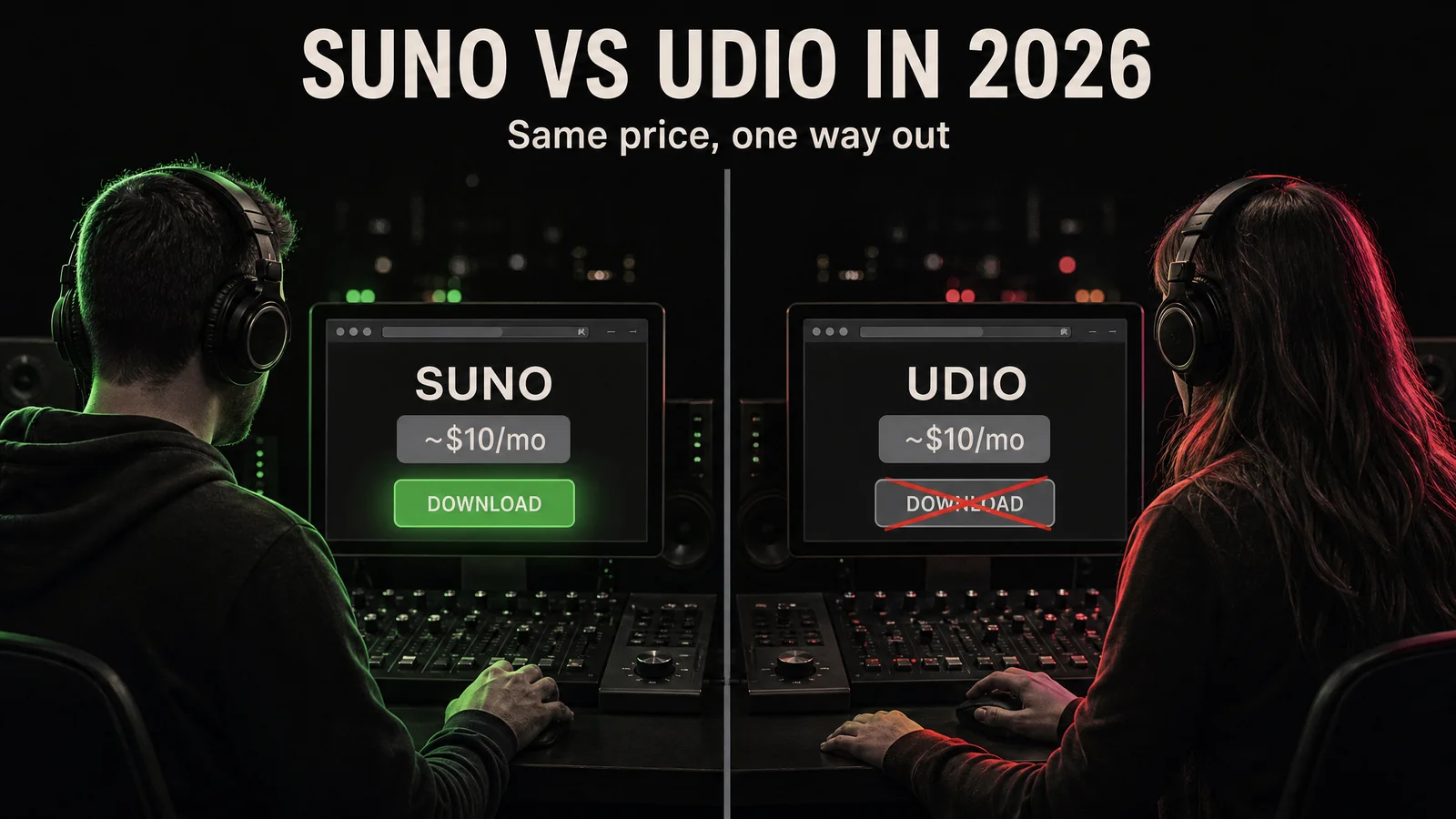
Ask which of these two is better and you get an answer about audio quality, which has quietly become the part that matters least. Suno and Udio charge the same money at every tier — the same free plan, the same ten dollars, the same thirty. What that money buys separates completely at exactly one point, and it is not the sound. This page is about that point, because it settles the decision more cleanly than any listening test does.
In short
Suno and Udio are priced identically at all three tiers, and for the same money Udio produces roughly twice as many songs. It also gives you no way to download any of them.
The comparison people expect — which one sounds better — has a real answer, and both of our reviews give it: Udio leads on instrumental detail, Suno leads on vocals. But Udio has disabled downloading of audio, video and stems since October 29, 2025, with no published return date, so for anyone who needs a file the question never reaches the listening stage. What follows puts the two price lists side by side, converts the credits into songs, and shows where the money actually separates.
- Same price, tier for tier. Both run a free plan, a middle plan near $10 a month and a top plan near $30, each cheaper paid a year ahead. Cost is not what separates them.
- A credit is not a credit. The same money buys roughly twice as many finished tracks on Udio, because a generation costs fewer credits there. Comparing the two credit figures directly tells you nothing.
- Udio has no exit at all. Downloading was switched off on October 29, 2025, and no return date has been published since. The block applies on the paid tiers as well as the free one.
- Suno's export allowance is the whole difference. Seven files in total on a free account, not seven a month; 20 a month on Pro and 60 on Premier. Small numbers, but they are the only ones on either side that are not zero.
Quick facts
- What this compares: Suno and Udio on price, output volume, and whether the work can leave the platform
- Price: Identical at all three tiers — free, around $10/month, around $30/month, cheaper annually on both
- Suno exports: 7 for the life of a free account, 20/month on Pro, 60/month on Premier
- Udio exports: Disabled on every tier since October 29, 2025
- Sound: Independent reviewers put Udio ahead on instrumentals, Suno ahead on vocals
- Decisive difference: One of kind rather than degree — whether a file exists at the end
- Not covered here: Full feature reviews; those are in our separate Suno and Udio pieces
- As of: October 2026 — check both pricing pages before subscribing
What this comparison is actually about
The question almost everyone types is which one sounds better, and it does have an answer. Independent reviewers through 2026 have been consistent: Udio pulls ahead on instrumental material, where separation and low-end definition survive decent headphones, and Suno pulls ahead on vocals. We have run no blind comparison of our own, and both of our full reviews say so in the same words.
That answer carries a hidden assumption, which is that you will end up holding the result. On October 29, 2025, the day its settlement with Universal Music Group was announced, Udio disabled downloading. By its own account the block covers audio, video and stems together, and it reaches backwards as well as forwards: work made before that day is caught too. A 48-hour export window opened the following month, once, and nothing since has replaced it or set a date for exporting to return.
So the two products are not competing on a scale. One of them ends with a file and the other ends with a library you can play but not carry, and no amount of audio quality converts the second into the first. That is a difference of kind rather than degree, and it is worth being precise about how long it has run: at the time of writing this is not a temporary outage but the settled condition of the product for nearly a year.
Which leaves a narrower and more useful question. The two companies charge the same money. What does the same money buy on each side, and where exactly does it stop buying the same thing?
Suno and Udio pricing, side by side
Put the plans next to each other and the first surprise is how little there is to compare. The tiers are not merely similar; the headline prices match at every level, and so does the annual discount.
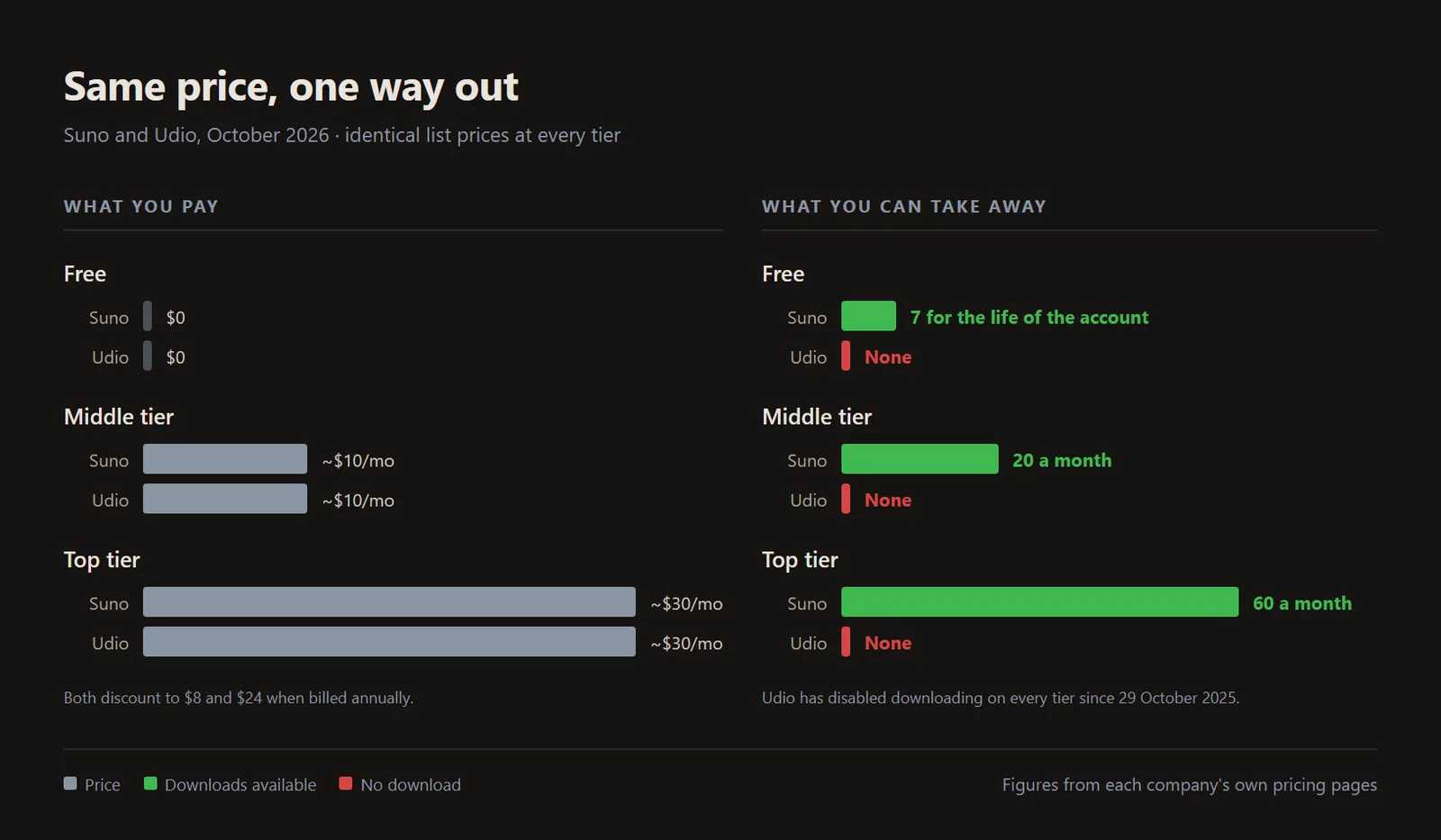
The prices match at every tier. Only the last column differs.
| Plan | Suno | Udio |
|---|---|---|
| Free plan | $0 | $0 |
| Free credits | 50 a day | 10 a day plus 100 a month |
| Free downloads | 7, for the life of the account | None |
| Middle plan | ~$10/month ($8 annual) | ~$10/month ($8 annual) |
| Middle credits | 2,500 a month | 2,400 a month |
| Middle downloads | 20 a month | None |
| Top plan | ~$30/month ($24 annual) | ~$30/month ($24 annual) |
| Top credits | 10,000 a month | 6,000 a month |
| Top downloads | 60 a month | None |
Three rows are highlighted because they are the only ones where the two columns describe different situations rather than different numbers. Everywhere else the products are close enough that a buyer could reasonably toss a coin: the middle tiers are 2,500 credits against 2,400, which is the same plan with a rounding difference.
Neither company lets monthly credits roll over. Suno's daily free allowance is use-it-or-lose-it, and subscribing replaces that allowance rather than adding to it. Udio's monthly credits expire the same way, although separately purchased ones do not — they simply sit out of reach while a subscription is lapsed.
The one row where Udio looks worse on paper is the top tier, 6,000 credits against Suno's 10,000. Hold that thought, because the next section is where it stops meaning anything.
Turning credits into songs
Credits are not comparable across products until you convert them into the thing you actually wanted, so here is the arithmetic both companies publish.
Suno publishes the rate directly: ten credits buys one generation, and a generation hands back a pair of songs. Takes that ask the model to work longer run dearer than that, so the number below is a planning figure rather than a fixed count, which is how Suno frames it too. Udio meters the same way but charges less per press: Create, Extend, Remix, Inpaint and Edit all hand back a pair, costing 2 credits at 32 seconds and 4 at full length, with trimming free.
Run those rates against the middle tier, where most people actually subscribe:
| At around $10 a month | Suno Pro | Udio Standard |
|---|---|---|
| Credits | 2,500 | 2,400 |
| Generations those credits fund | about 250 | about 600 |
| Songs those generations return | about 500 | about 1,200 |
| Songs you can take away | 20 | None |
| Share of output you can keep | roughly 1 in 25 | — |
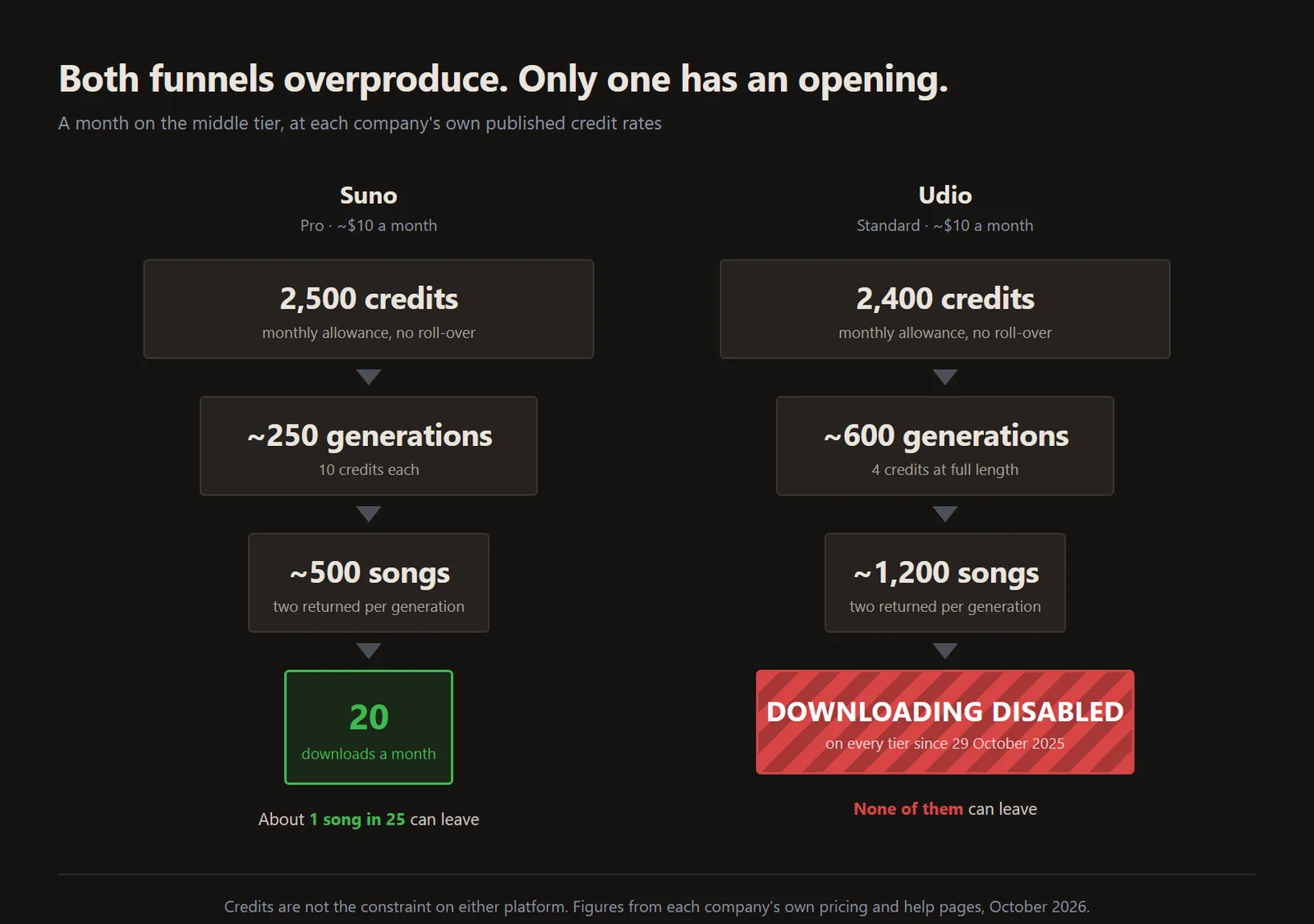
Both funnels overproduce. Only one of them has an opening at the bottom.
The striking part is not that Suno wins the last row. It is that both products are built the same way: generating is cheap and abundant on each of them, and on neither is the credit balance the thing that runs out first. A Suno Pro subscriber can make roughly twenty-five songs for every one they are allowed to download. A Udio Standard subscriber can make twelve hundred and keep none.
Which reframes the top-tier comparison from the previous section. Udio's 6,000 credits against Suno's 10,000 looks like a shortfall, but both figures sit far above what either subscriber can do anything with. Paying more on Udio buys more of the resource that was never the constraint — Udio's own top tier mostly sells the same activity faster, through more concurrent generations rather than a different outcome.
Worth noting on the other side: Suno's exports are metered too, and became more so. Since September 3, 2026 every Suno plan counts downloads, and under the current terms a track qualifies for commercial use only when it left the platform through an approved channel. Twenty a month is a real ceiling, not a formality. The difference is that a ceiling and a wall are not the same object.
What Udio still wins
A comparison published by a competitor that concluded the rival has nothing going for it would not be worth reading, and it would also be false. Four things run in Udio's favour, and two of them are almost always left out.
The instrumental sound. Of everything in this section, this is the part nobody disputes. Reviewers repeatedly rank it first in the category for jazz, classical, ambient, orchestral and acoustic folk: each instrument keeps its own room, bass stays legible instead of collapsing into mud, and the result holds up on proper headphones rather than only on a phone speaker. If your work is instrumental, this is not a marginal advantage.
Region editing. Udio's inpainting lets you select part of a track and regenerate only that part, and paired with its timeline view it changes how you work: fixing a bridge stops meaning rolling the dice on the whole song again.
The free tier is genuinely generous. Ten credits a day on top of a hundred a month covers as many as three 130-second songs every day, and it asks for no card. As a way to hear what the model does, it asks for nothing.
Allowances went up during the transition, not down. This one is reported almost nowhere. While downloads were switched off, Standard's monthly allowance doubled, 1,200 credits to 2,400; Pro went 4,800 to 6,000; and a further 1,000 credits carrying no expiry date were handed out on top. A company managing a subscriber base through a painful change had every commercial reason to quietly reduce what it was giving away, and it did the opposite.
Add to that the licensing position. Udio has agreements with Universal, Warner, Merlin, Kobalt, Believe and the NMPA, which is the most comprehensive set anyone in this category holds, though Sony is still litigating. None of this converts into a file today. All of it is real.
If you are already on one of them
Most people reading a comparison like this are not choosing from scratch; they already have a library somewhere and want to know what moving costs.
Leaving Udio is not a migration. Because nothing exports, there are no files to carry across, which means the work does not move — it gets made again. What travels is the text: your prompts, your lyrics, your style notes. Everything downstream of those has to be regenerated on the other side, and it will not come back sounding the same. The library itself is not deleted and stays playable inside Udio, so leaving costs you access to nothing you currently have.
Leaving Suno for Udio is a downgrade on exactly one axis, and it is the axis this page is about. It is a reasonable trade only if you genuinely never need the file — if the listening happens in the browser and the output is for your own ears.
Do not pre-pay for a restoration. If Udio's exporting returns, this becomes a real comparison again rather than a binary one, and that would be worth revisiting. But the official announcement of the licensed platform Udio and Universal are building describes a place to customize, stream and share. Exporting appears nowhere in that list. Treating its launch as the moment exporting comes back is a guess, and Udio's free tier is generous enough to re-evaluate the day it happens without paying for the wait.
Who each one suits
The honest version of this section is short, because one constraint does most of the sorting.
Work with a deliverable goes to Suno. If a track has to reach a client, an editor, a distributor or an upload form, Suno is the only one of the two that can do it. Check the download count against your actual output first: twenty a month suits someone finishing a handful of pieces, and does not suit someone publishing daily.
Vocal songs go to Suno on the reviewing consensus, independently of the export question.
Instrumental work that never leaves the browser goes to Udio, and specifically to its free tier. This is the case where Udio's advantage is clearest and its limitation costs you nothing, which also makes it the case where subscribing is hardest to justify — a paid plan buys more of something you were not running out of.
If neither fits, the shortlist is longer than two. Requirements like MIDI export, in-house training data or multi-format delivery are better answered by scanning a wider field than by choosing between these two, and we put ten tools through the same export-focused test in our benchmark. Our own song maker is one of the ten, and it sits on the side of this page’s axis where the file exists.
Same shelf, one till. The two price lists are close to the same document with different logos on them. What separates the products is a single row, and it happens to be the row that decides whether a month of work exists outside a browser tab. Until Udio's exporting returns, this is not a close comparison for anyone with something to deliver — and for anyone without one, it is barely a comparison at all.
The same axis, a third tool
Everything above sorts two products along one axis: whether a file exists when you are finished. We make a third, disclosed here and deliberately kept out of the comparison above.
MuseGen is built around that axis on purpose. A paid plan ends with an MP3 or WAV in your hands, and commercial use is covered at those tiers, attaching at the moment of generation, not at the moment of export — the distinction the whole page above turns on; which tier you are on, and our terms, are the two things to read before releasing anything. It turns a written idea into a finished song and will generate a music video from one you have already made, which is the step after the file rather than the file itself.
Udio is ahead on instrumental detail, and this page is not the place to pretend otherwise. Section repairs are not a gap: MuseGen's Edit song section regenerates a chosen stretch of 7 to 60 seconds with new lyrics, much as Udio's region editing does. If your constraint is the sound, stay with the two above. If your constraint is the file, that is the problem MuseGen was built for, and the plan details say which tier covers it.
FAQ
Is Suno or Udio cheaper?
Neither. They are priced identically at all three tiers: free, around $10 a month and around $30 a month, with the same annual discount on both. At the middle tier Udio's credits stretch further, funding roughly 1,200 songs a month against Suno's 500, but none of them can be downloaded, so the extra volume buys activity rather than output.
Do Suno and Udio credits mean the same thing?
No. Both meter generation, but at different rates and against different ceilings. A Suno generation returns two songs for 10 credits; two full-length Udio songs cost 4. The larger difference sits at the end of the process: Suno caps how many finished tracks you may download each month, and Udio does not let you download any, so its credits measure work you cannot collect.
Can I move my Udio songs to Suno?
Not as files. Udio disabled downloading of audio, video and stems on October 29, 2025, so there is nothing to carry across. What travels is the text: your prompts, lyrics and style notes. Moving therefore means regenerating rather than importing, and the results will not come back sounding the same. Your Udio library is not deleted and stays playable inside Udio.
Which one sounds better, Suno or Udio?
Independent reviewers through 2026 put Udio ahead on instrumental material such as jazz, classical, ambient and orchestral work, and Suno ahead on vocals. We have run no blind comparison of our own. Both of our full reviews go into the detail, and neither verdict changes the export position, which is what usually decides the purchase.
If Udio restores downloads, should I switch back?
It would make this a genuine comparison again rather than a binary one, so it would be worth revisiting. Worth knowing first: the licensed platform Udio and Universal announced is officially described as somewhere to customize, stream and share, and downloading is not among the listed capabilities, so treating its launch as the return of exporting is a guess.
Is it worth paying for both?
Rarely. Two middle-tier subscriptions cost around $20 a month, and the second one adds no ability to deliver anything. If you want Udio's instrumental sound while keeping a way to export, the cheaper arrangement is a paid plan on the tool that exports alongside Udio's free tier, which allows three 130-second songs a day without a card.
Which should I pick if I only make instrumentals?
This is the closest case, because instrumentals are where Udio's lead is clearest. It still turns on delivery. If the track has to reach an editor, a client or a distributor, Udio cannot do that today. If it only has to be heard inside the platform, Udio's free tier is the best-sounding way to do it, and paying for a higher tier adds little.
Related reading
- Suno AI Review 2026 — the full picture on the tool that still exports
- Udio Review 2026 — the best-sounding tool you cannot download from
- AI Music Generator Benchmark 2026 — ten engines tested on what they let you export
- Suno's New Download Limits — how exporting became the constraint on both sides
Sources
- Suno — plans, credits and download allowances
- Suno — terms of service effective September 3, 2026
- Udio Help Centre — plans, credits and limits
- Udio Help Centre — changes during the transition period
- Billboard — the 48-hour window to export existing libraries
- Music Business Worldwide — Sony Music's continuing action against Udio
- UMG and Udio — first strategic agreements for a licensed AI music platform
- MuseGen plan features, including the download line on paid tiers — musegen.ai/pricing.
Both price lists were read from each company's own pages on the same day as our Suno and Udio reviews, and both have a short shelf life. If Udio's exporting returns or Suno's allowances move again, the arithmetic on this page changes before the conclusion does — check the current figures on both pricing pages before subscribing to either.