Udio Review 2026: The Best Sound You Cannot Download

MuseGen Team
10/8/2026
Most descriptions of Udio end at the same compliment: it is the one that sounds best. In 2026 that is still broadly true. What sits beside it is stranger — for nearly a year Udio has not let anyone download the music they make on it. Audio, video and stems alike, by the company's own account, with no restoration date since. This review is about how those two facts fit together, because most coverage keeps one and drops the other.
In short
Udio produces the most detailed instrumental audio in the category, its inpainting regenerates a single region of a finished track, which only a few tools can do, and after settling with Universal it holds the cleanest licensing position of any AI music service. None of those are small, and this review is published by a competitor.
The cost changes the question worth asking. Udio's help centre states that downloading of audio, video and stems has been disabled, a change made the day the Universal settlement was announced on October 29, 2025, and nothing since has set a date for its return. The licensed platform meant to replace the current one is officially described as an environment to customize, stream and share; downloading is not on that list. Udio is somewhere to make music rather than to collect it, and that settles the buying decision far more than audio quality does.
Quick facts
- What it is: A text-to-music generator known for instrumental detail and region-level editing
- Last announced model: Allegro v1.5, March 2025; nothing newer has been announced
- Plans: Free, Standard around $10/month, Pro around $30/month, cheaper annually
- Free tier: 10 credits a day plus 100 a month, capped at three 130-second songs daily
- Downloads: Audio, video and stems disabled since October 29, 2025, with no published return date
- Commercial use: Hard to exercise while there is no way to export a file
- Licensing: Deals with UMG, Warner, Merlin, Kobalt, Believe and the NMPA; Sony is still litigating
- As of: October 2026 — confirm current figures on Udio's own pages
What Udio is in 2026
Udio turns a text prompt into a finished track, like every tool here. What separated it early was where the engineering went: instrumental detail, separation between parts, and the ability to reopen a finished piece and change part of it.
That second capability is the one that shapes how you work with it. Inpainting, added in January 2025, lets you mark a region of a completed track and regenerate only that region — a fumbled transition, a line that scans badly, four bad bars of drums — while everything around it stays as it was. Extend continues a piece in either direction, Remix re-renders it under a new prompt, and Sessions gathers the work into one place. You can run Extend or Inpaint across audio you upload yourself, which puts Udio closer to an editor than most rivals get.
Around those sit Styles, for fine control over genre and instrumentation including negative styles, and Voices, added in September 2025, which holds a singer consistent across tracks. There is an iOS app from May 2025.
One property of that list is rarely mentioned: everything in it shipped in 2025 or earlier. Udio's public changelog carries no entries for 2026, and the newest model version the company has announced is still Allegro v1.5 from March 2025. Articles citing a "v4" or a "v2.5" are not describing anything Udio has published. That is not proof development stopped — a company mid-transition has reasons to go quiet — but from outside, the visible record ends in September 2025.
What happened, and where it stands
In June 2024 the major labels, coordinated by the RIAA, sued Udio over its training material. On October 29, 2025, Universal Music Group and Udio announced a settlement and a licensed subscription service to be built together. The same day, downloading stopped.
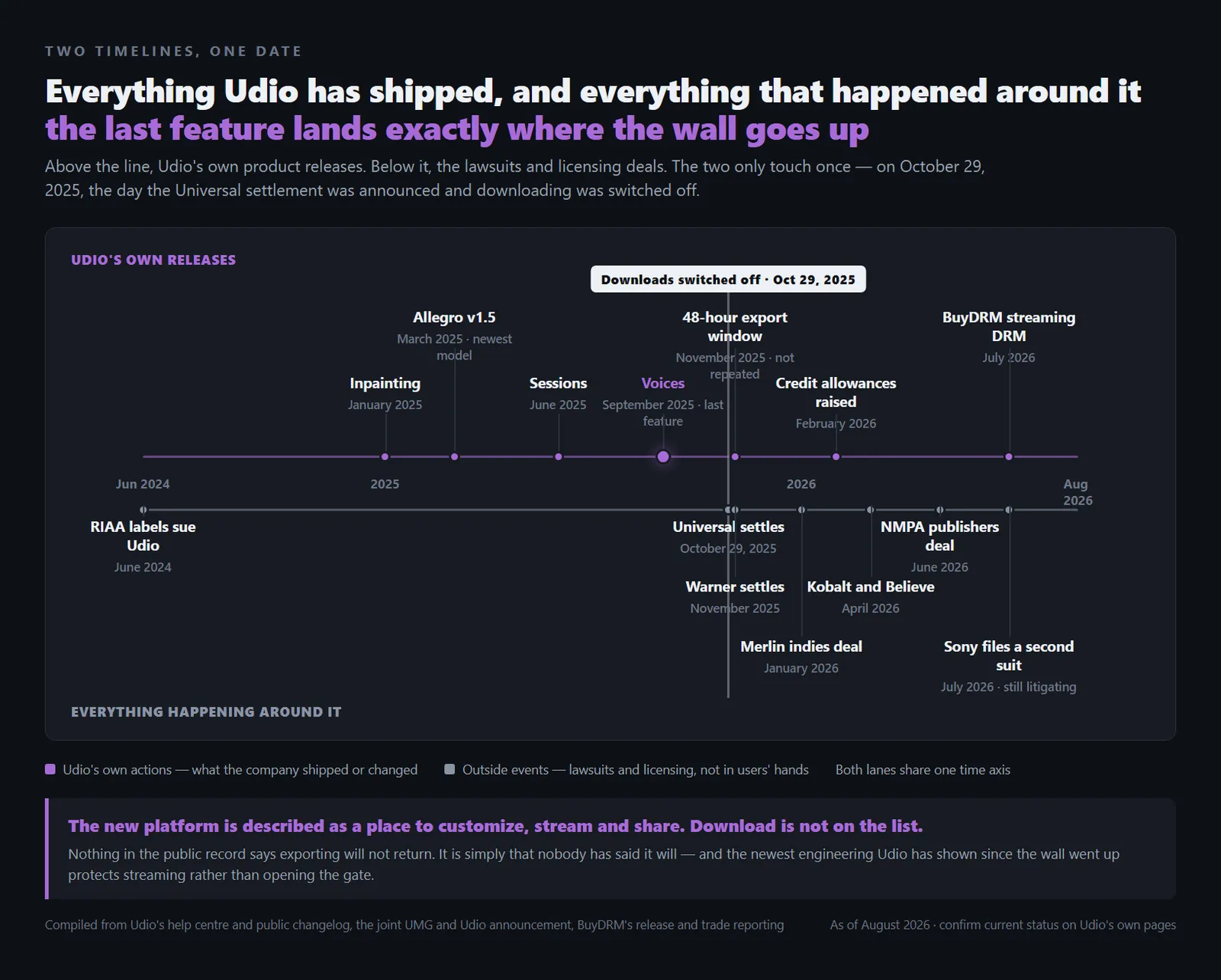
Udio's own releases above, the legal events below — the last shipped feature lands where the wall goes up
Udio's help centre puts it without decoration: downloading of audio, video and stems has been disabled. Nothing was deleted, and tracks stay playable inside the platform, but they cannot be taken out — including tracks made long before any of this. The reaction was strong enough that Udio opened a 48-hour export window in early November 2025, and chief executive Andrew Sanchez said the company hated not being able to offer downloads. That window has not reopened. (Billboard)
The licensing work since has been methodical and, on its own terms, successful. Warner settled in November 2025, the independent licensing body Merlin in January 2026, Kobalt and Believe in April, and in June the NMPA reached an industry-wide arrangement covering publishers. Sony is the only major still fighting: on June 29, 2026 a New York court refused to let it fold more than thirty thousand further recordings into its existing case, which stays at 333 works, and on July 20 Sony and nine affiliated labels filed a second suit asserting 30,117 recordings, seeking up to $150,000 for each. (Music Business Worldwide)
The detail worth reading closely is what the replacement has been promised to do. The joint announcement describes it as "a licensed and protected environment to customize, stream and share music responsibly, on the Udio platform", launching in 2026. Downloading is not among those capabilities, and nothing published since has added it. The most recent public move, in July 2026, was a deal with content-security vendor BuyDRM to protect the streaming of Udio's catalogue with the encryption that guards commercial video. Whatever else that is, it is investment in the walls rather than the gate. (the joint announcement; Music Business Worldwide)
None of that means exporting will not return. It means nobody has said it will, and a review assuming otherwise is guessing about the one thing you would be paying for.
▶ Watch on YouTube: "Lawyer: Udio & UMG Settle, Launching AI Music Service" — a legal reading of the deal, recorded at the settlement rather than as a 2026 status review
The three plans, and what credits actually buy
Udio sells three tiers, differing almost entirely in volume rather than permissions.
| Free | Standard | Pro | |
|---|---|---|---|
| Price | $0 | ~$10/mo ($8 annual) | ~$30/mo ($24 annual) |
| Credits | 10 daily plus 100 monthly | 2,400 per month | 6,000 per month |
| Daily cap | Three 130-second songs | Not stated | Not stated |
| Credits roll over | No | No | No |
| Downloads | Disabled | Disabled | Disabled |
Credits meter generation, and generation is cheap. Create, Extend, Remix, Inpaint and Edit each return two songs; two 32-second songs cost 2 credits and two full-length ones cost 4, while trimming costs nothing. Standard's 2,400 monthly credits are several hundred tracks. Pro adds five concurrent sets, ten songs at once, so the top tier mostly sells the same activity faster.
Which is where the arithmetic turns strange. A subscription buys a very large amount of generating inside a product whose output cannot leave. Credits have not been the constraint since the day downloads stopped.
Two details run in Udio's favour and are almost always omitted. Allowances rose during the transition rather than fell: Standard from 1,200 monthly credits to 2,400 and Pro from 4,800 to 6,000, with 1,000 extra credits that never expire. Monthly credits do not carry over, but separately purchased ones have no expiry, though they sit out of reach while a subscription is lapsed. Every figure here is current as of October 2026 — check Udio's own pricing and help pages before subscribing.
What it actually sounds like
Sound quality is the one claim Udio has never had to defend, which makes it the claim a competitor should handle most carefully. We have run no blind comparison, so what follows summarises independent reviewers through 2026.
Their findings are consistent. Udio's advantage shows most clearly on instrumental material: jazz, classical, ambient, orchestral and acoustic folk come back with a separation and detail reviewers repeatedly rank first in the category. Instruments hold their own space, the low end stays defined instead of turning to mud, and results survive decent headphones rather than only a phone speaker. That matters, because acoustic material is where most generators sound most obviously synthetic.
Where Udio gives ground is mainstream pop vocals. Reviewers generally put Suno ahead on sung lyrics holding together across a whole track, and Udio's own bias — treating a piece as an arrangement rather than a song built around a voice — is part of why. The two are not chasing the same job: Udio is better at music the playing carries, which is also, awkwardly, the material whose maker most wants a file at the end.
What Udio does genuinely well
Udio's problems get listed constantly. Its strengths get repeated far less.
- Instrumental fidelity is the best in the category. On jazz, classical, ambient and acoustic material, independent reviewers consistently place Udio first for detail and separation, and the margin is widest exactly where other generators sound most synthetic.
- Inpainting repairs a track instead of replacing it. Select a region of a finished track, regenerate only that region, leave the rest untouched: a near miss becomes a draft you repair rather than a take you throw away.
- Finished pieces can be restructured, not merely rerolled. Extend continues a track in either direction and Remix re-renders it under a new prompt, and both work on audio you upload yourself, not only on Udio's own output.
- The licensing position is the cleanest in the field. Udio holds agreements with Universal, Warner, Merlin, Kobalt, Believe and the NMPA. No other AI music service has assembled that set.
- The free tier is enough to judge the sound. Ten credits a day plus a hundred a month, up to three full-length songs daily, no card required. Finding out how Udio sounds costs nothing.
- Allowances went up during the transition, not down. Standard doubled from 1,200 monthly credits to 2,400 and Pro rose from 4,800 to 6,000, with 1,000 extra credits carrying no expiry date.
The editing tools deserve that emphasis because they change the working habit: instead of rerolling a whole track, you repair the part that missed.
Where Udio falls short
What follows describes what you would be buying today. Each point is paired with the fact that softens it.
- ✗ Downloading of audio, video and stems has been disabled since October 29, 2025, and the block covers tracks made long before that date. ✓ Nothing was deleted, libraries stay playable inside Udio, and the 48-hour window in November 2025 at least shows the function can be switched back on.
- ✗ No return date has been published in the eleven months since, and the official description of the coming licensed platform lists customizing, streaming and sharing without mentioning downloading. ✓ The licensing groundwork such a platform needs is genuinely finished, and finished far more thoroughly than at any competitor. This is a company executing a plan, not one drifting.
- ✗ Udio's public changelog holds no entries for 2026, and the newest model version announced publicly dates from March 2025. ✓ The help centre was updated in February 2026 to raise credit allowances, so the product is maintained rather than abandoned, and a business mid-transition has reason to go quiet.
- ✗ Sony Music is still litigating and escalated in July 2026 with a second suit asserting 30,117 recordings. ✓ Every other major rightsholder group has settled or licensed, the reverse of Udio's position a year ago, and litigation at this stage rarely changes what a subscriber can do.
- ✗ Paying $10 or $30 a month currently buys generation inside a platform you cannot export from, against a timetable nobody has published. ✓ The free tier is capable enough that nothing needs spending to find out whether the sound is worth waiting for.
The second of those should govern the decision, and it is the one most coverage skips. The assumption is that exporting returns when the licensed platform opens. It may. But it has not been said — not in the announcement, not in the help centre, not since — and the newest engineering Udio has shown in public is DRM for streaming. Buying now on an unstated intention is a different decision from buying against a published roadmap.
Who Udio suits, and who should look elsewhere
You want to make music and hear it. Udio is a superb toy in the most respectful sense, and the free tier is genuinely enough. If the track never needed to exist as a file, the missing export costs you nothing.
You are betting on the licensed platform. Standard at around $10 a month keeps you fluent in a tool that may become the industry's cleanest way to make AI music. That is defensible. Just be clear it is a bet, placed on a date nobody has published, and that the free tier lets you wait for less.
You need to deliver files. A video that needs scoring, a client, a release date, a game build. Udio cannot do that job at present, which is a statement about its export status rather than its quality. Suno is the nearest replacement and heads the alternatives below; our own song maker exists for exactly this step, where a paid plan ends with a file you can hand over.
The conditional hold. Udio still makes the best-sounding audio in the category, and it is also a product you cannot take anything out of. Both are true, and neither cancels the other. Until the licensed platform ships, treat it as a place to make things rather than a place to get things — and if downloads return, this review needs rewriting.
Alternatives worth knowing
If the work has to leave the building, what else does the job? Ordered by how closely each replaces Udio.
Suno — the closest thing to a replacement
Suno is stronger on vocals, ships a browser production environment with multitrack editing and stem export on its top tier, and — decisively here — lets you download what you make. It has conditions: from September 3, 2026 every plan meters exports, and a track is only commercially usable if it was downloaded through an approved channel. We went through the tool in our Suno review, and the export change in a piece on the new limits. On instrumental detail Suno sits behind Udio. On getting finished work out, there is no contest.
MuseGen — ours, and the export works
MuseGen is our own product, and the difference that matters in this review is the one Udio cannot offer at all right now: a paid plan ends in an MP3 or WAV you keep, and our published terms grant commercial use on the plan you subscribed to. That track can then become a music video starting from lyrics you wrote yourself. Section repairs work the same way here: mark any stretch of 7 to 60 seconds in Edit song section, give it fresh lyrics, and two regenerated takes come back to choose from. Udio remains ahead on instrumental fidelity.
Soundraw — the least anxious licensing
Soundraw builds its library from material written by its own composers, which sidesteps the training-data argument rather than settling it, and makes it the calmest choice for commercial background music. There are no generated vocals.
AIVA — when the result has to be read, not just heard
AIVA exports MIDI and concentrates on orchestral and soundtrack work, which makes it the pick when a musician has to open the output and change it rather than simply play it.
For six more tools scored the same way, see our ranked list of AI music generators.
Transparency note
MuseGen is an AI music generator, which makes Udio and Suno both competitors, and that belongs on the page rather than in the small print. Udio is ahead of us on instrumental fidelity, and the pros above say as much. Scoring tools against one another is the job of our ranked overview of AI music generators, which weighs every entry against the same criteria; this review keeps to dated, sourced claims about Udio that you can check for yourself.
Disclosure — the MuseGen team
FAQ
Can you download songs from Udio?
Not at present. Udio's help centre states that downloading of audio, video and stems has been disabled, a change made on October 29, 2025 alongside the Universal Music Group settlement, and it covers tracks made before that date as well as after. Nothing is deleted and libraries stay playable within Udio. A 48-hour export window opened in November 2025 and has not been repeated. No return date has been published.
Is Udio free?
Yes, and more generously than most: 10 credits a day plus 100 a month, enough for up to three 130-second songs daily, with no card required. Credits do not roll over. The limitation every tier shares is that you cannot download what you make, so the free tier evaluates how Udio sounds rather than supplying music you can use elsewhere.
Why did Udio disable downloads?
Udio has tied the change to its settlement and licensing agreement with Universal Music Group, announced on October 29, 2025. The companies said the existing service would keep running during a transition as what the announcement called a walled garden, with fingerprinting, filtering and other measures added before the new licensed service arrives. Udio has published no explanation beyond that, so the precise reason is not something we can state.
Is Udio better than Suno?
On instrumental audio quality most independent reviewers say yes, particularly for jazz, classical and ambient material. On vocals most of them say Suno. For anyone who needs the result outside the platform the comparison does not really run, because Suno lets you download and Udio currently does not. That difference is one of kind rather than degree.
Can you use Udio music commercially?
In practice it is very difficult while exporting is unavailable, because there is no way to hand a file to a client, a distributor or a video editor. Whatever commercial permissions a Udio plan grants are hard to exercise on music that cannot leave the platform. If you are weighing Udio for paid work, check its current terms and the download status on the day.
When will Udio's new platform launch?
Udio and Universal said in October 2025 that the new subscription service would launch in 2026. No specific date has been announced since, and it had not launched as of early October 2026. Trade press has reported the name Starstruck. The joint announcement describes a licensed environment for customizing, streaming and sharing music, and downloading is not among the capabilities it lists, so treating the launch as the moment exporting returns would be a guess.
What's a good Udio alternative?
It depends what you are missing. If it is simply getting files out, Suno is the closest match on capability and does let you export, subject to monthly limits from September 2026. If the training-data question bothers you, Soundraw only uses material written by its own composers. If the output has to be readable as notation, AIVA exports MIDI. MuseGen is ours: paid plans export MP3 or WAV, commercial use is covered, and it will convert MP3 to WAV if a delivery spec demands it. Read the current terms in every case, ours included.
Related reading
- How to Use Udio — the controls this review judges, in the order you meet them
- Suno AI Review 2026 — where most people leaving Udio land
- The 10 Best AI Music Generators of 2026 — ten tools, one scoring system
- Suno's New Download Limits — where exporting became the constraint
- What Are Stems? — one of the three things Udio switched off
Sources
- Udio Help Centre — changes during the transition period for the statement that downloading of audio, video and stems has been disabled and that it covers tracks made before that date.
- Udio Help Centre — plans, credits and limits for the plan prices, credit allowances and the free-tier daily and monthly caps.
- Udio Help Centre — changelog for the changelog with no 2026 entries and Allegro v1.5 as the newest announced model.
- Udio for the product and its current feature set.
- UMG and Udio — first strategic agreements for a licensed AI music platform for the licensed platform described as an environment to customize, stream and share, launching in 2026.
- Billboard — 48 hours to download AI songs after the settlement backlash for the 48-hour export window and the chief executive's comment on downloads.
- BuyDRM — Udio chooses BuyDRM to protect its AI music platform for the July 2026 content-security deal to protect Udio's streaming catalogue.
- Music Business Worldwide — Udio taps BuyDRM to secure its walled garden for the BuyDRM deal read as securing the walled garden rather than the gate.
- Music Business Worldwide — Sony sues Udio again over 30,000-plus recordings for the June 2026 ruling and Sony's second suit asserting 30,117 recordings.
- Rolling Stone — Why Universal is teaming with Udio for the background to the Universal settlement and partnership.