Soundraw Review 2026: The Safest Claim, One Real Contradiction

MuseGen Team
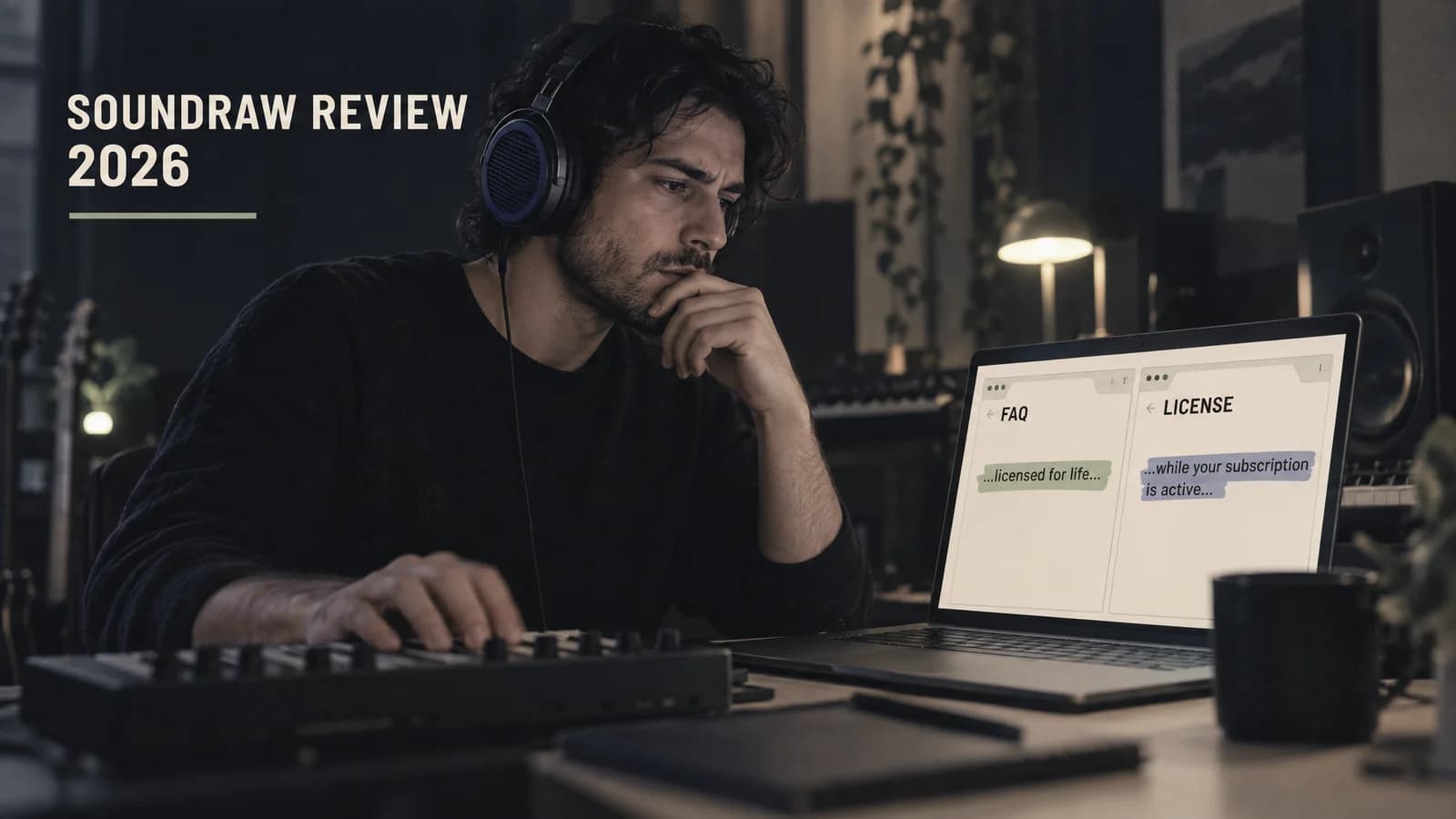
Several vendors in this series are carrying a lawsuit, a settlement, or a training-data question nobody has fully answered. Soundraw is a rare exception, and its whole pitch rests on that: train only on music your own team writes, and the copyright question disappears. We went looking for the catch anyway, and found one, though not the one we expected. It isn't a lawsuit. It's that Soundraw's own homepage and its own licence page tell you two different things about what happens to your music after you cancel.
In short
Soundraw is one of the few AI music generators in this series with no lawsuit we could find, and its claim to explain why — a training set built entirely from its own in-house recordings — is backed by one of the most detailed licence pages in the category, naming specific permitted uses down to a one-physical-store cap. That specificity is a real strength most competitors do not match.
It also means a contradiction on the same site is easier to catch than it would be for a vaguer competitor. Soundraw's homepage FAQ says a track you made while subscribed "stays licensed for life, even if you cancel later." Its own licence page says a track "used as downloaded" only "keep[s] your content published while your subscription is active." Those are not the same promise, and we could not find a third document that says which one wins.
- No lawsuit, and a stated reason for it. Soundraw claims its model trains only on in-house recordings, and unlike several rivals in this series, we found no one has sued over it.
- The licence page is unusually specific. It names exact permitted uses, down to background music for up to one physical store.
- It disagrees with its own homepage. Whether a cancelled subscription keeps your downloads licensed depends on which Soundraw page you read.
- Streaming release requires modification. An unmodified download cannot go on Spotify, even on the plan built for musicians.
Quick facts
- What it is: A Tokyo-based instrumental AI music generator, founded 2020 by Daigo Kusunoki
- Training claim: Only music written and recorded in-house; no material from outside artists
- Plans: Creator, Artist Starter, Artist Pro, Artist Unlimited, Enterprise
- Pricing seen: $16.99 to $50 a month across self-serve tiers ($11.04 to $32.50 with annual billing), shown in US dollars on 29 October 2026; confirm in your own currency
- Eligibility: Self-serve tiers for companies under 10 employees; Enterprise above that
- Streaming release: Artist plans only, and only after modifying the track
- Not permitted: Content ID registration, unmodified distribution, reselling on stock platforms
- Litigation: None found, as of this review
- As of: October 2026 — confirm current figures on Soundraw's own pages
A Tokyo company betting on clean data
Soundraw was founded in 2020 by Daigo Kusunoki, a former national dance champion who moved through music and wearable tech before starting the company. Its press materials describe SOUNDRAW Inc. as Japanese, and its Terms of Service carry a clause excluding dealings with "Antisocial Forces" — standard language in Japanese corporate contracts, and a small but real confirmation of where the company is actually based. Soundraw states its products are used by "275 million creators, developers, and businesses in over 100 countries," a figure we are reporting as the company's own claim rather than something we independently audited.
The product itself is built for instrumental background music rather than full songs with vocals. You choose a genre, or blend two or more — Soundraw's own examples are Hip-Hop plus Orchestra, or Trap plus Lo-Fi — set a mood and length, and generate. What happens next is what separates it from a one-shot prompt tool: a browser-based Mixer lets you mute or solo individual instrument layers, adjust intensity, and reshape the arrangement bar by bar, without opening a DAW or knowing any music theory. That editing layer, more than the generation itself, is what Soundraw leads with.
Two partnerships are worth naming because they are specific and checkable rather than vague. Music Business Worldwide reported in March 2024 that Soundraw raised $3 million from investors including Paul Rosenberg, Eminem's manager. And Soundraw's own press materials describe a partnership with LG Electronics bringing its AI music generation to "over 100 million webOS-powered devices," reported in Japanese trade press in May 2026. In August 2026 Soundraw launched a second product, Grid, a loop-based beatmaking app, and in June 2026 a third, Space Music, adaptive background audio for physical locations such as gyms and hotels, priced from $15 a month per location. Soundraw also names itself as a supporter of AI For Music, the responsible-AI initiative led by Roland and Universal Music Group.
The most notable fact about Soundraw's legal position is an absence. Several AI music vendors covered in this series carry some form of litigation or unresolved training-data question: Suno lost a case to GEMA and settled with Warner, Udio settled with Universal after a lawsuit, Google is defending the Kogon case over Lyria's training data, and Mureka is a co-defendant in a case filed in December 2025. We found no equivalent action against Soundraw. That is consistent with its central claim — that the model is trained exclusively on music its own team writes and records — though we have not audited that training pipeline ourselves and are reporting the absence of litigation, not a verified clean bill of health.
Licensed for life, or only while you pay
Soundraw's homepage answers a natural question directly, in its own FAQ: "How does the subscription pricing work — are downloads really unlimited?" Its answer for the Creator plan states that "anything you make while you're subscribed stays licensed for life, even if you cancel later." For the Artist tiers, the same page states that "anything you've already exported remains covered forever."
Soundraw's separate, dedicated licence page — the page whose entire purpose is to state what you may do with your music — describes a narrower condition. Under a section on permitted uses, it states: "If you use SOUNDRAW tracks as downloaded, you can only keep your content published while your SOUNDRAW subscription is active." The qualifier "as downloaded" appears to mean unmodified, as opposed to the modified tracks the same page discusses in the context of streaming release. But the core claim — can a lapsed subscriber keep using what they already made — is answered one way on the homepage and a different way on the licence page.
Why this is worth flagging rather than guessing at: we read both pages directly, on the same day, and neither one links to or acknowledges the other's wording. A creator who read only the homepage FAQ would reasonably plan to keep using old downloads after cancelling. A creator who read only the licence page would not. Nothing on either page tells you the other exists.
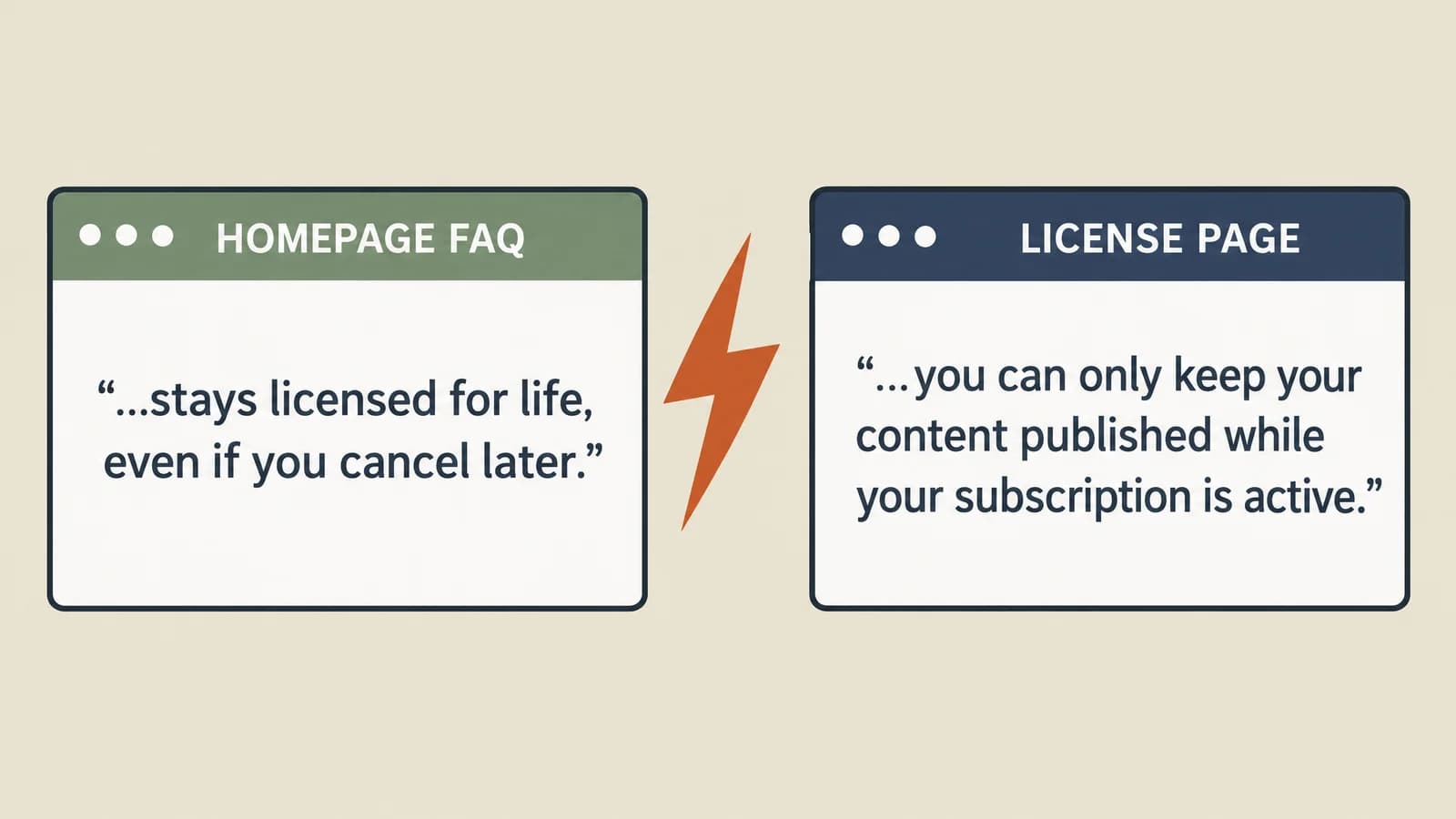
Same company, same day, two different answers to the same question — neither page mentions the other exists
We are not going to resolve this for you, because doing so would mean picking one of Soundraw's own sentences over the other without authority to do so. If your work depends on the answer — a video you plan to keep online past your subscription, a track you might stop paying for later — get it in writing from Soundraw directly rather than relying on either page alone.
What the licence page rules out
Soundraw's licence page is more specific than most of what we have read elsewhere in this series, which cuts both ways: it gives you more to check, and more that could trip you up if you skip it.
On every plan, permitted uses include YouTube, user-generated content, product videos, tutorials, livestreams, social media, video games, client work, hold music, radio and TV — and, specifically, background music for up to one physical store. Artist plans add the ability to release music to streaming platforms including Spotify and Apple Music, and to use Soundraw for meditation, lo-fi and relaxation content, with full ownership of the resulting streaming royalties.
The catch sits in how that streaming release actually works. You may not upload a track to Spotify exactly as Soundraw generated it. The licence page requires that you modify it first — remixing it, adding your own vocals, or recording an instrumental part over it — until the result "sound[s] clearly different" from the original download. An unmodified track, distributed as-is, is listed under "Not OK" regardless of which plan you are on.
Two more prohibitions are worth naming because they are easy to breach without realising it. First, registering a generated track as a Content ID claim on YouTube, Instagram, TikTok or an equivalent system is explicitly banned — a step some creators take reflexively to protect their own channel, and one Soundraw's terms rule out entirely. Second, you may not resell a modified Soundraw track on a stock audio platform, and you may not use Soundraw's output to train a competing AI model. Content you do not own — a film, a TV production, an ad you did not make — and theatrical or synchronised use both fall outside the standard licence and require contacting Soundraw directly.
Five plans, four published prices
Soundraw's pricing page lists five tiers. Creator is aimed at individuals and companies under 10 employees who want background music without releasing it to streaming platforms: unlimited monthly downloads, MP3 only. Artist Starter, for musicians and producers under the same headcount limit, allows streaming distribution but caps downloads at 10 tracks a month, also MP3 only. Artist Pro raises that to 20 tracks a month and adds WAV and stem downloads. Artist Unlimited removes the download cap entirely while keeping WAV and stems. Enterprise, for companies of 10 or more employees, is quote-based and adds API access.
When we read the pricing page on 29 October 2026 it showed US dollars: Creator at $16.99 a month, Artist Starter at $29.99, Artist Pro at $35.99 and Artist Unlimited at $50, each with a lower per-month figure on annual billing ($11.04, $19.49, $23.39 and $32.50). Prices can differ by location, so if you are budgeting in another currency, Soundraw's own pricing page will show the figure that applies to you.
What it actually sounds like
We ran no listening test of our own for this review. Soundraw's positioning does not really invite one in the way a vocal-heavy generator does — its own marketing leads with licensing safety and editability rather than a claim about outperforming Suno or Udio on realism, and we have not seen Soundraw make a head-to-head audio quality claim against either. What we can point to is the Mixer: because you can solo and adjust individual layers after generation, the honest way to judge Soundraw is to generate a track in your actual genre and see how far the editing tools get you toward something usable, rather than judging the first unedited output.
What it does genuinely well
- No lawsuit, for a stated reason. Several vendors in this series carry some form of legal exposure over training data. Soundraw's claim to train only on in-house recordings is, so far, matched by an absence of litigation.
- An unusually specific licence page. Most competitors state broad permissions; Soundraw names exact use cases, including a one-physical-store cap that most rivals do not bother to specify at all.
- Real editing without a DAW. The Mixer's mute, solo and intensity controls, plus genre-blending at the generation stage, go further than a simple regenerate button.
- Checkable outside partnerships. The Paul Rosenberg-backed funding round and the LG webOS integration are specific, reported facts, not just marketing copy.
- A product line beyond one web app. A Music API and Space Music for physical locations show the same technology sold through more than one channel.
- Aligned with an outside standards effort. Membership in the Roland- and UMG-led AI For Music initiative is a real, named affiliation.
Where it falls short
The homepage FAQ and the licence page give different answers to whether a cancelled subscription keeps your downloaded tracks licensed.
Both statements are specific and in writing, which is what let us catch the disagreement in the first place, rather than being left to guess.
Soundraw retains the neighbouring rights to the recordings; what you receive is a licence, not ownership of the underlying master.
The licence itself is broad and clearly enumerated, covering most commercial contexts a creator is likely to need.
An unmodified track cannot be released to Spotify or Apple Music on any plan; streaming release requires remixing, adding vocals, or otherwise changing the track first.
The bar for "clearly different" is Soundraw's own standard to enforce, and the underlying beat is still yours to build on rather than a locked file.
Registering a generated track on Content ID is banned outright, closing off a step some creators take by default.
The prohibition is stated plainly rather than buried, so it is possible to plan around it before publishing rather than after a strike.
Artist Starter allows 10 downloads a month and Artist Pro 20; only Artist Unlimited has no cap.
Creator has no download cap, and every Artist allowance is stated as a plain number on the pricing page.
Who it suits, and who should look elsewhere
You need background music and want the licensing question closed, not managed. This is Soundraw's strongest case. The Creator plan is built exactly for this and the licence page tells you precisely what is covered.
You are a musician planning to release on streaming platforms. An Artist plan gets you there, but budget the extra step of modifying the track before it goes to Spotify — and get Soundraw's position on post-cancellation rights in writing before you plan a release around it.
You need vocals or a full song from a prompt. Soundraw is not built for this. Its own comparison against vocal-first tools would not favour it, and our Suno review or Udio review are the better starting points. Our own song maker handles vocals from a prompt or from lyrics you bring, which is the gap Soundraw leaves open here.
The safest training story, told across two pages that disagree. Soundraw's no-scraping claim is real, specific, and so far unchallenged in court, and its licence page is more detailed than almost anything else in this category. That same specificity is what exposed the one place its own site contradicts itself. Read the licence page before the homepage FAQ if the two ever seem to disagree, and get anything load-bearing in writing.
Alternatives worth knowing
Suno — if you need vocals and a full song
Suno leads on vocal performance and ships a full production suite, covered in our Suno review. Every plan meters downloads since September 2026, a constraint Soundraw's unlimited Creator tier does not share.
Udio — for instrumental fidelity at the top end
Udio still sets the bar for instrumental detail, detailed in our Udio review, though exporting audio, video or stems has not worked since October 2025 — the opposite trade-off from Soundraw, whose whole pitch is that you can always get the file.
ElevenLabs Music — a rights table that at least exists
ElevenLabs publishes a dedicated Music Commercial Rights table, examined in our ElevenLabs review. It is a fair comparison point for how much detail a licence document can hold.
MuseGen — ours, built for the file rather than the background loop
MuseGen is our own product, and it solves a different problem than Soundraw does. We do not offer Soundraw's bar-level remix editor or its genre-blending controls. What subscription plans do give you is a full track with vocals rather than an instrumental background bed, under a Commercial License that is perpetual per work, survives cancellation for works made while you were subscribed, and says each eligible work can be accompanied by a certificate naming you, the work, a certificate number and the issue date. Bring lyrics you have already written into the song maker and the same session can hand you back a finished video too.
Transparency note
As a competitor, MuseGen read Soundraw's claims from its homepage, licence page, Terms, pricing page and press page on 29 October 2026, or took them from Music Business Worldwide's March 2024 reporting; statements about other vendors come from our own reviews. Our litigation check was a web search, not a search of court dockets, and we ran no listening test. MuseGen's own licence has restrictions too, so read our Commercial License before you compare.
Disclosure — the MuseGen team
FAQ
What is Soundraw?
Soundraw is a Tokyo-based AI music generator founded in 2020 by Daigo Kusunoki, built around a specific claim: its model is trained only on music written and recorded by its own in-house team, not on material scraped from other artists. You pick a genre, or blend several, set a mood and length, and the AI produces an instrumental track you can then adjust bar by bar in a browser-based Mixer without needing a DAW or music theory.
Who owns the music I make with Soundraw?
Soundraw does. Its Terms of Service state that the neighbouring rights to the recordings used in Generated Music belong to the company, and that subscribers receive a non-exclusive, non-transferable, non-sublicensable licence to use what they generate under the plan they are on. That is a real and usable licence for the purposes listed on Soundraw's own licence page, but it is a licence rather than a transfer of ownership.
Can I release Soundraw music on Spotify?
Only on an Artist plan, and only after you modify the track. Soundraw's licence page states that Artist plan subscribers may distribute to streaming platforms such as Spotify, but only if the beat is remixed, has vocals added, or otherwise changed enough that the final song sounds clearly different from the original downloaded file. Distributing a track exactly as downloaded is explicitly listed as not permitted, on any plan.
Do I keep the rights to my music if I cancel my Soundraw subscription?
Soundraw's own pages disagree. Its homepage FAQ states that the Creator plan's tracks stay licensed for life even after you cancel, and that Artist plan exports remain covered forever. Its dedicated licence page states that if you use a Soundraw track as downloaded, meaning unmodified, you may only keep your content published while your subscription is active. We could not find a document that resolves the difference, so we would confirm this directly with Soundraw before relying on it for anything already published.
Can I register my Soundraw track on YouTube's Content ID?
No. Both Soundraw's Terms of Service and its licence page list registering Generated Music as a Content ID on YouTube, Instagram, TikTok or equivalent systems as a prohibited act, on every plan. This is worth knowing because it is exactly the kind of thing a creator protecting their own channel might otherwise think to do.
Has Soundraw been sued for copyright infringement?
Not that we found. We located no pending lawsuit against Soundraw as of this review, which sets it apart from Suno, Udio, Google and Mureka, each of which faces or has settled litigation covered in this series. That is consistent with its central claim, that its model trains exclusively on music produced by its own in-house team rather than material gathered from other artists, though we have not independently audited that training process ourselves.
How much does Soundraw cost?
Soundraw's pricing page listed four self-serve tiers when we checked: a Creator plan, and three Artist tiers of increasing download allowance and export format, plus a custom Enterprise plan for companies of 10 or more employees. On 29 October 2026 the page showed US dollars: $16.99 a month for Creator, $29.99 for Artist Starter, $35.99 for Artist Pro and $50 for Artist Unlimited, each with a lower per-month figure on annual billing (for example $11.04 for Creator). Prices can differ by location, so check Soundraw's own pricing page for the figure that applies to you.
What's a good Soundraw alternative?
It depends what Soundraw does not give you. If you need vocals and full songs rather than instrumental background tracks, Suno or Udio go further, each with its own trade-offs on downloads. If you want a published commercial-rights table by plan, ElevenLabs has one. MuseGen is ours, and it takes a different approach to the same worry this whole review is about: its licence says commercial use covers works generated while you hold an eligible subscription, and that those rights survive cancellation, so a lapsed subscription does not put earlier work in doubt. Whichever tool you pick, read that vendor's own current wording before you rely on it.
Related reading
- ElevenLabs Music Review 2026 — a rights table that exists, and still disagrees with its own product page on the Free plan
- Google Flow Music Review 2026 — the other maker with no dedicated commercial-rights document
- Mureka Review 2026 — a vendor currently named as a defendant in a December 2025 copyright and biometric-privacy case
- The AI Music Generator Benchmark — Soundraw's terms recorded alongside nine other engines, from documentation rather than generation
Sources
- Soundraw — homepage, pricing and FAQ
- Soundraw — Licence explainer
- Soundraw — Terms of Service (updated 12 June 2025)
- Soundraw — Press Releases and Coverage, source of the founding date, funding, LG partnership, and Space Music and Grid launch dates
- Music Business Worldwide — source of the $3 million funding round and Paul Rosenberg's involvement (March 2024), as republished on Soundraw's own press page