AIVA Review 2026: Who Actually Owns the Music

MuseGen Team
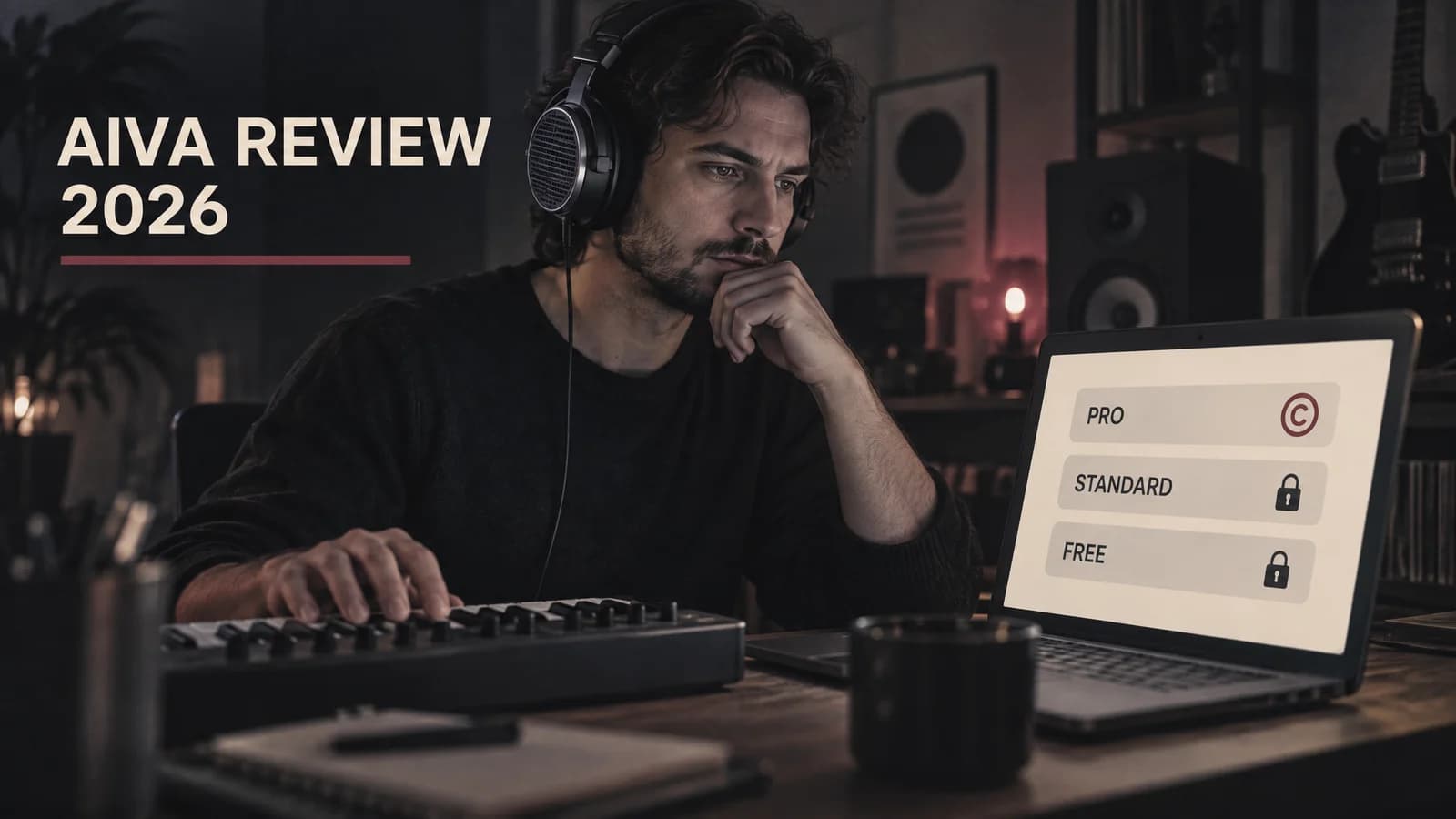
Every other review in this series asks some version of the same question: can you use what you make commercially, and under what conditions? AIVA raises a different, more basic one first. On its two cheapest plans, the composition you generate is not legally yours at all — AIVA's own licence agreement keeps the copyright and grants you a right to use the work, not ownership of it. That is not hidden in fine print. It is stated on the pricing page, in the open, and most people scanning past three plan cards will not stop to register what it means.
In short
AIVA is one of the few AI music tools covered here where copyright ownership itself, not just commercial permission, depends on your plan. Free and Standard subscribers get a licence to use their compositions; AIVA keeps the copyright. Only the Pro plan, priced at three times Standard, transfers full copyright to the subscriber. All of this is written into a clear, publicly readable End User License Agreement, which is exactly how we were able to quote it precisely below.
A second detail is easy to miss beside the ownership question: uploading your own reference track through AIVA's Upload Influence feature grants AIVA a perpetual, worldwide, commercial licence to train its systems on that upload. Neither fact makes AIVA a bad product. Both are worth knowing before you pick a plan based on the price alone.
- Copyright is tiered, not just commercial use. Free and Standard plans keep the copyright with AIVA. Only Pro assigns it to you.
- Standard's commercial licence covers four platforms. YouTube, Twitch, TikTok and Instagram, and nothing else.
- Your uploads train the model, forever. Reference tracks fed into Upload Influence come with a perpetual training licence to AIVA.
- The legal terms are unusually easy to read. A full, specific End User License Agreement at a public URL, readable without logging in.
Quick facts
- What it is: A Luxembourg-based AI music generator founded in 2016, focused on orchestral and soundtrack work
- Styles: 250+, from orchestral and cinematic to electronic, jazz, pop and more
- Plans: Free (€0), Standard (€11/month annual), Pro (€33/month annual), Enterprise (custom)
- Copyright by plan: Free and Standard: AIVA retains copyright. Pro: full copyright assigned to the user
- Standard's commercial scope: YouTube, Twitch, TikTok and Instagram only
- Upload Influence: Grants AIVA a perpetual, worldwide, commercial licence to train on anything you upload
- Rate limits: 5 compositions at once, 100/hour, 400/24 hours, 4,000 stored per account
- Litigation: None found, as of this review
- As of: October 2026 — confirm current figures on AIVA's own pages
A Luxembourg composer, ten years in
AIVA Technologies Sarl was founded in Luxembourg in February 2016 by Pierre Barreau, Vincent Barreau and Denis Shtefan, and the product has kept a distinct identity ever since: where most of this category chases full songs with vocals, AIVA has stayed closest to instrumental composition, with orchestral and cinematic scoring as its original focus. The style library has grown well past that starting point — AIVA's own pricing page lists more than 250 styles today, spanning electronic, jazz, pop and more — but the export options still reflect the composer's-tool origin: every plan, Free included, includes MIDI alongside audio, letting you open the actual notation in a DAW or notation software rather than treating the output as a finished, unchangeable file.
We found no pending lawsuit against AIVA as of this review, which puts it alongside Soundraw among the vendors in this series without active litigation. AIVA's own terms are governed by the law of Luxembourg, with any dispute falling under the exclusive jurisdiction of the courts of the city of Luxembourg — a detail worth knowing if you are ever in a position to need it.
The plan you pick decides who owns the music
Read AIVA's End User License Agreement and the structure is stated without ambiguity. Section 3 sets out three license types, and which one you receive depends entirely on your subscription: a Non-Commercial License grants "a non-exclusive, non-transferrable and non-commercial license to use, modify and distribute" your composition; a Limited Commercial License adds the right to monetize on a named list of platforms; and Full Copyright is where "Licensor hereby assigns, grants and conveys all copyrights of the MIDI and/or Audio Composition to Licensee."
The Free plan carries the Non-Commercial License. AIVA's own pricing page states it plainly under the Free tier: "Copyright owned by AIVA," alongside "No monetization" and a requirement that "Credit must be given to AIVA." The Standard plan, at €11 a month billed annually, upgrades to the Limited Commercial License — but its pricing card states "Copyright owned by AIVA" too, just with "Limited monetization" added and the AIVA credit requirement dropped. Only the Pro plan, at €33 a month billed annually, carries the line "Copyright owned by YOU" and "Full monetization."
What this means if you only read the price: a Standard subscriber paying €11 a month is, in AIVA's own words, using a composition that AIVA owns the copyright to. That subscriber can monetize it on YouTube, Twitch, TikTok or Instagram under the license granted, but does not hold the underlying copyright the way a Pro subscriber does. Nothing about the interface tells you this at the point of generating a track; it is written into the plan comparison and the license agreement, not into the creation screen.
To be fair to AIVA, this structure is disclosed clearly and consistently — the pricing page and the End User License Agreement say the same thing. The issue is not that AIVA hides this. It is that "copyright owned by AIVA" is easy to read past when it is one line among several on a pricing card, and the practical consequence — you do not own the work you paid to generate, until you pay considerably more — is larger than its placement suggests.
What happens to what you upload
AIVA's Upload Influence feature lets you provide your own MIDI or audio file so that AIVA can "generate a unique MIDI and Audio Composition that shares some of the emotional qualities" of what you uploaded. The feature itself is a reasonable and fairly common idea, similar in spirit to the reference-upload tools offered by several rivals in this series.
The license terms attached to it are more specific than most. Section 5 of AIVA's End User License Agreement states: "Licensee provides Licensor with a worldwide, non-exclusive, commercial and transferrable license to train AIVA's AI systems on the Uploaded Influence, in perpetuity." That is a broad grant by any standard — worldwide, commercial, transferable to other parties, and with no end date — attached to material the user supplies, not material AIVA generates. The same section requires the uploader to warrant that the material does not infringe anyone else's rights, and to take full responsibility for its use of the feature and hold AIVA harmless against any third-party claim.
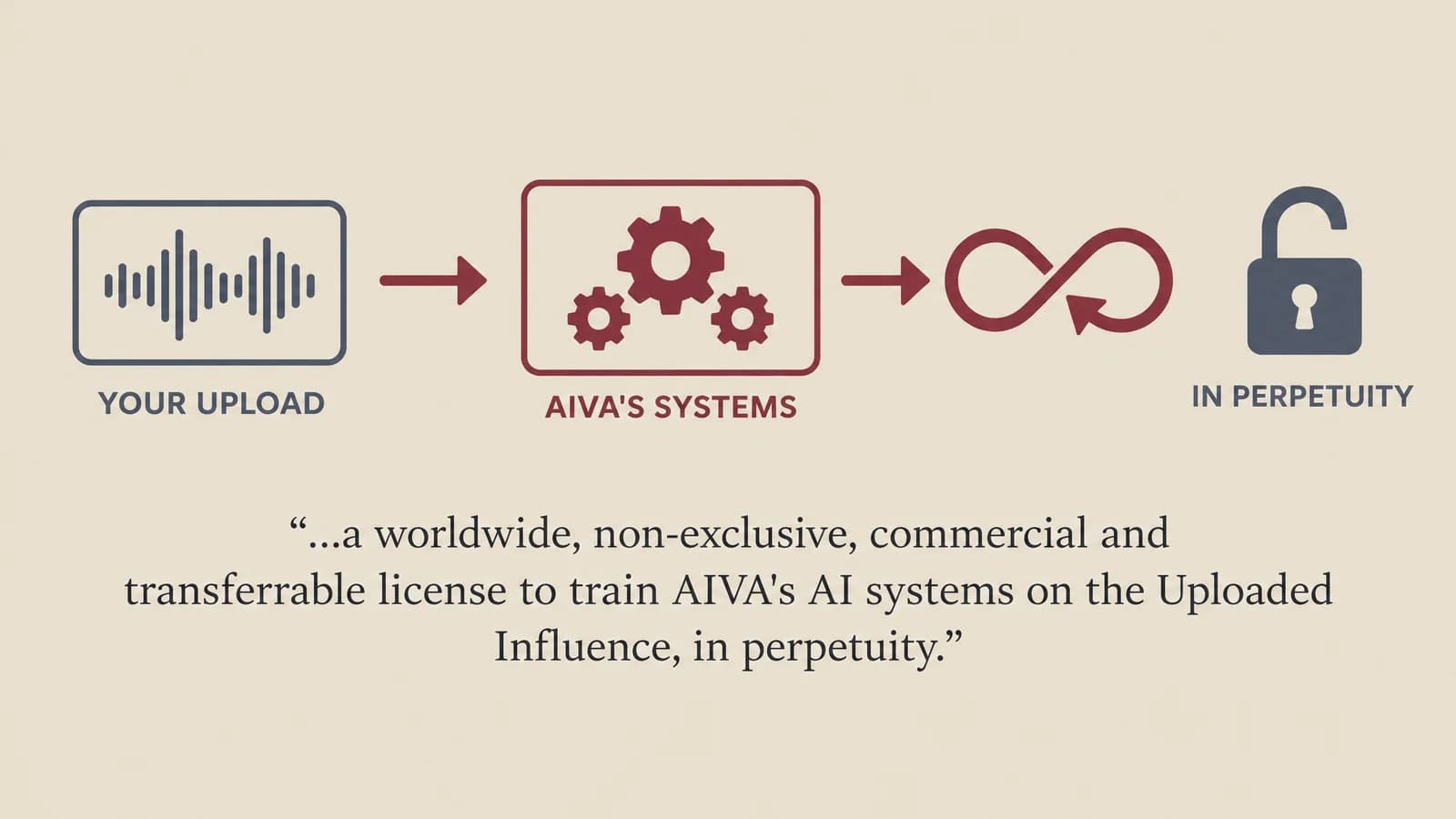
Your plan decides who owns the composition AIVA hands back. This one sentence decides what happens to what you fed in
We are not asserting that AIVA is doing anything improper with this clause; a perpetual training license is the kind of term a company reasonably wants if it plans to use uploaded material to keep improving its model, and it says so plainly rather than through vague language. What is worth flagging is how easy this is to miss: it sits in a section about a specific optional feature, not in the headline plan comparison, and it is a meaningfully different commitment from uploading a reference to a service that screens the file and discards it after generation.
Four tiers, one price that actually matters
AIVA's pricing page, read directly, lays out four options. Free, Forever costs €0 with no credit card required: 3 downloads a month, tracks up to 3 minutes, MP3 and MIDI formats, non-commercial only, AIVA credit required, AIVA retains copyright. Standard costs €11 a month billed annually (a 26% discount against monthly billing): 15 downloads a month, tracks up to 5 minutes, MP3 and MIDI, monetization limited to YouTube, Twitch, TikTok and Instagram, no credit required, AIVA retains copyright. Pro costs €33 a month billed annually (33% off monthly): 300 downloads a month, tracks up to 5 minutes 30 seconds, every file format including high-quality WAV, unrestricted monetization, and full copyright assigned to the subscriber. A separate Enterprise tier, along with student and school discounts, requires contacting AIVA directly.
The eligibility line matters here too. AIVA's terms define an "Individual" — eligible for the four self-serve plans above — as a natural person, or a business with fewer than 3 employees, or a business with less than $300,000 in revenue over the past year. An "Enterprise", by contrast, is a business with 3 or more employees and more than $300,000 in revenue over the past year, and it has to negotiate a custom plan. Both conditions must hold, so a larger team with modest revenue, or a high-revenue business with fewer than 3 employees, still counts as an Individual. The employee line is lower than the under-10-employee cut-offs used elsewhere in this series, but the revenue condition sits on top of it.
What it actually sounds like
We ran no listening comparison of our own for this review. AIVA's own positioning has stayed close to orchestral and cinematic composition since 2016, longer than most of the vendors covered in this series have existed at all, and its output is generally judged on different terms than a vocal-first generator — harmonic and structural coherence over a full arrangement, rather than how convincing a sung vocal sounds. The most direct way to judge it yourself is the Free plan: three full downloads a month, in MP3 and MIDI, is enough to hear a finished arrangement and to open the MIDI file itself to see how the composition is actually structured underneath.
What it does genuinely well
- The legal terms are genuinely readable. AIVA's End User License Agreement is complete, specific and readable at a public URL without an account, which is why we could quote it precisely.
- MIDI export on every plan. A composer who needs to open, edit, or rescore the actual notes gets that option from the Free plan up, not gated to a paid tier.
- A genuinely broad style range built on a specific strength. Over 250 styles, with orchestral and cinematic scoring as the throughline the product has kept since 2016.
- No lawsuit, over a decade of operation. Alongside Soundraw, one of the vendors in this series with no pending litigation we could find.
- Specific, numeric limits instead of vague plan language. Generation rate caps and eligibility thresholds are both stated as exact numbers.
- Upload Influence is a real creative tool. Steering a new composition from your own reference material is a genuine capability, not just a marketing line.
Where it falls short
Free and Standard subscribers do not own the copyright to what they generate; AIVA's own terms state that AIVA retains it.
This is disclosed consistently across the pricing page and the license agreement, in matching language, rather than buried in only one of the two.
Full copyright requires the Pro plan, at three times the price of Standard.
Pro's other allowances scale with it — 300 downloads against Standard's 15, and every export format including high-quality WAV.
Uploading a reference track grants AIVA a perpetual, worldwide, commercial license to train on it, a broader claim than some rivals make on reference uploads.
The term is written in specific, unambiguous language rather than vague platform-usage boilerplate, so it can actually be evaluated before you use the feature.
Standard's commercial license is capped to four named platforms and nothing else.
Those four — YouTube, Twitch, TikTok, Instagram — cover most of what a content creator on that budget actually needs.
No refund once any premium feature is used, and none for a forgotten auto-renewal.
The terms explicitly recommend using the Free plan to evaluate the product before paying, which is a reasonable way to avoid the issue entirely.
Who it suits, and who should look elsewhere
You need MIDI you can actually edit. This is AIVA's clearest strength in this series — a real notation file, not just an audio render, on every plan, Free included.
You are budgeting on the Standard plan and plan to monetize. Check the four-platform limit against your actual distribution plan before subscribing, and remember the copyright itself stays with AIVA at this tier.
You plan to use Upload Influence with material you consider sensitive or proprietary. Read Section 5 of the license agreement first; the training grant is broad and perpetual.
You need vocals or full songs. AIVA is not built for this. Our Suno review and Udio review are better starting points, and our own song maker returns a finished song with vocals rather than a score to arrange afterwards.
Clear terms, a ladder most people won't notice they're climbing. AIVA writes its licensing structure down clearly, which is exactly what let us quote it precisely. The structure itself asks more of a casual subscriber than it first appears: real copyright ownership is a top-tier purchase, and a common creative feature comes with a perpetual training grant on your own material. Read the license agreement, not just the pricing cards, before you decide which tier actually gets you what you need.
Alternatives worth knowing
Soundraw — the closer comparison
Soundraw shares AIVA's instrumental, licensing-conscious positioning, detailed in our Soundraw review. It transfers usage rights differently — a licence rather than tiered copyright — and carries its own contradiction between its homepage and its licence page worth reading before you compare the two.
Suno — for vocals and full songs
Suno is built for exactly what AIVA is not: complete songs with convincing vocals from a short prompt, with a full browser production suite. Every plan meters downloads since September 2026, detailed in our Suno review.
Udio — if the sound matters more than the score
Where AIVA hands you a MIDI file to open and rework, Udio is judged almost entirely on how the finished audio sounds, and most reviewers still rate it highest on that measure — the trade-off, laid out in our Udio review, is that it has not let anyone export audio, video or stems since October 2025, MIDI included.
MuseGen — ours, and simpler about ownership
MuseGen is our own product, and the comparison worth making here is specifically about ownership: our own terms state plainly that users retain ownership of generated music, on every plan including Free, with no tier where we keep the copyright the way AIVA's Free and Standard plans do. We do not generate a native MIDI score the way AIVA does, though our Audio to MIDI tool can convert a finished track afterwards, and we do not match its orchestral specialism; a song you write can become a track and then a video in the same place, which is a different kind of workflow than AIVA's composition-first approach.
Transparency note
The ownership question this review leads with is one where MuseGen's own terms read favourably, so weigh that. Our Terms and Commercial License are public, and they limit free and pay-as-you-go works to personal use. AIVA's figures were read from its pricing page, End User License Agreement and About page on 29 October 2026; statements about other vendors come from our own reviews. Our litigation check was a web search, not a search of court dockets, and we ran no listening test.
Disclosure — the MuseGen team
FAQ
What is AIVA?
AIVA is a Luxembourg-based AI music generator, founded in 2016, that specialises in orchestral and soundtrack composition alongside more than 250 other styles. It exports both audio (MP3 or WAV) and MIDI files, which makes it a common pick for composers who want to open the actual notation and edit it rather than just play back a finished track.
Do I own the copyright to music I make with AIVA?
Only on the Pro plan. AIVA's End User License Agreement states that the Free and Standard plans grant the user a Non-Commercial or Limited Commercial licence while AIVA itself retains the copyright. Full Copyright, meaning AIVA assigns all rights in the composition to you, is granted only on the Pro plan, which costs three times as much as Standard.
Can I monetize AIVA music on the Standard plan?
Only on four named platforms. The Standard plan's Limited Commercial License permits monetizing compositions specifically on YouTube, Twitch, TikTok and Instagram, and nowhere else. Monetizing on any other platform, or in any other kind of commercial project, requires the Pro plan's Full Copyright licence.
What happens to a reference track I upload to AIVA?
AIVA's licence terms state that uploading a track through the Upload Influence feature grants AIVA a worldwide, non-exclusive, commercial and transferable licence to train its AI systems on that upload, in perpetuity. This is separate from the licence covering the composition AIVA generates for you, and applies specifically to the reference material you provide.
How many tracks can I generate with AIVA?
AIVA's terms cap generation at 5 compositions at a time, 100 per hour, and 400 in a 24-hour period, regardless of plan, with a maximum of 4,000 compositions stored in an account at once. Separately, each plan limits monthly downloads: 3 for Free, 15 for Standard, and 300 for Pro.
Has AIVA been sued for copyright infringement?
Not that we found. As of this review we located no pending lawsuit against AIVA Technologies, consistent with a company that has written its own scores since 2016 rather than built a model primarily around imitating named artists.
Can I get a refund if I don't like my AIVA subscription?
Only if you have not used any premium feature of the plan. AIVA's terms state that using a premium feature acts as a waiver of your right to a refund, and that it is your own responsibility to downgrade or cancel auto-renewal before the next billing date; forgetting to cancel is not grounds for a refund.
What's a good AIVA alternative?
Soundraw sits closest to AIVA in positioning: instrumental, licensing-conscious, and built around background and score use rather than full songs with vocals. Vocals and full-song arrangements are not what either tool is for, so for that you would need to look at Suno or Udio instead, and weigh their own download limits. MuseGen is ours: subscription plans export MP3 or WAV with commercial use included on those plans, under terms you can read without logging in. Check the current terms in every case, ours included.
Related reading
- Soundraw Review 2026 — the other instrumental, licensing-first AI music tool, and its own homepage-versus-licence contradiction
- Mureka Review 2026 — a model that publishes real quality metrics, from a company facing an active copyright case
- ElevenLabs Music Review 2026 — a commercial-rights table by plan, in Music Terms that took effect on 9 October 2026
- Google Flow Music Review 2026 — the opposite end of the ownership question: Google claims none of it, and publishes no commercial terms either
- The AI Music Generator Benchmark — AIVA's export and licensing terms recorded alongside nine other engines
Sources
- AIVA — homepage and pricing
- AIVA — End User License Agreement, source of the license types, Upload Influence terms, rate limits, eligibility definitions and refund policy
- AIVA — About the Company, source of the founding team