Mureka Review 2026: Real Metrics, Messy Plan Copy

MuseGen Team
10/22/2026
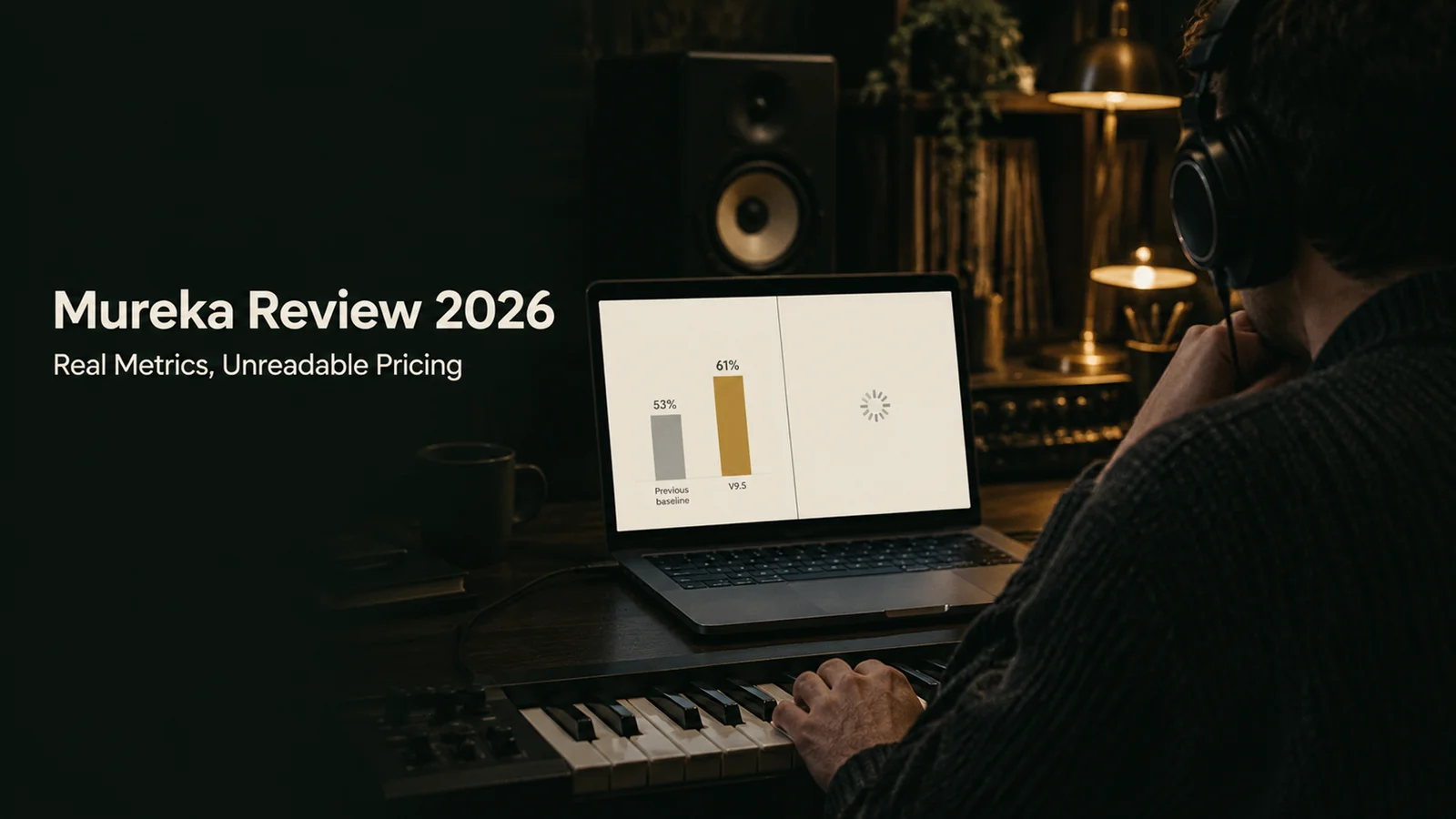
Mureka is a review with a clean half and a messy half. Its maker published a real before-and-after quality table for its newest model, in percentages, including figures that are not flattering — a level of candour nobody else in this category has matched. Its plans are also readable and inexpensive: $8 a month billed yearly for Pro, $24 for Premier. What does not hold together is the copy around them. The homepage describes plans with different names and quotas, and the commercial-rights promise changes depending on which sentence you read.
In short
Mureka's maker published an actual before-and-after quality score for its newest model — 61.0 percent against a 53.0 percent baseline, plus a candidly modest 28.0 percent overall usability figure — which is more numerical honesty about output quality than any other vendor in this series offers. That is a real, checkable thing to praise, and we sell a rival product while we say it.
The rest of the site is easier to read than it first looks, and harder to reconcile. The plan page loads in a browser with clear prices — Pro at $8 a month billed yearly ($10 monthly), Premier at $24 ($30 monthly) — while the homepage describes a "Basic" and a "Pro" plan at the same two annual prices with different quotas, and a marketing line promises commercial rights on every song that the FAQ grants only during an active subscription. Mureka is owned by China’s Kunlun Tech through its Singapore subsidiary Skywork AI, and both companies are currently defending a lawsuit that names one of Mureka’s own advertised features as part of the alleged infringement.
- The quality claim is unusually checkable. Mureka's own blog states a percentage, a baseline, and the gain between them — not just an adjective.
- The plans are readable and cheap. Pro is $8 a month billed yearly ($10 monthly) and includes the current models and music video creation; Premier is $24 ($30 monthly).
- The copy around them contradicts itself. The homepage lists different plan names and quotas, and one marketing line promises more than the FAQ and the plan table deliver.
- Mureka is currently being sued. The complaint names its own Reference feature as part of how the alleged infringement works.
Quick facts
-
What it is: An AI music generator from Kunlun Tech (China) and Skywork AI (Singapore), formerly SkyMusic
-
Current model: V9.5, released August 28, 2026, built on the MusiCoT framework since March 2025
-
V9.5 self-reported quality: 61.0% vocal pass rate (up from 53.0%), 97.0% prompt control, 28.0% overall usability (up from 25.0%)
-
Plans: Free (4 songs a day); Pro $8 a month billed yearly ($10 monthly), 5,000 Gold; Premier $24 billed yearly ($30 monthly), 20,000 Gold
-
Commercial rights: Plan FAQ: full commercial rights during an active subscription, past creations included; a marketing line says every song
-
Music video: On Pro and Premier; song clips of 10 to 90 seconds, 40 Gold per second, one-click or storyboard mode
-
Premier-exclusive: Up to 12-stem splitting, MIDI/WAV export, Mureka Studio, any-voice singing
-
Active litigation: Attack the Sound et al. v. Kunlun et al., filed December 17, 2025, N.D. Illinois; motions to dismiss under advisement
-
As of: October 2026 — confirm current figures on Mureka's own pages
From SkyMusic to Mureka
Mureka's own blog dates its own history back further than most of this category: a beta called SkyMusic in February 2024, followed two months later by a bilingual launch on Tiangong, the Kunlun Tech platform it grew up inside. Mureka's own version-history page lays out what happened next in yearly increments — 3.0 in June 2024 building base-model capability at scale, 4.0 in August 2024 rebuilding audio quality on carefully filtered data, 5.0 and 5.5 in November 2024 adding multilingual support. None of that is remarkable on its own; most AI labs tell a version of this story.
What changed the shape of the product was version 6.0 in March 2025, when Mureka introduced MusiCoT — Music Chain-of-Thought — the framework it still runs on. Rather than turning a prompt directly into sound, MusiCoT has the model first form an explicit plan of a song's structure and expressive direction, then generate section by section against that plan. Mureka's own description of it is that a melodic idea is judged not only by whether it sounds good alone, but by where it sits in the song and whether it helps that specific structure move forward. Versions 7.0 and 7.5 refined that framework through the second half of 2025; V8 arrived in January 2026 with a broad lift in musicality and vocal expression; V9 in March 2026 tightened text control and mixing quality; and V9.5, the current model, shipped August 28, 2026.
The company behind all of this is Kunlun Tech Co., Ltd., a publicly listed Chinese technology company, operating Mureka internationally through a Singapore-registered subsidiary, Skywork AI Pte. Ltd. — the same entity listed as the app's publisher on Apple's App Store. Both names matter later in this review, because both are named defendants in the same lawsuit.
The numbers nobody else publishes
Every AI music company we have covered in this series announces its new models with adjectives. ElevenLabs promised Music v2.5 would have "more layers, more movement." Google said Lyria 3.5 delivers "improved musicality, lyrics and vocals." Neither post contained a number.
Mureka's release notes for V9.5, published by its own editorial team, do something different. They state that in "the same-round evaluation of 100 songs," V9.5 reached a 61.0 percent vocal pass rate, a 97.0 percent prompt-control pass rate, a 95.7 percent fully-expressed-genre rate, an 84.0 percent audio-health rate, and a 28.0 percent overall usability rate. And critically, the post does not stop at the new numbers. It prints a table of seven dimensions against what it calls the "previous baseline" — the comparison baseline in that same evaluation — so the vocal pass rate goes from 53.0 to 61.0 percent, "a gain of 8.0 percentage points." The table is not all good news: overall listening pass moves from 34.0 to 35.0 percent and mean audio quality from 34.5 to 35.0, and the post itself says those measures "improved, but more moderately."
Why the 28 percent matters more than the 97 percent: a company controlling its own narrative could easily have led with the 97.0 percent prompt-control figure and left the rest vague. Publishing a 28.0 percent overall usability rate — up from 25.0 percent, so still well under a third on Mureka's own scale — is the kind of number most vendors keep to themselves. Whether or not you trust Mureka's methodology, the willingness to publish an unflattering figure at all is itself informative.
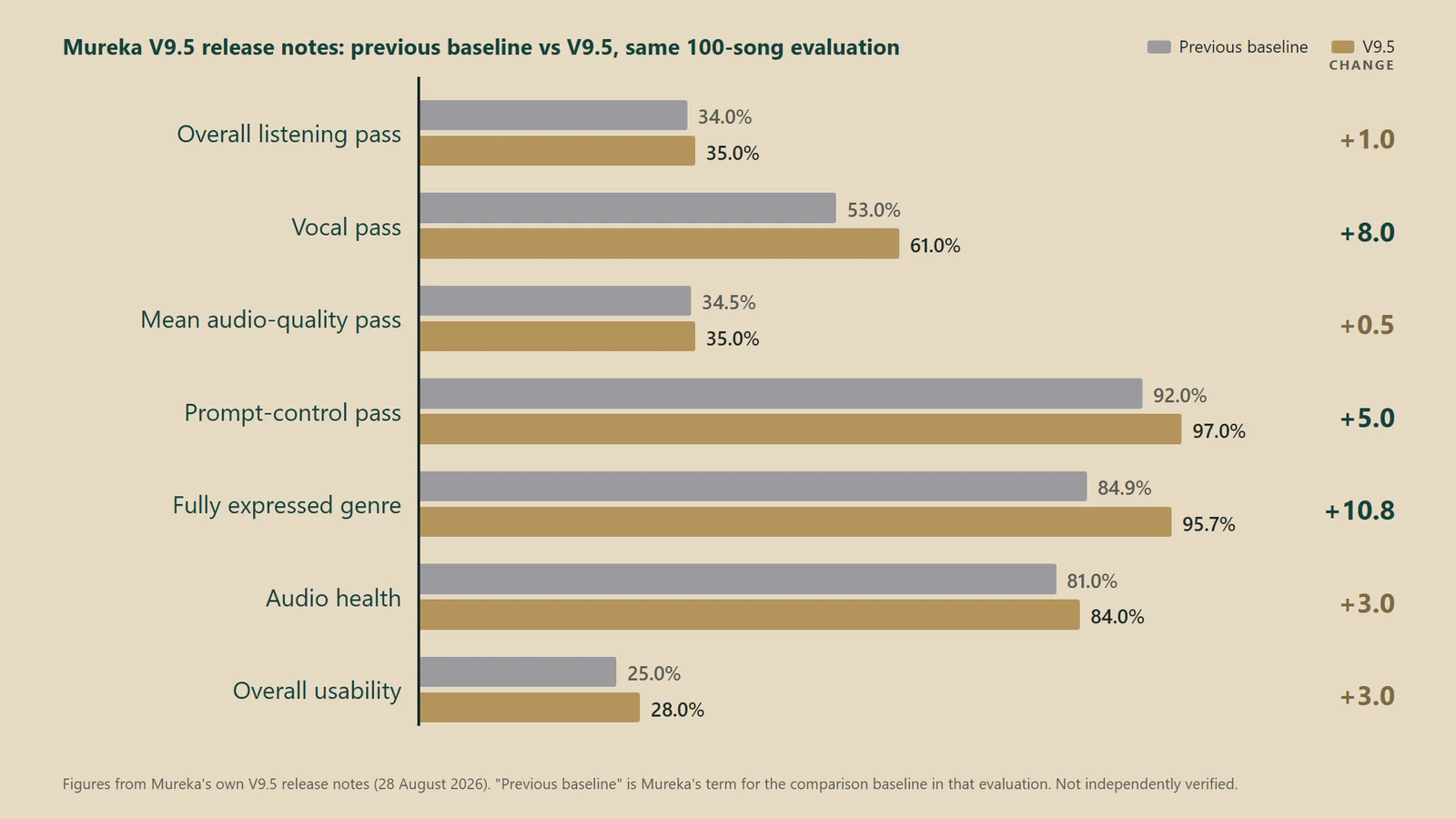
Mureka's own table, seven dimensions: previous baseline against V9.5. Four of the seven moved by three points or less, including overall listening pass (+1.0) and mean audio quality (+0.5)
The release notes also concede a trade-off in their own words: "Compared with some alternatives, certain reference models may stand out more in fullness, part count, and immediate first-listen impact." Mureka’s answer is that V9.5 "chooses a more layered direction" — arrangement density that serves the section rather than the first five seconds. Whether you agree is a matter of ear, but it is another place where the company writes down something a marketing page would leave out.
We have no way to independently verify these percentages; no outside lab has run the same evaluation, and Mureka does not publish its methodology in enough detail to reproduce it. What we can say is that this is a substantively different kind of claim than "sounds better," and it is worth more credit than an adjective is, precisely because it names a number a critic could hold the company to next time.
Plans that load, copy that disagrees
Mureka’s plan page at mureka.ai/subscribe is rendered by JavaScript, which is why a script that fetches the raw page sees almost nothing. In an ordinary browser it loads in full, and it is clear. Free gives four songs a day on an older model (v7.5-all). Pro is $8 a month billed yearly as $96, or $10 if you pay monthly, for 5,000 Gold, up to 500 songs a month, the current models, music video creation, remix, extend, reference tracks and unlimited MP3 downloads. Premier is $24 a month billed yearly as $288, or $30 monthly, for 20,000 Gold and up to 2,000 songs a month, and adds 12-stem splitting, Mureka Studio, WAV, stem, MIDI and DAW-session downloads, any-voice singing and professional voice cloning. Mureka’s terms and privacy pages load in a browser in full too; the Terms of Service carry a release date of October 18, 2024.
The mismatch is elsewhere. The homepage carries a pricing paragraph describing a "Basic Music & Speech" plan at $8 a month, billed annually at $96, with up to 400 songs or 200 minutes of speech, and a "Pro" plan at $24 a month, billed annually at $288, with 1,600 songs or 800 minutes. The dollar figures are the plan page’s annual prices for Pro and Premier, but the names are different and so are the quotas: the plan page says 500 songs or 250 minutes of speech for Pro and 2,000 or 1,000 for Premier. The homepage also says video export is excluded from its lower plan, where the plan page lists music video creation under Pro. It reads like copy written for an earlier plan structure and never updated.
The commercial-rights wording has the same problem. One promotional line on the plan page says: "Every song you generate comes with full commercial rights and unlimited downloads in all formats." The FAQ is narrower and clearer: "During your active subscription, all new songs created as well as past creations created before subscribing come with full commercial rights," and, separately, "There are no download limits." Read together they say that commercial rights belong to subscribers, which is reasonable. But the marketing line says every song, and the plan table gives Pro MP3 downloads while WAV, stems, MIDI and DAW-session downloads are Premier-only. Nothing in the FAQ says what happens to those rights if a subscription lapses; if that matters to a release, ask Mureka before relying on it.
The same plan page is where the music-video feature shows up, and its limits are documented elsewhere on Mureka’s own site. The Knowledge page and the features blog both state that the song clip must be between 10 and 90 seconds, that the video is fully AI-generated with no manual timeline editing, and that generation costs 40 Gold per second. A separate Mureka blog post describes the same feature as able to export a "Full-Length Music Video" from a full track, which does not fit a 90-second cap. At 40 Gold per second a 90-second video is 3,600 Gold, so Pro’s 5,000 Gold a month covers roughly 125 seconds of video if nothing else is generated — our arithmetic, not a Mureka figure.
The lawsuit over how it was built
On December 17, 2025, a group of independent musicians and songwriters filed Attack the Sound, et al v. Kunlun, et al in the US District Court for the Northern District of Illinois, represented by the civil rights firm Loevy & Loevy — the same firm that sued Suno and Udio two months earlier over similar claims. This is, according to the firm's own announcement, the first such lawsuit to target AI music generators owned by companies based outside the United States.
The complaint's core allegation is familiar from the Suno and Udio cases: that Mureka was built by copying and storing copyrighted sound recordings and compositions without permission, then generating new music from that material as a "cheaper substitute for human creativity" that competes directly with the artists whose work trained it. Where this complaint goes further is in naming a specific product feature as part of the mechanism. According to the filing, Mureka's own interface lets a user upload a copy of any existing song as a "reference track" to guide the style of a new generation — with no requirement to show they have the right to use it. That is a description of the Reference feature, which Mureka's own pricing page lists among its exclusive member features.
The complaint does not stop at copyright. It also brings a Digital Millennium Copyright Act claim, alleging Mureka strips copyright-management information from the works it trains on and generates from, and a claim under the Illinois Biometric Information Privacy Act, tied to the voice-cloning feature that lets a subscriber use "any voice" as an AI singer. It further alleges that Mureka's marketing — "royalty-free," "copyright-friendly," phrases like "no music theory required" — is affirmatively misleading given how the underlying model was built, and that the ownership certificates Mureka issues to subscribers carry false information about the rights being granted.
As of this review there is no ruling on the merits. Both defendants moved to dismiss in July 2026, and after the briefing closed in August the court took the motions under advisement in September; the most recent docket entry we found is dated September 10, 2026. We are not going to predict an outcome, and everything above is an allegation from one side of an active case, not an established fact — but it is a court record, filed under a specific case caption, naming specific features by name, and readers weighing Mureka against its training-data-conscious competitors should know it exists.
What it actually sounds like
Nobody on our team sat down and A/B tested Mureka against its rivals track for track. What we have instead is more unusual than what we found for any other vendor in this series: a self-published, quantified quality report, described in the section above, that we cannot independently verify but that at least commits to specific, falsifiable numbers rather than adjectives. That is a genuinely different category of claim from "richer sound" or "more natural," and it deserves to be read that way — as a testable claim Mureka has chosen to put in writing, not as a substitute for hearing it yourself.
The practical way to resolve this is a month of Pro, because the free tier runs an older model (v7.5-all) and will not show you what the V9.5 numbers describe. Listen for the specific things Mureka's own release notes told you to expect from MusiCoT: whether a verse sets up its chorus, whether instruments make room for the vocal rather than crowding it, and whether the emotional arc of a track develops across sections rather than repeating the same idea. Those are the claims Mureka is actually making, and they are more checkable by ear than "sounds better" would be.
What it does genuinely well
- It publishes a real quality score, including the unflattering part. A 61.0 percent vocal pass rate against a stated 53.0 percent baseline, and a candid 28.0 percent overall usability figure, is more numerical honesty than any competitor in this series offers.
- MusiCoT is a genuine structural idea, not a rebrand. Planning a song's structure before generating audio, section by section against that plan, is a specific technical claim with a specific rationale behind it.
- The editing pipeline is unusually deep. Reference, Remix, and Mureka Studio together cover style-guided generation, genre-swapping, and full timeline editing with stem extraction in one product.
- Mureka Co is a real point of difference. Directing an actual DAW workflow with natural language is a feature we found no equivalent of in Suno, Udio, ElevenLabs or Google Flow Music.
- Video is native, not bolted on. MV Director's one-click and storyboard modes turn a finished track into a video inside the same platform, and storyboard mode lets you regenerate only the shots you do not like.
- The plans are readable and inexpensive. Pro is $8 a month billed yearly and includes the current models and music video creation, which is a low price for a current model.
- There is a community layer. Mureka's own app positions it as somewhere to listen to and remix other people's tracks, not only a private generation tool.
Where it falls short
The homepage describes plans that are not on the plan page: a "Basic Music & Speech" plan and a "Pro" plan at $8 and $24 a month, with different quotas and a different feature list.
The prices are the plan page’s annual prices for Pro and Premier, and the plan page itself is clear.
A marketing line promises full commercial rights on every song, while the FAQ grants them during an active subscription and says nothing about what happens after cancelling.
The FAQ is specific and generous on the rest: past creations from before you subscribed gain full commercial rights too.
The same line promises unlimited downloads in all formats, but on the plan table Pro downloads MP3 and WAV, stems, MIDI and DAW sessions are Premier-only.
Pro’s MP3 downloads are unlimited, and the FAQ says there is no monthly download cap.
Music videos are marketed as full-length, but the documentation caps the song clip at 90 seconds and charges 40 Gold per second.
Storyboard mode lets you regenerate single shots rather than a whole video.
Kunlun Tech and Skywork AI are defending a lawsuit that names Mureka’s own Reference feature as part of the alleged infringement mechanism, alongside DMCA and biometric-privacy claims.
The case is public record with a specific caption and filing date, not a rumour, so it can be tracked and the outcome checked in due course.
No independent lab has corroborated Mureka’s self-reported quality percentages, and the methodology behind them is not published in enough detail to reproduce.
Publishing any quantified figure, with a stated baseline and an unflattering number included, is a higher bar than most competitors clear at all.
Who it suits, and who should look elsewhere
You want deep, versioned editing in one place. Reference, Remix, Mureka Studio and Mureka Co together cover more of the production pipeline than most single tools in this category attempt.
You want inexpensive access to a current model. Pro at $8 a month billed yearly includes the current models and music video creation; the free tier runs an older one, so it is not a fair preview.
You need rights wording that does not contradict itself. The plan page and FAQ are clear enough to budget from, but the homepage and the marketing lines around them say different things. Read the FAQ rather than the headline, and ask Mureka in writing if a release depends on what happens to your rights after you cancel.
You are weighing legal exposure in your vendor choice. Compare the open Kunlun Tech case against Udio’s settled UMG position, Suno’s GEMA loss, ElevenLabs’ new licensing deals, and the open case against Google covered elsewhere in this series — every major AI music vendor carries some version of this risk in 2026, and this is Mureka’s.
Trust the numbers, read the FAQ. Mureka’s published quality metrics are more honest than anything its competitors have put in writing, its toolset is deep, and its plans are inexpensive and readable once the page loads. What lets it down is the copy around them: a homepage describing plans that no longer match, and marketing lines that promise more than the FAQ and the plan table deliver. Both things are true at once, and the second is easy to fix and worth checking before you subscribe.
Alternatives worth knowing
ElevenLabs Music — a rights table you can check line by line
ElevenLabs advertises more minutes for a plan than its own terms grant, a gap we go through in our ElevenLabs review — but the gap sits between documents you can actually open. Its Commercial Rights table loads as plain text with no login and no JavaScript required, so the contract can be compared with the advertising line by line.
Suno — plans and commercial terms stated on the pricing page
Suno states its plans and commercial terms directly, and leads on vocals with a full browser production suite. Its own constraint, set out in our Suno review, is metered downloads on every plan since September 2026.
Udio — the other AI music maker mid-lawsuit fallout
Udio traded its own legal trouble for a settlement with Universal Music Group, and most reviewers still rate its instrumental detail above anything in this cluster, ours included — the full story is in our Udio review. The price of that settlement has been steep: exporting audio, video or stems has not worked since October 2025.
MuseGen — ours, and lighter on paperwork by design
MuseGen’s pitch here is consistency between what the homepage says and what the terms say. Our terms load as an ordinary page, you keep the copyright in everything you generate, even on the free plan, and commercial use is spelled out for whichever paid plan you are on, attached when a track is generated rather than when you download it. Stem and MIDI export of generated songs is not available yet. What is: select 7 to 60 seconds of a finished song and regenerate just that part with new lyrics, and send the finished track straight into a video without leaving the site, starting from lyrics you write yourself in the song maker.
Transparency note
MuseGen competes with Mureka, which is why we show where every figure came from. The quality figures come from Mureka's own V9.5 release notes, the plan and rights wording from its homepage, plan page and FAQ as they load in a browser, the music-video limits from its own documentation, and the lawsuit details from the plaintiffs' law firm and the court docket on CourtListener, each listed in the sources below and re-checked on October 20, 2026. Where Mureka's own pages contradicted each other, such as the homepage plans against the plan page, or the every-song rights line against the FAQ, both versions are printed above rather than one being quietly dropped. Mureka's quality percentages are self-reported and we could not verify them. No listening test of ours backs this review, and we found no independent one for V9.5.
Disclosure — the MuseGen team
FAQ
What is Mureka AI?
Mureka is an AI music generation platform that turns a text prompt, lyric or reference track into a complete song, then lets you keep editing it: replacing sections, extending it, splitting it into stems, remixing it into another genre, or turning it into a music video. Its current model is V9.5, released August 28, 2026, and its technical approach is built around a framework called MusiCoT, which plans a song's structure before generating audio rather than producing sound directly from a prompt.
Who owns Mureka?
Mureka is operated by Kunlun Tech Co., Ltd. of China through its Singapore-based subsidiary Skywork AI Pte. Ltd. Mureka began in February 2024 as a beta product called SkyMusic, launched bilingually on Kunlun's Tiangong platform in April 2024, and was rebuilt into the Mureka model line from version 3.0 onward. Both companies are named as co-defendants in a lawsuit filed in December 2025.
Is Mureka free?
Yes, but only four songs a day, on an older model. The plan page lists Free at 4 songs daily with the older v7.5-all model and a shared queue of 2 concurrent generations. The current models (V9.5, V9, V8, O2 and V7.6), music video creation, remix, extend and a priority queue start at Pro, and Gold top-ups are open to Pro and Premier members only. Mureka's FAQ ties commercial rights to a paid subscription.
Can I use Mureka music commercially?
Yes on a paid plan, according to Mureka's FAQ, which says that during an active subscription all new songs, and past creations from before you subscribed, come with full commercial rights. One marketing line on the same page says every song comes with full commercial rights, which reads as if the free tier were included; the FAQ is the more specific statement and treats rights as a subscriber benefit. It does not say what happens to those rights if you cancel, so confirm that with Mureka before releasing anything you plan to keep earning from.
Is Mureka being sued?
Yes. A group of independent musicians and songwriters filed Attack the Sound, et al v. Kunlun, et al on December 17, 2025 in the US District Court for the Northern District of Illinois, naming Kunlun Tech and Skywork AI as defendants. The complaint alleges copyright infringement, a DMCA violation, and a violation of the Illinois Biometric Information Privacy Act tied to voice cloning, and specifically cites Mureka's Reference feature, which lets a user upload any song to guide a new generation, as a mechanism of the alleged infringement. As of this review there is no ruling on the merits: both defendants moved to dismiss in July 2026, and the court took those motions under advisement in September 2026.
What is MusiCoT?
MusiCoT, short for Music Chain-of-Thought, is the technical framework Mureka has used since version 6.0 in March 2025. Rather than generating audio directly from a prompt, the model first forms an explicit plan of the song's structure and expressive direction, then generates section by section, melody, vocals and arrangement, in a way meant to keep those elements coherent with each other across the whole track.
Does Mureka publish real quality data?
More than any other vendor we cover in this series. Mureka's own blog post on its V9.5 release states a same-round evaluation of 100 songs, reporting a 61.0 percent vocal pass rate, up 8.0 percentage points from a 53.0 percent previous baseline in the same evaluation, alongside a 97.0 percent prompt-control pass rate, a 95.7 percent fully-expressed-genre rate, an 84.0 percent audio-health rate, and a 28.0 percent overall usability rate, up from 25.0 percent. That last figure is a genuinely modest number to publish voluntarily, and no independent lab has verified any of these figures.
What's a good Mureka alternative?
It depends what you value most. If you want commercial terms stated directly on a pricing page, Suno does that, though its downloads are now metered. If licensing paperwork matters, ElevenLabs publishes an actual commercial-rights table by plan. If instrumental fidelity matters most, Udio is still the reference point, minus its ability to export anything. MuseGen is ours, and the pitch is simpler: rights that attach when a track is generated, terms on an ordinary page, and a finished track that can go straight into a video. Read whichever vendor's terms apply to you before you release anything.
Related reading
- ElevenLabs Music Review 2026 — what a published rights table looks like, and why the minutes it advertises do not match it
- Google Flow Music Review 2026 — another lawsuit, another AI music maker, filed less than three months after this one
- Udio Review 2026 — what a licensing settlement cost the one feature everyone actually wanted
- The AI Music Generator Benchmark — where Mureka sits alongside five other engines, measured the same way
Sources
- Mureka — Subscribe / pricing page
- Mureka — What Changed in the Mureka V9.5 Model? (28 August 2026)
- Mureka — What is Mureka?, including the version-history timeline (28 August 2026)
- Mureka — homepage, source of the plan paragraph that does not match the plan page
- Apple App Store — Mureka: AI Radio & Music Maker, listing Skywork AI Pte Ltd as publisher
- Loevy & Loevy — American Musicians and Songwriters Sue AI Music Companies Located in China and Singapore (19 December 2025)
- CourtListener — Attack the Sound LLC v. Kunlun Tech Co., Ltd, No. 1:25-cv-15354 (N.D. Ill.), docket, source of the 17 December 2025 filing date and the July–September 2026 motion practice (last known filing 10 September 2026)
- Mureka — Knowledge page and features blog, source of the 10–90 second clip limit and the 40 Gold per second cost
- Mureka — How to create a full AI MV with Mureka, source of the “Full-Length Music Video” wording
- Mureka — Terms of Service (release date 18 October 2024)