What BPM Is Techno?

MuseGen Team
9/28/2026
Ask what tempo techno runs at and the answer arrives with total confidence, and it is a different answer every time. One reference work says 120 to 150. A production guide says 120 to 125. Producers say 128, or 135, depending on who taught them and in which decade. All of those figures came from somewhere real. They cannot be reconciled because techno, alone in this series, refuses to hold still — and the width of the disagreement turns out to be the most useful thing about it.
The short answer
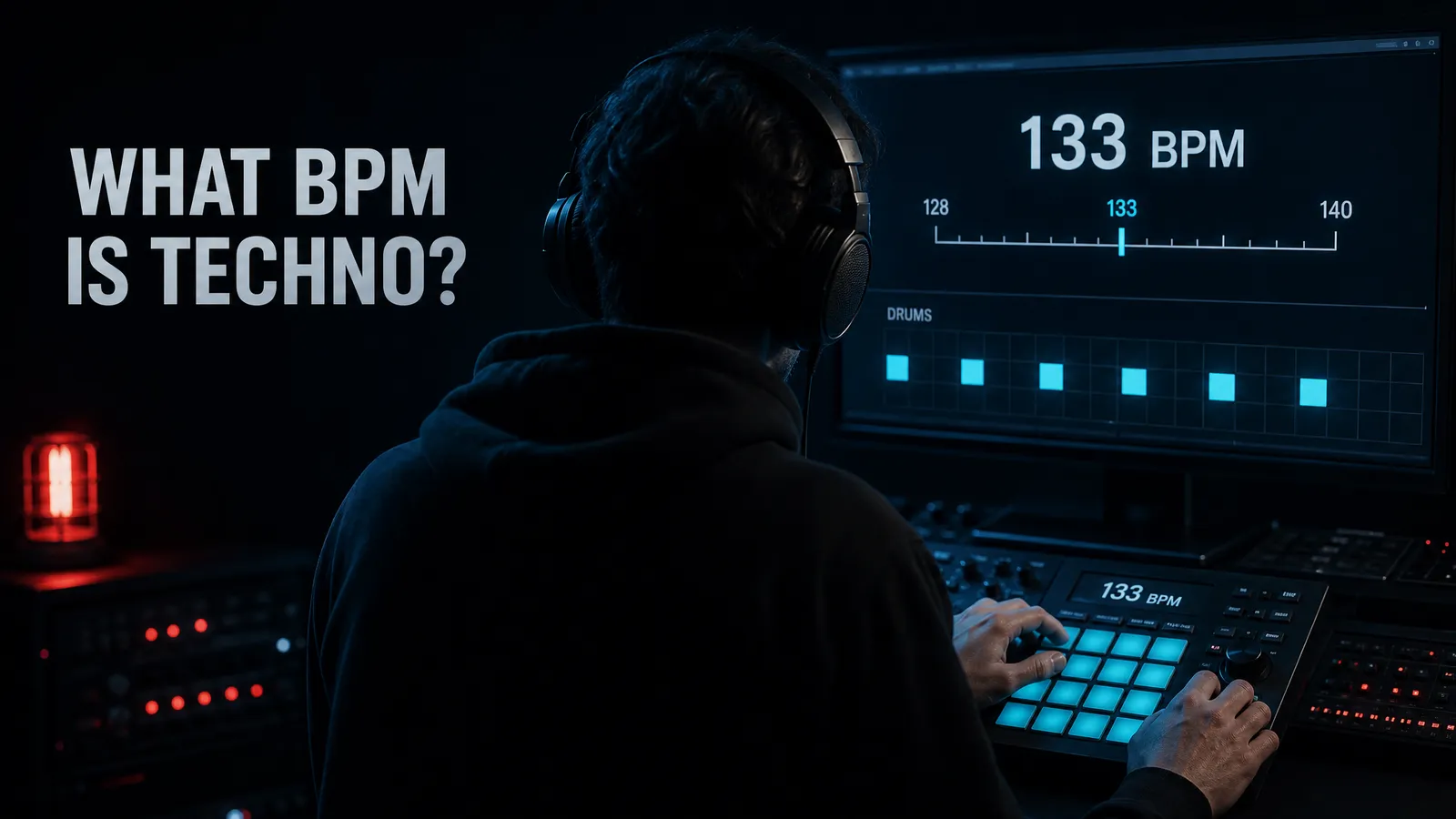
Techno medians at 133 BPM. That figure comes from 43,429 catalogued tracks measured in September 2026: half of them sit between 128 and 140, and nine in ten between 126 and 146. If you need one number to start a project on, use 133. If you want a number that will still be right in ten years, there is not one — techno's median has climbed roughly ten beats per minute since 1991 and has not stopped.
The two figures people actually quote are 128 and 135, and neither is the centre. 128 is the lower quartile — a quarter of techno is slower than it — and it is famous for a different reason entirely, as the peak of dance charts taken as a whole. 135 is the arithmetic mean, sitting two beats above the median because a long tail of hard techno pulls it upwards. Neither is where the records are.
The family behind the word matters here too. Melodic techno medians at 125, minimal techno at 127, techno itself at 133, hard techno at 146 — twenty-one beats per minute between the ends.
- Start at 133, not 128. The measured median across 43,429 catalogued techno tracks is 133 BPM. The 128 everyone quotes is the lower quartile, and it belongs to dance music as a whole rather than to techno.
- Attach a year to the number. Techno's median has climbed about ten beats per minute since 1991. Nothing else in this series moves like that, so a techno tempo without a date is only half a figure.
- Name the subgenre, because here it carries the tempo. Melodic techno medians at 125 and hard techno at 146. Twenty-one beats per minute separate the ends of the family, so the label does real work that a house label cannot.
- Judge a published range by how wide the music is. Where a distribution is tight the editorial figure lands on the measurement. Where it is wide, as in techno itself, every chart disagrees and all of them have a case.
Quick facts
- Measured median: 133 BPM across 43,429 tracks, September 2026
- Middle half: 128–140 BPM — twelve beats wide
- Nine records in ten: 126–146 BPM
- Published ranges: 120–150 in reference works, 120–125 in production guides
- Across the family: Melodic techno 125 up to hard techno 146
- Since 1991: The median has moved from 128 to 138
The number, and how wide it is
Begin with a measurement rather than a definition, because for this genre a large one exists. A catalogue of 43,429 tracks carrying the techno tag was measured in September 2026 and returned a median of 133 BPM. That is not a range somebody remembered or an average of published opinions. It is the middle value of forty-three thousand records: half faster, half slower.
The shape around that median is what makes techno difficult. The lower quartile sits at 128 and the upper quartile at 140, so the middle half of all techno covers twelve beats per minute. Open it out to nine records in ten and the band runs 126 to 146 — a spread of twenty.
Put that beside a genre measured by the same catalogue. House medians at 125, and nine house records in ten fall between 121 and 131: a ten-beat window. Techno's middle half is wider than the whole nine-in-ten band of house. Half of techno is more spread out than ninety percent of its closest neighbour.
That comparison drives everything below. A genre with a narrow distribution can be summarised by one number and nobody argues; a genre this broad cannot, and the arguments are not carelessness. They are people standing in different parts of a genuinely large room, each reporting the view. It also settles a boundary this series has left vague: the two genres overlap across most of house's range, and between 128 and 131 a record is ordinary in either.
What the published ranges are doing
Wikipedia's article on techno describes tempos in the range from 120 to 150 beats per minute. That range does contain the measured middle half, so it is not wrong. It is also thirty beats wide, which is more than the distance between house and hard techno — at that width a figure has stopped being a tempo and started being a category boundary.
iZotope's tempo guide for producers gives techno as 120 to 125. Set that against the catalogue and something sharper than a disagreement appears: the entire production-guide range sits below the measured lower quartile. A track written anywhere inside 120 to 125 lands in the slowest quarter of techno as it has actually been released. The guide is describing the genre's slow end as though it were the whole.
This series has already covered why definitional and production sources pull in opposite directions. What techno adds is scale. When a genre is narrow, those two purposes land within a beat or two of each other and the reader never notices. When it is twenty beats wide, they produce ranges that barely touch.
One published figure does land well. The catalogue that produced the measurement prints its own editorial range alongside it — 130 to 140 — which contains the median, the upper quartile and most of the middle half. That is the sentence you get from someone who looked at the distribution first.
128 and 135, and what each one is
Two numbers dominate conversation about techno tempo, and each survives because it is true of something. Neither is true of the thing people use it for.
128 is a real number wearing three hats. It is techno's lower quartile today. It was techno's median in 1991. And it is the most common tempo in recorded dance music generally: a decade of weekly dance chart data peaked at 128 throughout, with that one value taking 11.3 percent of every entry and the band from 125 to 130 taking 44.2 percent between them. That finding is the reason 128 has the standing it does — but it was measured across dance music as a whole, weighted by what charted, a population dominated by house and its relatives. 128 is where the charts peak. It is not where techno sits.
135 arrives by arithmetic, twice, from two directions. The catalogue's mean is 135 against a median of 133. A mean above the median is the signature of a long right tail, and the tail here is obvious: hard techno medians at 146 and reaches 160 at its ninetieth percentile, dragging the average of the whole tag upward while leaving the middle where it was.
The second route is one this series has already warned about. Split the difference between a definitional 120 to 150 and a production-guide 120 to 125 and you also arrive at 135, which is a tempo neither source was describing. Two separate pieces of arithmetic, one averaging measurements and one averaging opinions, converge on a number no method of counting records puts at the centre.
So the three figures divide cleanly:
| Number | What it actually is | Safe to use for |
|---|---|---|
| 128 | Lower quartile; the peak of dance charts generally; techno's own median in 1991 | A deliberately groovy, house-adjacent techno track |
| 133 | The median of 43,429 measured techno tracks | Starting a project when you have no other constraint |
| 135 | The mean, pulled up by hard techno; also the midpoint of two published ranges | Nothing in particular — it is an artefact of averaging |
133 is where the records are. 135 is where the arithmetic lands. 128 is where the charts peak. Three different questions that have quietly been sharing one answer slot for years.
The only number in this series that moves
Every previous article in this cluster treated tempo as a fixed property of a genre, and was right to. Drum and bass settled at 170 to 180 around 1996 and has stayed there for thirty years. Trap is written at 140 and has been for the whole life of the style. Hip-hop's two tempo families are separated by decades of practice, not by drift.
Techno is the exception, and it is not close. Across 9,726 year-stamped techno tracks spanning 1991 to 2026, the median climbed from 128 to 138 — a rise of 10.5 beats per minute. The lowest annual median in the series was 126, in 2013. The highest was 140, in 2025. Within one genre, under one label, the centre of gravity has moved further than the entire width of house.
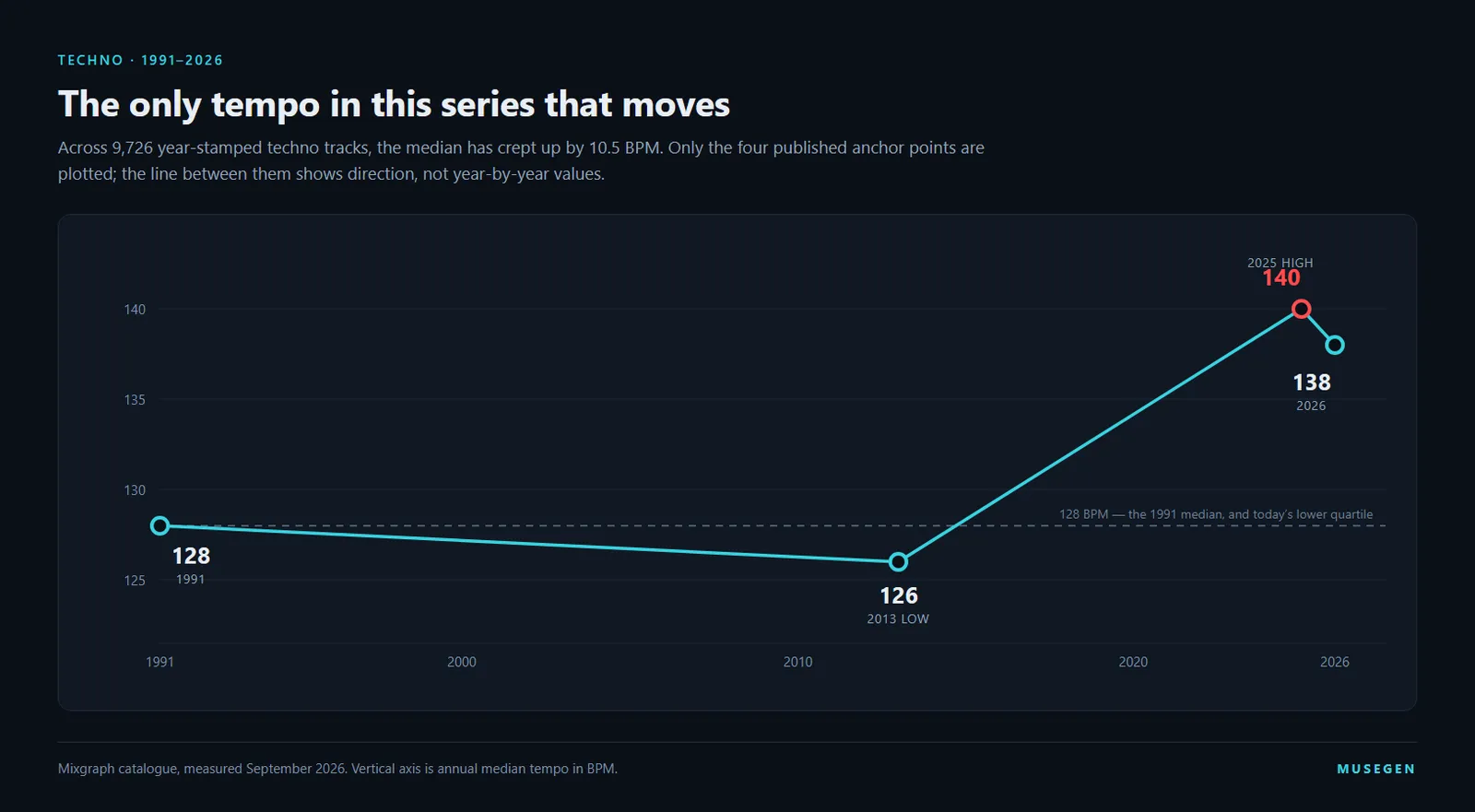
The same word, thirty-five years apart, with ten beats per minute between them.
Two qualifications before that number gets carried anywhere. The drift is measured on the 9,726 records that carry a usable year, not on all 43,429. And an annual median computed from a thin slice of early years is noisy, so the shape of the trend is far more trustworthy than any single point on it.
The drift is also uneven across the family, which is what makes it believable rather than suspicious. Minimal techno, measured over 2003 to 2026, moved by one beat per minute. Hard techno, measured over 2012 to 2026, shows no trend at all: its highest annual median was 155 in 2012 and its lowest 128 in 2016, which is noise around a stable centre rather than a direction. The acceleration is happening in the broad middle of the tag, not in the branches held in place by a tighter definition.
The practical consequence is a habit no other genre here needs. A techno tempo without a date attached is only half a figure. A guide that says 128 is not lying; it may have been written when 128 was the median, which it was, once. Reading a techno BPM anywhere — a chart, a forum post, a sample pack — the useful question is not whether it is right but when it was right.
Five labels, twenty-one beats apart
Techno's subgenre labels behave differently from house's, and the difference is large enough to change how you use them. Here is the family, each row measured separately by the same catalogue in September 2026.
| Subgenre | Median BPM | Middle half | Nine in ten | Tracks |
|---|---|---|---|---|
| Melodic techno | 125 | 124–126 | 122–128 | 602 |
| Dub techno | 125 | 120–128 | 117–134 | 182 |
| Minimal techno | 127 | 124–129 | 122–130 | 21,803 |
| Techno | 133 | 128–140 | 126–146 | 43,429 |
| Hard techno | 146 | 136–155 | 128–160 | 9,893 |
Read the sample sizes before the tempos. Minimal techno and techno itself rest on tens of thousands of records; hard techno's 9,893 is solid and melodic techno's 602 usable. Dub techno's 182 is a small enough bucket that its median deserves a wider mental error bar, and the unusually broad band on that row is partly what a small sample looks like.
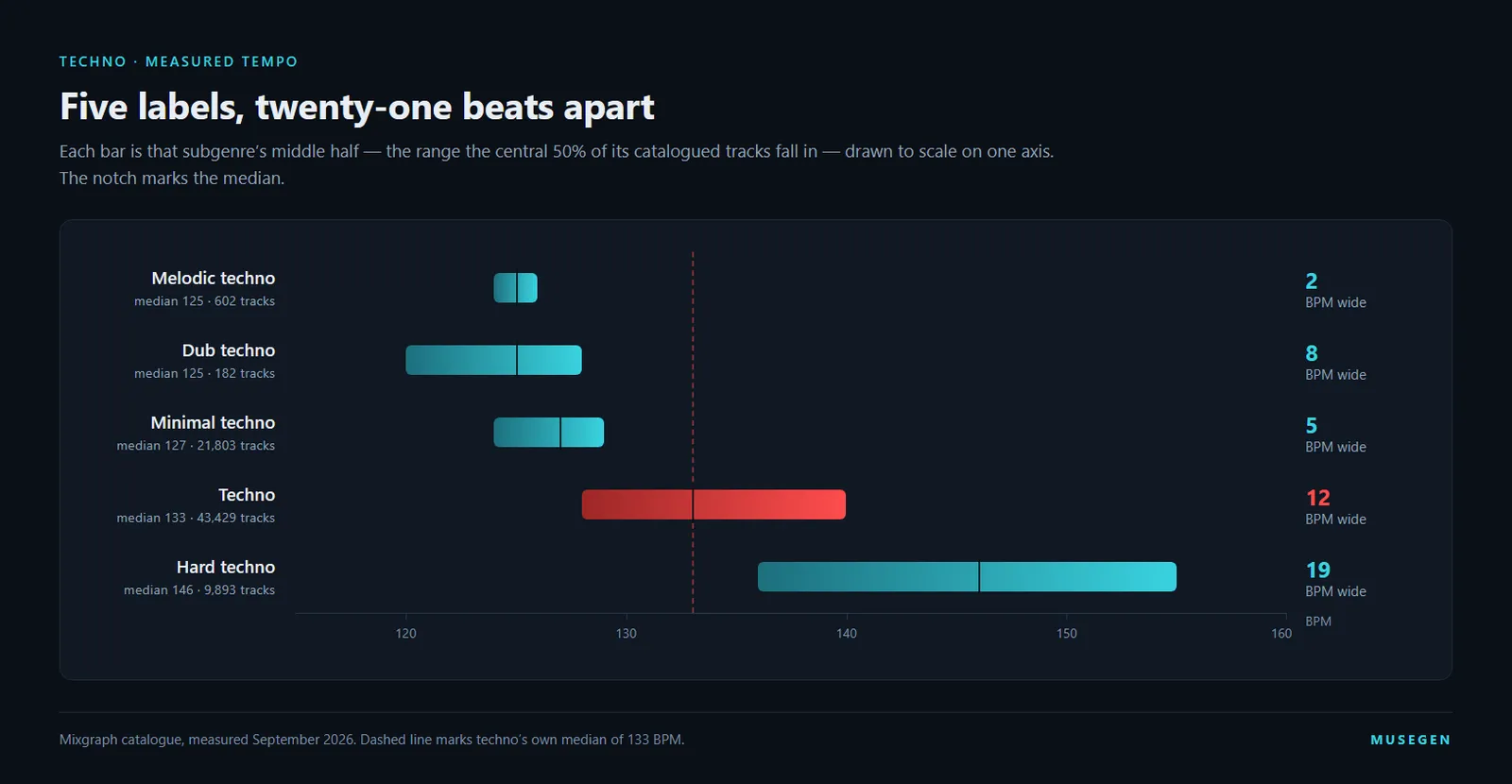
Each bar is that subgenre's middle half, drawn to scale on one axis.
Now the comparison that matters. Measured by the same method, four house labels sit within two beats per minute of one another — deep and progressive house both at 123, melodic house at 124, house itself at 125. The conclusion there was blunt: tempo cannot tell you which house subgenre you are writing.
The techno family inverts that. From melodic techno at 125 to hard techno at 146 is twenty-one beats per minute, a gap wider than the middle half of any single row in the table above. Saying "hard techno" instead of "techno" is not a mood adjustment; it is an instruction to move the tempo by thirteen beats.
One exception inside the table is instructive. Melodic techno and dub techno share a median of 125 exactly, so on that figure alone they are indistinguishable. What separates them is spread: melodic techno's middle half is two beats wide, dub techno's is eight. Same centre, different discipline — which is the point of the next section.
Why some published figures are right
A median is only half of what a distribution tells you. The other half is how tightly the records cluster around it, and here the difference is dramatic. Melodic techno's middle half spans two beats per minute. Hard techno's spans nineteen. Same method, same catalogue, same week.
That changes what a genre word is worth. "Melodic techno, 125" is close to a complete tempo specification, because the genre does not permit much else. "Hard techno" narrows a track to a nineteen-beat window in the middle and a thirty-two-beat window at nine in ten, which is barely a specification at all.
Here is where it becomes useful. This series has spent five articles documenting the gap between what reference works publish and what catalogues measure, and the gap has been real every time. Minimal techno is the first clean exception. Wikipedia states that the average tempo of a minimal techno track is between 125 and 130 beats per minute; the measurement, over 21,803 records, gives a median of 127 with a middle half of 124 to 129.
The published claim and the measurement agree almost exactly, and the reason is visible rather than mysterious. Minimal techno is a narrow genre. When the music clusters that tightly, a writer working from impression and a catalogue working from counting converge, because there is very little room between them to disagree in.
Run the rule backwards and it holds. Techno proper is twelve beats wide in its middle half, and its published figures run from 120 to 125, through 130 to 140, to 120 to 150 — three ranges that scarcely overlap. Hard techno is nineteen beats wide, and the reference works give up entirely: Wikipedia carries no separate hard techno article. The term redirects to hardcore, a different genre running from 160 to 200 beats per minute or more, so a reader following the obvious path lands fourteen beats above hard techno's actual median.
So a rough rule, and it generalises past techno: trust a published tempo range in inverse proportion to the width of the music it describes. Narrow genres get quoted accurately because there is nothing else to say. Broad ones collect contradictory figures because every honest observer saw a different part of them.
What a measurement admits about itself
Numbers this specific invite more trust than they deserve, so look at what the measurement says about its own reliability. Usefully, this one publishes that.
Of the 43,429 techno tracks, 2,925 were removed as tempo outliers by a statistical fence before any median was computed. A further 1,847 were detected at half their written tempo and corrected upward. And 3,960 — 9.1 percent of the catalogue — carry a tempo the detector itself flagged as uncertain, and were included anyway.
That flag rate varies enormously by subgenre, in a way that makes sense. Minimal techno, with its steady pulse and very little else competing for the grid, comes in at 1.2 percent flagged. Hard techno reaches 18.0 percent and dub techno 18.7. Dense distortion and sparse, reverb-heavy material are both hard to count, and the detector says so rather than pretending otherwise.
The half-tempo corrections deserve a note, because this cluster has been circling the topic for five articles. In trap and drum and bass, two readings of the same record are both honestly true. Techno is not like that: it is felt at the tempo it is written at, four kicks to the bar, so a techno track reported at 66 is not an alternative description but an error. Those 1,847 corrections are the detector being wrong and being caught, not a genre being ambiguous.
One last piece of housekeeping, because it explains a discrepancy readers of this site may notice. The same catalogue published a techno median of 130 in March 2026, drawn from 6,582 tracks; in September, from 43,429 tracks, it published 133. That is not the genre gaining three beats in six months. It is a sample growing sevenfold and the estimate settling as it does. When a figure moves, ask whether the music changed or the counting did.
Writing the number down
All of that collapses into a short set of instructions.
With no other constraint, use 133. It is the median of the largest measurement available, and it sits inside every credible published range including the wide one.
If the track has a job, pick from the quartiles instead. 128 for something groove-led that will sit next to house in a set, 140 for peak-time material. Those are the two edges of the middle half, so a record at either is still ordinary techno rather than a border case.
If you know the branch, say the branch. This is the one genre in the series where the subgenre word moves the number by more than a rounding error.
And where it matters, say when. A techno reference from 2013 and one from 2025 are fourteen beats apart at the median. If you are matching an era rather than a genre, the year is doing as much work as the number.
Written out as a specification, that becomes something a person or a tool can act on without guessing: hypnotic techno, 133 BPM, one bassline that never resolves, rolling closed hats, no chord changes. The genre word sets the character, the number settles what the word alone leaves open across twenty beats, and the rest describes what happens on top.
Techno medians at 133 BPM, and the middle half of it runs 128 to 140 — a spread wider than the whole of house. The 128 people quote is the lower quartile, the 135 they quote is an average pulled up by hard techno, and the centre has climbed ten beats since 1991. One number is enough to start with. It is not enough to describe the genre with.
▶ Watch on YouTube: "140 BPM Techno - How To Make A Track In Ableton Live" — A production walkthrough written at 140 BPM, the fast end of the range measured above.
Type 133, and mean 2026
A tempo field has no year in it. That is the small problem sitting underneath everything above: the word "techno" typed into a description box resolves to some historical centre of gravity, an average of everything the phrase has ever meant, rather than to what the genre medians at this year. The number you type is the only place where you get to say when.
Which makes the number worth getting from somewhere. If you are working from a reference track, MuseGen's BPM detector reads the tempo of an uploaded file and hands back a single figure — useful here precisely because techno is not a half-time genre, so the number needs no interpretation before you use it. Check where it falls against the quartiles above and you know whether your reference is groove-led, centre-of-the-genre, or already leaning hard.
Going the other way, MuseGen's song maker accepts a tempo stated in plain language alongside the description, which is where the specification from the previous section belongs. Naming 133 rather than leaving "techno" to speak for itself removes the twenty-beat ambiguity this article has been measuring. The genre word and the number are doing two different jobs, and only one of them can be left implied.
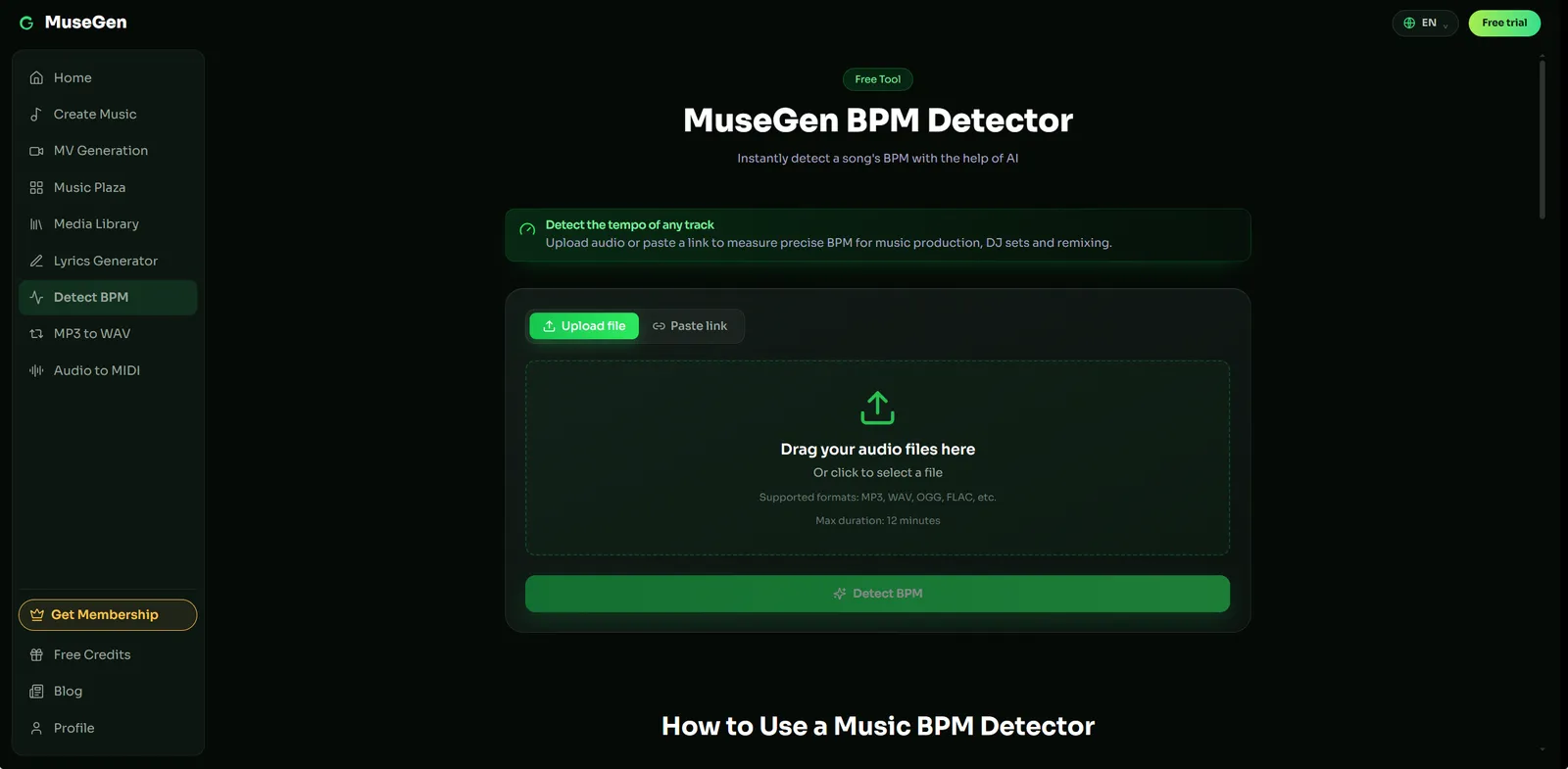
Reading a reference track's tempo, before deciding where it sits in the range.
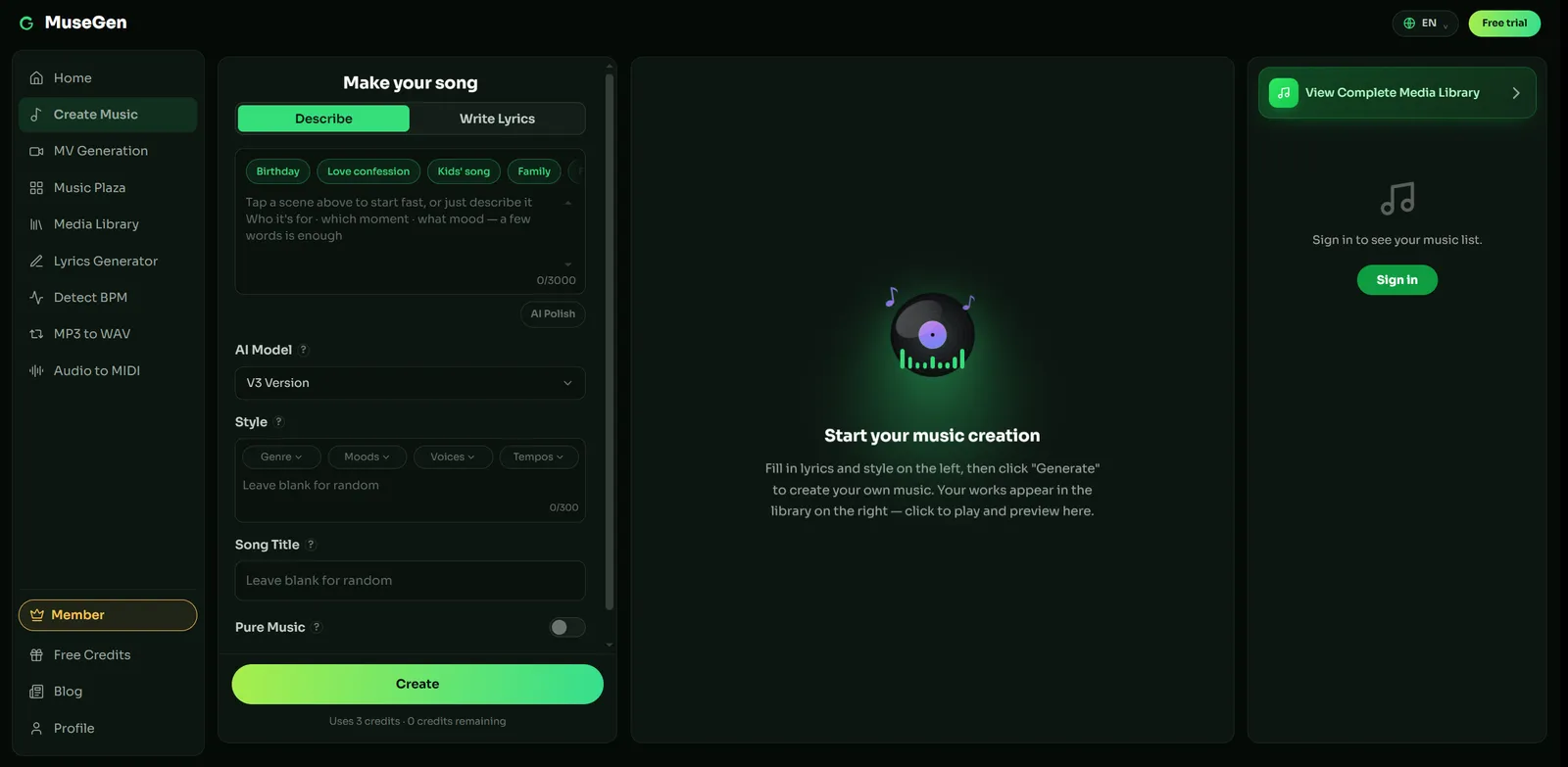
The other direction: state the tempo instead of detecting it afterwards.
Put the number in, not just the word. Read the tempo of a reference track, or state it up front and have the music written to it — Try MuseGen.
FAQ
What BPM is techno?
133 BPM is the median across 43,429 catalogued techno tracks measured in September 2026. Half of those records sit between 128 and 140, and nine in ten between 126 and 146. Reference works give a much wider 120 to 150, and production guides a much narrower 120 to 125.
Is techno 128 or 130 BPM?
Neither is the centre. 128 is the lower quartile of the measured distribution, the point below which a quarter of techno records sit, and it is also the peak tempo of dance charts as a whole, which is house territory rather than techno's. 130 was the median a smaller catalogue reported in March 2026; a much larger one in September put it at 133.
What BPM is hard techno?
146 BPM is the median across 9,893 catalogued hard techno tracks. It is also the widest spread in the family: half of those records fall between 136 and 155, a nineteen BPM window. Wikipedia carries no separate hard techno article, so there is no reference figure to check it against.
What BPM is minimal techno?
127 BPM, measured across 21,803 tracks, with half of them between 124 and 129. This is the one figure in the family where the published claim and the measurement agree: Wikipedia puts the average minimal techno tempo between 125 and 130, and the catalogue lands inside that.
Has techno got faster over time?
Yes, by about ten beats per minute. Across 9,726 year-stamped techno tracks spanning 1991 to 2026, the median climbed from 128 to 138. The lowest annual median was 126 in 2013 and the highest was 140 in 2025. No other genre covered in this series drifts that far.
Is techno faster than house?
Yes, by about eight beats per minute at the centre: house medians at 125 and techno at 133. They overlap heavily all the same, because techno's middle half runs from 128 to 140 while house reaches 131 at the top of its nine-in-ten band. A record at 129 is ordinary in both.
Why do techno BPM charts disagree?
Because techno genuinely has no narrow centre. Its middle half spans twelve BPM, which is wider than the whole nine-in-ten band of house. Any writer sampling a different corner of that spread arrives at a different figure, and most of them are describing real records.
Is 140 BPM techno or trap?
It can be either, and the tempo is not what separates them. A trap record at 140 is felt at half that speed with the backbeat on beat three, while a techno record at 140 is felt at 140 with four kicks to the bar. 140 is the standard written tempo for trap and the upper quartile for techno.
Related reading
- What Is BPM in Music? — tempo from first principles, including why one recording can carry two numbers
- BPM by Genre and Subgenre — the full chart this page expands one row of, and how to read a contested range
- What BPM Is House Music? — the neighbour techno overlaps, measured the same way and far narrower
- How to Match BPM and Key for Mashups — what to do when two records sit at different points in a range this wide
Sources
- Mixgraph — BPM for Techno (September 2026) for the 133 median across 43,429 tracks, the quartiles and nine-in-ten band, and the outlier, half-tempo and flag figures.
- Mixgraph — BPM for Hard Techno (September 2026) for hard techno's median of 146, its nineteen-beat middle half and 18.0 percent flag rate.
- Mixgraph — BPM for Minimal Techno (September 2026) for minimal techno's median of 127 across 21,803 tracks and its 1.2 percent flag rate.
- Mixgraph — BPM for Melodic Techno (September 2026) for melodic techno's median of 125 and two-beat middle half.
- Mixgraph — BPM for Dub Techno (September 2026) for dub techno's 125 median across 182 tracks and its wide, small-sample band.
- Mixgraph — BPM Guide: Tempo Ranges by Genre (March 2026) for the earlier March 2026 techno median of 130 from 6,582 tracks.
- Wikipedia — Techno for the 120 to 150 published range.
- Wikipedia — Minimal techno for the average minimal techno tempo of 125 to 130.
- iZotope — Using Different Tempos To Make Beats For Different Genres for the production-guide range of 120 to 125.
- Dirk Moelants — Hype vs. Natural Tempo: a Long-term Study of Dance Music Tempi (ICMPC 2008, Ghent University) for the dance-chart peak at 128 and the 125 to 130 band taking 44.2 percent of entries.