What BPM Is Lo-Fi?

MuseGen Team
9/30/2026
Seven times in this series the answer to "what BPM is this genre" has been a number somebody counted: a catalogue of tagged records, a detector reading each one, a median out the other end. Ask about lofi and that machinery stops. Nobody has counted it. There is still an answer, and it is a good one, but it is worth knowing which kind of answer you are holding.
The short answer
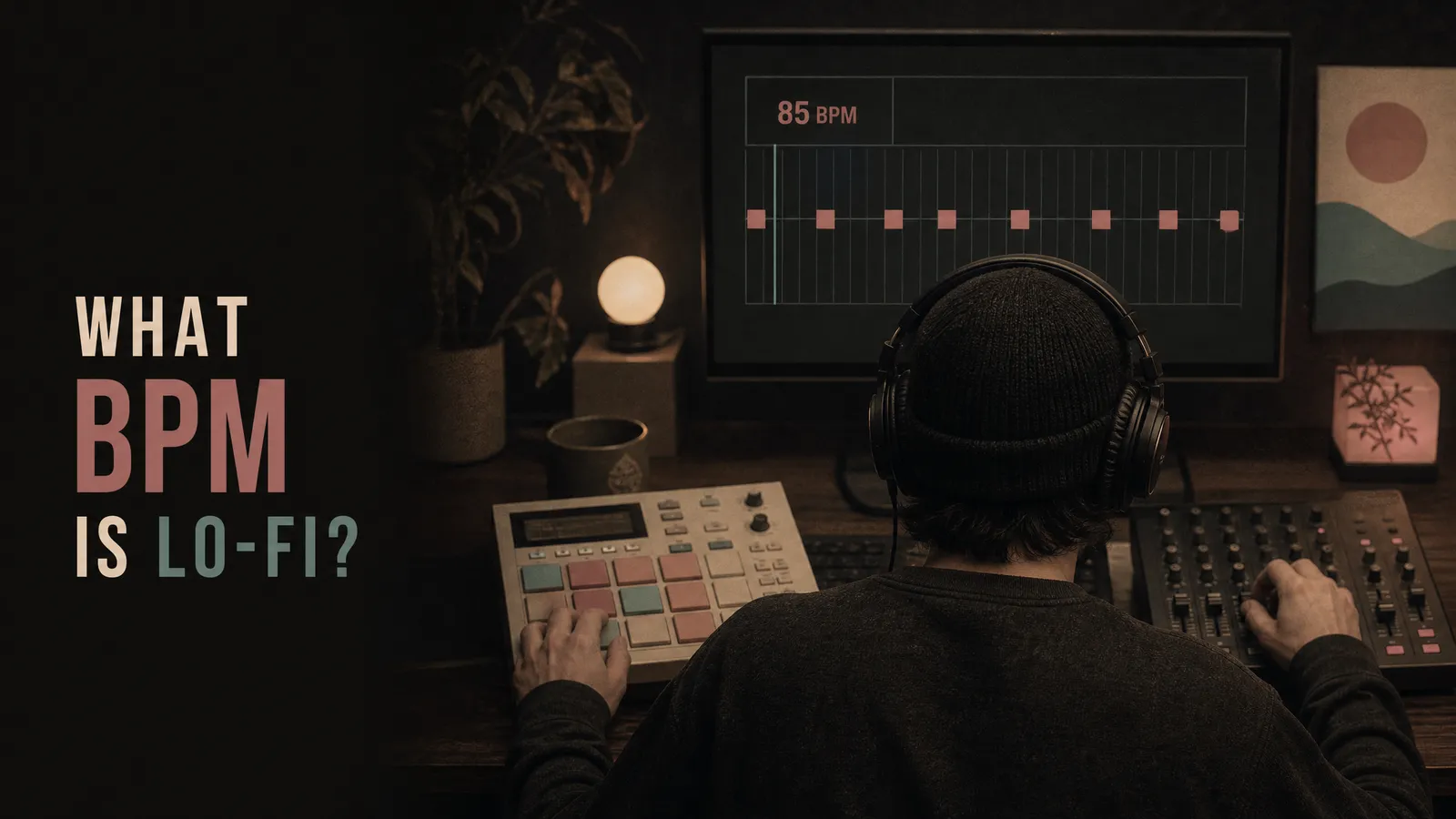
Lofi runs 70 to 90 BPM and clusters near 80. That figure is a convention rather than a measurement: no catalogue has published a median for lofi, and the reference works carry no tempo number for the genre at all. Use 80. Just know it rests on agreement among the people making the music rather than on a count of records.
The silence is not one site's oversight. A catalogue publishing 58 genre tempo pages has none for lofi. A producer's tempo guide listing seven genres omits it. Wikipedia's articles on lo-fi music and lofi hip-hop contain no beats-per-minute figure anywhere. What fills the gap is an agreement so uniform nobody notices it is one.
- Use 70 to 90, and treat 80 as the centre. Every source that names a lofi tempo names roughly that band. A track written at 80 will read as the genre to anyone who knows it, and no competing figure is in circulation.
- Know that nobody has counted this genre. A catalogue publishing 58 separate genre tempo pages has none for lofi, chillhop or lofi hip hop. Wikipedia's articles on lo-fi music and lofi hip-hop carry no tempo figure at all.
- Expect a detector to need checking here. Flag rates climb as music leaves the grid, from 1.2 per cent of minimal techno to 80.4 per cent of ambient. Lofi is built on deliberate off-grid placement, which is the hardest case of all.
- Read a measurement above the editorial range with care. In all three neighbouring genres where both exist, the measurement landed above the published range. The one correction these catalogues apply only ever moves a tempo upward.
Quick facts
- Working range: 70–90 BPM, clustering near 80
- Status of that figure: Editorial convention — no measured median exists
- Genre pages in the largest catalogue: 58, and not one of them lofi
- Nearest measured neighbour: Downtempo, 105 BPM across 1,617 tracks
- Hardest genre to detect: Ambient — 80.4% of tracks flagged for review
- The usual detector error: Reporting 160 for an 80 BPM record
The number, and what kind of number it is
Lofi sits between 70 and 90 beats per minute and clusters near 80. That is not controversial, and if you came for a figure to start a project on, you have it. What makes this article unlike the seven before it is not the number. It is what stands behind the number.
Behind house's 125 there are 3,587 measured records. Behind techno's 133 there are 43,429. Behind drum and bass at 174 there is a measurement and thirty years of a genre policing its own edges. Behind trap at 140 there is a written convention so rigid that the interesting question became why the same record feels like 70. In each case, someone can be pointed at who counted.
Behind lofi's 80 there is agreement. Producers use it, sample packs are built around it, and every written source naming a tempo names the same band without citing anything. That is not worthless — unanimity this broad is itself evidence about what the music does — but it is a different class of evidence, and treating the two as interchangeable is how a convention quietly acquires the authority of a measurement. Use 80. Just do not repeat it as though someone had counted.
Nobody has counted this genre
That is a strong claim, so here is the evidence. Four kinds of source were checked, each the sort that supplied a figure to the other articles in this cluster.
The measuring catalogue. The tempo database behind most of the numbers in this series publishes an index of every genre it has measured: 58 pages, grouped into house, techno, trance, bass and breaks, hardstyle, hip-hop and soul, disco, ambient and downtempo, and a short tail. Twelve varieties of house have a page. Eight varieties of techno do. Lofi does not appear, and neither does chillhop or lofi hip hop.
The general tempo guide. The same source publishes one cross-genre reference built from more than 49,500 tracks, giving a median and a range for each of fourteen buckets, from tech house through trance to drum and bass, UK garage and hip-hop. There is no lofi row in it, and no downtempo row either.
The reference works. Wikipedia's article on lo-fi music defines low fidelity as a production quality in which flaws are included on purpose, and never mentions tempo. Its separate article on lofi hip-hop calls the music downtempo, fuzzed-out atmospheric beats, quotes a critic on the genre's poky tempos, and traces the whole streaming history without one beats-per-minute figure.
The producer's guide. The iZotope tempo reference this series has cited repeatedly names seven genres: hip hop at 85 to 95, glitch hop at 105 to 115, techno at 120 to 125, house at 115 to 130, electro at 128, dubstep at 140 and drum and bass at 174. Lofi is not among them, and neither is any of its neighbours.
The most useful find was not a number but an explanation. The catalogue does hold pages for two genres immediately adjacent to lofi, chillout and trip-hop, and both open by refusing to give a median: it cannot measure what is not tagged. The chillout page is blunter still, saying there is nothing there to measure a median from and that it is not going to invent one. A source declining to publish a figure it could easily have guessed is the best possible reason to trust the figures it does publish — and it names the mechanism. These catalogues measure whatever arrives labelled, and lofi is enormous as listening and tiny as a tag.
Why counting fails here
Tagging is the stated reason and it is true, but the rest of the answer is a property of the music rather than of a database. The catalogues that publish medians also publish how confident they were, as the share of tracks whose tempo the detector flagged for review and included anyway. Line those rates up and they form a ladder.
| Genre | Flagged for review | What the music is like |
|---|---|---|
| Minimal techno | 1.2% | A metronome with decoration |
| Techno | 9.1% | Four kicks to the bar, regular |
| Downtempo | 11.8% | Slower, still on a programmed grid |
| Hard techno | 18.0% | Distortion smearing transients |
| Dub techno | 18.7% | Reverb blurring where hits begin |
| Hip-hop | 50.8% | Live-feel drums, swing, two traditions |
| Ambient | 80.4% | Often no percussion to lock onto |
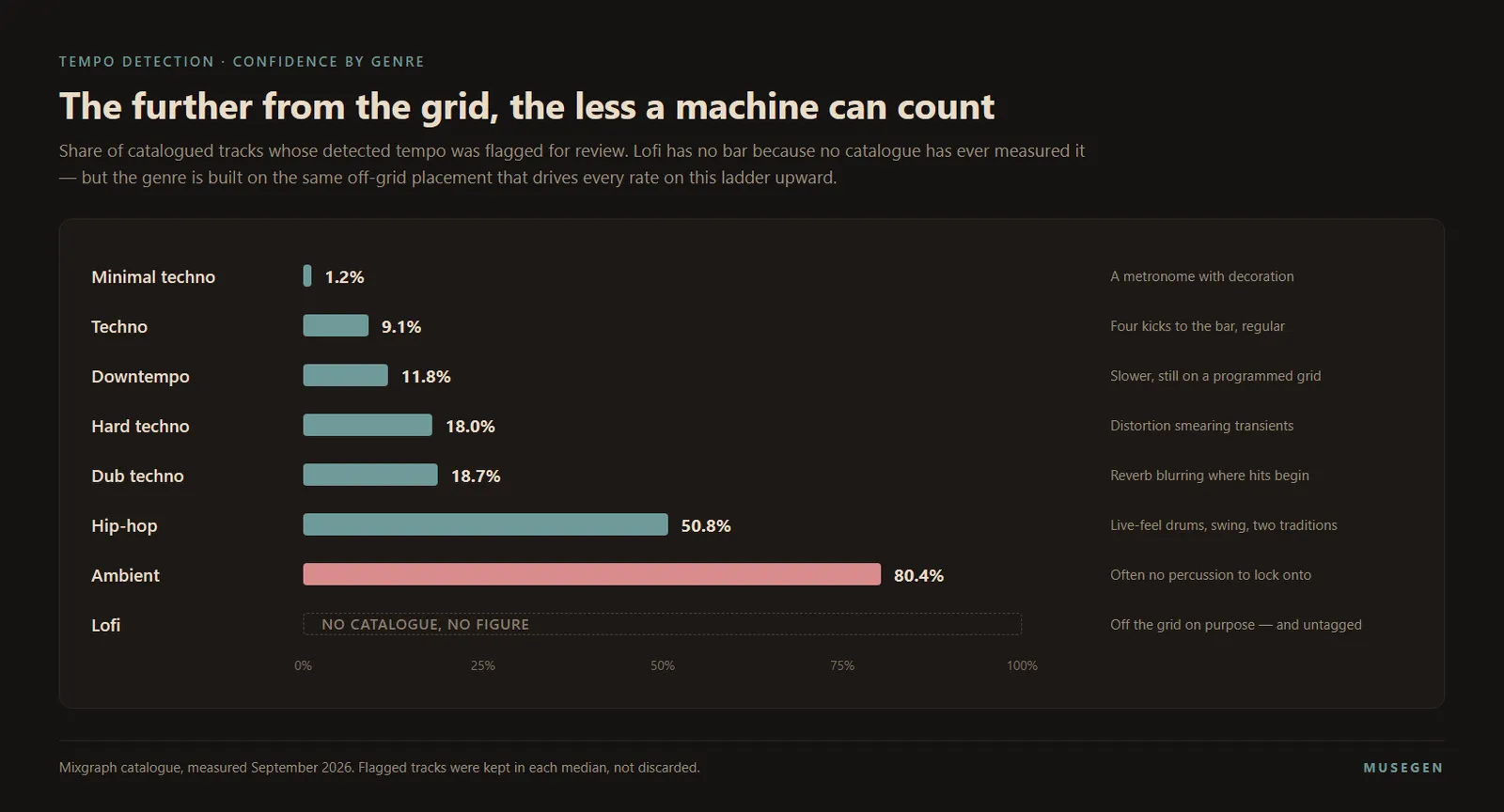
Detector confidence falls as music leaves the grid. Lofi has no bar because nobody has measured one.
Read down that column and a pattern appears. The further a genre's rhythm sits from a rigid grid, the less certain a machine is about its tempo. Ambient is nearly impossible because there is often no percussive event to measure between.
Lofi cannot be placed on that ladder, because there is no measurement — that is the point of the empty slot above. But the genre's construction says where it would fall. The sound is built on deliberate imperfection: hits nudged off the grid by hand and left there, pitch that wanders because the source was tape, swing applied until the sixteenths stop being evenly spaced.
Which produces the loop at the centre of this article. The property that makes a track lofi is the same property that makes its tempo hard to count. A detector needs regularly spaced transients; the genre's defining move is to make them irregular on purpose. Even if every lofi record were tagged tomorrow, the resulting median would carry a flag rate near the ambient end of that ladder. That is a better answer than "the tag is missing", because it would still be true if the tag were not.
▶ Watch on YouTube: "NO QUANTIZE on DRUMS!? | How to Make BOOM BAP DRUMS for LOFI & HIP HOP" — A drum-programming tutorial built on leaving the grid alone, which is the property that makes this genre hard to count.
Where 80 actually came from
A genre with no measurement and no authority behind its tempo ought to be a mess. Ask five house producers and you get 125 because a catalogue says so; ask five lofi producers and you also get one answer, and nothing forces them to agree. So something did the forcing.
The first article in this series argued that genres converge on a tempo under three forces: bodies on a dancefloor responding to a particular rate, DJs needing adjacent records to blend, and a generation of hardware that shipped with a default. Lofi has none of the three, and converged anyway. It is not dancefloor music, it is not beat-matched in the club sense, and the samplers associated with it sequenced whatever the producer set. By that account it should be as tempo-agnostic as rock. It is instead one of the tightest bands in this cluster.
Two other forces did the work, neither of them seen earlier in this series.
The first is inheritance. Wikipedia's definition is unusually precise for a genre this loose: lofi hip-hop, also known as chillhop, is a style of lo-fi music that combines hip-hop beats with elements of chill-out. That first half is a tempo instruction in disguise. The sampled hip-hop tradition, built from chopped breaks rather than programmed 808s, sits at 85 to 95 in every production guide that names it, and lofi took its rhythmic signature wholesale before slowing it to suit the second half. 80 is 85 to 95 with the energy taken out.
The second force is why the convergence held. Lofi is consumed as a continuous stream, and its popular history is a streaming history: a form tagged chillhop or lo-fi hip-hop became popular among YouTube music streamers in 2015, the style was popularised on that platform through the 2010s, Spotify's chill playlist had reached 5.4 million listeners by 2018, and stream viewership grew sharply during the pandemic. The unit of consumption is not a track. It is an unbroken hour, or six.
That imposes a constraint a DJ would recognise instantly, arriving by a different route. If a listener is going to hear four hundred consecutive tracks while working, no track may jolt. A record twenty beats faster than its neighbours pulls attention, which is the one thing this music is designed never to do. So the playlist enforces tempo agreement exactly as a DJ's mixer does — not so the beats can be blended, but so the listener never notices a change.
So lofi is less a counterexample to that theory than a third case of it. The convergent force is adjacency: records that must sit next to each other end up at the same speed. Lofi has extreme adjacency pressure and no dancefloor at all.
What the neighbours measure
Lofi has not been measured, but the genres either side of it partly have, and those figures are the closest thing to external evidence available.
| Genre | Published range | Measured median | Middle half | Tracks |
|---|---|---|---|---|
| Lofi | 70–90 | None | — | — |
| Chillout | 70–100 | None — source declines | — | — |
| Trip-hop | 80–100 | None — source declines | — | — |
| Hip-hop | 80–100 | 105 | 92–130 | 944 |
| Downtempo | 70–100 | 105 | 98–111 | 1,617 |
| Ambient | 60–100 | 111 | 93–129 | 1,082 |
One caution. The chillout and trip-hop pages each carry a comparison chart with a number printed on it — 85 and 90 — and it would be easy to lift those as measurements. Both pages state in their own text that they have no measured median, so those figures can only be an editorial estimate drawn as a bar. A number on a chart is not a measurement just because it is on a chart. They are quoted here only to show where the source itself would place the genres, which is below every measured neighbour and right around lofi's own band.
The most interesting of the three genuine measurements is downtempo, because it is the word people reach for when they want a formal name for this music. Downtempo measures at 105 across 1,617 tracks, and it is a tight population: half of it falls inside a 13 BPM window from 98 to 111, narrower than the middle half of techno. That is a real centre, and it is twenty-five beats above lofi's, so the two words are not interchangeable whatever the playlist titles suggest. Ambient sits higher still at 111, which is counterintuitive until you remember it often has no drums, so whatever the detector locked onto may not be a pulse anyone perceives.
Hip-hop's 105 needs its own footnote, and this site has supplied it: that median sits in the gap between two tempo traditions rather than describing a population with one centre. The 85 to 95 production figure is the one lofi actually inherited.
The direction the evidence leans
One more thing sits in that table, and it is the only real evidence available about whether 80 is in the right place. Look at the three rows carrying both a published range and a measurement. Hip-hop's range is 80 to 100 and it measured 105. Downtempo's is 70 to 100 and it measured 105. Ambient's is 60 to 100 and it measured 111. In all three the measurement came out above the top of the range. The catalogue notices, and prints the same remark on each page: its own tracks sit a little above the editorial figure.
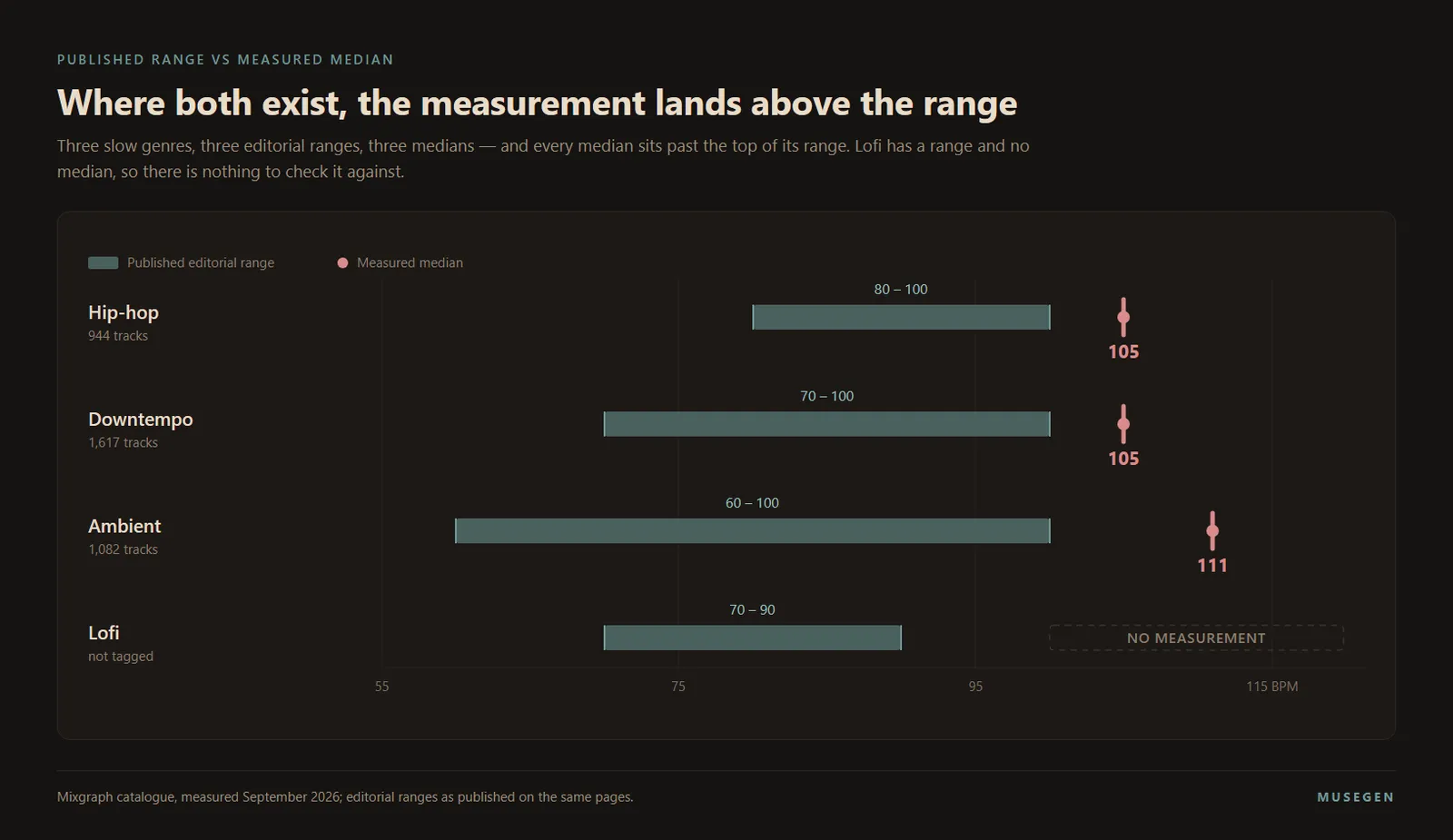
Where both exist, the measurement has landed above the published range every time.
Three for three is a pattern, and it has two explanations. They are not mutually exclusive, and the honest position is that both are probably operating.
The first is that the editorial ranges are old and low. Writers describing these genres may be picturing the classic material rather than what is tagged and released today, in which case the measurements are right and the conventions need updating. If that applies to lofi, its true centre is in the nineties.
The second is that detectors read high on this music and the cleaning process cannot catch it. Each page lists the corrections applied before the median was taken: outliers removed by a statistical fence, and tracks detected at half their written tempo and corrected upward. That second correction runs in one direction only. No step takes a track reported at 160 and decides it is really 80.
For a fast genre the asymmetry is right — a drum and bass record read at 87 needs doubling, and the fix exists. For a slow genre it points the wrong way. The characteristic failure on slow music with busy hi-hats is to report double the real tempo, and nothing reverses it. Tellingly, all three slow genres report the same result: not one track needed a half-time correction. In a family of genres running at 80 to 110, the one correction mechanism available fired zero times.
Which leaves an open question rather than a verdict, and what can be said is narrow. If 80 is wrong, the evidence does not suggest lofi is slower than people think. But a measured median for a neighbouring slow genre is no proof that lofi belongs higher either, because the machinery producing those medians leans that way and has no step to correct for it. Keep 80, as a convention with a reasonable case behind it rather than a fact somebody established.
Counting it yourself
Since there is no table to consult, the practical skill is getting a trustworthy number off a record in front of you, and lofi has one characteristic trap worth naming precisely. The hi-hats usually run sixteenth notes. At 80 BPM that is 5.3 hits per second, evenly spaced, over a kick and snare pattern that is sparse and deliberately imprecise. A detector looking for the most regular repeating event in the audio will often find the hats rather than the drums, and report 160.
The fix is to count the other layer on purpose. Ignore the hats, find the kick, then find the snare that answers it. On an 80 BPM lofi beat those two land about a second and a half apart, and the kick comes back around every three seconds. If you are tapping four times faster, you are tapping the hats.
Two safeguards for a reading from a tool. If it returns something in the 150s or 160s, halve it before doing anything else — almost nothing here is genuinely that fast, and 160 halves to an ordinary 80. If it returns something in the high 90s, that is plausible rather than suspicious; the fast end of lofi overlaps the slow end of downtempo.
This is worth separating from a case the series has already covered, because the two look similar and are not. A trap record written at 140 and felt at 70 carries two honest numbers at once. Lofi is written at 80 and felt at 80, with the kick and snare marking the pulse directly and the hats subdividing it decoratively. There is one true number, and a doubled reading is a detector mistake rather than a second valid interpretation.
Writing it down
With no other constraint, use 80. It is the centre of every band any source publishes, and nothing in the available evidence displaces it.
Move within 70 to 90 according to what the track is for. The low seventies read as heavy and almost static, and work when the music is genuinely background. The high eighties keep a little forward motion. That is the only dial tempo gives you here.
Do not use a neighbouring genre's median as a target. Downtempo's 105 and ambient's 111 describe different music, measured by a process with a known upward lean. Borrowing them will produce something faster than the genre.
And say lofi rather than lo-fi when you mean the tempo. This site has drawn the distinction between the aesthetic and the genre at length: lo-fi as a production quality covers everything from 1960s garage recordings to bedroom indie and carries no tempo implication. Only the genre has a number.
Put together, those choices read as one line a person or a tool can follow: lofi hip hop, 85 BPM, hats dragging behind the kick, muted upright piano loop, tape wobble on the sustains. The genre word sets the texture, the number removes the only real ambiguity, and the rest describes what happens on top.
Lofi runs 70 to 90 BPM and clusters near 80, and that is a convention rather than a count. No catalogue has measured it, the reference works give no figure at all, and the property that defines the genre is the same one that defeats a tempo detector. Use 80. Cite it as what it is.
No table to point at
Every other page in this cluster can end by pointing at a table. This one ends by pointing at your ears, which is less satisfying, and it is where a couple of tools earn their place.
Given a reference track, MuseGen's BPM detector will read an uploaded file and report a tempo. Treat that as a strong first opinion rather than a settled answer — everything above explains why lofi is among the harder material to detect, and the failure to watch for is a doubled reading. A result near 160 should be halved and checked against the kick before it goes anywhere. A result near 80 is the genre behaving normally.
In the other direction, MuseGen's song maker reads a tempo you name inside the description, which is exactly where the line above belongs. That matters more here than anywhere else in this series, because the word "lofi" carries an enormous amount of texture and almost no tempo information, with no published median behind it to fall back on.
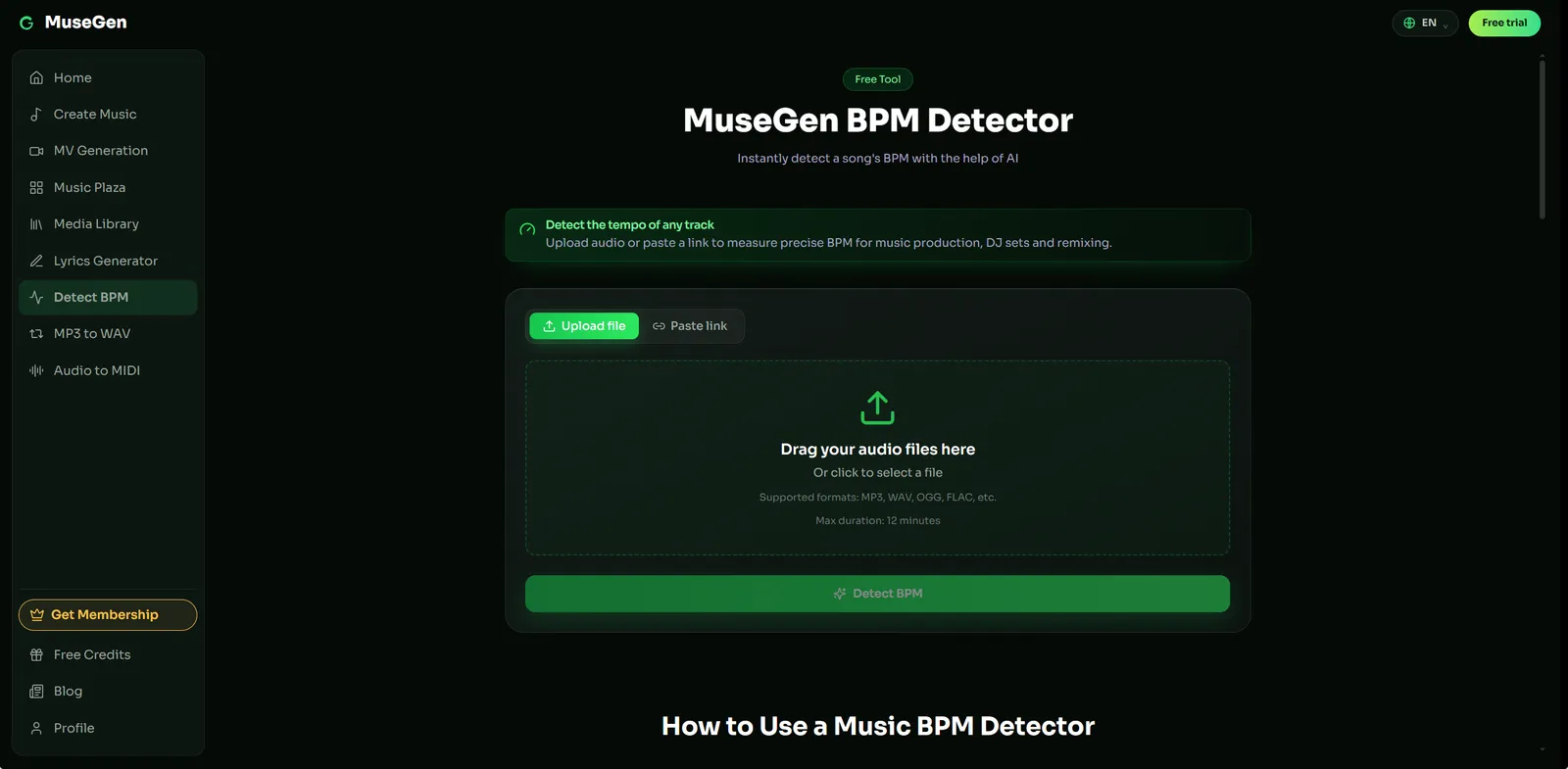
A first opinion on a reference track, worth checking against the kick on this material.
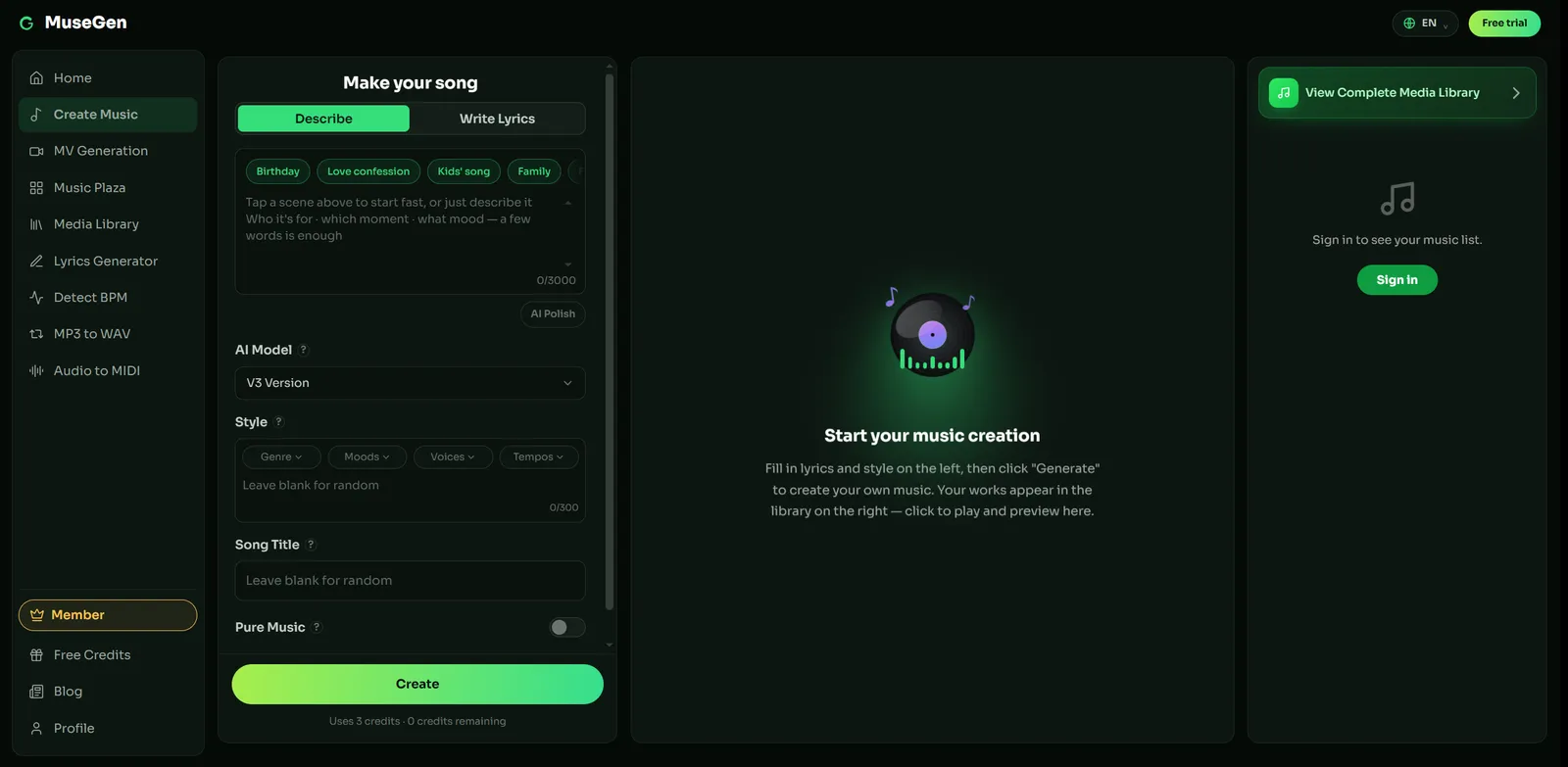
State the tempo, because the genre word is not carrying one.
Nobody counted it. You still have to pick a number. Check a reference track before trusting its tempo, then put the figure you settled on into the description — Try MuseGen.
FAQ
What BPM is lofi hip hop?
70 to 90 BPM, clustering near 80. That figure is a convention rather than a measurement: no catalogue has published a median for lofi, and the reference works carry no tempo figure for the genre at all. It is still the answer to start from, because no rival figure is in circulation.
Why is there no measured BPM for lofi?
Because the genre is not tagged as a separate category in the catalogues that measure tempo. One of them publishes 58 genre pages with none for lofi, chillhop or lofi hip hop, and writes of a neighbouring genre that there is nothing there to measure a median from and that it will not invent one.
Is lofi 80 or 160 BPM?
- The confusion comes from the hi-hats, which usually run sixteenth notes and give a detector something regular to lock onto at twice the real tempo. Count the kick and the snare instead: on an 80 BPM beat they land about a second and a half apart.
Is lofi slower than hip hop?
Yes, at the centre. Production guides put the sampled hip-hop tradition at 85 to 95 BPM, and a catalogue of 944 hip-hop tracks measured a median of 105 with a middle half running 92 to 130. Lofi's 70 to 90 sits below all of those figures.
Is chillhop the same tempo as lofi?
Yes, because they are the same music. Wikipedia treats chillhop as another name for lofi hip hop rather than a separate genre, and neither name has a measured tempo of its own. Anything true of one is true of the other.
Is lofi the same thing as downtempo?
No, although they are neighbours and the words get swapped. Downtempo has been measured: 1,617 catalogued tracks give a median of 105 BPM with half of them inside 98 to 111. That centre sits well above lofi's 70 to 90, so treating the two as interchangeable pushes a track more than twenty beats too fast.
Will a BPM detector work on a lofi track?
Often, but expect to check it. Detector confidence falls as music leaves the grid: one catalogue flags 1.2 per cent of minimal techno for review and 80.4 per cent of ambient. Lofi's deliberately loose timing puts it toward the difficult end, and the usual failure is a doubled reading.
Does lofi use a half-time feel like trap?
No. Trap is written at 140 and felt at 70, so both numbers describe the same record honestly. Lofi is written at 80 and felt at 80, with the kick and the snare marking the pulse directly. A lofi track reported at 160 is an error rather than a second reading.
Related reading
- What Is Lofi Music? — the genre itself: where it came from, what makes it sound the way it does, and how to build one
- What Is BPM in Music? — tempo from first principles, including why a detector reports double
- BPM by Genre and Subgenre — the full chart, in which lofi is the slowest row and the least measured
- What BPM Is Hip-Hop? — the tradition lofi inherited its tempo from, and why its own median misleads
Sources
- Mixgraph — BPM by Genre (index of 58 measured genre pages) for the catalogue index that lists 58 genres yet none for lofi, chillhop or lofi hip hop.
- Mixgraph — BPM for Downtempo (September 2026) for downtempo's measured median of 105 across 1,617 tracks and its 98 to 111 middle half.
- Mixgraph — BPM for Ambient (September 2026) for ambient's 111 median and its 80.4 per cent flag rate, the highest on the ladder.
- Mixgraph — BPM for Hip-Hop (September 2026) for the 944-track hip-hop median of 105 with a 92 to 130 middle half.
- Mixgraph — BPM for Chillout (editorial range only; no measured median) for the adjacent chillout page that declines to publish a median.
- Mixgraph — BPM for Trip-Hop (editorial range only; no measured median) for the adjacent trip-hop page that also declines to publish a median.
- Mixgraph — BPM Guide: Tempo Ranges by Genre (March 2026) for the fourteen-bucket cross-genre reference built from 49,500 tracks that has no lofi row.
- Wikipedia — Lofi hip-hop for the definition of lofi hip-hop as chillhop, its streaming history, and the absence of any tempo figure.
- Wikipedia — Lo-fi music for low fidelity as a production quality that carries no tempo implication.
- iZotope — Using Different Tempos To Make Beats For Different Genres for the seven-genre producer's guide (hip hop at 85 to 95) that omits lofi and its neighbours.