What Is Lofi Music? The Aesthetic, the Genre and the Sound Explained

MuseGen Team
9/2/2026
The same word covers two things that barely met. One is a batch of deliberately rough records made on cassette machines in the 1980s. The other is a stream that has been playing beats behind a cartoon student for years. Most explanations of lofi pick one and then quietly describe the other, which is why the definitions never quite fit — and the gap between them is the most interesting thing about the subject.
In short
Lo-fi means low fidelity: recording and production in which the things normally treated as flaws — noise, distortion, wobble, a restricted frequency range — are audible in the finished result, and kept there on purpose. Lofi hip hop is one genre built out of that aesthetic, not the aesthetic itself.
The aesthetic is old and broad. It comes out of home recording, cassette culture and punk self-release, and it has been applied to rock, pop and electronic music since the 1980s.
The genre is narrow and recent. It's hip-hop drum programming plus jazz harmony plus sampling, degraded on purpose, and it took its current form online in the 2010s.
Quick facts
- What the word means: Short for low fidelity. Imperfections that would normally be engineered out are left in, as a stylistic choice.
- Two different things: The aesthetic dates from the cassette underground of the 1980s; the hip-hop genre is a much later descendant of it.
- Typical tempo: Most lofi hip hop sits between 70 and 90 BPM, clustering near 80.
- The signature gear: Roland's SP-303 and SP-404 samplers — both of which carry a dedicated lo-fi effect on the front panel.
- Common starting points: Nujabes' Metaphorical Music (2003), Madlib and MF DOOM's Madvillainy (2004), J Dilla's Donuts (2006).
- Does it help you study: Weaker evidence than its reputation suggests. Instrumental beats a lyric; silence usually beats both.
What "lo-fi" actually means
Lo-fi is a contraction of low fidelity, and fidelity here has its literal sense: how faithfully a recording reproduces the thing that was played. High fidelity was an engineering goal — wide frequency response, low noise, low distortion, stable speed. Lo-fi is the state of failing at that.
The standard description of the term is careful about one point, and it's the point everything else depends on: elements usually regarded as imperfections are present in the recording, and they're there sometimes as a deliberate stylistic choice. That word deliberate is doing the work. A badly recorded demo and a lo-fi record can be technically indistinguishable on a meter. What separates them is whether anyone decided.
The threshold also moves. A 1940s jazz recording was made at the highest fidelity available at the time and nobody involved considered it lo-fi; played next to a modern master, it obviously is. So lo-fi is not a fixed measurement but a relationship between what a recording sounds like and what the listener knows was possible.
By the 1990s the term had settled into a recognised style of popular music, associated with home recording, four-track cassette machines and self-released tapes — frequently discussed under the name DIY music. That's the sense in which a Guided by Voices album or a Daniel Johnston tape is lo-fi. No hip-hop drums, no jazz chords, no rain sounds. Just an aesthetic position about what a record is allowed to sound like.
On the definition, the deliberate-imperfection distinction and the 1990s DIY association: lo-fi music.
The two things people call lofi
Here is the confusion in one line: lo-fi is a way of treating sound, and lofi hip hop is a genre that treats sound that way. They share a root and about thirty years of distance. Almost every argument about whether something "counts as lofi" is really two people using different definitions without noticing.
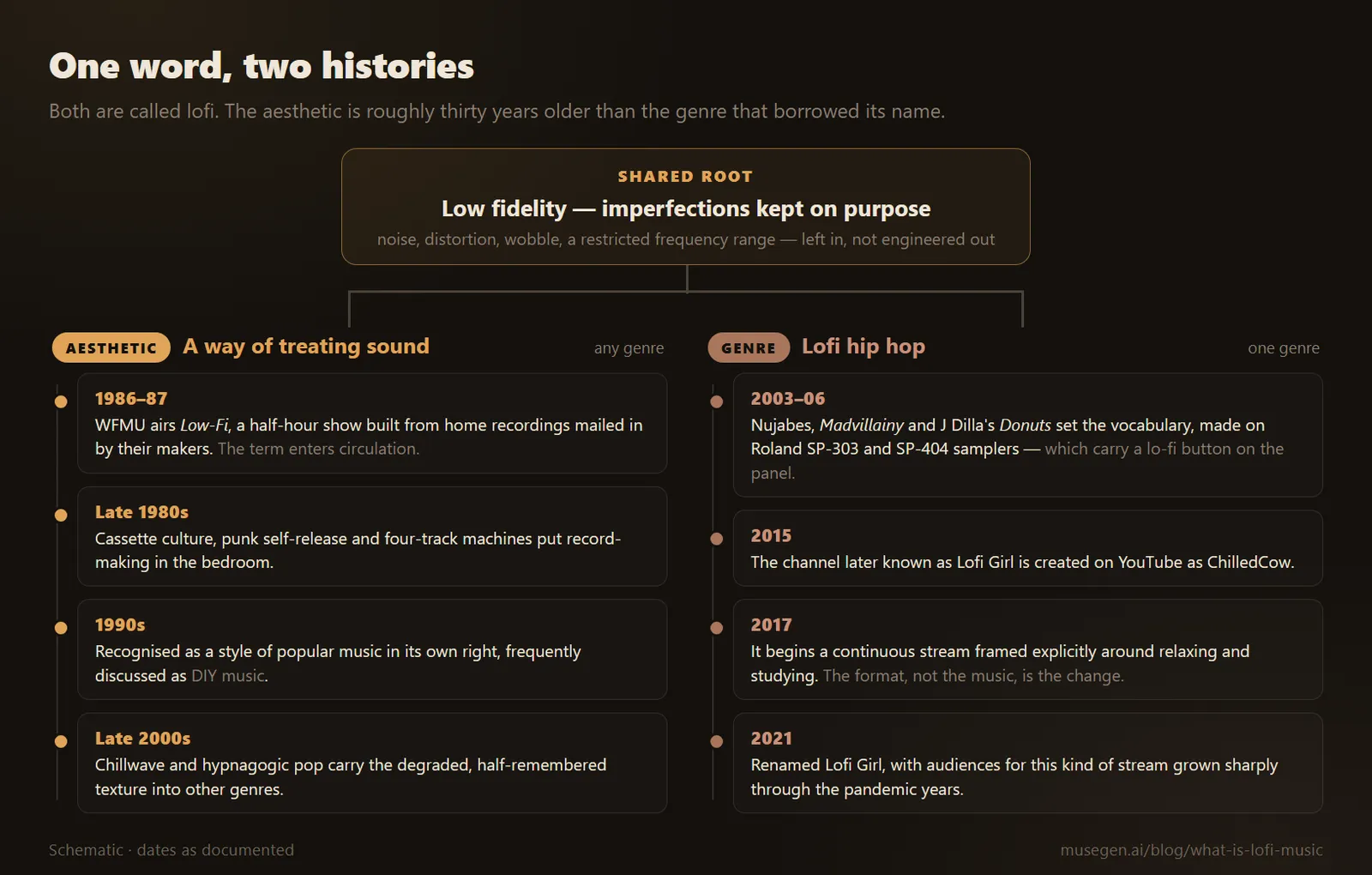
One root, two branches — the aesthetic is roughly thirty years older than the genre named after it.
| Lo-fi — the aesthetic | Lofi hip hop — the genre | |
|---|---|---|
| What it is | A production stance: keep the imperfections. | A specific style of instrumental beat music. |
| Roughly when | 1980s onward, named in the mid-1980s. | 2000s underground, mainstream online from mid-2010s. |
| Came out of | Home four-tracks, cassette culture, punk self-release. | Sampling, jazz records, hip-hop drum programming. |
| Applies to | Any genre. Rock, pop, folk, electronic. | One genre, with fairly narrow conventions. |
| How you meet it | An album, listened to as an album. | A stream or playlist, left running in the background. |
| Vocals | Usually central — often the whole point. | Usually absent, or a short spoken sample. |
The relationship is one-directional. Every lofi hip hop track is lo-fi, because degrading the audio is a defining move of the genre. Most lo-fi records are not lofi hip hop, because they have nothing to do with hip hop. It's the same relationship distortion has to metal: the technique is older and wider than the genre that made it a requirement.
Late in the 2000s the aesthetic threw off other descendants too — chillwave and hypnagogic pop both lean on degraded, half-remembered texture without being hip hop at all. Lofi hip hop is the branch that got huge, not the only branch.
Where the sound came from
Three separate things had to happen: the word, the sound, and the delivery. They arrived decades apart.
The word
The term is generally credited to William Berger, who ran a half-hour show called Low-Fi on the New Jersey radio station WFMU from 1986 to 1987. The format was simple and entirely of its moment: the material was home recordings, mailed in by the people who made them. Whether Berger coined the phrase is not settled — what is documented is that the show put it into circulation. Note the date. This is nearly two decades before anything that sounds like a lofi hip hop beat.
The sound
The musical vocabulary came together in underground beatmaking in the early 2000s. Two producers get named more than any others. Nujabes, working out of Tokyo, released Metaphorical Music in 2003 and Modal Soul in 2005, and scored the anime series Samurai Champloo in 2004 — which is, incidentally, why this music has been visually bound to anime ever since. J Dilla, in Detroit, released Donuts in 2006, three days before he died, and his drum programming is the single most imitated thing in the genre: hits deliberately pushed off the grid so that a machine-sequenced pattern reads as a person playing slightly behind the beat.
Alongside them, Madlib and MF DOOM's Madvillainy (2004) is the album most often pointed to as a shared origin, and there's a piece of hardware in the story that most explanations skip. The genre grew up on Roland's SP-303 and SP-404 samplers — boxes with a bank of effects on the front panel, one of which is literally labelled lo-fi. A generation of producers learned this sound by pressing a button called lo-fi and liking what happened.
The delivery
What turned a producer's genre into a listening habit was the format, not the music. The channel now known as Lofi Girl was created in March 2015 as ChilledCow, and in February 2017 it began running a continuous stream explicitly framed around relaxing and studying. It was renamed Lofi Girl in March 2021, and audiences for this kind of stream grew sharply through the pandemic years, when a very large number of people were suddenly working alone at home and looking for something to fill the room.
That's the real break with everything before it. The aesthetic was about how a record was made. The genre, as most people now encounter it, is about what a room sounds like while you do something else — which is a different kind of music entirely, and it explains most of the genre's conventions. There is no lead vocal because a vocal asks to be listened to. The loops are short because nothing is supposed to arrive.
On the genre's underground origins, the SP-303 and SP-404 lineage, and the stream that popularised it: lofi hip hop.
What lofi actually sounds like
Six ingredients. Very few tracks use all of them, and almost none work without at least four.
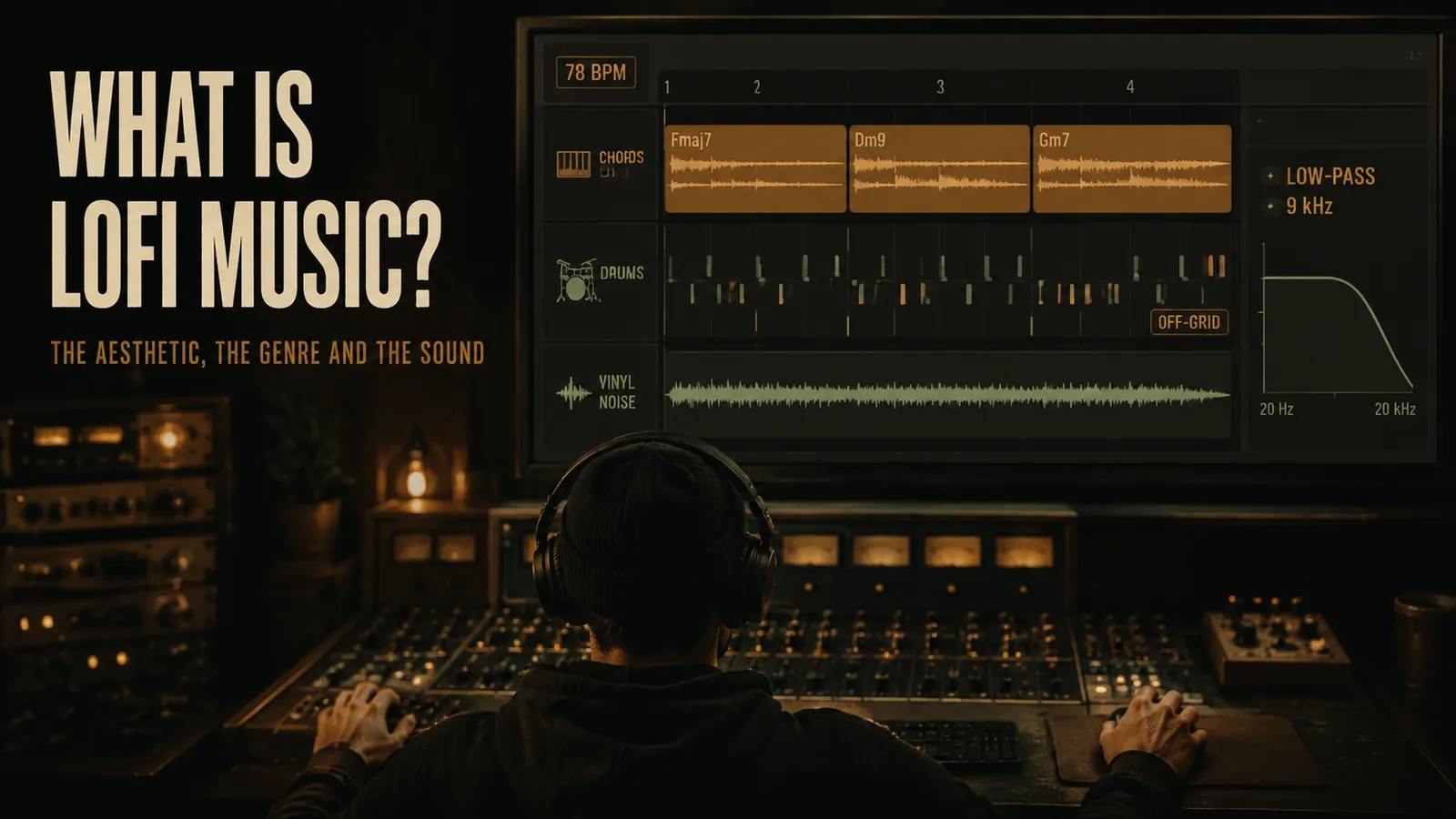
- A slow, unhurried tempo. Most lofi hip hop sits between 70 and 90 BPM and clusters near 80, slow enough that the drums read as a relaxed walking pace rather than something to move to. The slowest downtempo material drops into the 60s, at the bottom of the range tempo in BPM gives to ballads and lo-fi. If you're matching a loop to an existing track, a BPM detector saves a lot of counting.
- Jazz harmony in very short loops. Seventh and ninth chords borrowed from jazz, arranged into a two to four chord loop that resolves gently and then starts again. The harmonic language is rich, the chord progression underneath it is tiny — that combination is why the music sounds sophisticated and demands nothing.
- Drums that sit off the grid. Soft kicks, brushed or muted snares, and hits nudged slightly early or late so the rhythm reads as a person playing rather than a sequencer running. This is the part inherited most directly from J Dilla, and the part most beginners leave out.
- Deliberately degraded texture. Vinyl crackle, tape saturation, pitch wobble, bit reduction, and a low-pass filter that removes the top of the frequency range. This is the ingredient that makes the genre lo-fi rather than simply slow.
- Ambience and found sound. Rain, room tone, cafe noise, film dialogue, clips from old games or animation — mixed low enough to sit beneath the music rather than beside it.
- Restraint. Few elements, minimal arrangement, and no lead vocal, so nothing in the track ever demands to be listened to. Most tracks are two or three minutes and do not develop.
Why deliberately damaged audio sounds good
This is the part worth understanding, because it's not arbitrary. Each of those degradations does something specific to how the music is perceived.
The low-pass filter removes the alerting band. High frequencies carry consonants, transient attack and the sharp edges of a sound — the parts that make audio feel close and present. Roll the top off and the same performance moves into the next room. That's a distance cue, and distance is the whole point of background music.
The noise floor fills the silence. A modern digital mix has true silence between elements. A continuous bed of crackle or rain covers those gaps, so instead of separate parts triggered together you hear one continuous surface. It's glue, and it's why removing the crackle from a finished lofi track makes it sound thin rather than clean.
Wobble removes machine precision. Tape and vinyl never held perfectly stable speed, and the resulting slow pitch drift is something no sequencer produces. Add a small amount and a synthesised loop stops sounding like a file. It has been somewhere.
Off-grid timing reads as a human. Perfect quantisation is legible to the ear as inhuman even when a listener could not say why. A few milliseconds of drag on a snare, kept rather than corrected, is enough for the pattern to be heard as played.
The difference between lofi and a bad recording is control, not quality. You start from clean material and choose which part to damage and how far. That's the exact inverse of mastering, which spends its effort fighting for clarity and loudness — and it's why you can't get here by recording carelessly. Careless damage lands on the wrong things.
How to make a lofi beat
The order matters more than the tools. Build it clean, then break it on purpose.
- Set the tempo and the harmony. Pick something between 70 and 90 BPM and write a two to four chord loop out of seventh and ninth chords. Keep it to eight bars. If the harmony is not pleasant on a clean piano sound, no amount of tape noise later will rescue it.
- Play the chords in, badly on purpose. Use an electric piano sound and play the part by hand rather than drawing it in. Do not quantise it. The small timing errors you're about to leave in are the ones a listener reads as a human being at an instrument.
- Program drums that lean. A soft kick, a brushed or muted snare and a light hat pattern is enough. Add swing, drop in a few ghost notes, then drag two or three hits a few milliseconds off the grid by hand and leave them there.
- Degrade it, one step at a time. Now damage the clean version deliberately: low-pass somewhere around 8 to 10 kHz, add tape saturation, add a small amount of pitch wobble, and reach for bit reduction only if it still sounds too clean. Bypass each step and compare, because the point is to choose the damage rather than accumulate it.
- Lay in a noise floor. Add a continuous bed of vinyl crackle, rain or room tone underneath everything, and set the level so low that you only notice it when you mute it. That bed is what glues the separate parts into one continuous surface.
- Take things out until the loop survives three passes. Delete anything that is competing for attention, then listen to the eight or sixteen bar loop three times without touching anything. If you got bored or reached for a control, the problem is usually one element too many rather than one too few.
None of this needs specialist equipment. A filter, a saturator and a noise sample cover most of it, and every DAW ships with all three. The SP-404 is worth knowing about as history rather than as a shopping list — nothing it does is unavailable in software.
A short, honest note on sampling
The genre's history is built on sampling old records, so it's worth being plain about this rather than leaving it implied.
Using someone else's copyrighted recording requires permission from the rights holders. That's a legal requirement, not a stylistic convention, and it does not stop applying because the sample is short, heavily filtered or buried under crackle. It's also not something a blog post can resolve for you — the rules vary by territory, and anything you intend to release is worth checking against the ones that apply where you are releasing it.
Three routes avoid the question entirely. Play the part yourself and sample your own recording, which is what a lot of producers in this genre already do. Use sample packs or royalty-free libraries licensed for the use you have in mind, and read what that licence actually covers. Or generate your own source material. If you're working from audio and want the underlying notes rather than the recording, converting audio to MIDI gives you a structure you can replay with your own sounds.
Does lofi actually help you concentrate?
This is the genre's entire public identity, and it's the claim with the least behind it. The honest summary is uncomfortable in both directions.
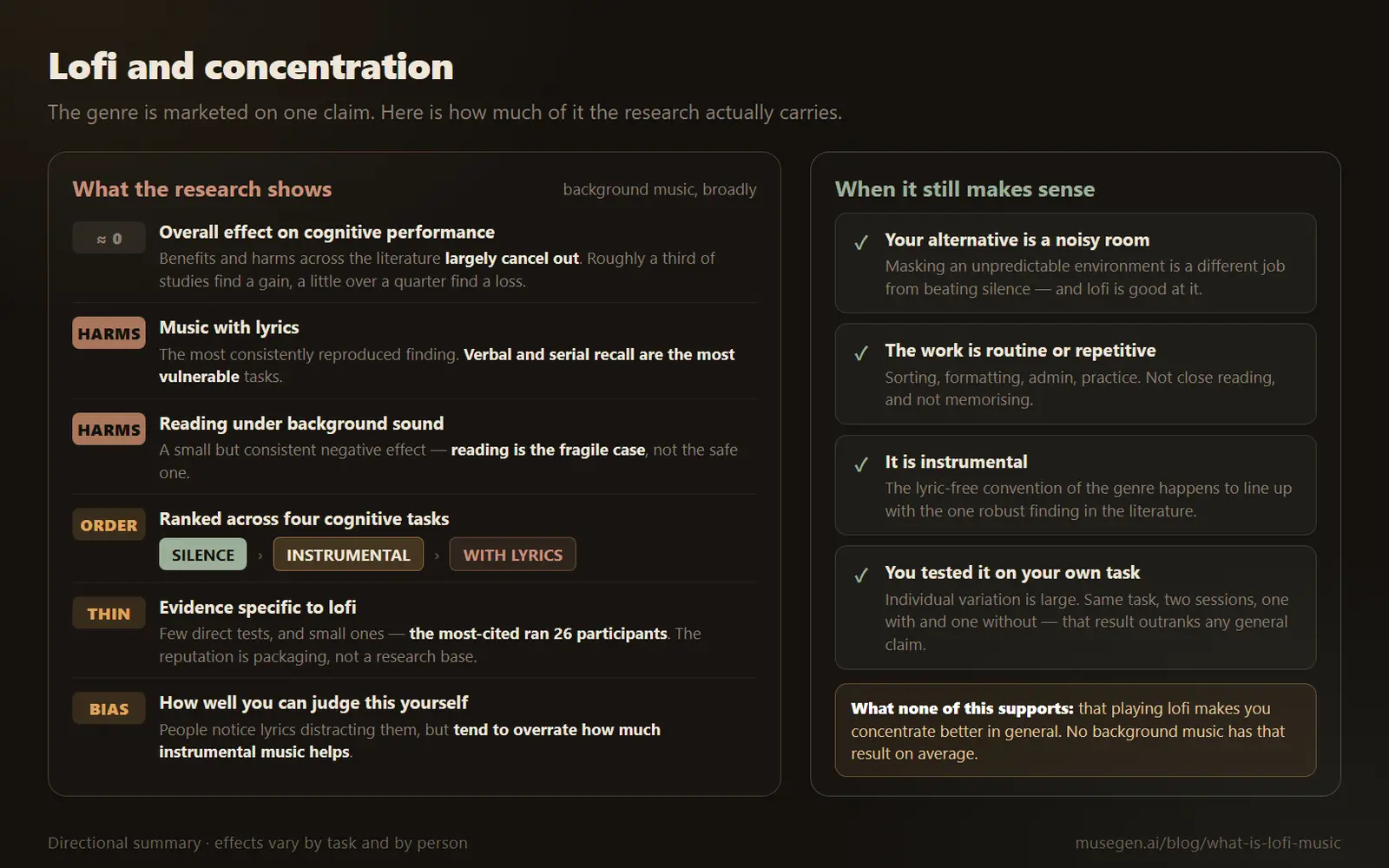
What the research supports, and the narrower set of situations it still supports.
The overall effect of background music on cognitive performance is close to zero. A widely cited 2011 meta-analysis found that positive and negative effects largely cancel each other out across the literature, and recent surveys land in the same place: roughly a third of studies report a benefit, a little over a quarter report harm, and the rest find nothing much either way. An average of nothing is not the same as no effect — it means the effect depends on the person, the task and the music, and that no general recommendation is supported.
The one result that reproduces reliably is that lyrics interfere. A 2022 systematic review of the memory literature found music with words impairing performance fairly consistently, with verbal and serial recall tasks the most vulnerable. A four-task study in the Journal of Cognition put the ordering plainly: silence outperformed instrumental music, which outperformed music with lyrics. Reading is a particularly fragile case — a meta-analysis of reading under background speech and music found a small but consistent negative effect.
Evidence specific to lofi is thin. The direct experimental tests are few and small; the most-cited one ran with 26 participants. The genre's reputation as study music rests on how it's packaged and marketed, not on a research base.
And there's a metacognitive wrinkle worth knowing about yourself: people are reasonably good at noticing that lyrics are distracting them, and noticeably worse at judging instrumental music, which they tend to rate as more helpful than measurement supports.
On lyric interference in memory tasks: a 2022 systematic review in Music & Science. On the silence → instrumental → lyrical ordering and the gap between judgement and performance: a four-task study in the Journal of Cognition.
The defensible version: instrumental lofi is a good choice when the alternative is a noisy room, and a worse one when the alternative is a quiet one. It holds up better for routine or repetitive work than for close reading and memorising. And the variation between individuals is large enough that the only answer that means anything is the one you get by trying a specific task both ways — not by trusting this article or the marketing.
Where MuseGen fits
Be clear about the boundary first: none of the degradation described above happens inside MuseGen. The low-pass, the saturation, the wobble, the noise floor — those are DAW moves, applied to a file that already exists. What MuseGen produces is the clean thing you damage.
What it does sits one step earlier — an all-in-one system covering lyrics, complete songs, and music videos. For a genre defined by a short loop and a mood, that's a fast way to find out whether an idea holds before you spend an evening on it. Generated songs come out as a stereo mix — which is exactly what the rest of this article operates on, since every move in the degradation section is applied across the whole track anyway.
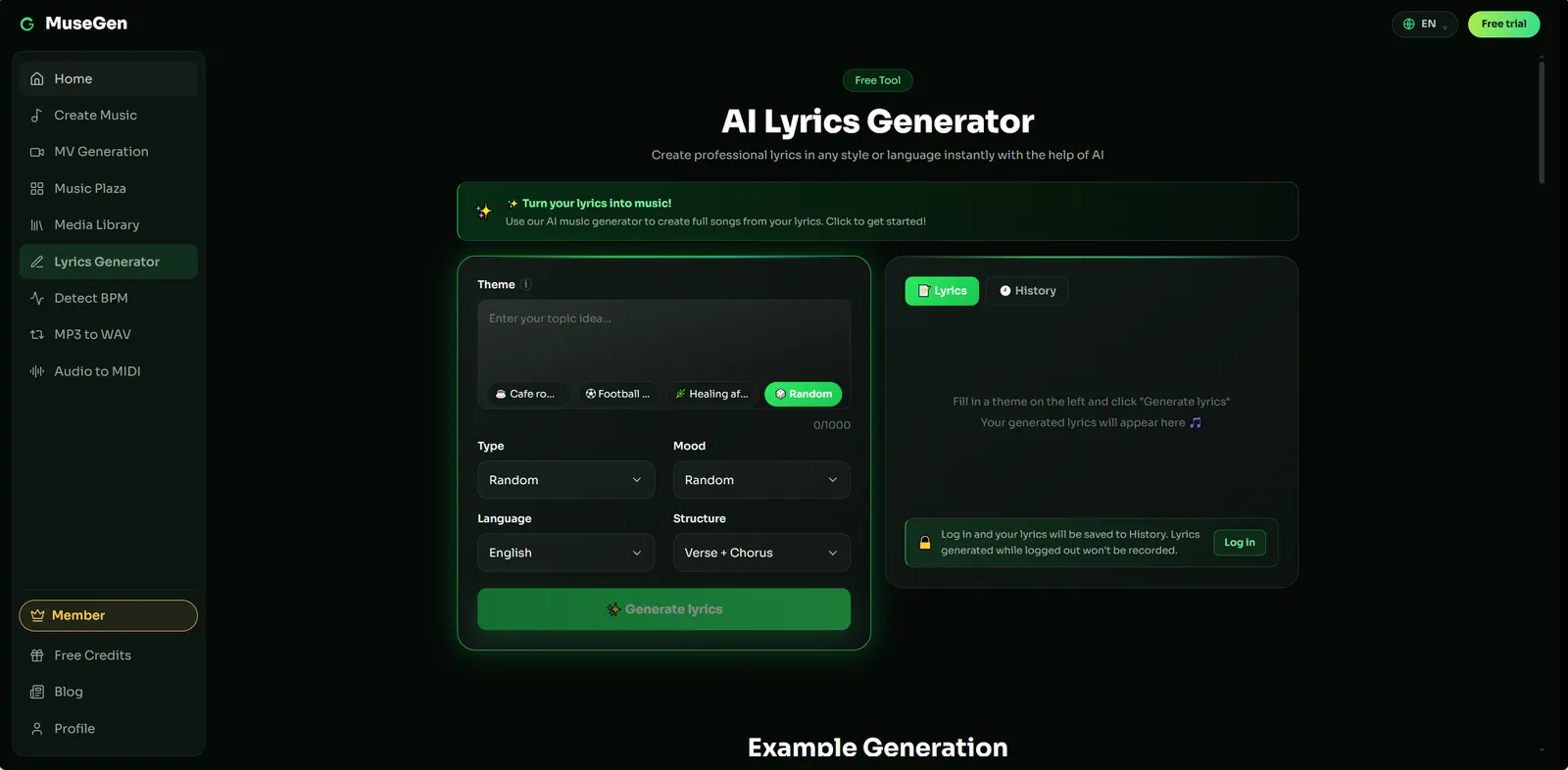
Lyrics, for the sung variants — most lofi beats never need this step.
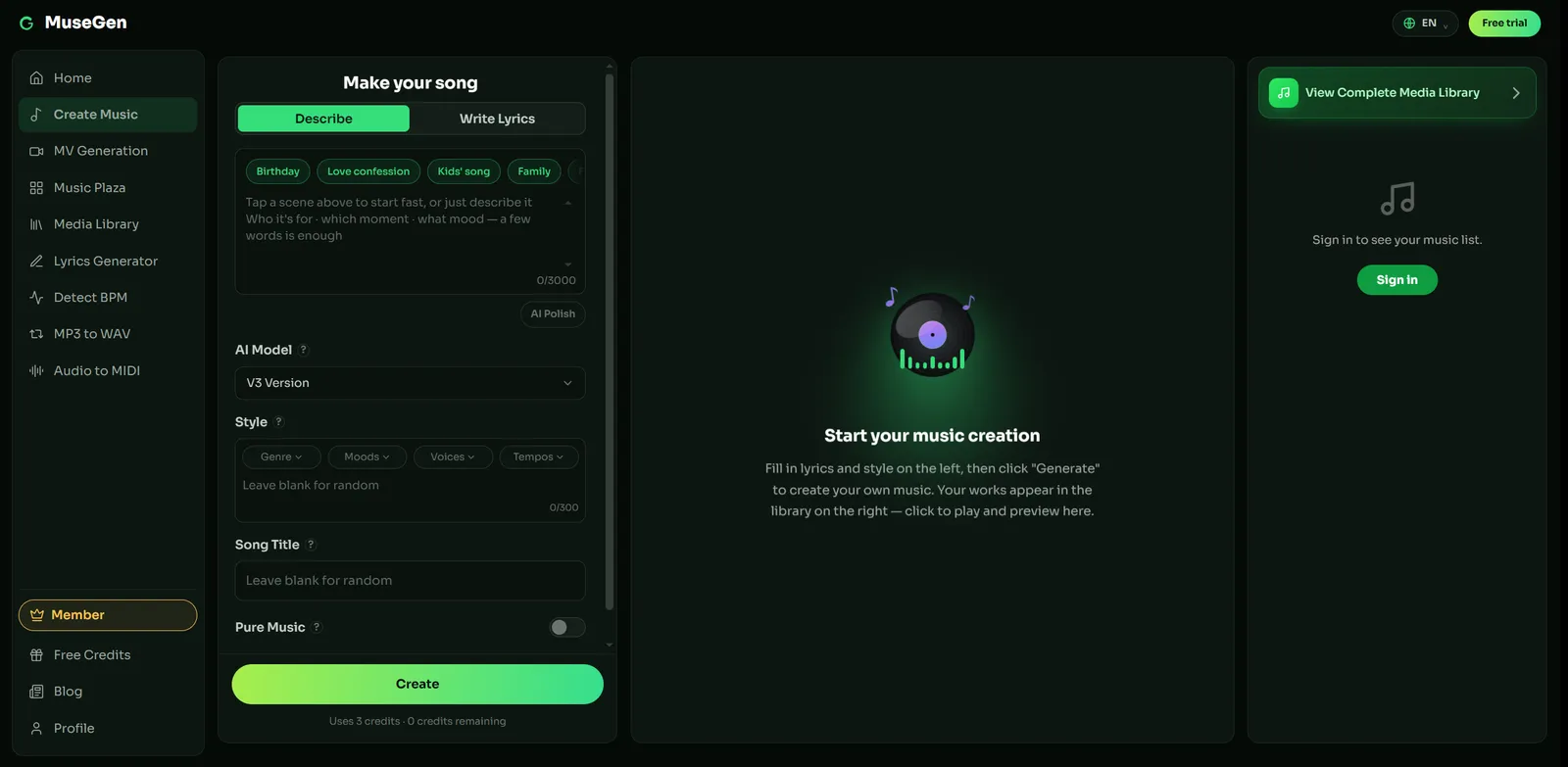
The idea as a finished track, before you commit an evening to it.
A brief that describes the damage, not just the mood: "dusty jazz guitar loop over brushed drums, 78 BPM, warm tape saturation, gentle pitch wobble, muffled high end, rain against a window, no vocals, 60 seconds."
What comes back today: lyrics — available; full song — available, as a stereo mix; music video — available.
Since this genre is instrumental by definition, the Pure Music toggle on the create page is more reliable than asking for it in words. Exports come as royalty-free WAV or MP3 — check MuseGen's current terms before commercial use rather than assuming. If you get an MP3 and intend to process it further, convert it to WAV first, since every degradation in this genre should be one you chose.
The practical division of labour for this genre: turn an idea into a song to hear whether the mood is actually there, write a lyric only if you're making one of the sung variants rather than a beat, and generate a music video for the loop you decide to publish. Then take the file into a DAW and do the damage deliberately — everything in this guide applies from that point on.
Hear the loop before you build it. Describe the mood and the texture, get a finished track back, and find out in a minute whether the idea holds. → Make a song with MuseGen
FAQ
What does lofi actually mean?
Lo-fi is short for low fidelity, and it describes recording or production in which things normally treated as flaws are audible in the finished result — noise, distortion, wobble, a restricted frequency range. What makes it a style rather than an accident is that those flaws are kept on purpose. The standard is also relative: what counts as low fidelity moves as recording technology improves.
Is lofi the same thing as lofi hip hop?
No. Lo-fi is a production aesthetic that goes back to the cassette underground of the 1980s and has been applied across rock, pop and electronic music. Lofi hip hop is one genre built out of that aesthetic, using hip-hop drum programming, jazz harmony and sampling, and it took its current shape online in the 2010s. Every lofi hip hop track is lo-fi; most lo-fi records are not lofi hip hop.
What BPM is lofi music?
Most lofi hip hop sits between 70 and 90 BPM and clusters around 80. Slower downtempo material drops into the 60s, which is where the wider ballad and lo-fi tempo range starts. Tempo is not what makes a track lofi, though — an 80 BPM loop with clean, bright, perfectly quantised production is not lofi, it is just a slow beat.
Why does lofi have vinyl crackle if it was made on a computer?
Because the crackle is doing a job, not documenting a format. A continuous quiet noise bed fills the silence between the musical elements and glues them into one surface, so the loop reads as a single recorded thing rather than as separate parts triggered together. It also signals the tradition the music comes from, which was built on sampling old records.
Does lofi music help you study?
Less reliably than its reputation suggests. Across the background music research the average effect on cognitive performance is close to zero, because studies finding a benefit and studies finding harm roughly cancel out. The one finding that reproduces consistently is that lyrics interfere, especially with memory tasks, and silence usually outperforms instrumental music, which in turn outperforms music with words. Reading is particularly vulnerable. Instrumental lofi is a reasonable choice when your alternative is a noisy room rather than a quiet one.
Can I sample old records for a lofi beat?
Not without permission. Using someone else's copyrighted recording requires clearance from the rights holders, and that's a legal requirement rather than a stylistic convention, regardless of how short the sample is or how heavily it's processed. The routes that avoid the problem are playing and recording the part yourself, using sample packs that are licensed for the use you have in mind, or generating your own source material.
What do I need to make a lofi track?
Less than almost any other genre. A DAW, an electric piano sound, a basic drum kit and a low-pass filter will get you a recognisable lofi loop, because the genre is built on subtraction rather than on layering. The samplers associated with the sound, Roland's SP-303 and SP-404, are worth knowing about as history, but nothing they do is unavailable in software.
Keep reading
- What Is BPM in Music? A Beginner's Guide to Tempo & Beats Per Minute
- What Is a Chord Progression? Definition, Examples & How They Work
- What Is Music Arrangement? How to Master Song Craft with AI
- What Is a DAW in Music? Digital Audio Workstations Explained
Sources
- Wikipedia — "Lo-fi music" for the definition, the deliberate-imperfection distinction, the WFMU Low-Fi show, and the 1990s DIY association.
- Wikipedia — "Lofi hip hop" for genre characteristics, the SP-303 and SP-404 lineage, and Madvillainy as a shared origin.
- Wikipedia — "Lofi Girl" for the channel's founding as ChilledCow, the 2017 stream, and the 2021 rename.
- Wikipedia — "J Dilla" for Donuts and the off-grid drum programming the genre inherited.
- Wikipedia — "Nujabes" for the albums and the Samurai Champloo score behind the genre's anime association.
- Music & Science — "Background music and memory: a systematic review" (2022) for the consistency of lyric interference.
- Journal of Cognition — "Background music across four cognitive tasks" for the silence-over-instrumental-over-lyrical ordering.
- YouTube — "The J Dilla & Nujabes History (Documentary)" for the producers most often named as the sound's origin.