Google Flow Music Review 2026: Free Tier, Open Lawsuit

MuseGen Team
10/20/2026
Google Flow Music has carried three names in under four years, and the version you can sign up for today is only a few months old. It started as Riffusion, an open-source experiment in feeding audio spectrograms to Stable Diffusion. It became Producer.ai in 2025. In February 2026 Google acquired it, deleted what came before, and in April renamed it again. What survived that history is a genuinely generous free tier and a product built on a model Google is currently defending in federal court.
In short
Google Flow Music is the only tool in this category whose plan comparison table ticks downloads, stem downloads and publishing identically on every tier, Free included. That is a real, checkable fact, not a promotional claim, and it makes Flow Music's free plan more capable on paper than the paid tiers of some of its rivals.
The trade is what Google has not written down. There is no document spelling out what a given plan may be used for commercially, the pricing page never uses the word commercial at all, and the company is currently defending a lawsuit alleging its Lyria model was trained on 44 million YouTube clips without permission. This review sets out exactly what we could and could not find in Google's own pages, dated so you can check it again yourself.
- The free tier is not a stripped demo. Its row of ticks in the official comparison table matches Starter, Plus and Member on every core feature we could find.
- Nothing tells you what you may do with the output commercially. No Flow Music-specific rights table exists anywhere we could locate.
- Google is being sued over how the model was trained. The case was filed in March 2026 and is still open.
- This is the product's second rebrand in under a year. The first one deleted everyone's existing work.
Quick facts
-
What it is: Google Labs' AI music generator, built on the Lyria model family
-
History: Riffusion (2022) → Producer.ai (Aug 2025) → acquired by Google (Feb 24, 2026) → renamed Google Flow Music (Apr 17, 2026)
-
Current model: Lyria 3.5, launched July 29, 2026
-
Plans: Free, Starter $6/month, Plus $18/month, Member $48/month
-
Credits: Roughly 5 credits per song across every paid tier (600 songs per 3,000 credits, and so on)
-
Downloads & stems: Ticked identically on every plan, including Free, in Google's own comparison table
-
Commercial terms: No Flow Music-specific document found; the word "commercial" does not appear on the pricing page
-
Active litigation: Kogon et al. v. Google, filed March 6, 2026, alleging unauthorised training on YouTube recordings
-
As of: October 2026 — confirm current figures on Google's own pages
Three names in four years
Riffusion began in December 2022 as a side project by Seth Forsgren and Hayk Martiros: an experiment in applying Stable Diffusion's image-generation techniques to spectrograms, the visual representations of sound, rather than pictures. It raised a $4 million seed round in 2023 from investors including The Chainsmokers, and launched a public generative-music tool in early 2025.
By August 2025 the company had rebranded to Producer.ai, shipping a new flagship model called FUZZ 2.0 and a more conversational editing interface. On February 24, 2026, Google announced it was acquiring Producer.ai into Google Labs. The announcement, written by Elias Roman — whose previous music-streaming startup, Songza, Google also acquired, in 2014 — described a tool built on Google DeepMind's Gemini, Lyria 3, Veo and Nano Banana models, with every output carrying a SynthID watermark.
The transition had a cost most acquisition announcements don't mention. Earlier that February, Producer.ai had emailed its users advising them to download any songs or sounds they wanted to keep, because as of February 20 the service would run on "a new set of models" and "all past generations, sessions, models, and media will no longer be accessible." That is Producer.ai's own wording, reported at the time by Music Ally. Whatever existed under the Riffusion or Producer.ai name did not carry forward; Google Flow Music began, in a real sense, from zero.
The rename to Google Flow Music followed on April 17, 2026, when Google Labs announced on X that “the Flow family is growing”: Google Flow Music (formerly ProducerAI), a standalone site for creating, sharing and remixing original music, built on Lyria 3 Pro, Google's newest model at the time. On May 6, Seth Forsgren — one of Riffusion's original co-founders, now titled Group Product Manager, Google Flow Music — announced a partnership with Believe and TuneCore to bring the tool to their artist, producer and songwriter rosters. Two more updates followed: a May 19 release adding section-by-section editing, style-preserving "covers," Gemini Omni music video generation and a first mobile app, and a July 29 release bringing the current model, Lyria 3.5, with improved musicality, lyrics and vocal expression.
Three names, three architectures, one deleted history, all inside about four years and most of it inside one. That pace is either a sign of a company finding its footing fast under Google's resources, or a reason to hold anything you make in Flow Music a little more loosely than you would elsewhere. Both readings are defensible; this review comes back to which one matters more in the who it suits section.
If you would rather watch the workflow than read about it, a Google representative walked through the tool at length on an independent podcast about two weeks after the rename. It features a Google employee explaining a Google product, so read it as a guided tour rather than a neutral review — but it is a longer, more hands-on look than anything Google has published on its own channels.
Watch: “Google's New AI Writes Songs WITH You” — The Neuron Podcast's hands-on with Flow Music, featuring Google's Kendall Rankin, published 29 April 2026
The free tier that isn't a demo
Google Flow Music's pricing page lists four plans: Free at $0, Starter at $6 a month, Plus at $18, and Member at $48, each stepping up in monthly credits and concurrent generations. Roughly the same ratio holds across every paid tier — about five credits per finished song, whether that is 600 songs on 3,000 credits or 6,000 songs on 30,000.
What is unusual sits in the comparison table beneath the plan cards. We read the page's underlying markup directly, icon by icon, rather than trusting how it renders, because a greyed-out checkmark can look identical to an active one in a quick screenshot. Every icon on every row we checked — Lyria Models, Producer Projects, Downloads in MP3, WAV and M4A, Stem downloads, Publishing, Image and Video generation, Progress — is the identical tick, rendered with the identical class, on all four columns including Free. Nothing in the underlying code distinguishes a Free-tier tick from a Member-tier tick on any of those rows.
What this means in practice: on the evidence of Google's own comparison table, a Free account can download a finished track as MP3, WAV or M4A, pull its stems, and publish it — the exact set of actions that cost real money on most of this product's competitors. The only things reserved for the $48 Member tier are a badge, event access, merchandise and early feature access: community perks, not functional capability.
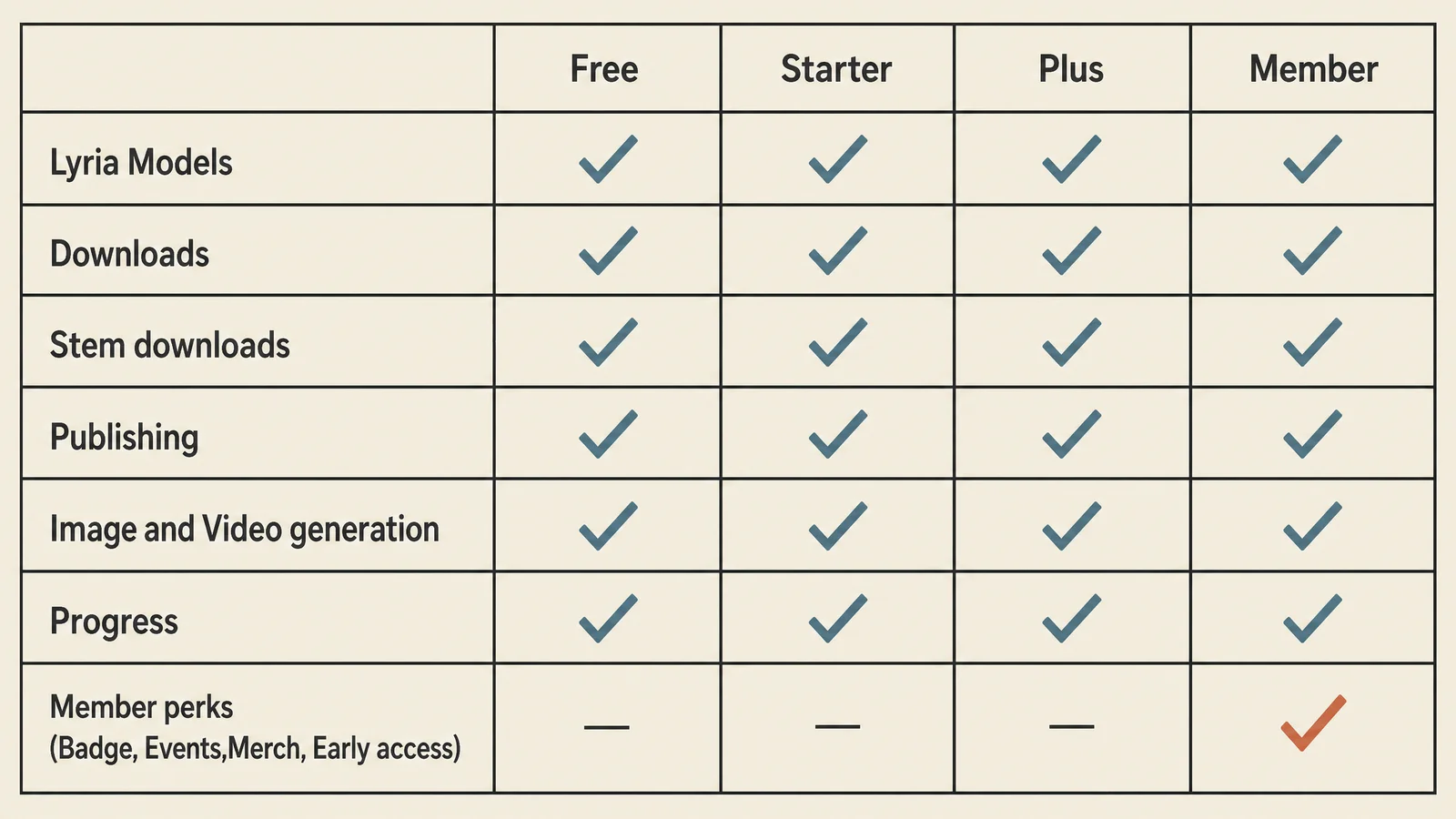
Every functional row ticks the same across all four plans. Only the community perks change — read straight from the page's own markup, not its rendered look
Two things this table does not tell you. It does not say how many credits the free tier actually receives — "Daily top-up credits" appears on the Free plan card with no number attached anywhere on the page, unlike every paid tier's stated monthly total. And a tick for a feature is not the same thing as a stated right to use its output commercially, which is the subject of the next section.
What nobody has written down
Every other vendor covered in this series publishes something that answers the question a paying customer actually asks: what am I allowed to do with what I make? Suno states commercial rights per plan directly on its pricing page. ElevenLabs publishes dedicated Music Terms with a full Commercial Rights table attached, even though its marketing pages advertise larger allowances than the table grants. Udio's help centre spells out, in writing, exactly why downloading stopped.
We looked for the equivalent from Google and did not find one. The Flow Music pricing page does not contain the word "commercial" anywhere on it — we searched the raw page text directly and it returns zero matches. Flow Music's own terms link resolves to Google's general Terms of Service, the same document that governs Search, Maps and Gmail, not a Flow Music-specific policy. That general document's content-license section addresses what happens to material you upload to Google's services; it does not separately address what rights attach to music the model generates for you. A narrower Generative AI Additional Terms of Service document exists, but Google states it stopped applying to consumer use back in May 2024, superseded by the main Terms. What layers on top today is a Generative AI Prohibited Use Policy — a safety document banning things like illegal activity, harassment and impersonation-to-deceive, with nothing music-specific in it and no per-tier commercial language at all.
What Google has said, in its own words, is narrower than a rights grant: its May 2026 announcement states plainly that "Google doesn't claim ownership of the original content generated with Flow Music." That is a real and meaningful statement — it rules out Google asserting copyright over your song — but it is not the same sentence as "you may sell this," and we could not find that second sentence anywhere on Google's own pages, for any plan.
To be fair to Google, this may simply be a young product that has not yet published the document a lawyer would want, rather than a deliberate withholding — the company rewrote nearly everything else about this tool twice in a year, and paperwork is a plausible thing to still be catching up. But the honest position for a reviewer is to report the absence rather than fill it with a guess. If your work depends on a specific plan's commercial standing, that is a question to put to Google directly before you rely on this tool for it, not something this review or Google's own pricing page currently answers for you.
The lawsuit over how Lyria was trained
On March 6, 2026, a group of independent musicians sued Google in the US District Court for the Northern District of Illinois, in a case naming New York singer-songwriter Sam Kogon, Los Angeles composer Magnus Fiennes, Atlanta producer Michael Mell, members of the Chicago band Directrix, and several others as plaintiffs. Their 118-page complaint alleges that Google "copied millions of copyrighted sound recordings, musical compositions, and lyric, including at least 44 million clips and 280,000 hours of music," and used them to train Lyria 3 without permission or payment.
The complaint's central argument is not just about training data — it is about Google's position in the market. Because Google owns YouTube and operates Content ID, the platform's rights-management system, the plaintiffs argue Google had "structural leverage" that no standalone AI music startup has: direct access to the recordings, the metadata identifying their owners, and the technical means to license them properly before training, which the complaint says Google chose not to do. Several of the named plaintiffs had previously sued Suno and Udio over similar claims, which is worth knowing when weighing how this fits into the wider pattern of AI-music litigation covered elsewhere in this series.
Google responded on June 8, 2026, with a motion to dismiss the case "with prejudice." Its central argument is that the plaintiffs already granted the necessary rights when they uploaded their music to YouTube in the first place: YouTube's Terms of Service, Google's filing states, grant the platform and its "Affiliates" — a term it says covers other companies within Alphabet, Google included — a "worldwide, non-exclusive, royalty-free, sublicensable and transferable license" to "use," "reproduce, distribute, [and] prepare derivative works" from uploaded content. Google's filing also notes that YouTube paid more than $8 billion to the music industry in the twelve months to June 2025, and separately argues the plaintiffs lack standing under the Digital Millennium Copyright Act because they have not identified specific infringing output from their own recordings.
The last filing we could find on the docket is the plaintiffs' sur-reply, dated July 27, 2026; as of this review, the court has not ruled on Google's motion and the case remains open. We are not going to predict the outcome. What we can tell you is that Google's own defence is built on the same mechanism this review flagged in the section above — a general Terms of Service doing work that a music-specific licensing document would otherwise do — and that the theory has not yet been tested by a judge.
What it actually sounds like
Here we have to be straightforward about what we can and cannot tell you. We ran no blind listening comparison of our own, and Google has not published one either. Its own announcement for Lyria 3.5 describes "improved musicality," "enhanced lyrics" and "improved vocals" in exactly those words — adjectives, not a benchmark, a listener-preference study, or a percentage. That is consistent across every Lyria release announcement we read: real, specific new capabilities are named, but none of the three posts we checked contains a number describing how much better the audio actually sounds.
Independent testing is possible in principle but harder than for some rivals. Flow Music the consumer app has no API of its own, but the underlying Lyria model is reachable separately through Google's Vertex AI platform and, more recently, the Gemini API — so a controlled, side-by-side benchmark against Suno or Udio is not structurally impossible, it is simply something we did not find published by anyone at the time of writing. Treat any claim you read elsewhere that Flow Music has been "proven" to beat or lose to a named competitor with the same scepticism we are applying to Google's own adjectives.
The free tier is the honest way to resolve this for yourself, and it costs nothing to try given the ticks in the comparison table above. Listen with one thing in mind: every output carries a SynthID watermark, an inaudible signal Google says survives common audio edits, which is a real transparency feature but not itself a claim about how the track sounds.
What it does genuinely well
Several of these are things a small AI-music company simply cannot match, because they depend on being Google.
- The free tier is not a cut-down trial. Downloads, stem downloads and publishing tick identically across every plan in Google's own comparison table, Free included — verified against the page's underlying markup, not its rendered appearance.
- Google states it will not claim your output. "Google doesn't claim ownership of the original content generated with Flow Music" is a specific, quotable line from the company's own announcement.
- Every track is watermarked. SynthID embeds an inaudible, Google-verifiable signal in every output, positioned as an industry provenance standard rather than a one-off feature.
- Believe and TuneCore artists have a direct line in. The May 2026 partnership puts working musicians and producers into a weekly feedback loop with the product team, not just a beta waitlist.
- The model has shipped three real upgrades in five months. Lyria 3, Lyria 3 Pro and Lyria 3.5 each added a stated, checkable capability rather than just a version bump.
- Editing, covers and video generation live in one workspace. Section-level rewriting, style-preserving restyling of a whole track, and Gemini Omni music video creation from the same song, without leaving the tool.
Where it falls short
Each of these is a documented gap, not a guess, and each is paired below with the context that makes it fair.
No document anywhere states what a Free, Starter, Plus or Member plan may be used for commercially. The pricing page never uses the word.
Google's statement that it does not claim ownership of your output is at least a real, positive commitment, even if it stops short of a commercial-use grant.
Google is defending an active lawsuit alleging Lyria 3 was trained on 44 million YouTube clips without permission, filed March 2026 and still open.
Google's defence rests on a specific, checkable legal theory — YouTube's own upload terms — rather than silence, and the company has moved to litigate it in the open rather than settle quietly.
No independently published benchmark measures Flow Music's own output against Suno or Udio, so quality claims rest on Google's adjectives.
The underlying Lyria model is reachable via Vertex AI and the Gemini API, so an independent test is possible in principle for anyone who runs one.
The February 2026 transition into Google erased users' prior generations, sessions and media, with advance warning but no migration path.
Nothing has repeated since; the product has shipped three feature updates on the same infrastructure without another wipe.
The free tier's actual daily credit allotment is not published anywhere on the pricing page, unlike every paid tier's stated monthly total.
The features that allotment unlocks — downloads, stems, publishing — are, at least, stated clearly and identically to the paid tiers.
The thread running through all five is the same one this review keeps returning to: Google is doing several genuinely generous things with this product and documenting almost none of them precisely. A company with Google's legal resources not writing a commercial-rights table is a choice, not an oversight, and it is worth treating it as one when you decide how much to build on top of this tool.
Who it suits, and who should look elsewhere
You want to make music for free and are not relying on it for income. This is the clearest case. The comparison table's ticks are real, the watermark is disclosed, and Google is not going to bill you. Treat the deleted Riffusion-era history as a reminder to download anything you want to keep.
You are a Believe or TuneCore artist. The ambassador programme gives you an actual feedback channel into the product team, which is a different relationship than a free account gets anywhere else in this category.
You need a specific, written answer about commercial rights before you release something. This is where Flow Music is weakest relative to its peers. Go and get that answer directly from Google before you build a release schedule on an assumption.
You are choosing based on litigation risk. Weigh the open Kogon lawsuit against Udio's settled UMG case and Suno's GEMA loss and Sony litigation, covered in our other reviews — none of the major AI music tools in 2026 has a clean record, and each carries a different shape of risk.
Generous, and largely unwritten. Google Flow Music gives away, for free, features that cost real money elsewhere in this category, backed by a genuine and specific ownership statement. It has not published the commercial-rights document that would let you build on that free tier with confidence, and it is currently in court over how the model behind it was trained. Both things can be true, and neither cancels the other — check Google's own pages again before you rely on either.
Alternatives worth knowing
Ordered by how each one answers the specific gap Flow Music leaves open.
ElevenLabs Music — an actual rights table, published in full
ElevenLabs is the closest thing to an answer to Flow Music's silence: it publishes a real Music Commercial Rights table, with named exclusions for film, TV, radio and Studio Games on every self-serve plan. The catch, covered in our ElevenLabs review, is that the minutes it advertises are higher than the generation limits that table grants. A table you can check against the marketing is still a step past no table at all.
Suno — the fullest production suite
Suno leads on vocals and ships a full browser production environment, with commercial rights stated directly on its pricing page. Its own constraint is the exit: every plan meters downloads since September 3, 2026, and a track is only commercially usable once it clears an approved download.
Udio — still the fidelity reference
Udio remains the category's benchmark for instrumental detail, and its settlement with Universal Music Group gives it a cleaner licensing position than Google currently has. It comes with the largest asterisk in the category: downloading audio, video and stems has been disabled since October 2025.
MuseGen — ours, and the rights are stated, not implied
MuseGen is our own product, and the contrast worth drawing is with the exact gap this review is about: what a paid plan permits commercially is set out in our own published terms, attached to the plan you are on, rather than left to be worked out from ticks in a comparison table. On a paid plan the file you get back is an MP3 or WAV, and a song you have already written can become a music video without leaving the site. The open case described above has no counterpart here either, and ownership of what you generate stays with you on every plan, Free included.
Transparency note
MuseGen competes with Google Flow Music, and a fair chunk of this review is about things Google hasn't written down rather than things it has said, so the sourcing matters as much as the findings. Every claim above was read directly from Google's own pages, from Music Business Worldwide's court filing coverage, or from Music Ally's contemporaneous reporting, each dated so you can check it again, and Google's pricing page and terms links were re-read on October 20, 2026. Where we could not find a document — a commercial-rights table, a stated free-tier credit number — we said so explicitly rather than filling the gap with an assumption from a third party. Rankings are left to our ranked overview; this page records what Google has and has not published, with both the generous free tier and the unresolved lawsuit kept in view. We ran no blind listening comparison, and at the time of writing nobody else had published one either.
Disclosure — the MuseGen team
FAQ
What is Google Flow Music?
Google Flow Music is Google Labs' AI music generation tool, built on the Lyria family of models. It lets you generate full songs with vocals or instrumentals from a text prompt, edit them section by section, restyle a finished track as a cover, and turn a song into a music video using Google's Gemini Omni model. It is available on the web and, since May 2026, as an iOS app.
Is Google Flow Music the same thing as Riffusion?
It is the same product under its third name. Riffusion launched in 2022, rebranded to Producer.ai in August 2025, was acquired by Google in February 2026, and was renamed Google Flow Music in April 2026. The February 2026 transition was not seamless: existing users were told their past generations, sessions and media would stop being accessible once the service moved to its new models. Nothing from the Riffusion or Producer.ai era carried forward automatically.
Is Google Flow Music free to use?
Yes, there is a permanent free tier, and unusually, the plan comparison table on Google's own pricing page ticks the same core features for Free as for every paid tier: Lyria Models, downloads in MP3, WAV and M4A, stem downloads, and publishing. What the page does not state anywhere is how many credits the free tier actually receives each day, so the practical ceiling on free use is not written down.
Can I use Google Flow Music songs commercially?
Google has not published a commercial-use grant for any plan; it states only that it does not claim ownership of the content you generate, which is different from a positive grant of commercial rights. We could not find a Flow Music-specific document setting out what a Free, Starter, Plus or Member plan may be used for commercially; the pricing page does not use the word commercial anywhere, and Flow Music's terms link leads to Google's general Terms of Service rather than a dedicated policy. If a release depends on this, we would confirm it directly with Google before publishing.
Is Google being sued over how it trained its music AI?
Yes. A group of independent musicians sued Google on March 6, 2026 in the US District Court for the Northern District of Illinois, alleging Lyria 3 was trained on at least 44 million copyrighted YouTube clips without permission. Google moved to dismiss the case on June 8, 2026, arguing that YouTube's Terms of Service already granted it a broad license to use uploaded content, including for training. As of this review the case remains pending with no ruling on the merits.
Does Google Flow Music watermark the music it generates?
Yes. Google states that every output from Flow Music carries a SynthID watermark, an imperceptible signal embedded in the audio to identify it as Google AI-generated content. Google describes SynthID as surviving common audio transformations, and the company has been positioning it as an industry provenance standard rather than a Flow Music-specific feature.
Is Google Flow Music better than Suno or Udio?
There is no independently published, controlled benchmark comparing the three as of this review, so a confident verdict is not something we can give you. Google's own posts about Lyria 3.5 describe better musicality, lyrics and vocals in adjectives, not numbers. Udio remains the reference point for instrumental fidelity and Suno for vocal performance and production tools; Flow Music's own case rests less on beating either at their strength and more on being free, watermarked and backed by Google's infrastructure.
What happened to my old Riffusion or Producer.ai account?
If you had not downloaded your songs before the transition, they are very likely gone. Producer.ai emailed users in February 2026 advising them to download anything they wanted to keep, stating that as of February 20 the service would run on a new set of models and that all past generations, sessions, models and media would no longer be accessible. Google Flow Music is a new build on new infrastructure, not a continuation of the old account data.
Related reading
- ElevenLabs Music Review 2026 — the one competitor that actually publishes a commercial-rights table by plan
- Udio Review 2026 — the other AI music service currently shaped by a major-label settlement
- Suno AI Review 2026 — the market leader on vocals, and its own download limits
- The AI Music Generator Benchmark — export and licensing limits across the field, in one table
Sources
- Google — ProducerAI: Your music creation partner, now in Google Labs (24 February 2026)
- Google Labs on X — Meet Google Flow Music (formerly ProducerAI) (17 April 2026)
- Google — Google Flow Music and Believe bring next-gen tools to artists (6 May 2026)
- Google — New agents, mobile apps and Gemini Omni for Google Flow and Google Flow Music (19 May 2026)
- Google — Lyria 3.5 launch announcement (29 July 2026)
- Google Flow Music — pricing and plan comparison
- Google — Terms of Service
- Google — Generative AI Prohibited Use Policy
- Music Ally — Google buys AI-music startup ProducerAI, formerly Riffusion (25 February 2026)
- Music Business Worldwide — Indie artists sue Google, claiming it mined music from YouTube to train Lyria 3 (10 March 2026)
- Music Business Worldwide — Google moves to dismiss indie artists' Lyria 3 AI training lawsuit (10 June 2026)
- CourtListener — Kogon v. Google, LLC, No. 1:26-cv-02582 (N.D. Ill.), docket, source of the 6 March 2026 filing date and the June–July 2026 motion practice (last known filing 27 July 2026)