What BPM Is Hip-Hop? One Word, Two Tempos

MuseGen Team
9/23/2026
Every other genre in this cluster has one tempo and an argument about how to write it down. Drum and bass runs at 174 and your software prints 87. Trap is written at 140 and heard at 70. In both cases there is one piece of music underneath and a disagreement about the scale on top of it — the kind of problem that gets solved by multiplying by two. Hip-hop is where that stops working. Ask what BPM hip-hop is and you are not asking about one tempo written two ways. You are asking about two tempos, thirty years apart, that genuinely coexist under one word — and no arithmetic collapses them into one.
The short answer
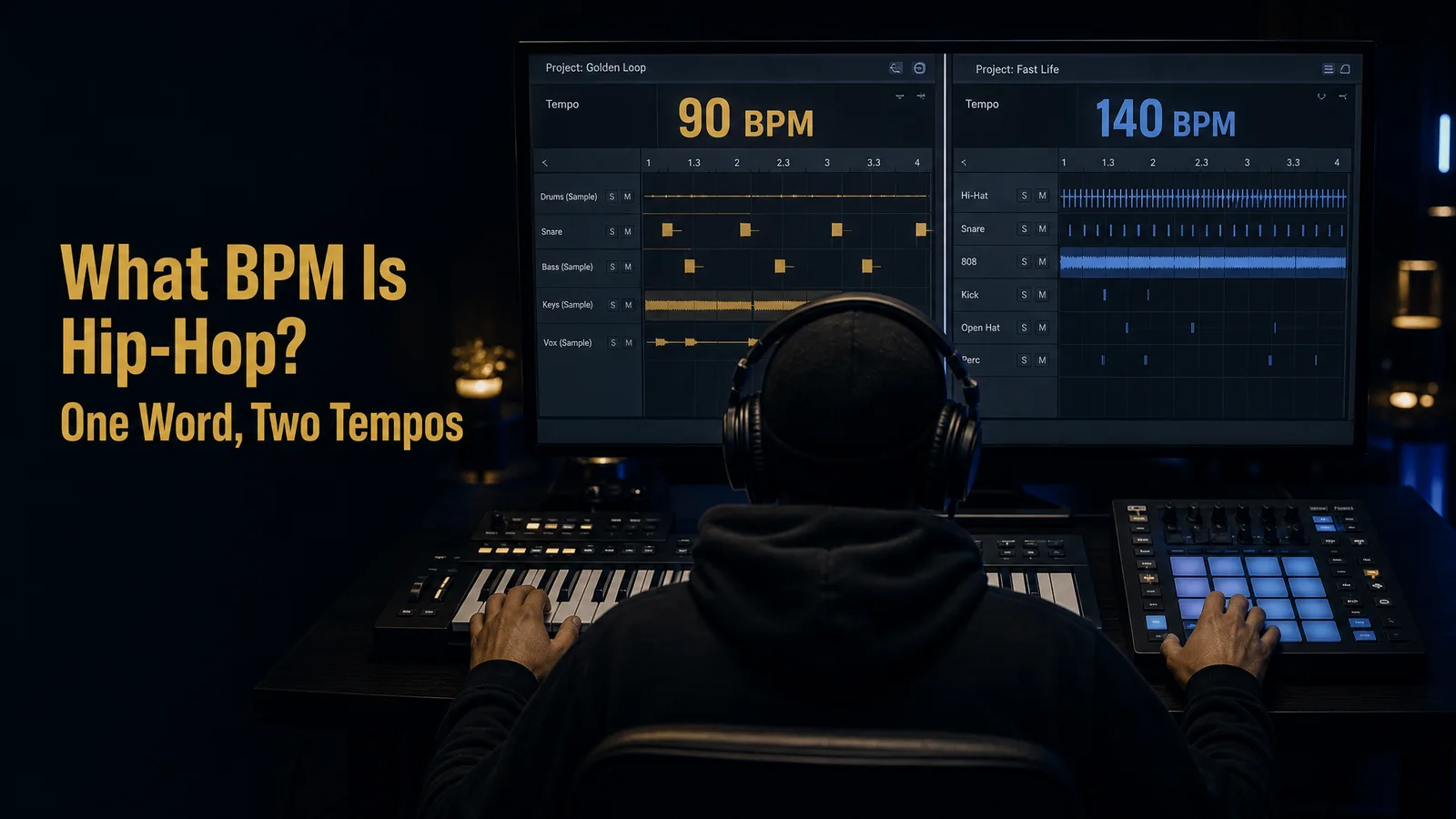
Production guides put hip-hop at 85 to 95 BPM, and that figure describes the sampled, straight-counted tradition. Trap-derived rap is written at 130 to 150 and felt at roughly half of that. Both are hip-hop. There is no single number in between that describes either one, which is why every hip-hop chart you have ever seen disagrees with every other.
That is a different situation from the one the rest of this cluster describes. Elsewhere the two numbers on the page were one tempo counted on two scales, so picking the wrong one cost you vocabulary and nothing else. Here they are two tempos, and picking the wrong one gets you a beat that is not the one you asked for.
- Hip-hop is one label sitting over two tempos. The sampled tradition is counted straight and lands near 90. Trap-derived rap is written at 130 to 150 and felt at roughly half of that. Both are hip-hop.
- The 85 to 95 figure describes one of the two. Production guides print it as though it covered the genre. It is a straight-counted number, and it was never weighed against the half-time records.
- This is not the half-time problem again. In trap, one tempo carries two names. Here, two real tempos carry one name. Doubling or halving a figure moves you between scales, not between families.
- What stays constant is the backbeat, not the BPM. Hip-hop is held together by where the snare lands and how the sixteenths divide. That survives at 90 and at 140, which is what leaves the tempo free.
Quick facts
- Production-guide figure: 85 to 95 BPM — iZotope's tempo guide, counted straight.
- The other family: written 130 to 150, felt about 65 to 75 — the trap-derived side's published range.
- Encyclopedia figure: none — the reference article on hip hop music states no tempo at all.
- This site's pillar chart: ≈ 80 to 100 BPM, quoted for hip-hop and R&B together.
- Measured corpus: median 105 BPM across 944 tracks, with half the sample flagged as ambiguous.
- What is actually constant: the backbeat and the sixteenth-note subdivision, not the beats per minute.
Where 85 to 95 comes from
Start with the number you will actually meet. Open almost any tempo chart and hip-hop is quoted at 85 to 95 BPM. The band is narrow, confident, and sits in the table looking exactly like the figures either side of it. iZotope's production guide gives it in a list of seven styles, alongside glitch hop at 105 to 115 and house at 115 to 130, formatted identically to both.
The first thing worth knowing about that figure is where it does not come from. Encyclopedic sources hand out exact figures to the dance genres and to trap, and hand hip-hop nothing whatsoever. We have already gone through why that absence is structural rather than an oversight, in the genres a tempo chart cannot honestly describe, so take it as established: 85 to 95 is a working figure from people who make beats, not a definition from people who catalogue them.
The second thing worth knowing is more useful, and as far as we can tell nobody says it out loud. That figure is not just soft. It is partial. It describes one of the two things the word hip-hop refers to, and it describes that one quite well.
Watch what happens when you take it seriously. Set a project to 90, load a sampled loop, put the snare on two and four and swing the sixteenths a little. What you get is recognisably hip-hop, and 90 is not an approximation you are tolerating — it is the right answer. The band is doing its job.
Now put on a rap record made in the last decade and try to count it at 90. You cannot — not because the guide was wrong, but because that record was not built on the scale the guide counts in. Its project file says something in the 130s or 140s; its pulse, to a listener, is in the sixties or seventies. Neither number is 90, and neither is trying to be.
The 85 to 95 band did not fail to describe that record. It was never pointed at it.
Two traditions, two tempos
So the honest answer starts by refusing the question in its current form and asking a smaller one first: which hip-hop. There are two answers in wide circulation, and they are not neighbours on a scale — they are two clusters with an empty space between them.
On one side is the sampled tradition — the lineage most people mean when they say boom bap, built from chopped breaks and looped records, counted straight, with the swing living in the sixteenths and the backbeat firmly on two and four. This is the family the 85 to 95 band was written for. Its written tempo and its felt tempo are the same number, which is a property so ordinary that nobody thinks to mention it until they meet music where it is not true.
On the other side is everything downstream of trap. The rap style out of Atlanta, built around the 808 drum machine, is written in half-time, and the encyclopedia files it at 70 with 140 in brackets. Its descendants inherit the arrangement: a project file in the 130s or 140s, a pulse at half that, and hi-hat figures fast enough that the faster grid is the only comfortable place to program them. We took that apart in detail in what BPM trap is and why 140 feels like 70.
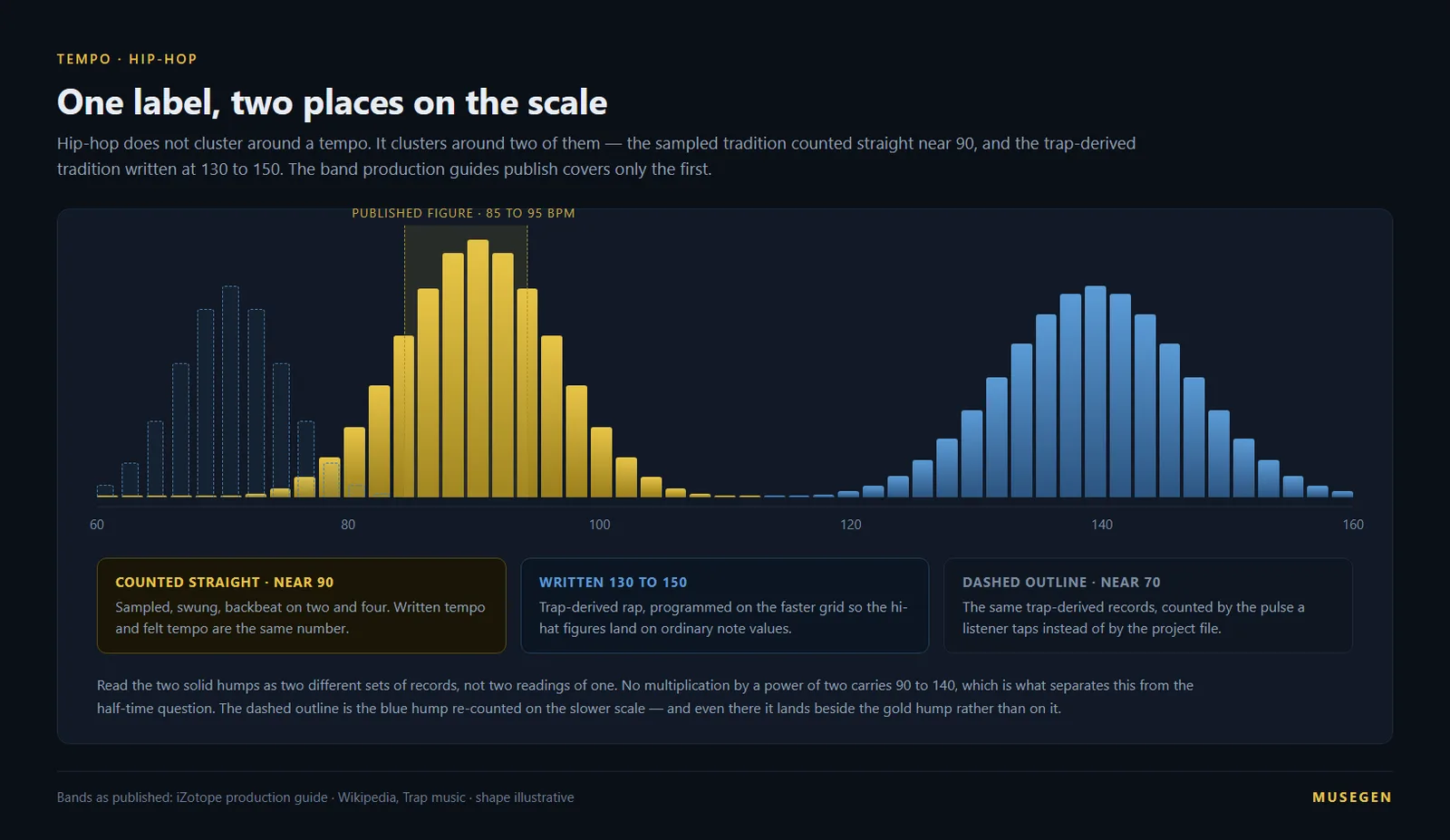
Two clusters, not one range with a middle. The band every chart prints sits on top of the left-hand cluster and has nothing to say about the right-hand one.
Set the two side by side and the shape of the problem becomes obvious.
| The sampled tradition | The trap-derived tradition | |
|---|---|---|
| Tempo in the project file | About 85 to 95 | About 130 to 150 |
| Pulse a listener counts | About 85 to 95 | About 65 to 75 |
| Are those the same number? | Yes | No |
| Where the snare lands | Two and four, every bar | Once a bar, on the third beat |
| Fastest routine hat figure | Swung sixteenths | Thirty-seconds and triplet rolls |
| Published tempo figure | 85 to 95, from production guides | 70, with 140 in brackets |
Look down the last row. A record at a written 90 and one at a written 140 differ by a factor that is not two, so no amount of doubling reconciles them. And a record felt at 90 against one felt at 70 is a real difference in how fast the music moves past you.
This is the part that separates hip-hop from everything else in this cluster. House subgenres sit within a few beats per minute of each other. Drum and bass has one tempo and a display convention wrapped around it. Trap has one tempo and two vocabularies for it. Hip-hop has two tempos and one word, and the word arrived first.
▶ Watch on YouTube: "What Is The Ideal BPM For Different Hip Hop Beats? - Hip Hop Gurus" — an outside answer to the same question, taken across different kinds of hip-hop beat.
Why halving will not fix this
The reflex, once you have read a few pages of this cluster, is to reach for half-time: two numbers on a page, one roughly double the other, and the lesson has always been that they describe the same records. That reflex is right about trap and wrong about hip-hop, and the difference between those two statements is the whole of this section.
Inside trap, 140 and 70 are one tempo. The audio does not change when you rewrite the project from one to the other; only the note names do. We laid out the three separate reasons a written figure and a felt figure can diverge in three reasons a number gets doubled, and the mechanism itself is covered in the pillar under half-time and double-time.
Now try the same move across the two hip-hop families. Take a sampled beat at 90 and a trap-derived beat written at 140. Halve the second and you get 70. Is 70 the same tempo as 90? No — it is meaningfully slower, a listener tapping roughly three beats in the time they would tap four. Double the first instead and you get 180, which is not near 140 either and which nobody has ever used to describe a hip-hop record.
There is no scale on which the two families land on the same figure, and that is a clean test. When two numbers are one tempo, some multiplication by a power of two brings them together, because that is what changing the counting unit does. When no such multiplication exists, you are looking at two tempos.
It is worth being precise about what the shared word is doing, because the answer is not that the label is sloppy. A hip-hop record at 105 is still a hip-hop record at an unusual tempo, in a way that a drum and bass record at 105 simply is not. The category was never built on speed, so it never acquired the constraint that would have pulled its records into one place.
What actually stays constant
If the tempo of hip-hop is free to sit at 90 or at 140, something else must be carrying the identity. Two things are, and both are rhythmic rather than metric — they describe how a bar is divided, not how many go past per minute.
The first is the backbeat. In the sampled family the snare falls on two and four of every bar; in the trap-derived family it falls once a bar, which is the same placement counted on the slower scale. Written differently, felt identically: in both cases the snare is answering the kick at the midpoint of the phrase you are actually hearing. That is the accent pattern that makes a beat read as hip-hop rather than something else at the same speed: a 90 BPM record with the snare on one and three is not slow hip-hop, it is a different genre.
The second is the sixteenth-note subdivision, and specifically the freedom to place things unevenly inside it. The sampled tradition swings its sixteenths, dragging the offbeat late so the loop breathes. The trap-derived tradition subdivides further and rolls, using triplets and thirty-seconds inside a grid that is already running at the faster figure. These look like opposite habits and they are the same habit: the genre treats the sixteenth as the unit worth playing with, and everything expressive happens at that resolution or finer.
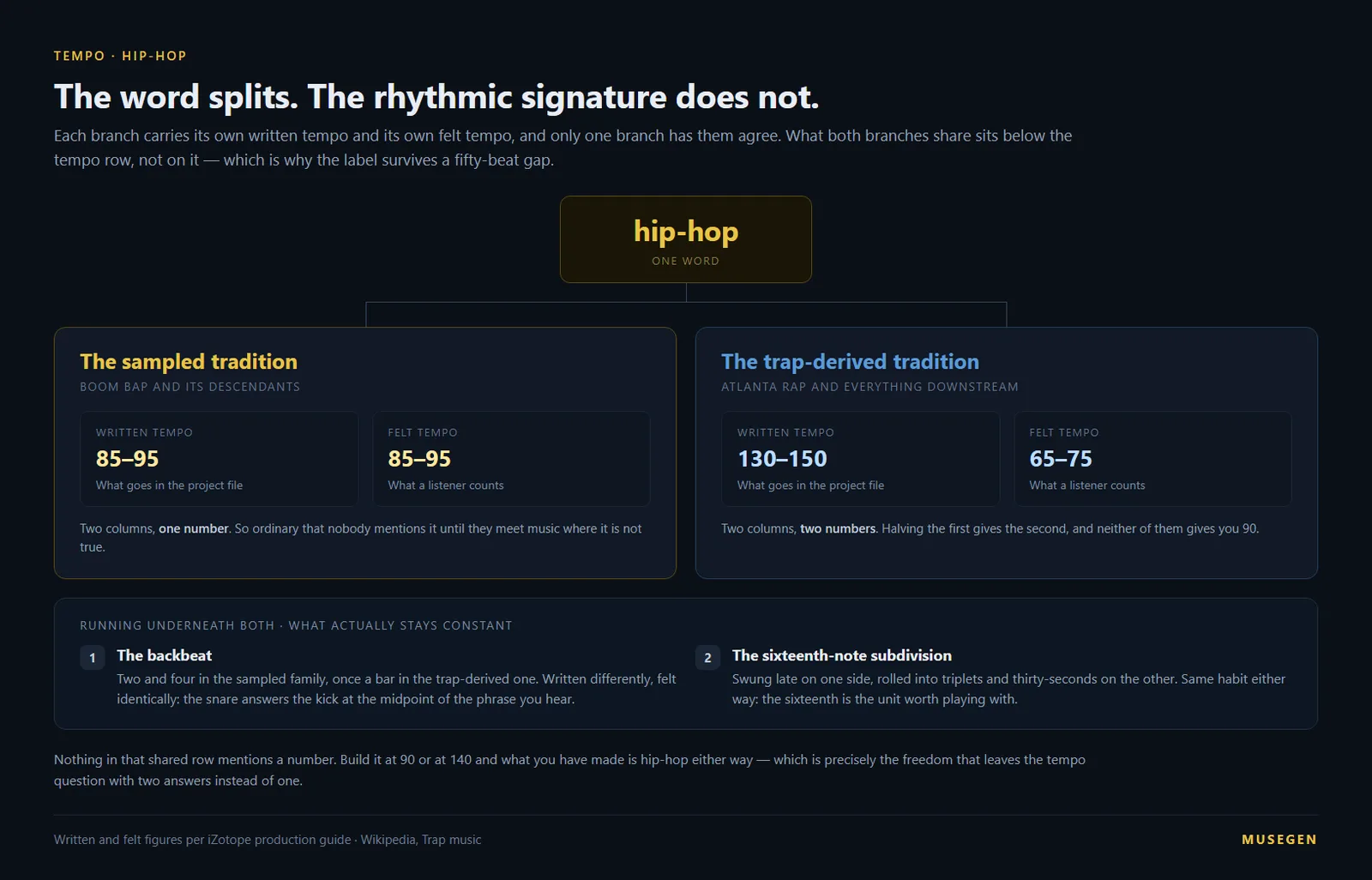
The word splits; the rhythmic signature does not. What both branches share sits below the tempo row, not on it.
Put those two together and you have a definition that survives the tempo change: snare answering kick at the midpoint of the felt bar, expressive detail at sixteenth resolution or finer, and a spoken or sung line sitting on a loop rather than a progression. Nothing in it mentions a number. Build it at 90 or at 140 and what you have made is hip-hop either way.
Compare that to a genre where tempo is definitional. Move drum and bass from 174 down to 140 and the same breakbeats and the same bassline stop being drum and bass. The label follows the number because the number was part of the label. Hip-hop never made that bargain, and the price of the freedom is the confusion this page is about.
One related case is worth naming rather than absorbing here. Lo-fi hip-hop borrows the sampled family's rhythmic signature but sits at its own tempo with its own conventions; it is a separate question, and we handle it in what lofi music is rather than folding it into either family above.
Why measuring would not settle it
The natural instinct is to go and count. Every other page in this cluster was improved by measurement: house turned out to be genuinely narrow, drum and bass to sit exactly on the number producers already used. Surely a large enough sample of hip-hop would produce a median, and surely that median would be the answer.
It would produce a median. It has, and the median is not the answer — for a reason that applies to more genres than this one.
A median describes the middle of a population. That is a useful summary when the population has a middle — when the records pile up somewhere and thin out on both sides. It is a misleading summary when the population has two piles and a gap. The middle of two piles is the gap, and the gap is where none of the records are.
Run the arithmetic. Suppose a hundred hip-hop tracks split evenly: fifty sampled records at a written 90, fifty trap-derived at a written 140. The mean is 115, and not one track is at 115. Now let the counting tool correct the trap-derived half to its felt 70, as detectors and DJ software often do. The mean becomes 80, and again no track is there. Two defensible methods, the same hundred records, 35 BPM apart — not because either erred, but because the question has no single answer.
That is the mechanism behind something you may have noticed: hip-hop is quoted differently in different places, including on this site. Our own pillar chart gives about 80 to 100 for hip-hop and R&B together. The chart in the full tempo chart gives 85 to 95 for hip-hop alone. Neither is a typo and neither supersedes the other: a merged hip-hop-and-R&B row is a wider container answering a broader question. They differ because the containers differ.
Someone has since counted. Mixgraph measured 944 hip-hop tracks in September 2026 and reports a median of 105, with the middle half of its catalogue spread from 92 to 130. That middle half begins above the sampled tradition and ends above the trap-derived one, and its centre is a tempo almost no hip-hop record uses. The median is not wrong. It is the gap, measured carefully.
One line in the method note is worth more than the median. Of those 944 tracks, 480 — 50.8 per cent — carried a tempo the detectors flagged for review. A genre where half the sample is uncertain does not have a detector problem. It has two families, and every record forces a choice about which one is being counted.
This is the general lesson, worth carrying to other genres. When a label is a container rather than a constraint, measuring it more carefully improves your description of the container. It does not tell you what to type into a tempo field.
Which number to write down
Which leaves the practical question, and the answer is short because the work was done above. Decide the family before you decide the number. Once you know which of the two traditions you are building in, the tempo is not a hard call — it is a look-up with a narrow band and a sensible default.
If you are building in the sampled tradition, start at 90 and count straight. Ninety sits in the middle of the published band, loops cut at that tempo line up with each other, and the number means one thing to everybody who reads it. There is no half-time reading of a boom bap beat waiting to catch you out, which makes this the easier of the two cases.
If you are building anything trap-derived, start at 140 and write half-time next to it: 140 is the figure the sample packs and tutorials are cut against, and the word half-time is what stops the number being read as a dance tempo. Writing 70 instead gives you identical audio and a vocabulary nobody else is using.
What you should not do is average the two. A project at 115 is not a compromise between the families, it is outside both of them, and the beat you build there will inherit the conventions of neither. The gap between the clusters is not a design space waiting to be explored; it is just the place where the arithmetic put the mean.
And when you write the tempo down for somebody else — a collaborator, a brief, a description field — add the family word. Ninety with no qualifier will be read as sampled and straight, which is usually what you meant. A hundred and forty with no qualifier will be read as a dance tempo by half the people who see it, which almost never is.
There is no tempo for hip-hop, and that is a fact about the label rather than a gap in the research. There are two tempos, they are both correct, and the question you have to answer before the number means anything is which of the two traditions you are working in.
Name the family, then the number
Type the word hip-hop into a description field and you have not narrowed the tempo at all. You have narrowed it to two places thirty years apart and left the choice to whatever the model has seen most of. That is a different failure from getting a number wrong, and a quieter one: nothing errors, nothing looks broken, and what comes back is the other family's idea of the word.
MuseGen keeps the reading step and the writing step in the same place, which is the practical fix. Detect BPM takes a reference record and hands back a figure, and on hip-hop the figure is only half the information — a returned 70 and a returned 90 are two different families, not two roundings of one. Carry the number into the MuseGen AI Song Maker with the tradition named alongside it, so that "hip-hop, boom bap era, 92 BPM counted straight, swung sixteenths over a dusty sampled loop" settles the family and the grid in the same line instead of leaving the first to be inferred from the second.
The rest of what belongs in that sentence is its own craft, and MuseGen collects a library of worked AI music prompts to borrow structure from. But on this genre the family word is the cheapest thing to state and the one whose absence does the most damage: leaving it blank does not produce a vaguer result, it produces a confident result from the wrong half of the genre.
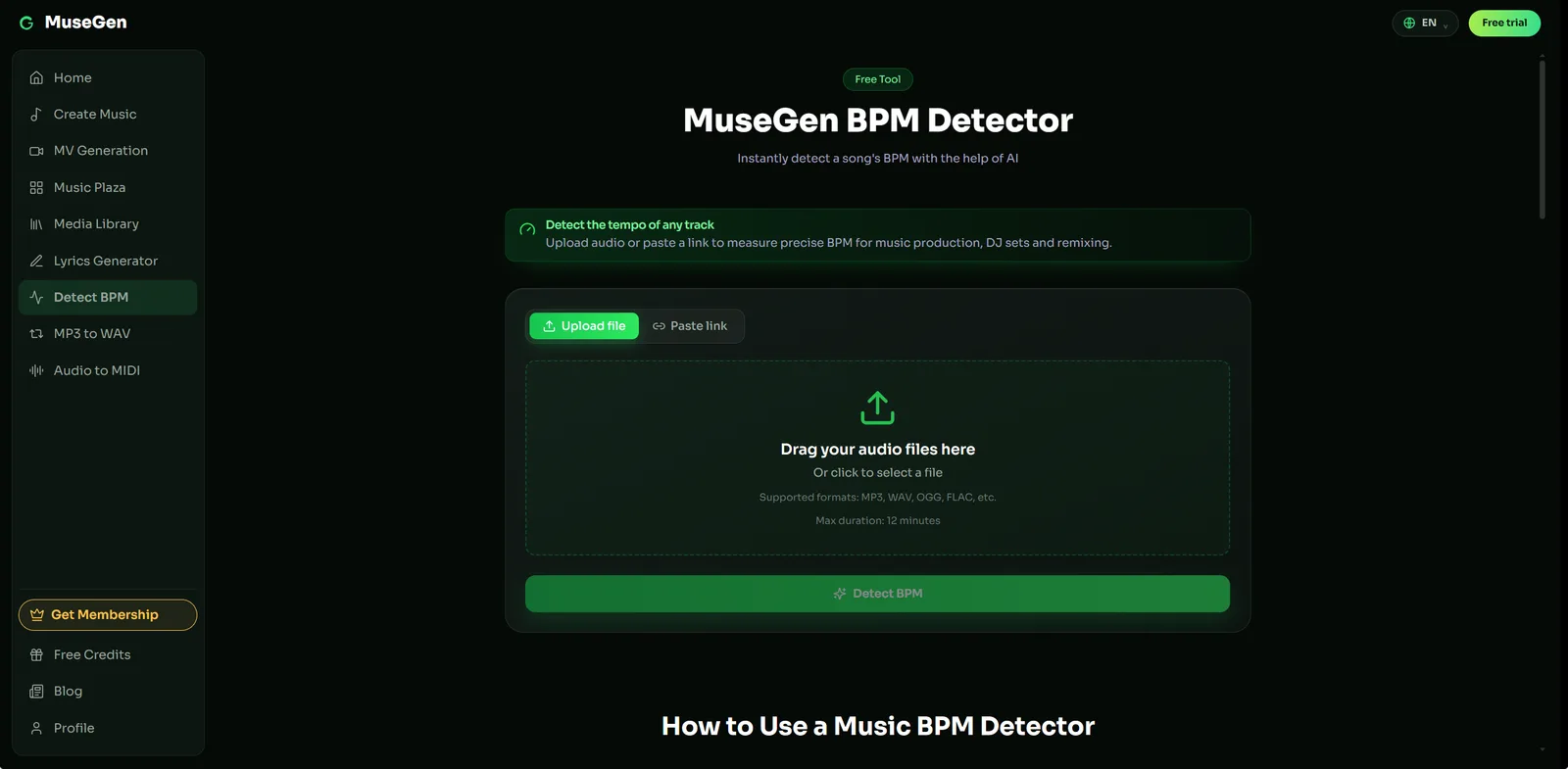
Detect BPM: on hip-hop the returned figure also tells you which of the two families the reference came from.
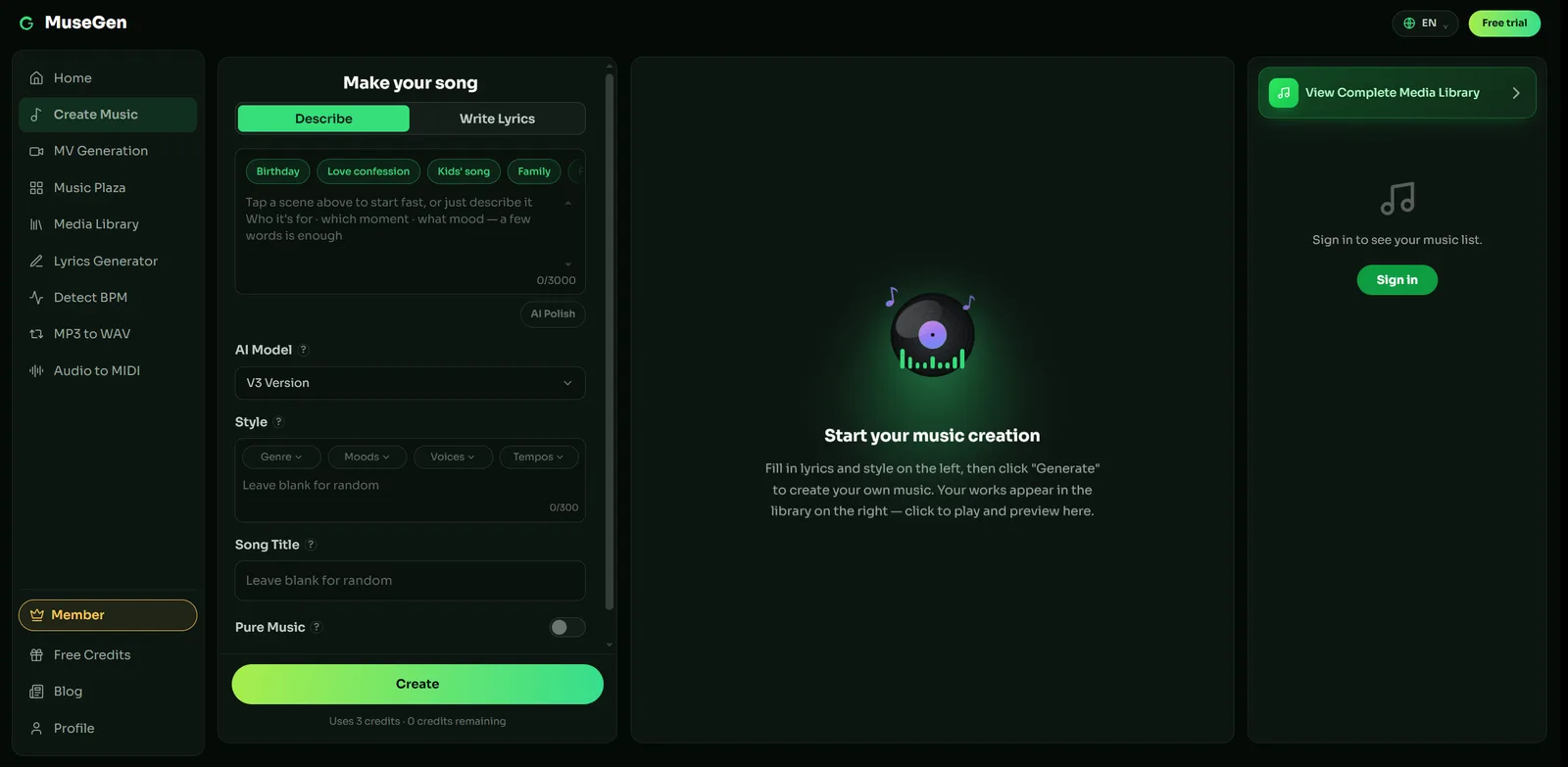
AI Song Maker: the family word goes in ahead of the number, because the number alone picks neither.
Say which hip-hop before you say how fast. Name the tradition, then give it a tempo, and the two stop fighting each other — try MuseGen.
FAQ
What BPM is hip-hop?
It depends which hip-hop, and that is not a dodge. Production guides put the genre at 85 to 95 BPM, which describes the sampled, straight-counted tradition. Trap-derived rap is written at 130 to 150 and felt at roughly half of that. Both are hip-hop records, and no single number sits comfortably between them.
Is hip-hop 90 BPM?
Ninety is a fair default for the sampled side and a poor one for anything trap-derived. It sits inside the 85 to 95 band production guides print, so a looped beat with a swung backbeat at 90 behaves the way you expect. A modern rap beat set to 90 is neither one tempo nor the other, and usually ends up sounding like a slow version of the wrong thing.
What BPM is boom bap?
Around 90, counted straight, with no half-time reading on offer. The only published band that covers it is the 85 to 95 from production guides, because reference works give hip-hop no tempo at all. What makes 90 usable here is that the beat is counted on the same scale it is written on, so the number means exactly one thing.
Why do hip-hop BPM charts disagree with each other?
Because each one is averaging a different mixture of the same two families. A chart built mostly from sampled records lands near 90. A chart that folds in trap-derived rap at its written tempo is pulled upward, and one that folds it in at its felt tempo is pulled down. The spread between charts is a fact about their source material rather than about the music.
Is modern rap slower or faster than 1990s hip-hop?
Both, depending on which of its two numbers you compare. A trap-derived beat is written at 130 to 150, which is faster than a 90 BPM sampled record, and felt at 65 to 75, which is slower. The pulse a listener taps really is slower, while the grid the hi-hats are programmed against really is quicker. Nothing about that is a contradiction.
What BPM should I set my project to for a hip-hop beat?
Pick the family first and the number follows. For a sampled, swung, straight-counted beat, start at 90. For anything built around 808s and fast hat figures, start at 140 and write it in half-time. Choosing a number before choosing a family is what produces beats that sound like neither, which is the failure this page is really about.
Is R&B the same tempo as hip-hop?
Charts often merge the two into one row, and our own pillar chart quotes about 80 to 100 for hip-hop and R&B together. That merged band is wider than either genre on its own, and it is doing the same averaging job as every other container figure on this page. Read it as a place to start rather than as a reading of either style.
Is trap hip-hop?
Yes, and that is precisely what makes the tempo question hard. Trap came out of Atlanta as a rap style, so it belongs in any honest hip-hop chart, and it arrives carrying a written figure of 140 and a felt figure of 70. Leaving it out makes the average tidier and makes it describe less of the music that people actually mean by the word.
Related reading
- BPM by Genre and Subgenre — the full tempo chart hip-hop sits inside, and why some of its rows carry less authority.
- What BPM Is Trap? — the other family in detail, and why its project files say 140 when its records feel like 70.
- What Is BPM in Music? — the pillar: what the number counts, and what half-time and double-time do to it.
- What Is Lofi Music? — the nearest relative of the sampled tradition, and a separate tempo question of its own.
Sources
- Wikipedia — Hip hop music for a genre article that states no tempo figure at all.
- Wikipedia — Trap music for the trap-derived family filed at 70 with 140 in brackets.
- iZotope — Using Different Tempos To Make Beats For Different Genres for the 85 to 95 production-guide band.
- Mixgraph — BPM Guide: Tempo Ranges by Genre (March 2026) for the catalogue methodology.
- Mixgraph — BPM for Hip-Hop (September 2026) for the 944-track median of 105 and the 50.8 per cent flagged as ambiguous.
- Mixgraph — BPM for Trap (Hip-Hop) (September 2026) for the trap-derived side counted separately.