What Does Compression Do? Dynamic Range Compression Explained

MuseGen Team
9/7/2026
Night mode on a television. The advert that arrives louder than the programme it interrupted. A car stereo that keeps a whispered verse audible at motorway speed. And a needle on a mixing engineer's screen, swinging the wrong way. One processor, four situations — and a job that is the opposite of the one most people assume.
In short
A compressor turns down whatever crosses a level you choose, shrinking the distance between the loudest and quietest parts of a signal. That is the entire operation, from a mastering suite to the night mode button on a remote control.
Notice what is missing: nothing goes up. The loud parts come down, the quiet parts stay where they were, and the result is quieter overall than what you started with.
Compressed music sounds louder because of a second, separate control — makeup gain, applied once the peaks are out of the way. Keeping the two apart is most of what it takes to understand everything below.
Quick facts
- What it does: Reduces the level of anything above a threshold, narrowing the gap between loudest and quietest.
- The six controls: Threshold, ratio, attack, release, knee, makeup gain.
- What it cannot do: Make anything louder. That is makeup gain, a separate control applied afterwards.
- Where you meet it daily: Broadcast television, streaming playback, car stereos, phone speakers, every record since the 1960s.
- Where the character is: In attack and release, not ratio. Two units at identical settings will not sound the same.
- Not to be confused with: MP3 and AAC. Same word, unrelated process — see below.
What a compressor actually does
A compressor is an amplifier that changes its own gain depending on how loud its input is. While the signal stays quiet it does nothing; the audio passes through untouched. Once the signal crosses a level you nominate, the unit turns itself down, and the further past that level it pushes, the harder it turns down.
Dynamic range — the distance between the quietest and loudest passages of a piece of audio, measured in decibels. A solo piano recorded well might span sixty of them. A modern pop master might span eight.
Compression narrows that distance from one end only: the top. Which is why a compressor's meter reads in negative numbers — the figure is how many decibels of gain the unit has removed at that instant. Producers call it gain reduction; a track with "four dB of compression on it" is one whose meter was moving four decibels.
The sentence worth keeping: a compressor does not make anything louder. It makes the loud parts quieter. Every impression of compression adding power comes from what happens next.
What happens next is makeup gain. With those peaks pulled down there is room above the signal that was not there before, so the whole thing can be raised without clipping. A track compressed by six decibels and then raised by six is no more detailed than before. It is the same performance flattened and lifted — far louder in the moments that used to be quiet, which is exactly what "bigger" sounds like.
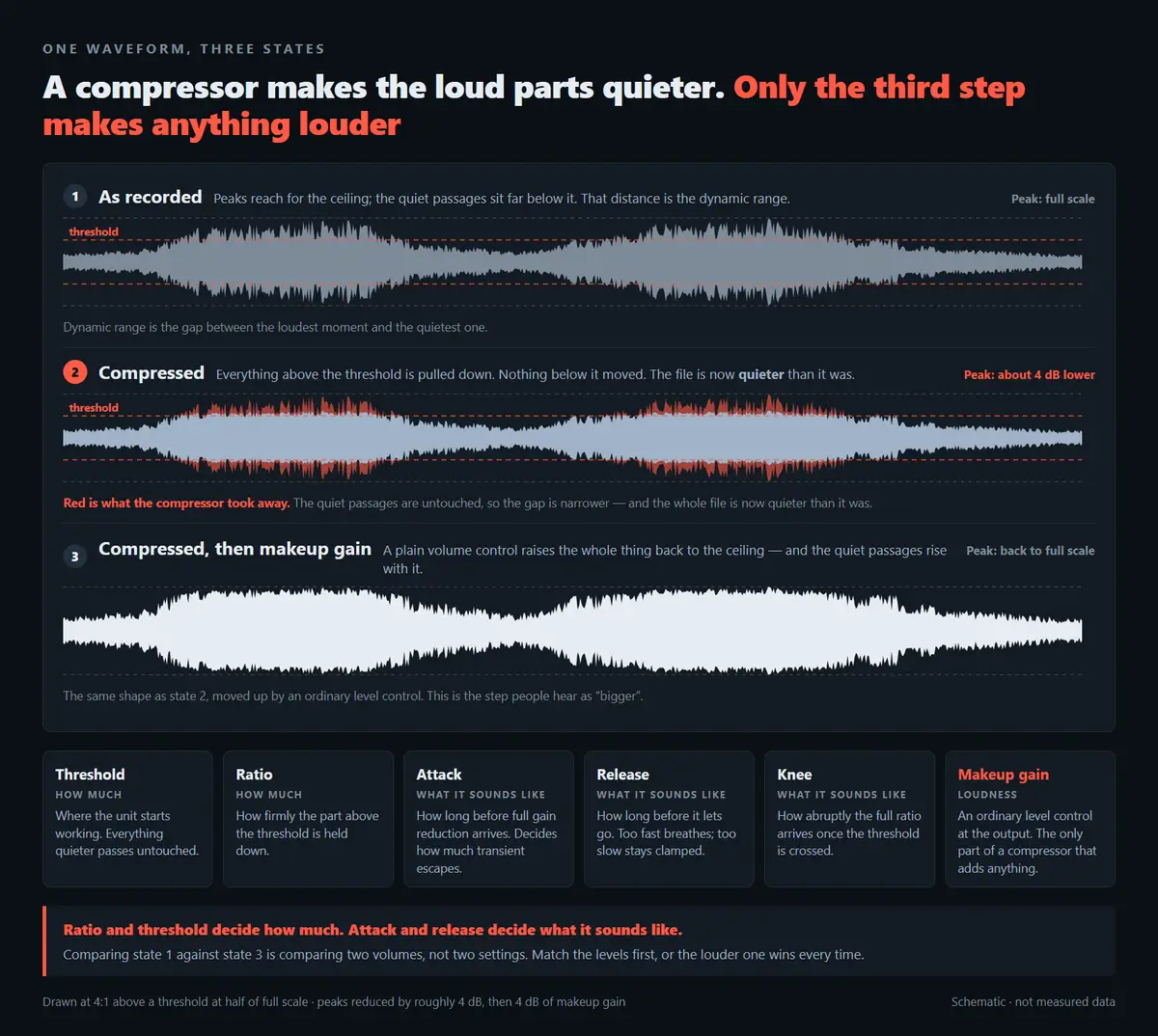
Three states of one waveform. Only the third is louder, and the third step is a volume control.
The consequence governs everything that follows: any comparison of a compressed and uncompressed signal is worthless unless the two are level-matched first. Leave makeup gain in the chain and you are judging a volume knob rather than a compressor, and the volume knob always wins. The guide to equalization works through why that bias is hard to defeat.
What compression buys is consistency: a vocal that stays intelligible through a whispered line and a belted one, a bass that holds a steady floor, a record that survives a phone speaker in a kitchen. What it costs is plain enough — the difference between the loud parts and the quiet parts was information too, and some of it is now gone.
Two different things called compression
Search for audio compression and half the results are about file sizes. The overlap is an accident of vocabulary; the two processes have almost nothing to do with one another.
Dynamic range compression is the subject of this article. It changes how loudness moves over time and leaves the file alone: a compressed WAV is exactly as large as the one it came from.
Data compression — MP3, AAC and their relatives — does the opposite bookkeeping. It leaves the loudness contour broadly alone and shrinks the file instead. Uncompressed PCM stores the waveform as it is; a perceptual encoder stores it as it sounds, running the audio through a psychoacoustic model that predicts what your hearing will not register. The best known prediction is masking: play a loud tone and quieter sounds nearby in frequency become inaudible, so the encoder spends no bits describing them.
Sound On Sound puts the distinction plainly: PCM captures a waveform as it is, MP3 captures it as it sounds. Perceptual Coding: How MP3 Compression Works.
That trade is real and not free. At 128 kbps both MP3 and AAC brickwall the signal above roughly 16 kHz, and two encoders at identical settings can produce audibly different files. None of that makes lossy coding a mistake — it made portable music possible, and at modern bitrates the losses are small. It is simply not this article's subject.
One genuine point of contact: material that has been heavily dynamically compressed is harder for a lossy encoder, because it sits near full scale throughout and leaves no quiet moments for artefacts to hide in. Everything from here on refers to the first meaning.
The six controls
Compressors differ in how many of these they expose, and several famous units omit one most people assume is mandatory. Between them the six describe every decision a compressor makes.
- Threshold. The level at which the compressor starts working. Anything quieter passes through untouched, which is why lowering the threshold brings more of the performance under control rather than squashing the peaks further.
- Ratio. How firmly the signal is held down once it crosses the threshold. At 2:1 roughly half of every decibel above the threshold survives; at 10:1 almost none of it does, and the compressor is behaving like a limiter.
- Attack. How long the compressor takes to reach full gain reduction once the threshold is crossed, in milliseconds or fractions of one. It decides how much of the initial transient escapes before the clamp arrives.
- Release. How long it takes to let go once the signal falls back below the threshold. Too fast and the gain audibly moves under the music; too slow and one loud moment keeps the next few seconds pinned down.
- Knee. How abruptly the full ratio arrives. A hard knee applies it the instant the threshold is crossed; a soft knee eases in below the threshold and reaches full ratio some way above.
- Makeup gain. A plain level control at the output, unrelated to the detection circuit. It exists because compression removes level, and it is responsible for every impression that compression made something louder.
Knee goes unmentioned most often and explains most of the mystery. A hard-knee unit like the classic dbx 160 is audible the moment it engages, which is useful when you want the compression to be part of the sound. A soft knee is much harder to catch in the act, and most compressors are soft-knee to some degree.
Sweetwater's comparison names where each design sits, including units whose knee changes with the ratio selected. Soft knee versus hard knee compression.
Deliberately absent here: starting numbers. Settings depend on how uneven the source already is, and the one instrument specific enough to quote figures for is the voice — which the vocal chain guide covers, by style.
Where the character lives
Threshold and ratio decide how much. Attack and release decide what it sounds like, and the span between their extremes matters far more than anything ratio does.
Take a snare drum. A fast attack catches the initial hit and pulls it down, so the stick sound flattens and the body of the drum comes forward. Slow the attack and the transient escapes before the compressor closes, so the hit stays intact while everything behind it is squeezed. Same gain reduction on the meter, and the second setting sounds more aggressive than the original. Hence the most counterintuitive fact in the subject: a slower attack can make a drum hit harder.
Release governs the other half. Very fast, and the gain audibly climbs back between hits, riding the noise floor up and down — breathing on sustained material, pumping on rhythmic material. Slow, and one loud moment keeps the following seconds held down: smooth on a vocal, lifeless on a drum bus. Tempo is the useful reference. A release that has recovered by the next beat feels like part of the groove; one that has not feels like a fault.
Many units do not offer a fixed release at all. Programme-dependent release means recovery time varies with what the audio is doing, letting go quickly after a brief peak and slowly after a sustained one. Optical compressors behave this way because of their physics rather than by design, which is why they are called forgiving.
Hence a practical instruction: when you meet an unfamiliar compressor, do not start with the ratio. Set a moderate amount of gain reduction, then listen to the attack at both extremes, then the release. The territory between them is where the personality lives.
The compression you never asked for
Everything above describes a decision made by someone mixing a record. But most of the compression people actually hear was applied afterwards, by systems nobody consulted them about.
Television, and the advert problem. In the United States, rules made under the CALM Act took effect on 13 December 2012 and require commercials to match the average loudness of the programming around them, measured to the ATSC A/85 recommended practice. The rule matches averages rather than imposing a ceiling — A/85 sets no absolute loudness limit. An advert sitting constantly at its own average can therefore measure as compliant and still feel relentless next to a film that spends half its runtime quiet. The rules also cover broadcast, cable and satellite only, which is why the complaint never went away.
The FCC's guide covers the timeline, the standard, and the fact that enforcement runs on viewer complaints. Loud Commercials on TV. In February 2025 the Commission asked whether the rules should extend to streaming.
Night mode, and what it actually is. On a television or set-top box, the button marked night mode, midnight mode or auto volume is usually dynamic range control in the Dolby decoder. The compression is not baked into the audio: the encoder ships gain values alongside the bitstream as metadata, and the decoder decides whether to apply them. Everything is referenced to dialnorm, the value describing where the dialogue sits, and the six profiles — Film Light, Film Standard, Music Light, Music Standard, Speech, None — are curves around it. A decoder feeding discrete outputs typically uses the lighter Line Mode; a box that always outputs a downmix uses the heavier RF Mode, so the same broadcast arrives with very different dynamics depending on the equipment in the room.

Four places the dynamics can be changed after the master is finished, and how much say you have at each.
Streaming normalization. Playback platforms adjust the level of each track so everything arrives at a comparable loudness. That is a per-track level offset rather than compression, but its consequences are the subject of the next section. The mastering guide lists the targets the major services publish.
Cars, and phones. A car at speed has a noise floor that swallows anything quiet, and a phone speaker cannot produce a wide dynamic range at all. Dynamic range control there is not aesthetic; it is the difference between hearing a verse and hearing road noise.
What the loudness war proved
From the late 1980s to the late 2000s, records got progressively louder. Not better recorded — louder. A CD has a fixed digital ceiling, so the only way to raise the average level was to remove the peaks, and mastering pushed limiting far enough that a finished album's waveform became a solid block. The mechanism was the bias described at the top of this article at industry scale: in any unmatched comparison the louder version sounds better, and radio programmers, label executives and listeners flicking between tracks were all comparing unmatched.
Two records are usually cited. The Red Hot Chili Peppers' Californication (1999) was heavily brickwalled with audible clipping, sold sixteen million copies anyway, and got a 2012 vinyl remaster recovering three to four decibels. Metallica's Death Magnetic (2008) drew enough criticism for its distortion that a fan petition asked for a remix, and measurements circulated at the time put the CD's average dynamic range near three decibels.
The war ended when the prize disappeared, not when the argument was won. Loudness normalization means a heavily limited master gets turned down to sit beside a dynamic one. Both arrive at the listener at the same level, and the limited one arrives with less contrast. There is nothing left to win.
The sequel is the interesting part. When Metallica returned in 2016, the band ran a blind, level-matched shoot-out between four mastering engineers and picked a winner without knowing whose work they were hearing — the method this article recommends, applied to a decision worth millions. The result measured roughly twice the dynamic range of its predecessor.
Sound On Sound's production feature describes both the earlier controversy and the blind shoot-out that replaced it. Inside Track: Metallica.
A caveat keeps the story honest. Normalization is close to universal on the listening side and nowhere near it on the making side: one survey put eighty to ninety per cent of online listening as normalised, while roughly three-quarters of engineers and musicians asked said they switch normalisation off. The people setting the loudness are, disproportionately, not hearing its consequences.
Accents and cousins
Compressors are built around different components, and the component determines the time constants available. This is not a ranking: each row is a set of trade-offs, and all four are in daily professional use.
| Type | How it works | The missing control | Behaviour |
|---|---|---|---|
| VCA | A voltage-controlled amplifier reduces gain electronically | None — usually the full set | Fast, precise, predictable. The default choice for buses and mastering. |
| FET | A transistor stands in for a variable resistor | Threshold, on the best-known unit | Very fast attack, aggressive character. Sought out rather than tolerated. |
| Optical | A light source and a light-sensitive resistor | Attack and release, on the classics | Slower onset, programme-dependent recovery. Smooth, forgiving, hard to make sound wrong. |
| Variable-mu | A valve whose gain changes with control voltage | Ratio | Highly programme-dependent. Described as glassy or creamy more often than as transparent. |
iZotope's survey covers which controls each design omits and why the omission follows from the circuit. Four types of analog compression.
Those missing controls are the useful detail. With no threshold knob, the input control is doing that job. With no ratio knob, the ratio is a property of the circuit and changes with how hard you drive it. Neither is an oversight, and both explain why an emulation feels so different from a general-purpose compressor.
The family contains relatives worth naming, because they are the same idea at different settings. A limiter is a compressor with a very high ratio and a fast attack, placed to stop anything passing a ceiling. A clipper is not a compressor at all — it removes the top of the waveform with no time constants involved, which is why it can beat a limiter on short transients and lose badly on sustained ones. A gate and an expander work the other way, making quiet parts quieter, which is how headphone bleed or a room noise floor gets cleaned up.
Three things people do with it
Three further uses come up constantly, and none is obvious from the controls.
Parallel compression. Rather than compressing a part, you duplicate it, compress the copy heavily, and mix it under the untouched original. Quiet detail in the copy is lifted while the original's transients survive, so you get density without losing the hits. Sometimes called New York compression, it is most often used on drums, where the conventional approach costs exactly what parallel processing preserves.
Sidechain compression. A compressor normally listens to the signal it is processing. Feed it a different one and it will duck one element out of the way of another: the classic case is a bass compressor keyed from the kick, so the bass steps aside every time the kick lands. In dance music the effect is deliberately exaggerated into audible pumping. Two things matter more here than elsewhere. Attack and release do the musical work, setting the shape of the duck rather than its depth. And filtering the sidechain input is often essential, since low frequencies carry most of the energy and will otherwise trigger reduction across the whole signal. One of the arguments for working with stems: a keyed compressor needs a source to listen to.
Multiband compression. A multiband unit splits the signal into frequency ranges and compresses each independently, so a boomy low end is controlled without the cymbals triggering reduction. It solves problems a single-band unit cannot, and introduces one: the bands drift out of balance, and a mix held together by four separate compressors is usually telling you something.
How to actually set one
The order matters more than the values, because most of these steps exist to stop you fooling yourself.
- Name the problem before you touch a control. Catching peaks, steadying an uneven performance, adding density, and making one element move out of the way of another are four different jobs. They call for different settings, and most contradictory compression advice is advice for one job applied to another.
- Set the amount by the meter, not by the knobs. Choose a modest ratio, then lower the threshold until the gain reduction meter shows the amount of movement you want. How far the threshold ended up is not interesting. How many decibels are coming off, and whether the meter is breathing with the music, is.
- Find the character at the extremes first. Listen with attack fully fast and then fully slow, then with release at both ends, before settling anywhere in between. The difference is far larger than anything ratio does, and hunting from the middle is how people conclude that compressors all sound the same.
- Set makeup gain to match, not to win. Bring the output back up until the compressed version is as loud as the bypassed one, and stop there. Going past that point feels like an improvement every time, which is exactly why it tells you nothing.
- Compare level-matched, then decide. Switch between the processed and unprocessed versions once they measure the same. If the compression still earns its place, keep it. If the improvement disappears the moment the levels match, what you liked was the volume.
- Check it against a whole arrangement, at a second volume. Compression is judged by how a part sits over time, so a looped bar will mislead you. Play a full section, then play it again quieter, because how much dynamic control feels right depends partly on how loud you are monitoring.
None of this needs a purchase. The stock compressor in any DAW has all six controls and a gain reduction meter, and steps four and five are worth more than any emulation.
Where MuseGen fits
Compression is the one process here you can apply to a MuseGen track the moment it finishes rendering — and the one where the single stereo file bites hardest. You can compress the whole song, not the snare inside it, and the sidechain techniques above need a key source a mixed file cannot give you.
Its own ground is earlier. A written brief comes back as a complete track, with words and a video alongside it if you want them — useful while the arrangement is still a question rather than a session.

Words drafted before there is anything to process.

The finished stereo mix — the file any compressor in this guide would be placed on.
A brief that asks for dynamics rather than density, since you cannot add them later: "slow-building alt-rock, quiet verse with brushed drums opening into a full chorus, live-room feel, plenty of contrast between the sections, 3 minutes."
What comes back today: lyrics — available; full song — available, as a stereo mix; music video — available.
Asking for contrast between sections gives a compressor something to work with; a brief that asks for constant intensity arrives already flat. Exports come as royalty-free WAV or MP3 — check MuseGen's current terms before commercial use. Take the WAV where you have the choice; otherwise convert the MP3 before processing, since compression lifts the quiet material an encoder has already thinned out.
Used in order, that is three separate jobs: turn an idea into a song and hear whether the dynamics are there at all, draft a lyric if the track is missing one, and make a music video once it is finished. Because what comes back is a stereo mix, any compression you add works on the whole song at once — stem and multitrack export is coming soon.
Get a track with something to compress. Describe an arrangement with quiet and loud sections, hear it as a finished song, and take it into a mix. → Make a song with MuseGen
FAQ
What does a compressor do to audio?
It reduces the level of anything that crosses a threshold you set, so the distance between the loudest and quietest parts gets smaller. Nothing is raised by that process: quiet passages stay where they were, and only the parts above the threshold move, downwards. The result sits in a narrower band of loudness, which is what makes it hold its place in a mix or stay audible in a noisy room.
Is audio compression the same as MP3 compression?
No. They share a word and nothing else. Dynamic range compression changes how loudness moves over time and leaves the file size alone. Data compression, which is what MP3 and AAC do, shrinks the file by discarding information a psychoacoustic model predicts you will not notice, and does not set out to change the dynamics. The only real connection: heavily compressed dynamics give a lossy encoder a harder job, because the material already sits near the ceiling.
Does compression make music louder?
Not by itself. Compression lowers the peaks, which on its own makes a track quieter, not louder. The extra loudness comes from a separate control, makeup gain, which raises the whole signal now that the peaks no longer define the ceiling. Keeping the two steps apart is the difference between judging a compressor and judging a volume knob.
What are good compressor settings?
There is no universal set, because the right amount depends on how uneven the source already is and what you want it to do in the arrangement. Work from the gain reduction meter rather than from remembered numbers: pick an amount of movement that suits the part, then find the attack and release that make that amount sound the way you want. Instrument-specific starting points are a separate question; the vocal chain guide covers voices.
Why are TV commercials louder than the show?
In the United States, FCC rules made under the CALM Act have required commercials to match the average loudness of the programming around them since December 2012. The rule works on averages rather than an absolute ceiling, so an advert compressed to sit constantly near its average can measure as compliant while still feeling relentless against a film with quiet passages. The rules cover broadcast, cable and satellite television only, not radio, internet advertising or streaming.
What is the difference between a compressor and a limiter?
Degree rather than kind. A limiter is a compressor with a very high ratio and usually a fast attack, set so almost nothing gets past a chosen ceiling. A compressor shapes how a part behaves; a limiter enforces a boundary. In practice the two blur, and many compressors become limiters once the ratio goes far enough.
Should I still master as loud as possible for streaming?
There is far less to gain than there used to be. Streaming services adjust playback level so tracks arrive at a comparable loudness, so a heavily limited master gets turned down to sit alongside a dynamic one and arrives with less contrast rather than more impact. Loudness remains a legitimate artistic choice, but it is no longer a competitive advantage.
Keep reading
- What Is a Vocal Chain in Music? Plugin Order and Settings Explained
- What Do Equalizers Do? EQ Explained, from Your Phone to the Mix
- What Is Audio Mastering? A Plain-English Guide to the Final Step
- What Are Stems in Music? How to Group, Export and Deliver Them
Sources
- Loud Commercials on TV — FCC. The CALM Act timeline, the A/85 reference, the services covered, and the 2025 streaming proceeding.
- Surround Sound Explained: Part 5 — Sound On Sound. Dolby metadata, dialnorm, the six profiles, and Line versus RF mode.
- Perceptual Coding: How MP3 Compression Works — Sound On Sound. The psychoacoustic model and masking.
- What Data Compression Does To Your Music — Sound On Sound. MP3 and AAC behaviour at 128 kbps.
- 4 Types of Analog Compression — iZotope. The four topologies and the controls each one omits.
- Soft Knee vs Hard Knee Compression — Sweetwater. The knee definitions and which classic units use which.
- Inside Track: Metallica — Sound On Sound. The dynamic range figures and the blind mastering shoot-out.
- Ian Shepherd: Loudness & Dynamics — Sound On Sound. The survey figures on normalised listening versus engineers who switch it off.
- Loudness war — Wikipedia. The Californication case and its 2012 vinyl remaster.
- How a Compressor Actually Works | Audio Compression Basics Explained — YouTube.
Compressor behaviour is not standardised: two units set to the same ratio and threshold will not sound the same, because their time constants and detection circuits differ. The broadcast figures describe how the systems are specified, not what a particular set-top box does.